

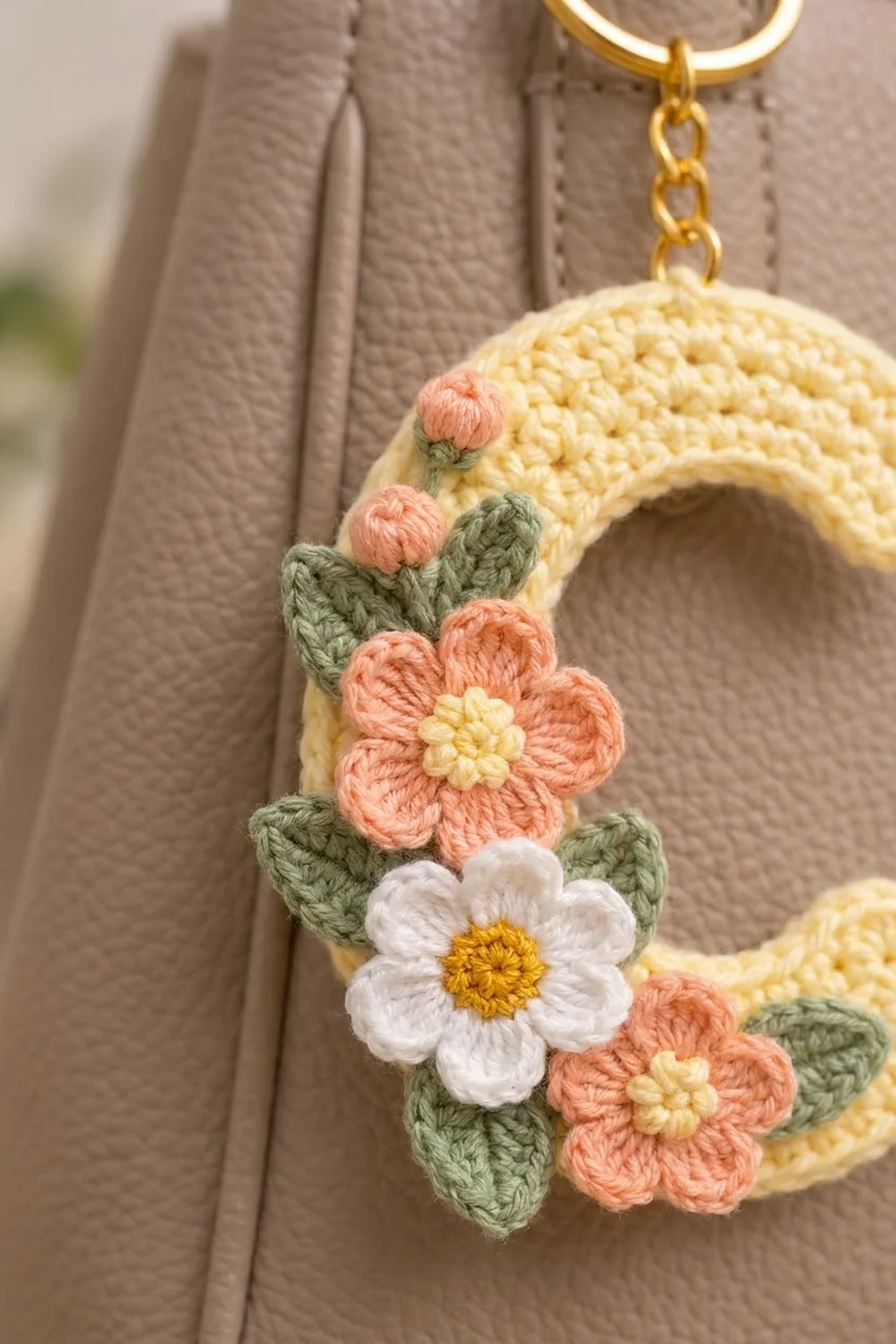
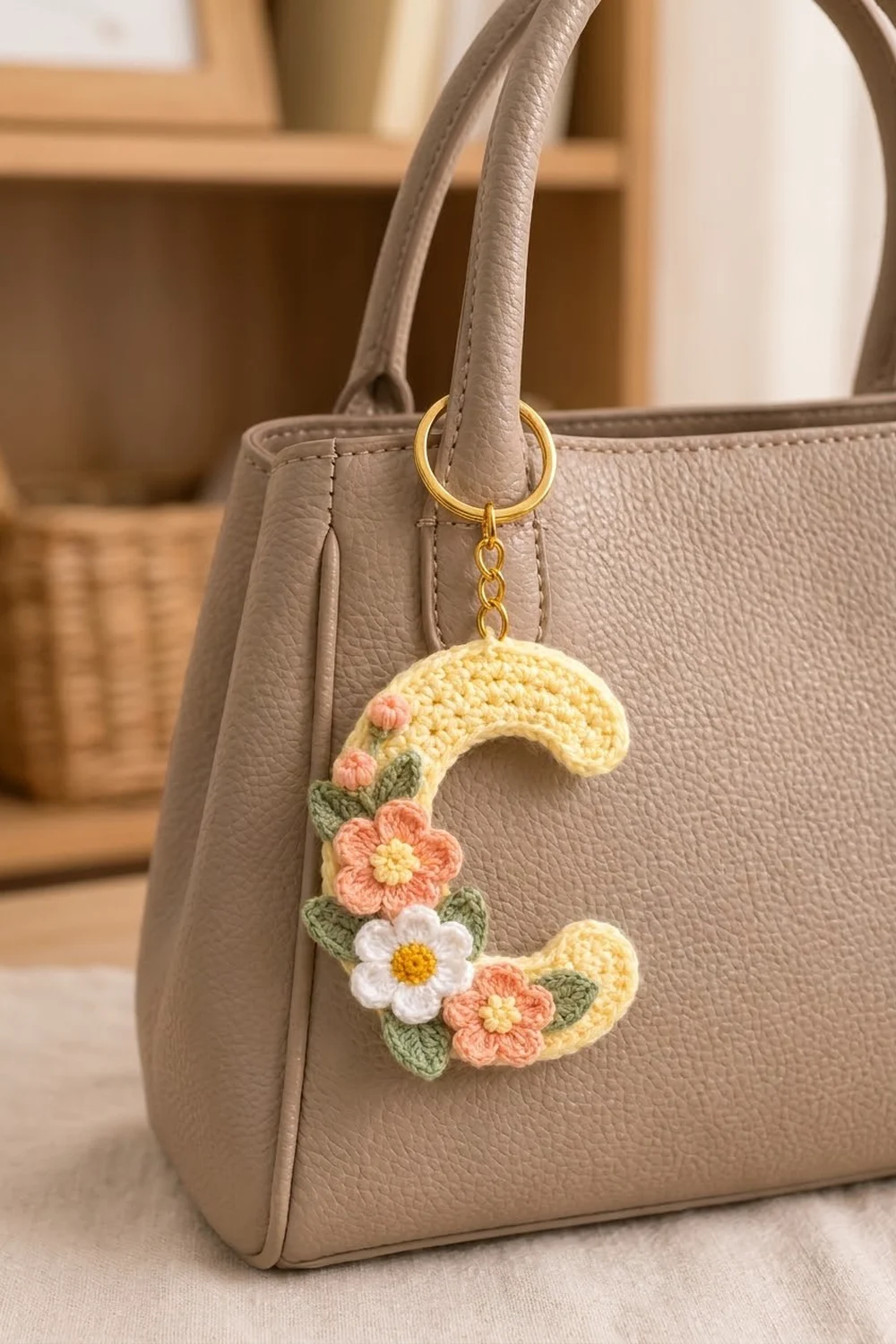
This little letter C keychain makes a sweet, personal accessory. A smooth, butter-yellow initial carries a small spray of crocheted flowers and leaves, and it hangs from a gold key ring on a short chain. It looks lovely clipped to a handbag handle, a backpack zipper, or a set of keys.
The colors are soft and springlike. The letter is pale butter yellow. The flowers are peach with pale yellow centers, plus one white daisy with a golden-yellow center. Two tiny peach buds and sage green leaves complete the spray.
All instructions use US crochet terms. Not counting the hardware, the finished charm measures about 3.5 in (8.9 cm) tall and 3 in (7.6 cm) wide. The stroke of the letter is about 1.1 in (2.8 cm) wide.
The construction is simple. You work the C as one flat piece in rounds around a foundation chain. Increases on the outer edge and decreases on the inner edge bend the strip into the letter shape. A slip-stitch round neatens the outline. Then you sew small flowers, buds, and leaves across the lower left curve.
Finished Size and Construction
- Finished size: 3.5 in (8.9 cm) tall x 3 in (7.6 cm) wide
- Skill level: Easy to intermediate
- Terminology: US crochet terms
- Yarn weight: Sport weight (#2) cotton
- Hook: 2.75 mm (US C-2)
- Number of pieces: 1 letter body plus 11 small sewn-on appliqués (3 flowers, 2 buds, 6 leaves)
- Layout: A single letter that opens to the right, with the flowers clustered on the lower left outer curve
- Piece size: Stroke width 1.1 in (2.8 cm)
- Size before border: 3.4 in (8.6 cm) x 2.9 in (7.4 cm)
- Border depth: Less than 1/8 in (0.3 cm), one slip-stitch round
Materials
Choose a smooth sport-weight cotton, either mercerized or combed. Cotton holds the letter shape crisply, shows the stitches clearly, and stands up to daily handling on a bag or key ring. Avoid fuzzy yarns, because they blur the outline of a small letter.
Yarn (sport weight cotton):
– Pale butter yellow (letter and peach flower centers): 8 g, about 26 m
– Peach: 4 g, about 13 m
– White: 2 g, about 7 m
– Golden yellow: 1 g, about 3 m
– Sage green: 3 g, about 10 m
These amounts include a comfortable margin for a test strip and for weaving in ends.
Tools:
– 2.75 mm (US C-2) crochet hook
– Tapestry needle
– Sharp sewing needle and matching thread (optional, for the appliqués)
– Gold split key ring, 1 in (2.5 cm), with a short chain
– 1 gold jump ring, 5/16 in (0.8 cm)
– 2 pairs of flat-nose pliers
– Stitch markers
– Blocking mat, rust-proof pins, and a spray bottle
– Scissors
Abbreviations (US Terms)
- ch – chain
- sl st – slip stitch
- sc – single crochet
- hdc – half double crochet
- dc – double crochet
- sc2tog – single crochet 2 together (decrease)
- inc – 2 sc in the same stitch
- st(s) – stitch(es)
- rep – repeat
- RS – right side
Special stitch – 4-dc bobble: Yarn over, insert the hook in the stitch, yarn over and pull up a loop, then yarn over and pull through 2 loops. Repeat 3 more times in the same stitch (5 loops on hook). Yarn over and pull through all 5 loops.
Gauge and Checkpoints
Gauge: 24 sc and 24 rows = 4 in (10.2 cm), or 6 sc = 1 in (2.5 cm).
Gauge matters more than usual here, because the curve depends on the ratio between the outer and inner edges. Make a test before you commit: work the foundation chain and Round 1, then measure.
Checkpoints:
– After Round 1: a straight oval strip, about 5.25 in (13.3 cm) long and 0.4 in (1.0 cm) wide.
– After Round 2: the strip starts to bend and is about 0.75 in (1.9 cm) wide.
– After Round 3: a clear C shape, about 3.4 in (8.6 cm) x 2.9 in (7.4 cm), with a 1.1 in (2.8 cm) stroke.
– After the border and blocking: 3.5 in (8.9 cm) x 3 in (7.6 cm).
If your strip is too long, go down a hook size. If it is too short, go up a hook size. Aim for tight, firm stitches. Loose sc lets the letter sag, and the key ring will then pull it out of shape.
Letter C Body
Work in joined rounds around both sides of a foundation chain, without turning. Place a marker in the first stitch of each round.
Each round has four sections: Cap A (one end of the letter), the Outer edge, Cap B (the other end), and the Inner edge.
Foundation: With pale butter yellow, ch 31.
Round 1: Work 3 sc in the 2nd ch from the hook (Cap A). Sc in the next 28 ch (Outer edge), then work 3 sc in the last ch (Cap B). Rotate the piece and work along the opposite side of the chain: sc in the next 28 ch (Inner edge). Join with a sl st to the first sc. (62 sts: Cap A 3, Outer 28, Cap B 3, Inner 28)
Round 1 is still straight. The curve starts in the next round.
Round 2: Ch 1. Cap A: inc in each of the next 3 sts (6). Outer edge: (sc in the next 3 sts, inc in the next st) 7 times (35). Cap B: inc in each of the next 3 sts (6). Inner edge: (sc in the next 2 sts, sc2tog) 7 times (21). Join. (68 sts: Cap A 6, Outer 35, Cap B 6, Inner 21)
Round 3: Ch 1. Cap A: (sc in the next st, inc in the next st) 3 times (9). Outer edge: (sc in the next 4 sts, inc in the next st) 7 times (42). Cap B: (sc in the next st, inc in the next st) 3 times (9). Inner edge: (sc in the next st, sc2tog) 7 times (14). Join. (74 sts: Cap A 9, Outer 42, Cap B 9, Inner 14)
The outer edge now has three times as many stitches as the inner edge (42 vs. 14), so the strip bends into a three-quarter circle. Lay it flat with the opening on the right. If it looks like a backward C, just flip it over and use that side as your RS.
Don’t fasten off. Go straight on to the border.
Floral Appliqués
Leave an 8 in (20.3 cm) tail on every appliqué for sewing.
Large Peach Flower (make 1)
Round 1: With pale butter yellow, work 10 sc in a magic ring. Join with a sl st and fasten off. (10 sts)
Round 2: Join peach with a sl st in any st. (hdc, 2 dc, hdc) in the next st, sl st in the next st; rep from * 4 more times, working the final sl st into the joining st. (5 petals)*
Fasten off. The flower is about 1.1 in (2.8 cm) across.
Small Peach Flower (make 1)
Round 1: Work as for the Large Peach Flower. (10 sts)
Round 2: Join peach with a sl st in any st. (hdc, dc, hdc) in the next st, sl st in the next st; rep from * 4 more times, working the final sl st into the joining st. (5 petals)*
Fasten off. The flower is about 0.85 in (2.2 cm) across.
White Daisy (make 1)
Round 1: With golden yellow, work 10 sc in a magic ring. Join and fasten off. (10 sts)
Round 2: Join white with a sl st in any st. (ch 2, 3 dc, ch 2, sl st) in the next st, sl st in the next st; rep from * 4 more times, working the final sl st into the joining st. (5 rounded petals)*
Fasten off. The daisy is about 1 in (2.5 cm) across.
Buds (make 2)
With peach, ch 3. Work a 4-dc bobble in the 3rd ch from the hook, then ch 1 to close. Fasten off. Each bud is about 0.3 in (0.8 cm) across.
Large Leaves (make 4)
With sage green, ch 7. Sc in the 2nd ch from the hook, hdc in the next ch, dc in the next 2 ch, hdc in the next ch, then work (sc, ch 2, sc) in the last ch for the tip. Working along the opposite side of the chain: hdc in the next ch, dc in the next 2 ch, hdc in the next ch, sc in the last ch. Sl st to the first sc. (12 sts plus a ch-2 tip)
Each leaf is about 0.9 in (2.3 cm) long. The foundation chain looks like a center vein.
Small Leaves (make 2)
With sage green, ch 5. Sc in the 2nd ch from the hook, hdc in the next 2 ch, then work (sc, ch 2, sc) in the last ch. Working along the opposite side of the chain: hdc in the next 2 ch, sc in the last ch. Sl st to the first sc. (8 sts plus a ch-2 tip)
Each leaf is about 0.6 in (1.5 cm) long.
Border
The border is one slip-stitch round. It firms up the edge and gives the letter a crisp, clean outline.
Border gauge: Work 1 slip stitch in each stitch, matching the body gauge of 6 sts per 1 in (2.5 cm).
Round 4: Ch 1. Working loosely through both loops, sl st in each st around: Cap A 9 + 0, Outer edge 42 + 0, Cap B 9 + 0, Inner edge 14 + 0. Join to the first sl st. (74 sts worked 1-per-stitch + 0 added = 74 sts)
Fasten off, leaving a 12 in (30.5 cm) tail, and weave in the other ends.
Why the math works: A slip stitch adds almost no height, so it doesn’t change the length of the edge. Round 3 already has the right outer-to-inner ratio, and every section keeps its exact count. Extra stitches would make the outer curve ruffle, and skipped stitches would make the inner curve pucker. Working one sl st in each st keeps the letter flat and adds less than 1/8 in (0.3 cm).
Assembling the Keychain
Attach the hardware: Lay the C with the opening to the right, so the upper cap is the top end. Count 9 sts along the outer edge from the top cap and mark that stitch. It sits at the top center of the letter. Twist the jump ring open sideways with two pliers, pass it through the marked stitch and the last link of the key ring chain, and close it fully.
Arrange the flowers: Pin the appliqués to the RS along the lower left outer curve, from about the 10 o’clock position down to 6 o’clock. Petals can stick out about 1/4 in (0.6 cm) past the outer edge.
- Two buds at about 10 o’clock, with the 2 small leaves tucked behind them.
- The large peach flower at about 9 o’clock.
- The white daisy just below it, at about 8 o’clock.
- The small peach flower at about 7 o’clock, near the start of the bottom stroke.
- Four large leaves tucked between and beside the flowers, with the tips pointing outward.
Sew: Use the tails. Sew down each leaf at its base first, then sew the flowers on top so they overlap the leaves slightly. Stitch around each flower center and under each petal tip, hiding your stitches in the backs of the crochet stitches. Sew the buds down through their bases.
Final Blocking
- Mist the keychain lightly with water until it is damp but not soaked.
- Lay it RS up on the blocking mat with the opening to the right.
- Pin the two caps first, then the top and bottom of the outer curve.
- Ease the shape to 3.5 in (8.9 cm) tall and 3 in (7.6 cm) wide.
- Pin the inner curve so the opening is smooth and even.
- Press the petals and leaves flat gently with your fingers.
- Let it dry completely, then take out the pins.
You can also block before you attach the hardware if you prefer. The result is the same.
Final Quality-Control Checklist
- The Round 3 section counts are 9, 42, 9, and 14 (74 total).
- The letter lies flat, with no ruffles or puckers.
- It measures 3.5 in (8.9 cm) x 3 in (7.6 cm).
- The stroke is an even 1.1 in (2.8 cm) wide.
- The jump ring is fully closed, with no gap.
- Every appliqué is secure when you tug each petal gently.
- No yarn ends show on the front.
Troubleshooting
The C curls into a cup: The inner-edge decreases are too tight. Work them more loosely, and recheck your stitch counts.
The outer edge ruffles: Your increases are too loose. Go down a hook size or tighten your tension.
The letter is too open: Check that you worked all 7 decrease repeats on the inner edge in Rounds 2 and 3.
The letter is too small: Your gauge is tight. Go up a hook size.
The key ring pulls the top out of shape: Put the jump ring through two stitches, or through the stitch and the round below it.
The flowers flop forward: Add a few more stitches under each petal tip.
Care
Spot clean, or hand wash in cool water with mild soap. Reshape it and dry it flat, and take off the metal hardware first if you can.
Final Notes
The measurement chain is short and easy to follow. At 6 sc per 1 in (2.5 cm), you get a 5.25 in (13.3 cm) strip after Round 1 and a 3.4 in (8.6 cm) x 2.9 in (7.4 cm) C after Round 3. After the border and blocking, the finished keychain measures 3.5 in (8.9 cm) x 3 in (7.6 cm). Keep the 42-to-14 ratio between the outer and inner edges, and the letter will curve by itself.
Happy crocheting!