

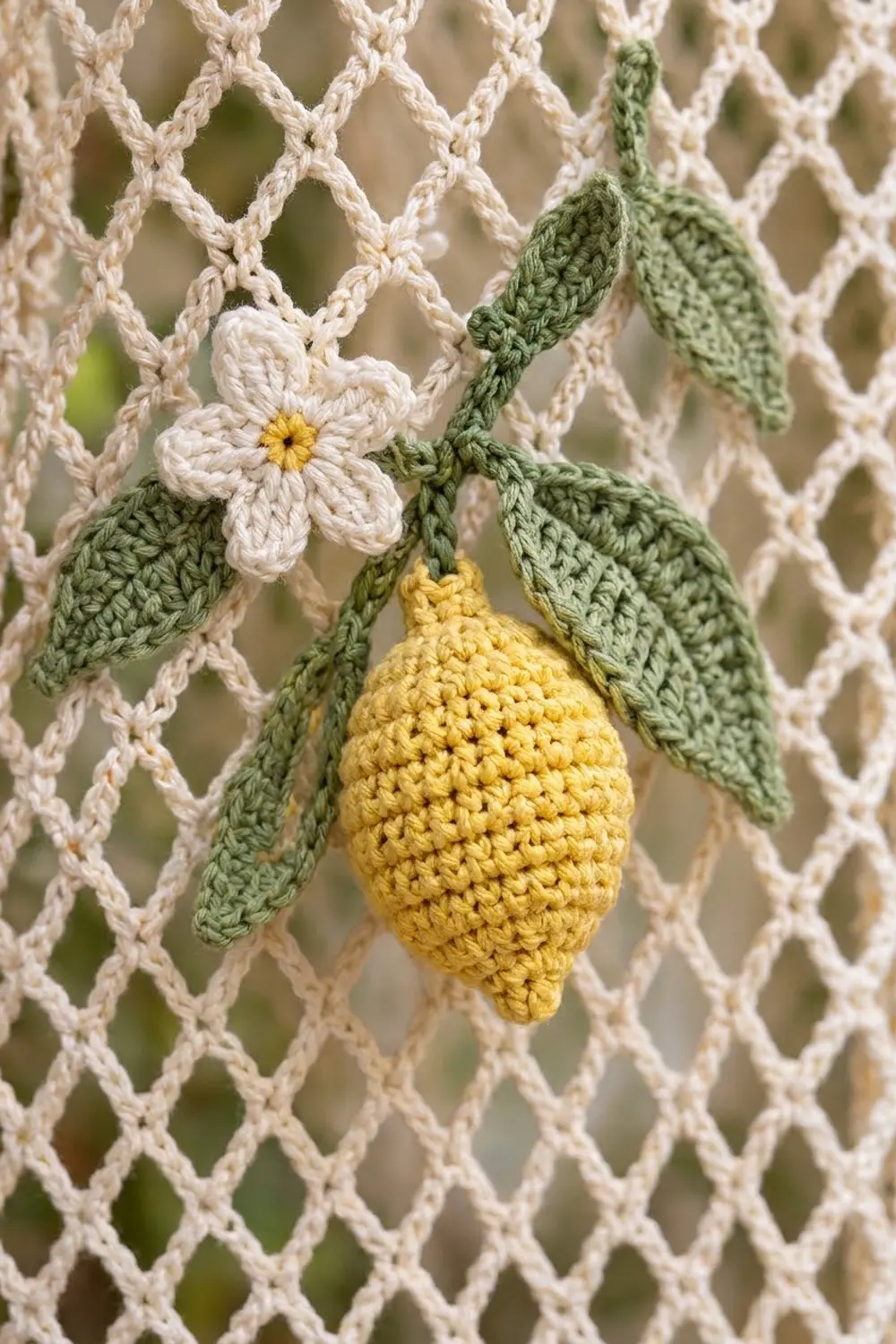
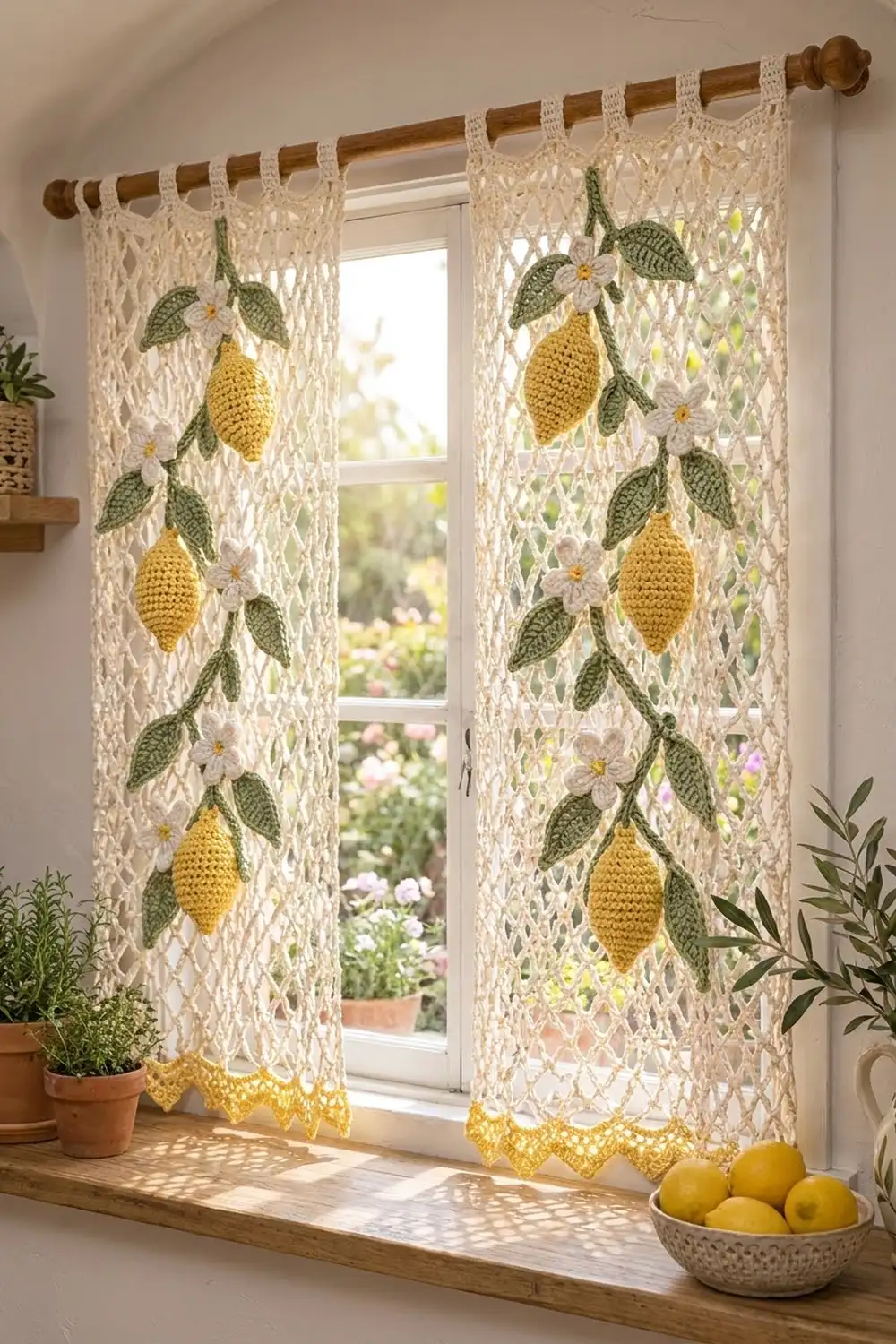
Bring a little Amalfi sunshine to a kitchen window with these Lemon Grove curtain panels. Each panel is an airy cream diamond mesh with a sage-green vine down the center. Puffy 3D lemons, slim leaves, and small white five-petal flowers with yellow centers decorate the vine.
The colors stay soft and fresh. Cream is for the mesh, and lemon yellow is for the fruit, flower centers, and pointed bottom border. Sage green is for the vine and leaves, and white is for the petals. The style is cottage-garden and light enough to let the view through.
This pattern uses US crochet terms. One finished panel measures 25 in (63.5 cm) wide and 44.5 in (113.0 cm) long from the top of the header to the border points. The hanging tabs add 2 in (5.1 cm) above that. The photo shows a pair, so make two panels and mirror the appliqué layout on the second one.
Construction is simple and flat. You work the mesh bottom-up from a foundation chain. Then you add a solid single crochet header and tabs at the top and work the yellow pointed border into the foundation chain. The appliqués are made separately and sewn on.
Finished Size and Construction
- Finished size (one panel): 25 in (63.5 cm) wide x 44.5 in (113.0 cm) long, plus 2 in (5.1 cm) tabs
- Skill level: Intermediate
- Terminology: US
- Yarn weight: DK / light (3) cotton
- Hooks: 4.0 mm (G-6) for the panel, 3.0 mm (D-3) for appliqués
- Number of pieces: 2 separate panels, not joined to each other. Each panel has 1 mesh body plus 29 appliqué pieces.
- Layout: one vine down the center of each panel, mirrored on the pair
- Mesh body size: 25 in (63.5 cm) x 40.5 in (102.9 cm)
- Size before border: 25 in (63.5 cm) x 42.5 in (108.0 cm), including the 2 in (5.1 cm) header
- Border depth: 2 in (5.1 cm) at the points
Materials
Choose a smooth, mercerized or soft-twist DK cotton, about 110 m per 50 g. Cotton holds the mesh open, keeps the lemons firm, and washes well.
Quantities for the pair:
- Cream (mesh, header, tabs): 300 g / 660 m
- Lemon yellow (lemons, flower centers, border): 100 g / 220 m
- Sage green (vines, sprigs, leaves): 100 g / 220 m
- White (flower petals): 25 g / 55 m
All quantities include a margin of about 15 percent for gauge differences and swatching.
Tools:
- 4.0 mm (G-6) and 3.0 mm (D-3) hooks
- A small handful of polyester fiberfill
- Tapestry needle
- Stitch markers
- Rust-proof pins and blocking mats
- Measuring tape
- Spray bottle
Abbreviations (US Terms)
- ch chain
- sl st slip stitch
- sc single crochet
- hdc half double crochet
- dc double crochet
- tr treble crochet
- inc 2 sc in the same stitch
- dec sc2tog (invisible decrease recommended)
- sp space
- RS / WS right side / wrong side
Special stitch – mesh loop: ch 5, sc in the next ch-5 loop. Each loop spans 4 foundation chains.
Gauge and Checkpoints
Mesh gauge (4.0 mm hook):
– 4 loops = 5 in (12.7 cm) wide
– 10 rows = 5 in (12.7 cm) tall
– One loop is 1.25 in (3.2 cm) wide, and one row is 0.5 in (1.3 cm) tall.
Solid gauge (4.0 mm hook): 16 sc and 18 rows = 4 in (10.2 cm).
Test one piece first. Ch 26 and work 10 mesh rows. You will have 6 loops, about 7.5 in (19.1 cm) wide. Pin the swatch lightly and measure the 4 center loops.
Checkpoints:
- After mesh Row 20: 25 in (63.5 cm) wide, 10 in (25.4 cm) tall.
- After mesh Row 81: 40.5 in (102.9 cm) tall.
- After the header: 42.5 in (108.0 cm) tall. The header is about 25.25 in (64.1 cm) wide and blocks to match the mesh.
- One finished lemon: about 3 in (7.6 cm) long.
If your swatch is too big, go down half a hook size. If it is too small, go up half a size. Width matters most. You can adjust the length by adding or removing pairs of rows.
Mesh Body (Make 1 per Panel)
With cream and the 4.0 mm hook, ch 82.
Row 1 (RS): Sc in 2nd ch from hook, *ch 5, skip 3 ch, sc in next ch; repeat from * 19 more times. (21 sc, 20 ch-5 loops)
Row 2: Ch 5 (counts as dc + ch 2), turn, sc in first ch-5 loop, *ch 5, sc in next ch-5 loop; repeat from * 18 more times, ch 2, dc in last sc. (19 ch-5 loops, 2 half loops, 20 sc)
Row 3: Ch 1, turn, sc in first dc, *ch 5, sc in next ch-5 loop; repeat from * 18 more times, ch 5, sc in 3rd ch of turning ch-5. (21 sc, 20 ch-5 loops)
Rows 4–81: Repeat Rows 2–3 thirty-nine more times.
– Every odd row has 21 sc and 20 loops.
– Every even row has 19 full loops and 2 half loops.
The mesh body measures 25 in (63.5 cm) x 40.5 in (102.9 cm). Do not fasten off.
Header and Tabs
Header Row 1: Ch 1, turn, sc in first sc, *4 sc in next ch-5 loop, sc in next sc; repeat from * 19 more times. (101 sc: 1 + 20 x 5)
Header Rows 2–9: Ch 1, turn, sc in each sc. (101 sc)
The header is 2 in (5.1 cm) tall. Fasten off.
Tabs (make 7): Tabs sit over sts 1–5, 17–21, 33–37, 49–53, 65–69, 81–85, and 97–101. That gives 7 tabs of 5 sts plus 6 gaps of 11 sts (35 + 66 = 101).
- Row 1: Join cream in the first st of the tab, ch 1, sc in same st and next 4 sts. (5 sc)
- Rows 2–27: Ch 1, turn, sc in each sc. (5 sc)
Each tab is 1.25 in (3.2 cm) wide and 6 in (15.2 cm) long. Fold it to the WS and whipstitch Row 27 to the back of Header Row 1. The tab covers 2 in (5.1 cm) of header and leaves a 2 in (5.1 cm) loop above the top edge.
Appliqués (3.0 mm Hook)
Lemon (Make 4 per Panel)
Work in continuous rounds from the bottom tip, marking the first st of each round.
- Rnd 1: With yellow, 4 sc in magic ring. (4)
- Rnd 2: Inc in each st. (8)
- Rnd 3: (Sc, inc) 4 times. (12)
- Rnd 4: (Sc 2, inc) 4 times. (16)
- Rnd 5: (Sc 3, inc) 4 times. (20)
- Rnd 6: (Sc 4, inc) 4 times. (24)
- Rnds 7–11: Sc in each st. (24)
- Rnd 12: (Sc 4, dec) 4 times. (20)
- Rnd 13: (Sc 3, dec) 4 times. (16)
Stuff firmly, keeping an oval shape.
- Rnd 14: (Sc 2, dec) 4 times. (12)
- Rnd 15: (Sc, dec) 4 times. (8)
- Rnd 16: Dec 4 times. (4)
Fasten off, close the opening, and leave a 10 in (25.4 cm) tail. The 4-st start and finish form the pointed tips. Each lemon is about 3 in (7.6 cm) long x 1.5 in (3.8 cm) wide.
Leaf (Make 14 per Panel)
With green, ch 12.
Rnd 1:
1. Sl st in 2nd ch from hook, sc in next ch, hdc in next ch, dc in next 5 ch, hdc in next ch, sc in next ch.
2. Work (sc, ch 2, sc) in last ch for the base.
3. Working along the other side of the foundation: sc in next ch, hdc in next ch, dc in next 5 ch, hdc in next ch, sc in next ch, sl st in last ch.
4. Ch 2, sl st in first sl st for the tip. (22 sts, 2 ch-2 sps)
Rnd 2: Sl st in back loop of each st around, working (sl st, ch 2, sl st) in each ch-2 sp. Fasten off.
Embroider a center vein in green with surface sl st or backstitch. Each leaf is 2.25 in (5.7 cm) long x 1 in (2.5 cm) wide.
Flower (Make 6 per Panel)
- Rnd 1: With yellow, 10 sc in magic ring, sl st to first sc. (10) Fasten off.
- Rnd 2: Join white in any sc, ch 1, sc in same st, ch 3, skip 1 sc, *sc in next sc, ch 3, skip 1 sc; repeat from * 3 more times, sl st to first sc. (5 sc, 5 ch-3 loops)
- Rnd 3: (Sc, hdc, 3 dc, hdc, sc) in each ch-3 loop, sl st to first sc. (5 petals, 35 sts)
Fasten off. Each flower is 1.75 in (4.4 cm) across.
Vine and Sprigs
- Main vine (1 per panel): With green, ch 151. Sl st in back bump of 2nd ch from hook and each ch across. (150 sl st) Length: 37.5 in (95.3 cm).
- Lemon sprigs (4 per panel): Ch 9, sl st in back bump of 2nd ch and each ch across. (8 sl st) Length: 2 in (5.1 cm).
Make All Pieces
Each panel needs 1 mesh body with header and tabs, 1 vine, 4 sprigs, 4 lemons, 14 leaves, and 6 flowers. For the pair:
- Cream: 2 mesh bodies, 14 tabs
- Yellow: 8 lemons, 12 flower centers, 2 borders
- Green: 2 vines, 8 sprigs, 28 leaves
- White: 12 petal rounds
The grid below is the layout for the first panel with the RS facing. Rows are counted from the bottom mesh row. Mirror left and right for the second panel.
Rows    Left        Center               Right
73-80   Leaf 1      Flower 1 (vine top)  Leaf 2
65-72   Leaf 3      vine                 Leaf 4 + Lemon 1
57-64   Flower 2    vine                 Leaf 5, Leaf 6
49-56   Lemon 2     vine                 Leaf 7 + Flower 3
41-48   Leaf 8      Flower 4             Leaf 9
33-40   Leaf 10     vine                 Lemon 3
25-32   Flower 5    vine                 Leaf 11, Leaf 12
17-24   Leaf 13     Lemon 4              Leaf 14
9-16    -           Flower 6 (vine end)  -
The vine runs from just below the header to about Row 9. It swings up to 2 in (5.1 cm) left and right of center.
Attaching the Appliqués
Method: Whipstitch with a matching tail. Go through the back loops of the appliqué and around the mesh sc and ch bars beneath it.
Stitch-to-stitch logic:
- Lay the panel flat with the RS up. Pin the vine following the grid and sew it every 0.5 in (1.3 cm) along its center.
- Sew one end of each sprig to the vine and the other end to Rnd 16 of its lemon. Tack the lemon at Rnds 6 and 12 only, so it stays plump.
- Sew each leaf base to the vine, then tack the tip and both sides at the widest point.
- Sew each flower through Rnd 1 only, so the petals sit free.
Tension: Keep the mesh flat and unstretched. Never pull a stitch tight enough to draw two mesh loops together. Weave tails into the appliqués, not the mesh.
Size checkpoint: The panel must still measure 25 in (63.5 cm) wide across the vine area. If it narrows, loosen the nearest tacking stitches.
Bottom Border
Border gauge: 16 sc = 4 in (10.2 cm), the same as the header. The border runs along the bottom edge only. The sides stay as open mesh, with 0 border stitches per side.
With the RS facing and the 4.0 mm hook, work into the free loops of the foundation chain.
Row 1: Join yellow at the base of the first Row 1 sc, ch 1, sc in same ch, *sc in next skipped ch, 2 sc in next skipped ch, sc in next skipped ch, sc at base of next sc; repeat from * 19 more times. (101 sc: 1 + 20 x 5)
Row 2 (points): Ch 1, turn, sc in first sc, *ch 1, skip 1 sc, hdc in next sc, ch 1, skip 1 sc, dc in next sc, ch 1, (tr, ch 3, tr) in next sc, ch 1, dc in next sc, ch 1, skip 1 sc, hdc in next sc, ch 1, skip 1 sc, sc in next sc; repeat from * 9 more times. (71 sts, 60 ch-1 sps, 10 ch-3 sps)
Row 3: Ch 1, turn, sc in first sc, *[sc in ch-1 sp, sc in next st] 3 times, (sc, ch 3, sc) in ch-3 sp, [sc in next st, sc in ch-1 sp] 3 times, sc in next sc; repeat from * 9 more times. (151 sc, 10 ch-3 picots)
Fasten off and weave in ends.
Why the math works:
– Each point uses 10 sts of Row 1 and is centered on its 5th st. Neighboring points share their sc anchors, so 10 points use 10 x 10 + 1 = 101 sts.
– Row 2 has 7 sts per point plus the first sc (7 x 10 + 1 = 71).
– Row 3 has 15 sc per point plus the first sc (15 x 10 + 1 = 151).
– The stitches get taller toward the center of each point (sc, hdc, dc, tr), which builds each triangle. The points are spaced 2.5 in (6.4 cm) apart.
Final Blocking
- Weave in all remaining ends.
- Pin the panel RS up to 25 in (63.5 cm) wide and 44.5 in (113.0 cm) from the header top to the border points.
- Pin the mesh columns straight so the diamonds line up vertically.
- Pin each border point at its picot, 2.5 in (6.4 cm) apart.
- Spray the mesh, header, and border until damp, avoiding the lemons.
- Let dry completely before unpinning.
- Plump each lemon and smooth the leaves flat.
Final Quality-Control Checklist
- Odd mesh rows have 20 loops; even rows have 19 loops plus 2 half loops.
- The header has 101 sc on all 9 rows.
- There are 7 evenly spaced tabs, each 5 sc wide and 27 rows long.
- The border rows count 101, 71, and 151 sts, with 10 points.
- Each panel has 4 lemons, 14 leaves, 6 flowers, 4 sprigs, and 1 vine.
- The second panel’s layout is mirrored.
- Each panel measures 25 in (63.5 cm) x 44.5 in (113.0 cm) plus tabs.
Troubleshooting
- Mesh leans to one side: Start even rows with ch 5 and end them with ch 2, dc.
- Header ruffles or pulls in: Change hook size for the header only, until 101 sc measure 25 to 25.25 in (63.5 to 64.1 cm).
- Lemon looks round: Stuff less in the middle and pinch the tips.
- Leaves curl: Work Rnd 2 more loosely and spray-block flat.
- Border points flop: Starch lightly, or block with a pin through each picot.
- Panel puckers behind appliqués: Remove the tight tacking stitches and resew more loosely.
Care
Hand wash in cool water with mild soap, roll in a towel, and dry flat, pinning the mesh back to size. Do not tumble dry.
Final Notes
The measurement chain is simple. Four loops equal 5 in (12.7 cm), so 20 loops make 25 in (63.5 cm). Eighty-one rows at 0.5 in (1.3 cm) each give 40.5 in (102.9 cm) of mesh. The 2 in (5.1 cm) header and 2 in (5.1 cm) border bring the panel to 44.5 in (113.0 cm). The 101-stitch edges divide cleanly into 7 tabs at the top and 10 points at the bottom. Check your gauge early and count your loops, and your lemon grove will hang straight and bright.
Happy crocheting!