

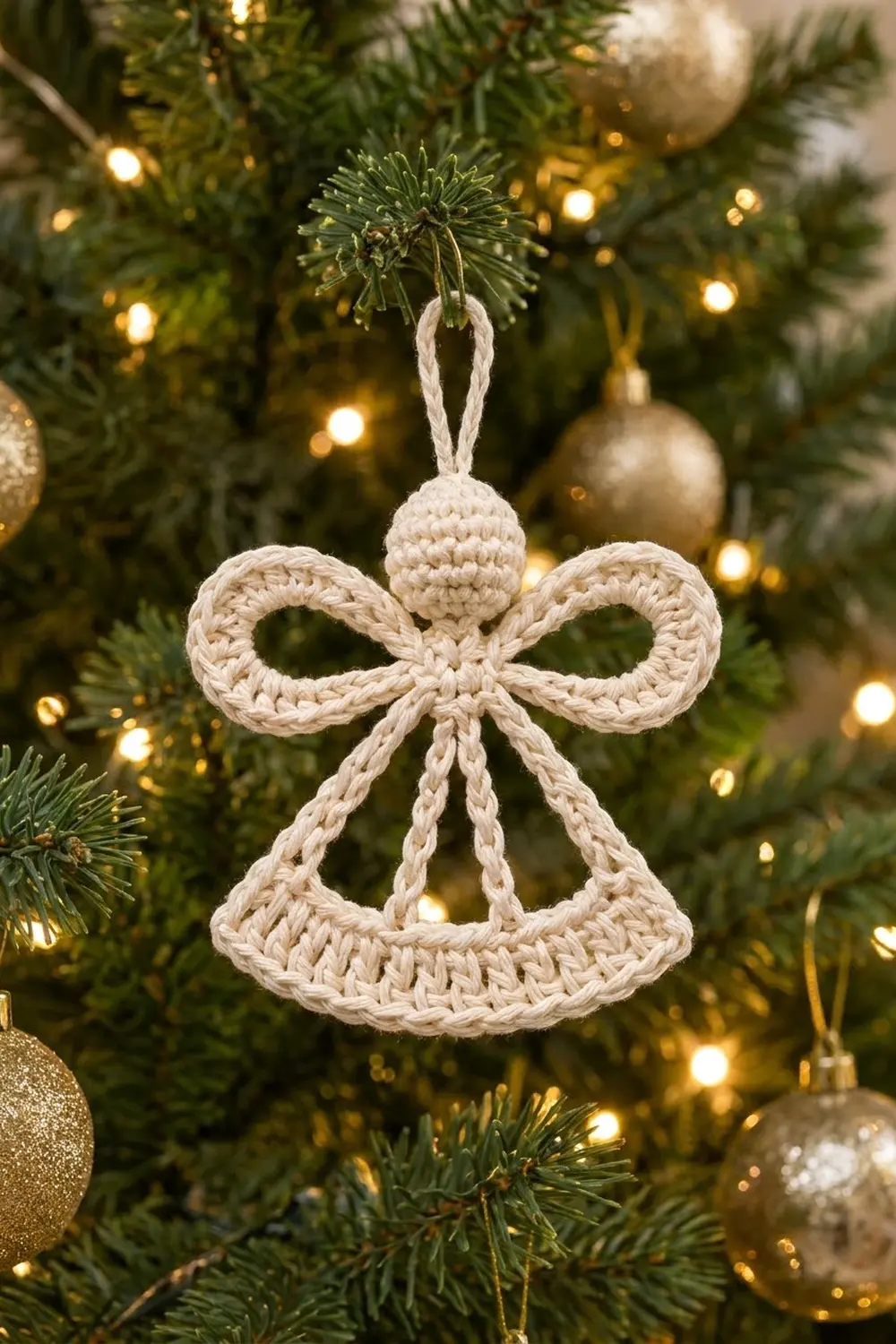
This little angel is mostly outline and texture. A firm, stuffed ball head sits above two rounded loop wings. The skirt is an open frame of four corded spokes that fan out from the neck to a solid, ribbed hem band. Light passes through the skirt, so the ornament looks delicate on a tree but still feels sturdy in the hand.
The sample uses one color, a soft ivory cotton, for a clean, heirloom look against green branches and gold baubles. Cotton shows every stitch clearly, so the wing loops look like smooth cords and the hem shows neat double crochet ribs.
The pattern uses US crochet terms. The finished angel measures about 4.25 in (10.8 cm) across the wings, 4 in (10.2 cm) across the hem, and 4 in (10.2 cm) tall from the top of the head to the hem. With the hanging loop it is 5.25 in (13.3 cm) tall.
The construction is simple. You make a stuffed head with its hanging loop, then a small center ring. Both wings and all four skirt spokes are worked straight off the ring. A short chain links the spoke tips, and the hem band is worked in three rows across that chain. Last, you sew the head on top of the ring.
Finished Size and Construction
- Finished size: 4.25 in (10.8 cm) wingspan x 4 in (10.2 cm) tall, plus a 1.25 in (3.2 cm) hanging loop
- Skill level: Easy to intermediate
- Terminology: US crochet terms
- Yarn weight: DK (weight 3) cotton
- Hook: 3.0 mm (C/2–D/3)
- Number of pieces: 1 ornament, made from 2 parts (head and body) sewn together
- Layout: One standing angel with the head on top, a wing on each side, and an open four-spoke skirt below
- Piece size: 4.25 in (10.8 cm) wide x 4 in (10.2 cm) tall
- Size before border: The spoke tips span 3.5 in (8.9 cm) across the hem foundation
- Border depth: The hem band is 0.75 in (1.9 cm) deep
Materials
Choose a smooth, tightly plied DK cotton or cotton blend. Mercerized cotton gives the crispest cords and holds its shape best after blocking. Avoid fuzzy or very soft yarns, because the wing loops need a firm fiber to stay rounded.
- Cream / ivory DK cotton: 10 g, about 24 m (26 yd)
This amount includes a margin of roughly 25 percent for gauge testing, sewing tails, and the hanging loop.
Tools
- 3.0 mm crochet hook
- Tapestry needle
- 1 stitch marker
- A small pinch of polyester fiberfill
- Scissors
- Blocking mat or folded towel, and rust-proof pins
- Spray starch or diluted fabric stiffener (optional)
Abbreviations (US Terms)
- ch – chain
- sl st – slip stitch
- sc – single crochet
- dc – double crochet
- inc – 2 sc in the same stitch
- dec – sc2tog (single crochet 2 together)
- MR – magic ring
- st(s) – stitch(es)
- RS – right side
Special technique – covered chain loop: Make the chain, then sl st into the stitch named in the pattern to close it into a loop. Work the given number of sc into the loop, around the chain rather than into single chains. Push the stitches together as you go so the chain is completely hidden. This makes the smooth, rope-like cord used for the wings and hanging loop.
Spoke: Chain the number given, sc in 2nd ch from hook and in each ch back toward the ring, then sl st into the ring. This makes a firm, single-cord line.
Gauge and Checkpoints
Gauge in sc rows: 11 sc and 12 rows = 2 in (5.1 cm). One row of dc is about 0.4 in (1.0 cm) tall.
The ornament is small, so the head doubles as your gauge test. Make it first and measure it before you start the body.
Checkpoints
- Head: about 0.9 in (2.3 cm) across after stuffing
- Center ring: about 0.6 in (1.5 cm) across the outer edge
- Each wing: about 1.75 in (4.4 cm) from ring to tip
- Outer spoke: 14 sc, about 2.5 in (6.4 cm) long
- Inner spoke: 12 sc, about 2.2 in (5.6 cm) long
- Hem Row 1: 19 sc, about 3.5 in (8.9 cm) wide
- Finished hem: 22 sts, 4 in (10.2 cm) wide and 0.75 in (1.9 cm) deep
If the head is too big (over 1 in / 2.5 cm across), switch to a 2.75 mm hook. If it is too small (under 0.8 in / 2.0 cm across), switch to a 3.25 mm hook. Keep all stitch counts the same and change only the hook.
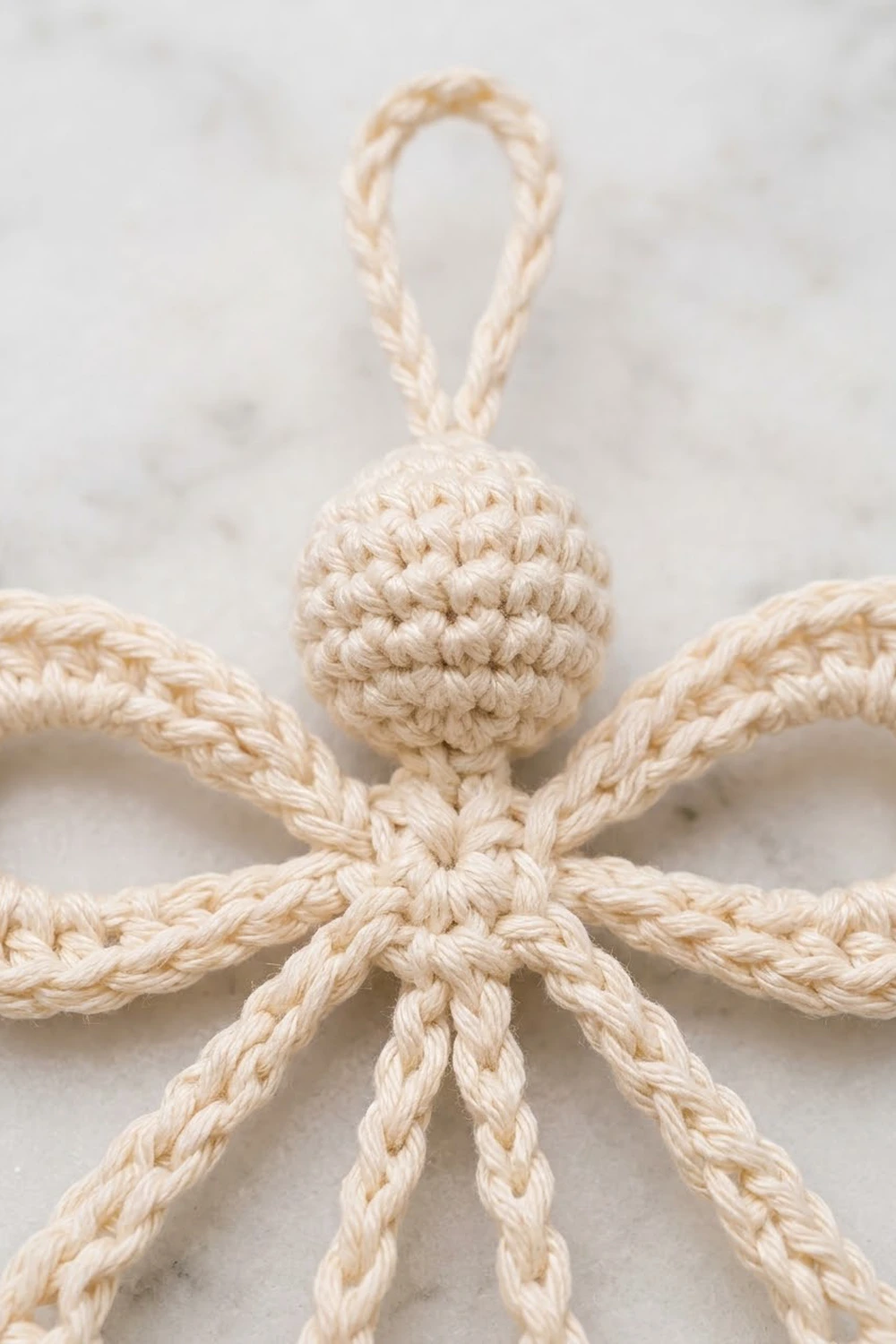
Head
The head is worked in continuous spiral rounds. Mark the first stitch of each round.
Rnd 1: Work 6 sc in a MR. Pull the ring closed. (6 sts)
Rnd 2: Inc in each st around. (12 sts)
Rnd 3: (Sc in next st, inc) 6 times. (18 sts)
Rnds 4–6: Sc in each st around. (18 sts in each round)
Rnd 7: (Sc in next st, dec) 6 times. (12 sts)
Stuff the head firmly and shape it into a round ball with your fingers.
Rnd 8: Dec 6 times. (6 sts)
Fasten off and leave a 10 in (25.4 cm) tail. Weave the tail through the front loops of the last 6 sts and pull tight to close. Keep the tail for sewing the head to the body.
Hanging Loop
Join yarn with a sl st at the center top of the head, where the MR closed.
Loop: Ch 16, then sl st into the same spot to close the loop.
Cover: Work 20 sc into the ch-16 loop, packing them tightly so the chain is hidden. Sl st into the top of the head. (20 sc)
Fasten off and weave the end into the head. The loop should stand about 1.25 in (3.2 cm) tall.
Body: Center Ring, Wings, and Spokes
The whole body frame is worked without fastening off. Count the ring stitches as you go. St 1 is at the top, under where the head will go, and st 9 is directly opposite it at the bottom center.
Ring: Ch 6, then sl st in the first ch to form a ring.
Rnd 1: Ch 1 and work 16 sc into the ring. Sl st in the first sc. (16 sts) The join is st 1.
Travel: Sl st in the next 3 sts to reach st 4.
First wing: Ch 24, then sl st in st 4 to close the loop. Work 30 sc into the ch-24 loop, then sl st in st 4 again. (30 sc)
Travel: Sl st in sts 5, 6, and 7.
First outer spoke: Ch 15, sc in 2nd ch from hook and in each remaining ch. Sl st in st 7. (14 sc)
Travel: Sl st in st 8.
First inner spoke: Ch 13, sc in 2nd ch from hook and in each remaining ch. Sl st in st 8. (12 sc)
Travel: Sl st in sts 9 and 10.
Second inner spoke: Ch 13, sc in 2nd ch from hook and in each remaining ch. Sl st in st 10. (12 sc)
Travel: Sl st in st 11.
Second outer spoke: Ch 15, sc in 2nd ch from hook and in each remaining ch. Sl st in st 11. (14 sc)
Travel: Sl st in sts 12, 13, and 14.
Second wing: Ch 24, then sl st in st 14 to close the loop. Work 30 sc into the ch-24 loop, then sl st in st 14 again. (30 sc)
Travel: Sl st in sts 15 and 16, then sl st in st 1.
Fasten off and weave in the end.
Symmetry check: Each wing is 3 sts away from st 1. Each outer spoke is 2 sts from st 9, and each inner spoke is 1 st from st 9. Lay the piece flat and fan the spokes so the outer ones angle down and out and the inner ones hang almost straight.
Hem Foundation
Three short chains link the spoke tips. This chain sets the top width of the hem.
With the RS facing, join yarn with a sl st at the free tip of the second outer spoke.
Foundation: Ch 5, sl st in the tip of the second inner spoke, ch 5, sl st in the tip of the first inner spoke, ch 5, sl st in the tip of the first outer spoke.
You now have 4 spoke tips joined by 3 ch-5 spans. Do not fasten off.
Border: Hem Band
The hem band is the only border on this design. It is a three-row band across the bottom of the skirt that flares slightly into a fan.
Border gauge: 11 sc = 2 in (5.1 cm); 1 dc row = 0.4 in (1.0 cm); 2 sc rows = about 0.35 in (0.9 cm).
Row 1: Ch 1, turn. Sc in the sl st at the spoke tip, *sc in each of the next 5 ch, sc in the sl st at the next spoke tip; repeat from * 2 more times. (19 sts)
Row 1 count: 4 spoke tips (4 sc) + 3 spans of 5 ch (15 sc) = 19 sts.
Row 2: Ch 2 (does not count as a st), turn. Dc in the first 4 sts, 2 dc in the next st, *dc in the next 4 sts, 2 dc in the next st; repeat from * once more, dc in the last 4 sts. (22 sts)
Row 2 count: 19 sts worked 1 per existing st + 3 extra dc from the increases = 22 sts. The stitches used are 4 + 1 + 5 + 5 + 4 = 19, so the row ends exactly at the edge.
Row 3: Ch 1, turn. Sc in each st across. (22 sts)
Fasten off and weave the ends along the back of the hem.
Why the math works: At 5.5 sc per inch, the 19 sts of Row 1 measure about 3.5 in (8.9 cm). Row 2 adds 3 evenly spaced stitches for 22 sts, and at the same gauge 22 sts measure 4 in (10.2 cm). That extra 0.5 in (1.3 cm) at the bottom edge turns the hem into a gentle fan instead of a straight rectangle. The depth is one dc row, 0.4 in (1.0 cm), plus two sc rows, 0.35 in (0.9 cm), for a total of 0.75 in (1.9 cm).
Attach the Head
Set the head above the ring so its closed bottom sits over sts 16, 1, and 2. Use the head’s long tail to whipstitch it to those three ring sts. Go through the back of the ring so the sewing stays hidden from the front. The ornament hangs from the head, so make 2 passes for strength. Weave the tail into the head and trim it.
Final Blocking
- Mist the body with water until it is damp. Keep the stuffed head as dry as possible.
- Lay the angel RS up on a blocking mat or folded towel.
- Pin the hem first. Ease the bottom edge to 4 in (10.2 cm) wide in a gentle fan curve, and check that the band is 0.75 in (1.9 cm) deep.
- Straighten each spoke. The outer spokes should run from the ring to the hem corners, and the inner spokes should hang almost straight down.
- Shape each wing into a rounded teardrop that tilts slightly upward. Pin the tips so the total span is 4.25 in (10.8 cm).
- Pin the hanging loop straight up, 1.25 in (3.2 cm) above the head.
- For extra stiffness, spray lightly with starch.
- Let it dry completely, at least 12 hours, before unpinning.
Final Quality-Control Checklist
- The head is round, firm, and about 0.9 in (2.3 cm) across, with no stuffing showing.
- The hanging loop is fully covered and stands 1.25 in (3.2 cm) tall.
- Both wings have 30 sc and match in size, about 1.75 in (4.4 cm) each.
- The outer spokes have 14 sc and the inner spokes have 12 sc.
- Hem Row 1 has 19 sts, and Rows 2 and 3 have 22 sts each.
- The hem is 4 in (10.2 cm) wide and 0.75 in (1.9 cm) deep.
- The angel is 4 in (10.2 cm) tall without the loop and 5.25 in (13.3 cm) with it.
- All ends are woven in, and the head is sewn on securely.
Troubleshooting
Wings ruffle or twist: Your tension is too tight for 30 sc. Redo the wing with 28 sc.
The chain shows through a covered loop: Push the sc closer together, or add 2 sc.
Spokes curl: Pin them straight while blocking and use starch.
The hem is narrow at the bottom: Make sure Row 2 has 22 dc. If it does, block the bottom edge out to 4 in (10.2 cm).
The hem pulls the spokes together: The foundation chains are too tight. Redo them with a 3.25 mm hook.
The ornament tilts when hung: Re-sew the head so it sits centered over st 1.
Care
Hand wash in cool water with mild soap, press the water out in a towel, and dry it flat in shape. Store it where nothing heavy can crush the wings.
Final Notes
The whole angel follows one measurement chain. A 0.9 in (2.3 cm) head confirms your gauge. A 0.6 in (1.5 cm) ring holds two 1.75 in (4.4 cm) wings for a 4.25 in (10.8 cm) span. Spokes of 14 and 12 sc meet the 19-st foundation at 3.5 in (8.9 cm), and three increases flare the hem to 22 sts and 4 in (10.2 cm). Check each number as you go, and the finished ornament will match from loop to hem.
Happy crocheting!