

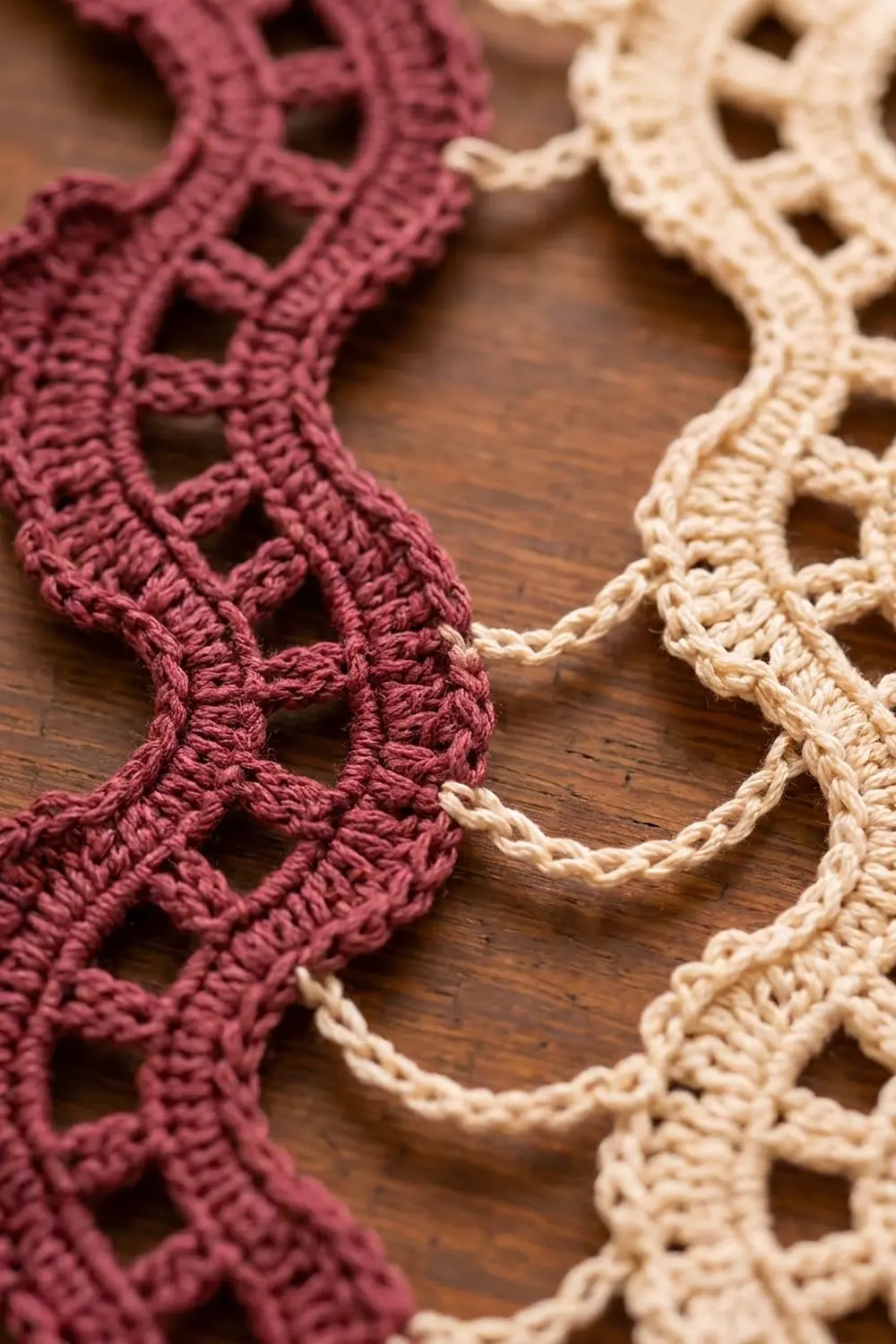
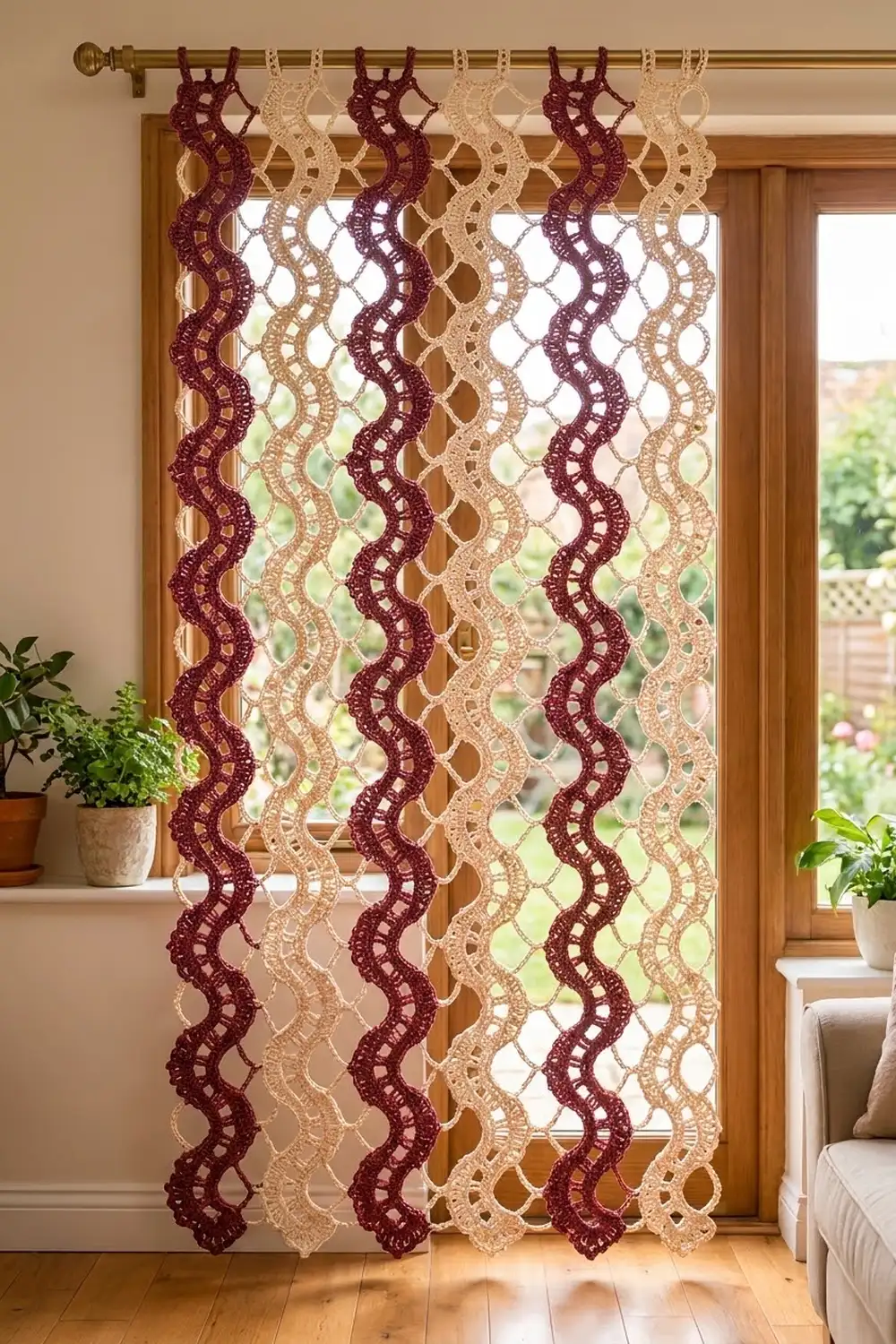
The Bordeaux Ribbon Wave Strip Curtain is an airy panel of six wavy lace strips. Each strip is a ladder of open windows that swings left and right in a soft S-curve, with scallops on the outer side of every bend.
The strips alternate deep burgundy and soft cream. Cream chain loops join each cream strip to its burgundy neighbors, so the panel hangs as one piece while light still passes through. The look is romantic and slightly vintage.
This pattern uses US crochet terms. The finished panel is 20.9 in (53.1 cm) wide and hangs about 50 in (127.0 cm) from the top of the rod pocket. The waves change the hanging length a little, so the pattern gives measurement checkpoints at each stage.
You work each strip in short rows across its width and curve it by changing stitch heights. You edge every strip with scallops, join the strips with chain loops, and finish with a heading band that folds into a rod pocket.
Finished Size and Construction
- Finished size: 20.9 in (53.1 cm) wide x about 50 in (127.0 cm) long
- Skill level: Intermediate
- Terminology: US crochet terms
- Yarn weight: DK (light, #3) cotton
- Hook: 3.5 mm (E-4)
- Number of pieces: 6 strips (3 burgundy, 3 cream), joined
- Layout: 6 strips side by side, alternating burgundy and cream
- Piece size: strip body 2 in (5.1 cm) wide, 2.5 in (6.4 cm) at the widest scallop, 50.8 in (129.0 cm) along the centerline
- Size before border: 20.9 in (53.1 cm) across the strip tops
- Border depth: 1.8 in (4.6 cm) folded heading band, top edge only
Materials
Choose a smooth mercerized or combed DK cotton. It keeps the windows crisp and holds the curves after blocking.
- Burgundy: 200 g / about 460 m (3 strips plus heading band)
- Cream: 250 g / about 575 m (3 strips plus all joining loops)
Quantities include a margin of roughly 15 percent for gauge differences.
Tools:
- 3.5 mm (E-4) crochet hook
- 2 locking stitch markers in contrasting colors
- Tapestry needle and scissors
- Rust-proof pins and blocking mats
- Curtain rod up to 1 in (2.5 cm) in diameter
Abbreviations (US Terms)
- ch = chain
- sl st = slip stitch
- sc = single crochet
- hdc = half double crochet
- dc = double crochet
- tr = treble crochet
- sk = skip
- sp = space
- tch = turning chain
- st(s) = stitch(es)
- RS / WS = right side / wrong side
- rep = repeat
Special stitch – Scallop: 5 dc worked into one row-end.
Row-end: the side of a row, worked around the post of the edge stitch or into the turning chain.
Gauge and Checkpoints
Gauge: 18 dc and 10 rows = 4 in (10.2 cm). For the heading, 18 sc and 20 rows = 4 in (10.2 cm).
Make one complete strip first. It is your real gauge swatch.
- After Row 1, the strip is 2 in (5.1 cm) wide.
- After Row 16, the centerline measures 6.4 in (16.3 cm) and shows one full S-wave.
- After Row 64, the centerline measures 25.6 in (65.0 cm).
- After Row 127, the centerline measures 50.8 in (129.0 cm).
- After edging, the strip is 2.5 in (6.4 cm) at the widest scallop.
Measure the centerline with a flexible tape following the curve.
If the strip is too wide, go down a hook size; if too narrow, go up a size. If the width is right but the waves are too flat, tighten your short-edge sc and hdc; if they are too deep, loosen them.
Strip Pattern (Make 3 Burgundy, 3 Cream)
How the Curve Works
Every row has 9 sts in three groups of 3. The short edge uses sc, hdc, dc; the long edge uses dc, tr, tr. The long edge grows faster than the short edge, so the strip bends toward the short edge.
- Bend A: Edge 1 short, Edge 2 long.
- Bend B: Edge 1 long, Edge 2 short.
Even rows are window rows and start at Edge 2. Odd rows are solid rows and start at Edge 1.
Row Definitions
W-A (even rows): ch 4 (counts as tr), tr in next st, dc in next st, ch 3, sk 3 sts, dc in next st, hdc in next st, sc in last st, turn. (6 sts and 1 ch-3 sp)
S-A (odd rows): ch 1 (does not count), sc in first st, hdc in next st, dc in next st, 3 dc in ch-3 sp, dc in next st, tr in next st, tr in last st (top of tch if present), turn. (9 sts)
W-B (even rows): ch 1 (does not count), sc in first st, hdc in next st, dc in next st, ch 3, sk 3 sts, dc in next st, tr in next st, tr in last st, turn. (6 sts and 1 ch-3 sp)
S-B (odd rows): ch 4 (counts as tr), tr in next st, dc in next st, 3 dc in ch-3 sp, dc in next st, hdc in next st, sc in last st, turn. (9 sts)
Strip Rows
Foundation: Ch 11.
Row 1 (RS): Dc in 4th ch from hook and in each ch across, turn. (9 sts; skipped ch count as first dc)
Mark the side where Row 1 ended as Edge 2 and the other side as Edge 1.
Setup half-bend (Bend A):
- Row 2: W-A. (6 sts, 1 ch-3 sp)
- Row 3: S-A. (9 sts)
- Row 4: W-A. (6 sts, 1 ch-3 sp)
Wave repeat (12 rows):
- Rows 5, 7, 9: S-B. (9 sts each)
- Rows 6, 8, 10: W-B. (6 sts, 1 ch-3 sp each)
- Rows 11, 13, 15: S-A. (9 sts each)
- Rows 12, 14, 16: W-A. (6 sts, 1 ch-3 sp each)
Rep Rows 5–16 nine more times, ending after Row 124. (10 wave repeats total)
Closing half-bend (Bend B):
- Row 125: S-B. (9 sts)
- Row 126: W-B. (6 sts, 1 ch-3 sp)
- Row 127: S-B. (9 sts)
Fasten off. The strip has 127 rows and 63 windows. The 3-row setup and closing half-bends turn the strip only halfway, so both ends sit straight and the waves swing evenly to each side.
Scallop Edging Round
Row-end rules:
- Short edge, any row: 2 sc.
- Long edge, odd (solid) row: Scallop.
- Long edge, even (window) row: 1 sc.
- Row 1, both edges: 2 sc.
Round: With RS facing, join the same color with a sl st in the first st of Row 127 (Edge 1 corner). Ch 1, sc in same st and in each of next 8 sts (9 sc), ch 1, work down Edge 2 by the rules (315 sts), ch 1, sc in each of 9 foundation ch (9 sc), ch 1, work up Edge 1 by the rules (319 sts), ch 1, sl st to first sc. Fasten off.
Edge counts:
- Edge 2: Row 1 (2) + Rows 2–4 (1 + 5 + 1 = 7) + 10 repeats x 30 (12 sc on short Bend B rows + 3 Scallops and 3 sc = 18 on long Bend A rows) + Rows 125–127 (6) = 315.
- Edge 1: Row 1 (2) + Rows 2–4 (6) + 10 repeats x 30 (18 on long Bend B rows + 12 on short Bend A rows) + Rows 125–127 (5 + 1 + 5 = 11) = 319.
Round total: 9 + 315 + 9 + 319 = 652 sts plus 4 corner ch-1 sps. Each long bend shows 3 scallops, one beside each window.
Make All Pieces
- Burgundy: 3 strips (Strips 1, 3, 5)
- Cream: 3 strips (Strips 2, 4, 6)
Edge every strip in its own color. Lay the strips RS up with Row 1 at the bottom, so all of them bend together. In this position, Edge 2 is on the left and Edge 1 is on the right.
Top (Row 127)
[1 Burg] [2 Cream] [3 Burg] [4 Cream] [5 Burg] [6 Cream]
Bottom (Row 1)
Joining
Method
You work all joins from the cream strips in cream yarn. Each seam is a zigzag of ch-6 legs between the cream strip and its burgundy neighbor.
- Anchors (cream strip): even-row row-ends, Rows 2 through 126. On a long edge, use the single sc; on a short edge, the first sc of the 2-sc group. (63 per edge)
- Join points (burgundy strip): odd-row row-ends, Rows 3 through 125. On a long edge, use the center (3rd) dc of the Scallop; on a short edge, the first sc of the 2-sc group. (62 per edge)
Joining Row
With RS facing, join cream with a sl st in the Row 2 anchor. *Ch 6, sl st in the Row 3 join point on the burgundy edge, ch 6, sl st in the next anchor (Row 4) on the cream strip; rep from * up the edge, ending with a sl st in the Row 126 anchor. Fasten off.
Count per seam: 62 repeats = 124 ch-6 legs and 62 joins.
Seams:
- Strip 2 Edge 2 to Strip 1 Edge 1
- Strip 2 Edge 1 to Strip 3 Edge 2
- Strip 4 Edge 2 to Strip 3 Edge 1
- Strip 4 Edge 1 to Strip 5 Edge 2
- Strip 6 Edge 2 to Strip 5 Edge 1
Free loops, Strip 6 Edge 1: sl st in the Row 2 anchor, *ch 9, sl st in next anchor; rep from * to the Row 126 anchor. (62 loops)
Stitch Logic and Tension
Each anchor sits one row away from its join point, so every leg runs on a gentle diagonal. Because all strips bend together, the concave edge of one strip nests against the convex edge of the next, and the gap stays even.
Count chains instead of judging by eye, and keep the sl st joins relaxed. Lay the work flat after each seam to check for puckering.
Size checkpoint: The gap between scalloped edges is about 1.25 in (3.2 cm), and the panel measures 20.9 in (53.1 cm) across the strip tops.
Border: Heading Band and Rod Pocket
The only border is a band across the top. The scallop edging already finishes the sides and bottom.
Border gauge: 18 sc and 20 rows = 4 in (10.2 cm).
Row 1: With RS facing, join burgundy with a sl st in the first of the 9 top sc of Strip 1. Ch 1, sc in same st and in each of next 8 sc, *ch 8, sc in each of 9 top sc of next strip; rep from * across, turn.
Count: 6 strips x 9 sc = 54 sc, plus 5 gaps x 8 ch = 40 ch. (94 sts)
Row 2: Ch 1, sc in each sc and each ch across, turn.
Count: 54 sc (1 per existing sc) + 40 sc (1 per ch) = 94 sc.
Rows 3–18: Ch 1, sc in each st across, turn. (94 sc)
Fasten off with a long tail. Fold Row 18 to the WS and whipstitch it to the back of Row 1, one st to one st, to form the rod pocket.
Why the math works: 9 sc at 18 sc per 4 in (10.2 cm) is 2 in (5.1 cm), exactly the strip body width. Each ch-8 gap spans about 1.8 in (4.6 cm): two edgings of about 0.25 in (0.6 cm) plus the 1.25 in (3.2 cm) gap. So 94 sc / 18 x 4 = 20.9 in (53.1 cm), which matches the size before the border, and the strips hang straight. 18 rows equal 3.6 in (9.1 cm), which folds to a 1.8 in (4.6 cm) band for a rod up to 1 in (2.5 cm).
Final Blocking
- Soak the panel in cool water for 15 minutes and press it in a towel. Do not wring.
- Lay it flat, RS up, Row 1 at the bottom.
- Pin the heading straight to 20.9 in (53.1 cm).
- Shape each strip into an even S-wave and pin the windows open.
- Pin each scallop into a rounded fan.
- Ease the ch-6 legs into even zigzags and the ch-9 loops into matching arcs.
- Let it dry completely before unpinning.
Final Quality-Control Checklist
- Every strip has 127 rows and 63 windows.
- Each edging round has 652 sts plus 4 corner ch-1 sps.
- Every bend shows 3 scallops on its long edge.
- All strips bend the same way at the same height.
- Each of the 5 seams has 62 joins; Strip 6 has 62 free loops.
- The heading has 94 sc per row and 18 rows.
- Width at the heading is 20.9 in (53.1 cm).
- Tails are woven into solid stitches, not across windows.
Troubleshooting
Strip drifts sideways: A half-bend is missing. Rows 2–4 and 125–127 must be 3 rows each.
Waves are uneven: Every half-bend needs exactly 6 rows of the correct row types.
Windows close up: Your ch-3 is too tight. Chain more loosely.
Scallops ruffle: Use 4 dc per Scallop, consistently on every strip.
Seams pucker: Your ch-6 legs are too short for your tension. Rework with ch 7.
Care
Hand wash in cool water with mild soap, press out the water, and dry flat, re-pinning the waves if needed. Do not hang it wet, since the weight stretches the strips.
Final Notes
Here is the measurement chain:
– a 2 in (5.1 cm) strip body
– a 50.8 in (129.0 cm) centerline over 127 rows
– a 2.5 in (6.4 cm) edged strip
– a 1.25 in (3.2 cm) gap between joined strips
– a 94-stitch heading that sets the panel at 20.9 in (53.1 cm)
Check each measurement as you go and the curtain will hang evenly.
Happy crocheting!