

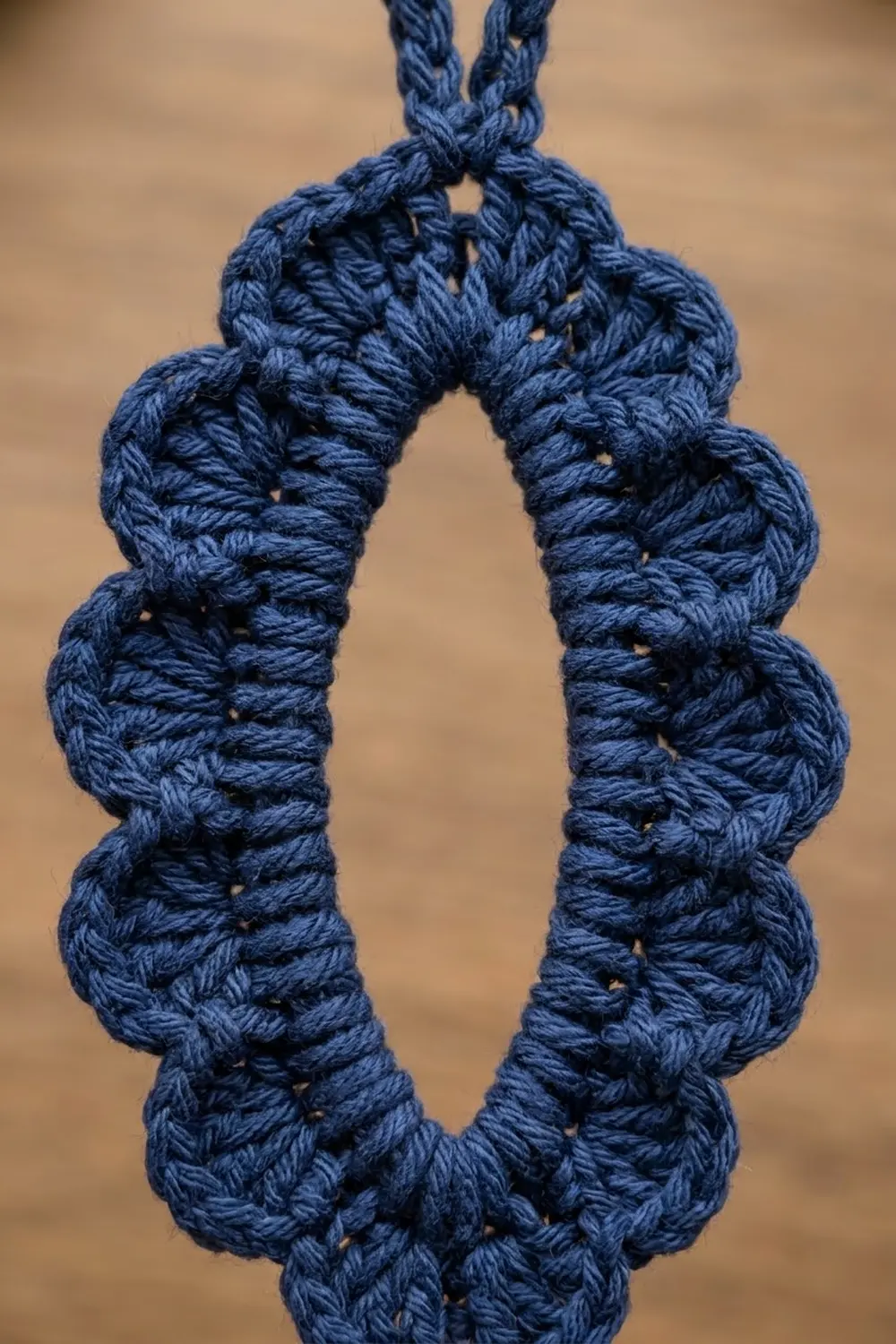
The Moonlit Scallop Strand Curtain is a light, airy window hanging made from pointed almond-shaped motifs linked into long vertical strands. Each motif has an open center, a smooth inner band and a ruffled scalloped edge. When they hang in a row, they look like chains of lace petals catching the light.
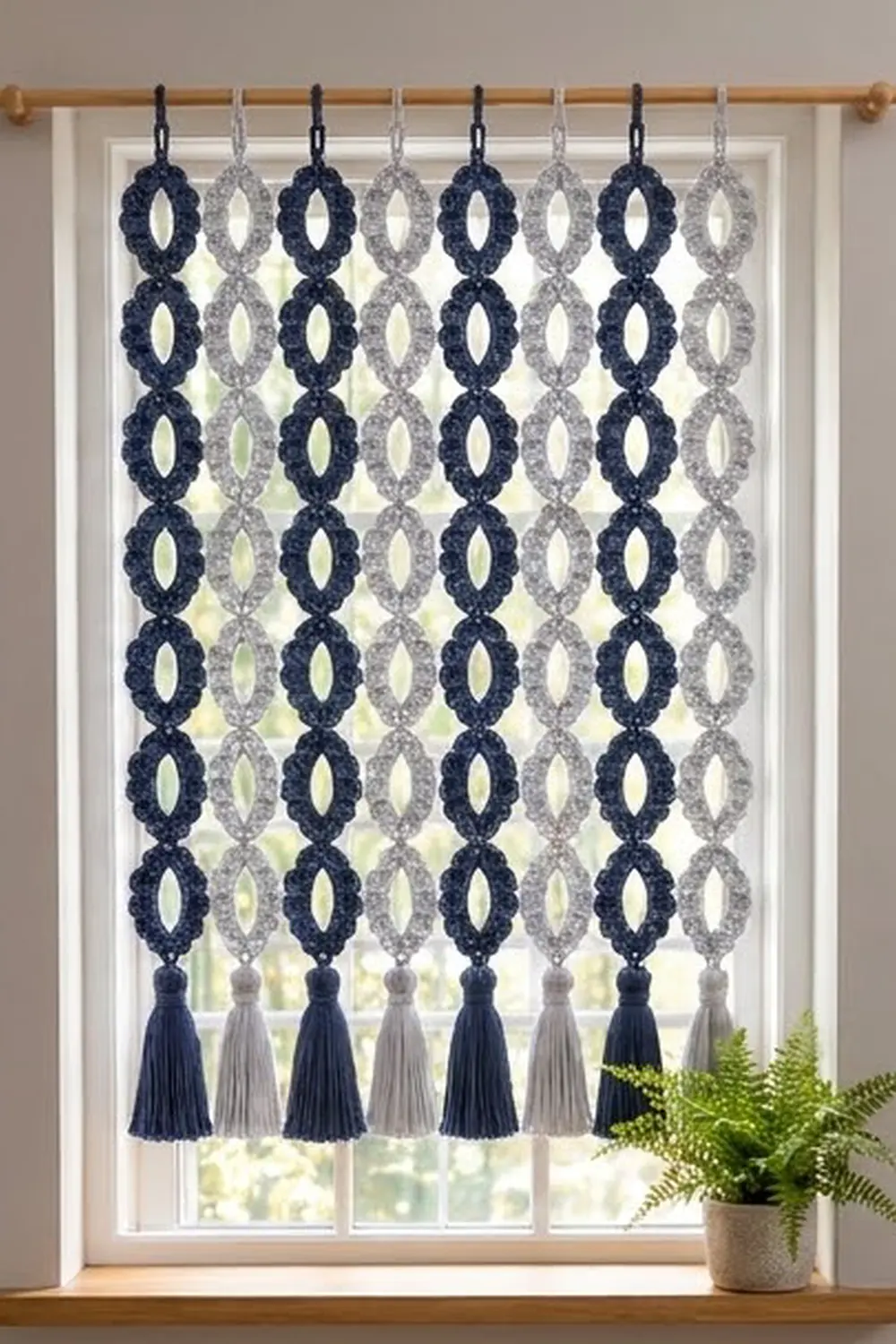
This version alternates deep navy and soft silver-gray strands across the curtain. Matching tassels finish each strand at the bottom, and a sturdy crocheted loop at the top slides over a curtain rod. The style is calm and coastal, and it suits both everyday decor and winter displays.
This pattern uses US crochet terms. One motif measures 3.5 in (8.9 cm) wide by 5 in (12.7 cm) tall, tip to tip. One finished strand is about 40.25 in (102.2 cm) long, including the hanging loop and tassel. Eight strands hung with 0.5 in (1.3 cm) gaps fill about 31.5 in (80.0 cm) of rod.
Construction is simple. Each motif is worked in the round in 3 rounds: a chain ring, a shaping round and a scallop round. Motifs are joined as you go at their pointed tips. A hanging loop and tassel finish each strand.
Finished Size and Construction
- Motif size: 3.5 in (8.9 cm) wide x 5 in (12.7 cm) tall
- Skill level: Easy to intermediate
- Terminology: US crochet terms
- Yarn weight: Worsted (#4), cotton or cotton blend
- Hook: 4.0 mm (G-6)
- Number of pieces: 56 motifs (28 navy, 28 gray), 8 tassels
- Layout: 8 strands x 7 motifs each, colors alternating by strand
- Strand body: 33.5 in (85.1 cm) long, 7 joined motifs
- Motif size before border (after Rnd 2): 2.25 in (5.7 cm) wide x 4.5 in (11.4 cm) tall
- Border depth: The scallop round adds about 5/8 in (1.6 cm) per side at the widest point and 0.25 in (0.6 cm) at each tip.
- Full strand: 40.25 in (102.2 cm), including a 2.25 in (5.7 cm) loop and a 4.5 in (11.4 cm) tassel
Materials
Yarn: Use a smooth, firmly twisted worsted-weight cotton. Cotton gives crisp scallops and hangs straight without stretching over time. Avoid fuzzy or very soft acrylics, because the fans lose their shape and the strands can grow longer.
- Navy (N): 100 g / 208 yd (190 m)
- Silver-gray (G): 100 g / 208 yd (190 m)
Each strand uses about 37 m (40 yd), including the tassel. These quantities include a margin of about 20% for gauge swatching and tassel trimming.
Tools:
- 4.0 mm (G-6) crochet hook
- Tapestry needle
- Scissors
- Stitch markers (2 per motif in progress)
- Stiff card cut to 4.5 in (11.4 cm) tall, for tassels
- Ruler or tape measure
- Blocking mat and rust-proof pins
- Curtain rod or tension rod, up to 1 in (2.5 cm) diameter
Abbreviations (US Terms)
- ch – chain
- sl st – slip stitch
- sc – single crochet
- hdc – half double crochet
- dc – double crochet
- sk – skip
- st(s) – stitch(es)
- sp – space
- rnd(s) – round(s)
- rep – repeat
Special stitches:
- Fan: Work 7 dc in the same stitch.
- Tip loop: (sc, ch 3, sc) worked in a ch-2 sp at a motif tip.
Gauge and Checkpoints
Gauge: 18 sc and 20 rows = 4 in (10.2 cm) in rows of sc.
Make one complete motif before starting production. Gauge errors multiply across 56 motifs, and a strand that is 1 in (2.5 cm) too long per motif ends up 7 in (17.8 cm) longer overall.
Checkpoints:
- After Rnd 1: Lay the ring flat as a pointed oval. It should measure 4 in (10.2 cm) tip to tip.
- After Rnd 2: 2.25 in (5.7 cm) wide x 4.5 in (11.4 cm) tall.
- After Rnd 3: 3.5 in (8.9 cm) wide x 5 in (12.7 cm) tall, including tip loops.
If your motif is too big, go down 0.5 mm in hook size. If it is too small, go up 0.5 mm. Fix Rnd 1 first, because every later round builds on it.
Motif Pattern
Make all motifs the same way. Motifs 2 through 7 of each strand change only the top tip loop, which is where they join to the previous motif (see Joining).
Foundation: Ch 40, then sl st in the first ch to form a ring. Make sure the chain is not twisted.
Rnd 1: Ch 1, then sc in each ch around. Join with sl st to the first sc. (40 sc)
Lay the ring flat. Place a marker in sc 1 (top tip) and in sc 21 (bottom tip). That leaves 19 sts on each side between the tips: sts 2–20 and sts 22–40.
Rnd 2 (shaping round): Ch 1.
- Top tip: Work (sc, ch 2, sc) in st 1.
- Side 1: Sc in the next 2 sts, hdc in the next 2 sts, dc in the next 11 sts, hdc in the next 2 sts, sc in the next 2 sts. (19 sts)
- Bottom tip: Work (sc, ch 2, sc) in st 21.
- Side 2: Rep the Side 1 sequence across sts 22–40. (19 sts)
- Join with sl st to the first sc.
This is a conversion round. 40 sts are worked 1 per existing stitch, and 2 extra sc are added (1 at each tip). (42 sts + 2 ch-2 sps)
The dc in the middle of each side push the edges outward while the sc stay short at the tips. That is what creates the almond shape with a point at each end.
Rnd 3 (scallop round): Sl st into the top ch-2 sp.
- Top tip: Ch 1, then work a tip loop in the same sp.
- Side 1: Sc in the next sc (the second sc of the tip). Sk 1 st, fan in the next st, sk 1 st, sc in the next st. Rep from * to * 4 more times, for 5 fans. The last sc lands in the first sc of the bottom tip.
- Bottom tip: Work a tip loop in the bottom ch-2 sp.
- Side 2: Sc in the next sc, then work [sk 1, fan, sk 1, sc] 5 times. The last sc lands in the first sc of the top tip.
- Join with sl st to the first sc and fasten off.
Per-side count: Each side, counted between the tip loops, has 6 sc + 5 fans (35 dc) = 41 sts. The 4 tip sc are counted separately.
Round total: (2 x 41) + 4 tip sc = 86 sts + 2 ch-3 loops
Why the math works: Each side of Rnd 2 offers 21 working stitches: 1 tip sc + 19 side sts + 1 tip sc. The pattern is 1 starting sc, then 5 repeats of 4 sts each, for 1 + 20 = 21. Each fan is centered over side sts 2, 6, 10, 14 and 18, so the middle fan sits exactly on the center dc (st 10). This keeps each side symmetrical.
Weave in tails of at least 6 in (15.2 cm) securely. Cotton tends to slip loose.
Make All Pieces
Motifs:
- Navy: 28 motifs (4 strands x 7)
- Gray: 28 motifs (4 strands x 7)
- Total: 56 motifs
Tassels: 4 navy and 4 gray.
Layout grid (columns are strands, left to right; rows are motifs, top to bottom):
        S1 S2 S3 S4 S5 S6 S7 S8
Loop     N  G  N  G  N  G  N  G
Row 1    N  G  N  G  N  G  N  G
Row 2    N  G  N  G  N  G  N  G
Row 3    N  G  N  G  N  G  N  G
Row 4    N  G  N  G  N  G  N  G
Row 5    N  G  N  G  N  G  N  G
Row 6    N  G  N  G  N  G  N  G
Row 7    N  G  N  G  N  G  N  G
Tassel   N  G  N  G  N  G  N  G
Each strand is a single color from loop to tassel.
Joining
Method: Join as you go at the tips. Strands are not joined to each other; they hang free from the rod.
- Work Motif 1 of a strand completely, with standard tip loops at both ends.
- Work Motif 2 through Rnd 2.
- On Rnd 3, replace the top tip loop with a joining tip: sl st into the top ch-2 sp, ch 1, and sc in the sp. Ch 1, then sl st into the bottom ch-3 loop of Motif 1. Ch 1, then sc in the same ch-2 sp of Motif 2. Finish Rnd 3 as written.
- Repeat for Motifs 3–7, each joined to the bottom loop of the motif above.
Stitch logic: The joining tip replaces ch 3 with ch 1 + sl st + ch 1. That is still 3 stitches’ worth of length, so the per-side count stays at 41 sts and the round total stays at 86 sts + 2 loops. No stitches are added at the seam.
Tension: Keep the joining sl st snug but not tight. A tight join pulls the motif tips into a pucker, and a loose one lets the strand twist. Before you work the sl st, hold the motifs so their tips point straight at each other.
Size checkpoint: Overlapping tip loops shorten each motif’s pitch to 4.75 in (12.1 cm). A 7-motif strand body measures 6 x 4.75 in + 5 in = 33.5 in (85.1 cm). Measure after Motif 3: three joined motifs should measure 14.5 in (36.8 cm).
Border: Hanging Loop and Tassel
A strand curtain has no outer frame. The motif scallop round (Rnd 3) acts as each motif’s border, and each strand is finished at the top with a loop and at the bottom with a tassel.
Border gauge: 24 sc worked around a ch-20 loop covers it snugly with no gaps. Chains measure about the same as sc at 18 sts per 4 in (10.2 cm), so ch 20 gives about 4.4 in (11.2 cm) around.
Hanging Loop (top of Motif 1):
- Join yarn with sl st in the top ch-3 loop of Motif 1.
- Ch 20, then sl st in the same ch-3 loop.
- Loop rnd: Ch 1, then work 24 sc around the ch-20 loop (not into the chains), 12 sc per side of the loop. Sl st into the ch-3 loop and fasten off. (24 sc)
Why the math works: Twenty-four sc over 20 chains is a 20% overfill. That is just enough to pack the loop firmly so it stays round instead of collapsing on the rod. The finished loop stands 2.25 in (5.7 cm) tall and fits a rod up to 1 in (2.5 cm) in diameter.
Tassel (bottom of Motif 7):
- Wrap yarn 30 times around the 4.5 in (11.4 cm) card.
- Thread an 8 in (20.3 cm) piece of yarn under the wraps at the top edge and tie tightly. Leave both ends long.
- Cut the wraps along the bottom edge and remove the card.
- Wrap a separate strand of yarn 6 times around the bundle, 0.5 in (1.3 cm) below the top, to form the neck. Tie it off and bury the ends inside the tassel.
- Use the long top ties to attach the tassel through the bottom ch-3 loop of Motif 7. Knot securely and bury the ends inside the tassel.
- Trim the ends evenly. The tassel should measure 4.5 in (11.4 cm) from the top of the head to the bottom.
Final Blocking
- Hand-wash or soak each strand in cool water for 10 minutes.
- Press out the water gently in a towel. Do not wring.
- Lay the strand flat on a blocking mat in a straight line.
- Pin each motif to 3.5 in (8.9 cm) wide x 5 in (12.7 cm) tall. Pin the two tips first, then the widest point of each side.
- Open each fan into an even rounded scallop with your fingers, and pin the center dc of each fan if needed.
- Check the strand body at 33.5 in (85.1 cm).
- Let it dry completely, then unpin.
- Steam the tassel lightly, then comb it straight and trim again if needed.
Final Quality-Control Checklist
- Every motif measures 3.5 x 5 in (8.9 x 12.7 cm).
- Every motif has 5 fans per side, and the middle fan is centered.
- Every side has 41 sts between the tip loops.
- All tip joins are snug and aligned, with no twists along the strand.
- Each strand body measures 33.5 in (85.1 cm).
- Hanging loops are 2.25 in (5.7 cm) tall and firmly packed with 24 sc.
- Tassels measure 4.5 in (11.4 cm) and are trimmed level.
- Colors alternate N, G, N, G… from left to right.
- All tails are woven in and trimmed.
Troubleshooting
Motif looks round, not pointed: The dc are probably creeping toward the tips. Recheck the Rnd 2 sequence: 2 sc, 2 hdc, 11 dc, 2 hdc, 2 sc.
Fans are uneven or one side is longer: You skipped the wrong number of stitches. Count 21 working sts per side before you start Rnd 3.
Scallops cup or ruffle: Your tension is too tight on the dc. Go up 0.5 mm in hook size for Rnd 3 only.
Strand twists when hung: One or more joins were made with a twisted motif. Undo the join, lay the motifs flat and rejoin.
Strands hang at different lengths: Measure each strand against the first one and block the longer or shorter ones to match.
Loop is too small for the rod: Increase to ch 24 and work 29 sc around it.
Tassel looks thin: Wrap 36 times instead of 30.
Care
Hand-wash in cool water with a mild detergent, then lay flat to dry and reshape the scallops while damp. Shake the strands gently and comb the tassels to refresh them between washes.
Final Notes
The measurement chain is short and reliable:
- Rnd 1 ring: 4 in (10.2 cm) tip to tip.
- Rnd 2: 2.25 x 4.5 in (5.7 x 11.4 cm).
- Rnd 3: 3.5 x 5 in (8.9 x 12.7 cm).
- Seven motifs joined at a 4.75 in (12.1 cm) pitch: a 33.5 in (85.1 cm) strand body.
- With the loop and tassel added: a 40.25 in (102.2 cm) strand.
- Eight strands spaced 0.5 in (1.3 cm) apart: 31.5 in (80.0 cm) of curtain.
Check your first motif against these numbers, and the rest of the curtain will follow.
Happy crocheting!