

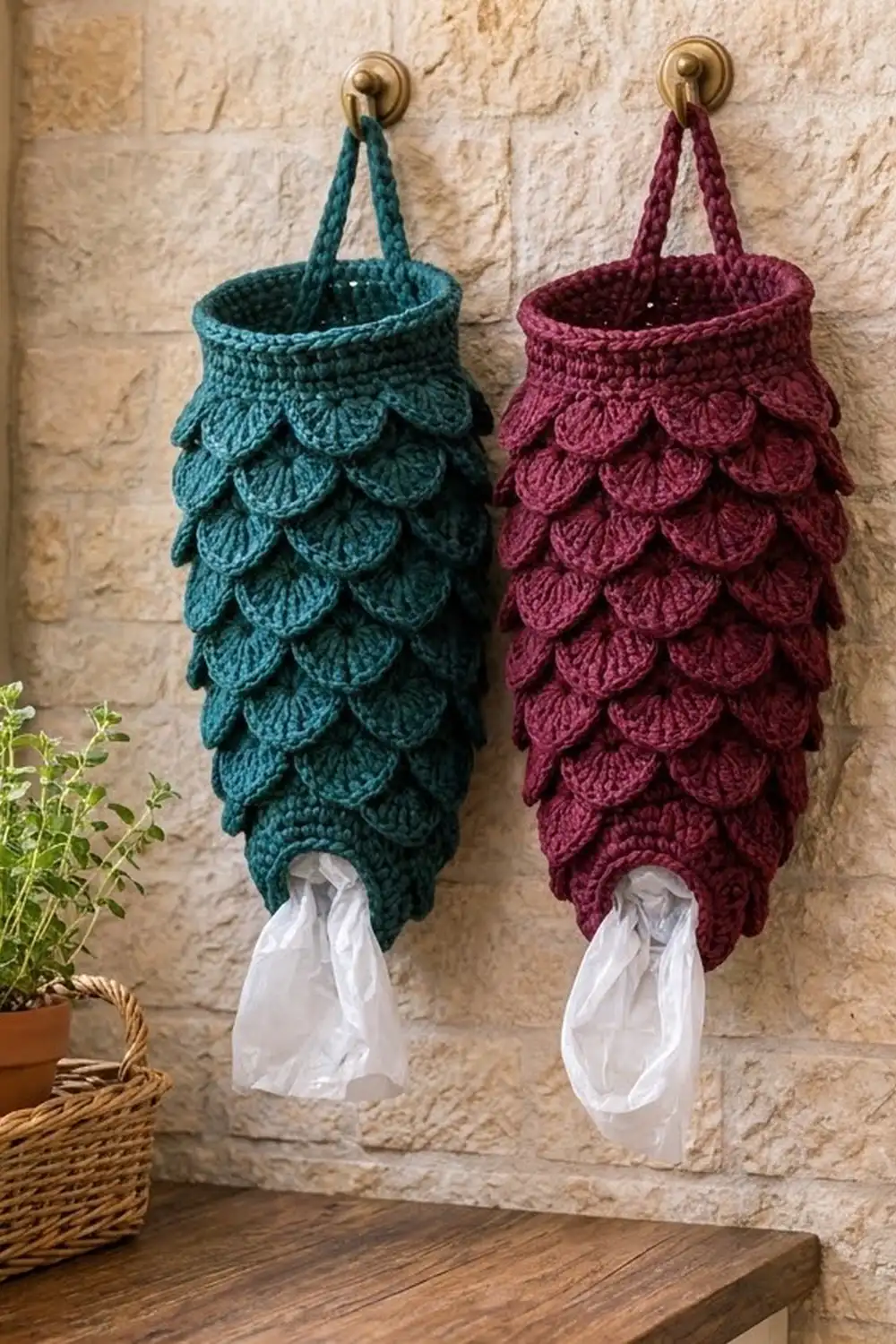
This plastic bag holder looks like a pinecone or a dragon’s tail. Rounds of overlapping crocodile-stitch scales cover a tapered tube. A plain single crochet band finishes the top, and a sturdy loop hangs it from a hook or knob. You push bags in through the top and pull them out one at a time through the small hole at the bottom.
The sample is worked in deep teal, and burgundy gives a warm, rich look. Any solid or semi-solid color works well, because a single color lets the scales show clearly. The style is cozy and slightly rustic, so it suits a kitchen, pantry door or laundry room.
The pattern uses US crochet terms. The finished holder is about 8 in (20.3 cm) wide at the top and 5 in (12.7 cm) wide at the bottom when laid flat. It is about 13 in (33.0 cm) tall, plus a hanging loop that rises about 3.5 in (8.9 cm).
You work the whole holder as one seamless piece from the bottom up. Start with a short single crochet collar for the bag opening. Then work 14 tiers of crocodile stitch, adding scales in the first few tiers to shape the cone. Next comes a conversion round that turns the scales back into single crochet. The top band and hanging strap are the “border” of this design.
Finished Size and Construction
- Finished size: 8 in (20.3 cm) wide at the top × 13 in (33.0 cm) tall, flat, without the loop
- Bottom opening: 10 in (25.4 cm) around, about 3.2 in (8.1 cm) across
- Skill level: Intermediate (crocodile stitch, working around posts)
- Terminology: US
- Yarn weight: Bulky (#5)
- Hook: 6.0 mm (US J-10)
- Number of pieces: 1
- Layout: Single seamless tube, worked in joined rounds
- Piece size: 16 in (40.6 cm) around at the top
- Size before border: 8 in (20.3 cm) wide × about 11.4 in (29.0 cm) tall
- Border depth: 1.75 in (4.4 cm) top band, plus the hanging loop
Materials
Yarn: Use a smooth bulky yarn of about 120 m (131 yd) per 100 g. Acrylic or an acrylic-wool blend is a good choice. It holds the scales’ shape, puts up with daily handling and washes easily. Avoid very fuzzy yarns, because they hide the scale edges.
- Main color (choose one): Deep Teal or Burgundy, 250 g / 300 m (328 yd)
Crocodile stitch uses much more yarn than plain fabric, so don’t skimp. These quantities include a margin of about 15 percent.
Tools:
– 6.0 mm (US J-10) crochet hook
– 4 stitch markers
– Yarn needle
– Scissors
– Measuring tape
– Spray bottle or steam iron, for blocking
Abbreviations (US Terms)
- ch – chain
- sl st – slip stitch
- sc – single crochet
- dc – double crochet
- sk – skip
- sp – space
- st(s) – stitch(es)
- rnd – round
Special stitches:
- V-pair: 2 dc worked into the same stitch or space.
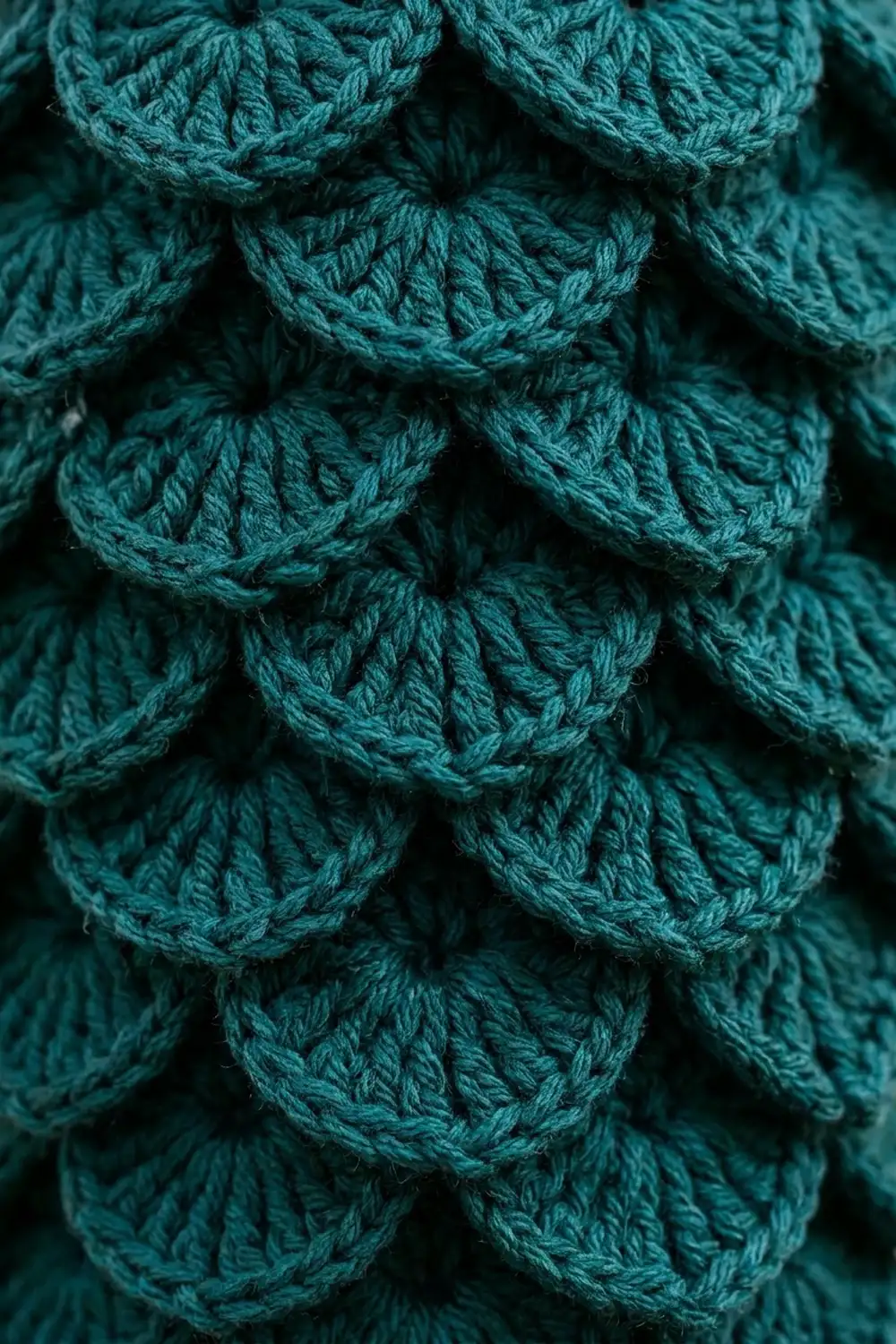
- Scale: This is worked over one V-pair. Turn the work slightly so the V-pair lies sideways. Work 5 dc around the post of the first dc of the pair, from top to bottom. Ch 1, then work 5 dc around the post of the second dc, from bottom to top. That makes 10 dc and 1 ch-1 tip space, forming a fan that hangs down over the round below.
- Anchor: A sl st worked between the 2 dc of a skipped V-pair. It holds the gap between two scales.
Gauge and Checkpoints
Gauge: 12 sc × 14 rnds = 4 in (10.2 cm) in sc worked in the round.
Scale gauge: One scale is 2 in (5.1 cm) wide. One tier (base round plus scale round) adds about 0.75 in (1.9 cm) of height.
Test the stitch before you start the holder. Ch 18, work 4 rows of sc, then work one base row and one scale row. The 3 scales should measure 6 in (15.2 cm) across.
Checkpoints:
– After Rnd 3 (collar): 5 in (12.7 cm) flat, 10 in (25.4 cm) around
– After Rnd 11 (shaping done): about 3.9 in (9.9 cm) tall, 8 in (20.3 cm) wide flat
– After Rnd 31 (all scales): about 11.4 in (29.0 cm) tall
– After Rnd 37 (top band): about 13 in (33.0 cm) tall, still 8 in (20.3 cm) wide
If your piece is too big, go down to a 5.5 mm (US I-9) hook. If it’s too small, go up to a 6.5 mm (US K-10.5) hook. A collar that is 0.5 in (1.3 cm) off in flat width makes the top about 0.8 in (2.0 cm) off. Fix gauge at the collar.
Pattern
Bottom Collar
Ch 30 and join with a sl st to the first ch to form a ring, taking care not to twist the chain.
Rnd 1: Ch 1, sc in each ch around, join to first sc. (30 sc)
Rnds 2–3: Ch 1, sc in each st around, join. (30 sc)
The collar measures 5 in (12.7 cm) flat and about 0.9 in (2.3 cm) tall. This edge forms the bag opening.
Tier 1 – 5 Scales
Rnd 4 (base round): Ch 3 (counts as dc), dc in the same st (first V-pair). Ch 1, sk 2. 2 dc in the next st, ch 1, sk 2; repeat from * around. Join to the top of the ch-3. (10 V-pairs, 10 ch-1 sps)
Rnd 5 (scale round): Sl st between the ch-3 and the dc of the first V-pair (anchor). Work a Scale over the next V-pair, then anchor in the next V-pair. Repeat from * around; the last anchor is the starting sl st. (5 scales, 5 anchors)
The ch-3 pair is always an anchored pair, so you never work a scale around a turning chain.
Shaping Tiers 2–4
Each base round from here on is worked into the scales of the round below. Work 1 V-pair into each scale’s ch-1 tip (a tip pair) and 1 V-pair into each anchor (a gap pair).
Increase gap: Some base rounds have increase gaps. In an increase gap, work 3 V-pairs instead of 1:
– 2 dc in the ch-1 sp of the old base round just before the anchor, ch 1
– 2 dc in the anchor, ch 1
– 2 dc in the ch-1 sp just after the anchor
Each increase gap adds 2 V-pairs, which makes 1 extra scale on the next scale round.
To start every base round: Sl st in each of the first 5 dc of the next scale and into its ch-1 tip. Ch 3 (counts as dc) and dc in the same tip (first tip pair).
Rnd 6 (base, 1 increase): Start as above. Ch 1, V-pair in the next anchor, ch 1, V-pair in the next tip; repeat around. Make the 1st anchor an increase gap. End with ch 1, V-pair in the last anchor, ch 1, join to the top of the ch-3.
Count: 5 tip pairs + 4 gap pairs + 3 increase-gap pairs = 12 V-pairs
Rnd 7 (scale): Anchor in the first (ch-3) pair, Scale over the next pair, anchor in the next pair; repeat around. (6 scales)
Rnd 8 (base, 1 increase): Work as Rnd 6, making the 4th anchor an increase gap.
Count: 6 + 5 + 3 = 14 V-pairs
Rnd 9 (scale): Work as Rnd 7. (7 scales)
Rnd 10 (base, 1 increase): Work as Rnd 6, making the 2nd anchor an increase gap.
Count: 7 + 6 + 3 = 16 V-pairs
Rnd 11 (scale): Work as Rnd 7. (8 scales)
Spreading the increases out keeps the cone round, not lopsided. In an increase gap, the outer two pairs get scales and the middle pair is anchored, so the scale/anchor pattern carries on unbroken.
Checkpoint: 8 in (20.3 cm) wide flat across the top of the scales, about 3.9 in (9.9 cm) tall.
Straight Tiers 5–14
Rnd 12 (base): Work as Rnd 6 with no increase gaps. (8 tip pairs + 8 gap pairs = 16 V-pairs)
Rnd 13 (scale): Work as Rnd 7. (8 scales)
Rnds 14–31: Repeat Rnds 12–13 nine more times, for 14 tiers in total. (16 V-pairs on each base round, 8 scales on each scale round)
The scales fall into a brick pattern. Each new scale sits over the anchor gap between two scales of the round below.
Checkpoint: about 11.4 in (29.0 cm) tall, 8 in (20.3 cm) wide flat.
Border: Top Band and Hanging Loop
Border gauge: 3 sc per inch (1.2 sc per cm), the same as the body gauge.
Top Band
Rnd 32 (conversion round): Sl st in each of the first 5 dc of the next scale and into its ch-1 tip. Ch 1. 3 sc in the tip, 3 sc in the next anchor; repeat around and join to the first sc.
Count: 16 points (8 tips + 8 anchors) × 1 sc = 16 sc, plus 2 extra sc at each of the 16 points = 32 sc. Total 48 sc.
Rnds 33–37: Ch 1, sc in each st around, join. (48 sc)
Fasten off and weave in the end. Then lay the holder flat with the joining seam at one side fold. Mark the sts so that sts 1–24 run across the front and sts 25–48 across the back.
Counts per side: 24 sc across the front and 24 sc across the back. Each side holds exactly 4 scales.
Why the math works: One scale takes up 6 sts of width (2 in / 5.1 cm). That’s 3 sc over its tip and 3 sc over the gap next to it. Eight scales × 6 sts = 48 sc, which is 16 in (40.6 cm) around and 8 in (20.3 cm) flat. That matches the width of the scale section, so the band sits straight without flaring or pulling in.
Hanging Loop
Row 1: Join yarn in back st 31. Ch 1, sc in sts 31–34, turn. (4 sc)
Rows 2–28: Ch 1, sc in each st across, turn. (4 sc)
The strap is about 8 in (20.3 cm) long and 1.25 in (3.2 cm) wide.
To attach: Bring the strap over in an arch without twisting it. Hold the last row against back sts 39–42 from the inside and sl st through both layers. (4 sl sts)
That leaves 4 sts (35–38) between the two legs, so the loop is centered on the back and rises about 3.5 in (8.9 cm). Fasten off and weave in the end securely through the band.
Final Blocking
- Weave in all ends along the posts of the scales or inside the band.
- Stuff the holder loosely with a rolled towel so it keeps its cone shape.
- Lightly mist the scales with water. For acrylic, hold a steam iron about 1 in (2.5 cm) above the fabric instead, and never press.
- With your fingers, curve each scale gently outward and downward so it overlaps the one below.
- Pat the top band smooth and check that it’s 8 in (20.3 cm) wide flat.
- Straighten the hanging loop and pin it upright if needed.
- Let it dry completely, at least 8 hours, before taking out the towel.
Final Quality-Control Checklist
- Bottom collar is 10 in (25.4 cm) around and opens easily
- Every round of scales has the correct count: 5, 6, 7, 8, then 8 to the top
- Scales are offset like bricks with no stacked columns
- No scale is worked around a ch-3
- Top band has 48 sc and is 8 in (20.3 cm) wide flat
- Loop legs are 4 sts apart and centered on the back
- Total height is about 13 in (33.0 cm) without the loop
- All ends are hidden and secure
Troubleshooting
Scales curl up instead of hanging down: You may be working from bottom to top on the first post. Always go down the first dc and up the second.
Scale count is wrong: Count V-pairs on the base round before you start the scales. Base rounds have 10, 12, 14, 16 pairs, then 16 every time.
Holes at the increase gaps: Work the flanking pairs snugly, and keep the ch-1 between pairs firm.
Top band flares: Your conversion round is too loose. Try working it with a hook one size smaller.
Top band pulls in: Make sure you put 3 sc in every anchor, not 2.
Bags won’t come out: The collar is too tight. Redo it with a loose chain, or use a larger hook for the collar only.
Loop stretches: Add 1 more row to make it thicker, or line it with a ribbon.
Care
Machine wash cold on a gentle cycle in a laundry bag, then reshape and lay flat to dry. Keep it away from the dryer so the scales keep their shape.
Final Notes
Everything depends on gauge. Twelve sc per 4 in (10.2 cm) makes a 30-st collar 5 in (12.7 cm) wide flat. Three increase tiers take it from 5 to 8 scales of 2 in (5.1 cm) each, for 16 in (40.6 cm) around. The 48-sc band matches that exactly, and the strap is centered on the back 24 sts. Check each step and the holder will come out straight, snug and ready to hang.
Happy crocheting!