

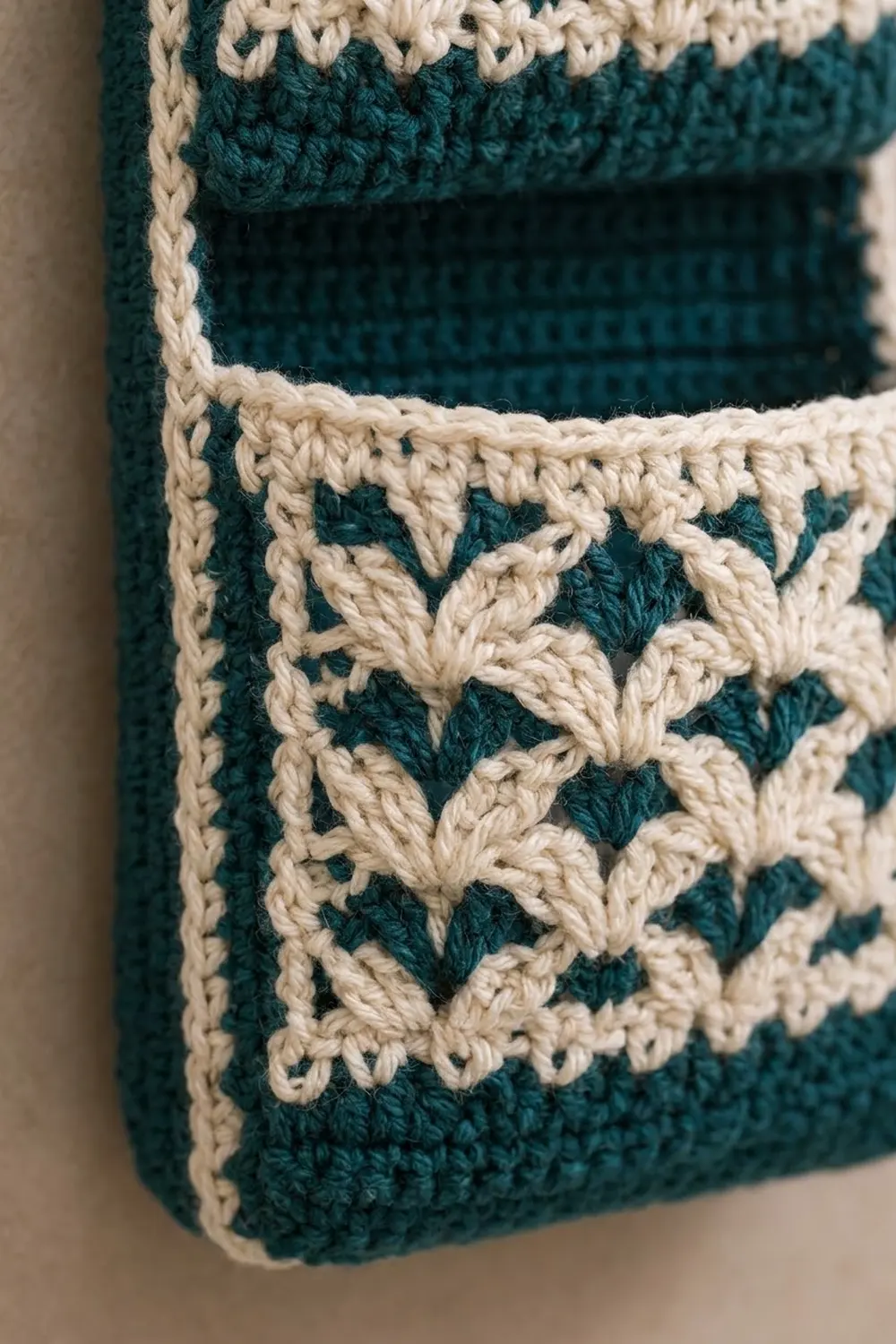
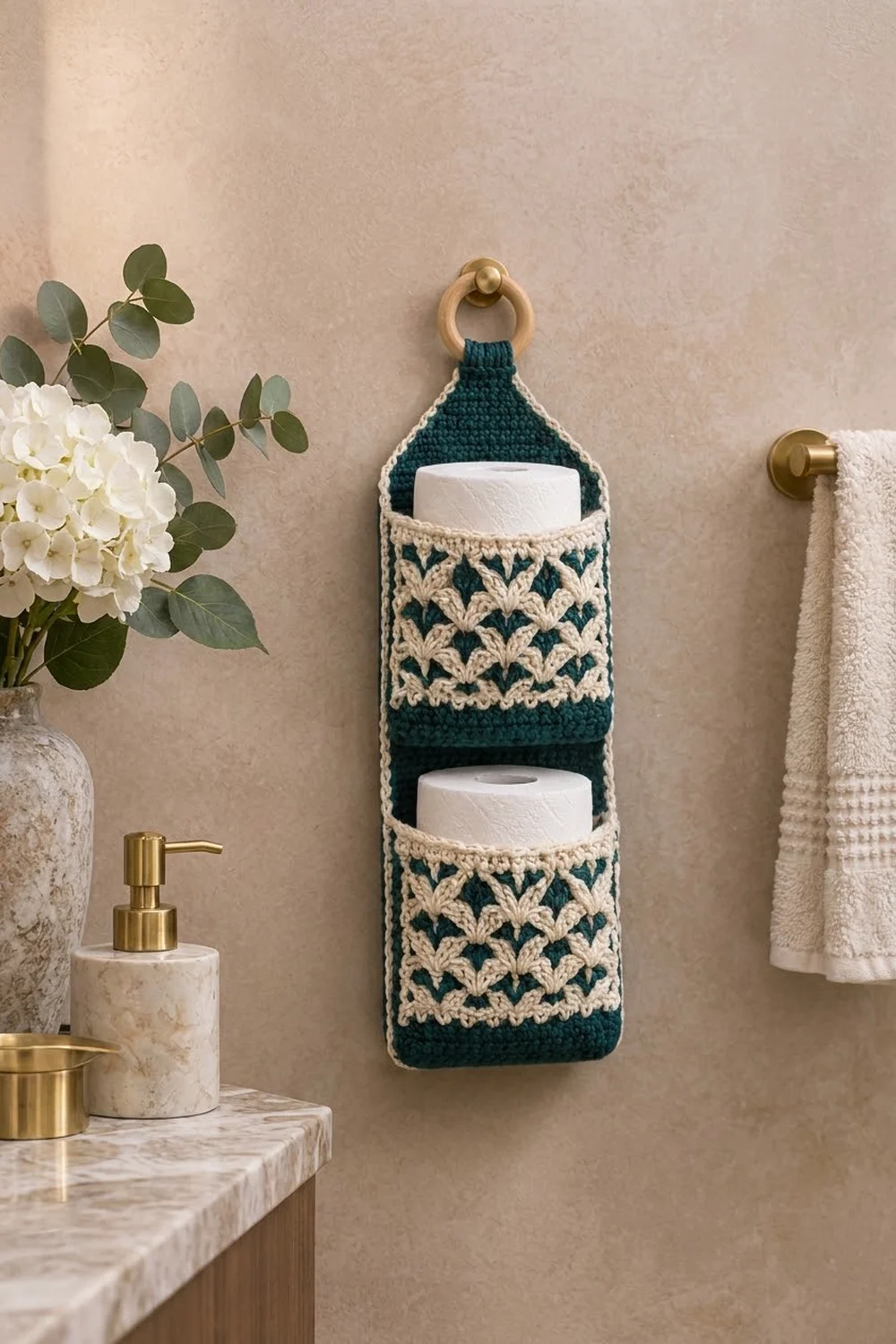
The Teal Fan Tower is a slim wall organizer that holds two spare toilet paper rolls. A deep teal back panel hangs from a wooden ring, and two lacy pockets sit one above the other on its front. Each pocket is worked in cream and teal shells that lock together into a diamond pattern.
A rope-like cream reverse single crochet edge frames the panel from the base of the hanging tab, down both sides and across the bottom. The tab stays plain teal so the ring stands out. The colors are calm and suit a spa-style bathroom, and the stitch pattern gives the piece a classic look.
This pattern uses US crochet terms. The finished holder is 6.5 in (16.5 cm) wide and hangs 22.25 in (56.5 cm) from the top of the ring loop to the bottom edge.
You make three pieces: one back panel worked in rows of single crochet, then two pockets worked flat in two-color shell rows. You add a two-row border to the panel, sew on the pockets with boxed bottom corners so they hold a full roll, and wrap the tab around the ring.
Finished Size and Construction
- Finished size: 6.5 in (16.5 cm) wide x 22.25 in (56.5 cm) hanging length
- Skill level: Easy-intermediate
- Terminology: US crochet terms
- Yarn weight: Worsted (#4)
- Hook: 4.5 mm (US 7)
- Number of pieces: 3 (1 back panel, 2 pockets)
- Layout: Pockets stacked vertically on the panel front
- Pocket size (flat): about 10 in (25.4 cm) wide x 3.75 in (9.5 cm) tall
- Panel size before border: 6 in (15.2 cm) wide x 20 in (50.8 cm) long, plus a 4 in (10.2 cm) tab
- Border depth: 0.25 in (0.6 cm) per edge
Materials
Use a smooth worsted-weight cotton or cotton blend so the shells look crisp and the panel holds its shape. Acrylic also works but gives a softer, stretchier panel. The quantities below assume about 200 m per 100 g.
- Teal (Color A): 110 g, about 220 m
- Cream (Color B): 70 g, about 140 m
Both quantities include a margin of about 15% for swatching and tails.
Tools:
– 4.5 mm (US 7) crochet hook
– Wooden ring, 2 in (5.1 cm) across
– Tapestry needle
– Locking stitch markers or pins
– Measuring tape
– Blocking mat and rustproof pins
– Spray bottle
Abbreviations (US Terms)
- ch – chain
- sc – single crochet
- dc – double crochet
- sc2tog – single crochet 2 together
- st(s) – stitch(es)
- sk – skip
- RS / WS – right side / wrong side
- tch – turning chain
Special stitches:
– Shell: 5 dc in the same stitch.
– Half shell: at the row start, ch 3 (counts as dc) and 2 dc in the same stitch (3 sts); at the row end, 3 dc in the same stitch.
– Reverse sc (rev sc): without turning, work from left to right. Insert the hook in the next stitch to the right, yarn over, pull up a loop, yarn over and pull through both loops.
Gauge and Checkpoints
- Panel (sc): 16 sc x 18 rows = 4 in (10.2 cm).
- Pocket shells: 4 shell repeats (24 sts) = 5 in (12.7 cm), and Rows 1–9 = 3.75 in (9.5 cm).
Make one pocket first. It works as your gauge swatch and is part of the finished project.
Checkpoints:
– Pocket after Row 9: 10 in (25.4 cm) wide, 3.75 in (9.5 cm) tall.
– Panel after Row 36: 6 in (15.2 cm) wide, 8 in (20.3 cm) tall.
– Panel after Row 72: 16 in (40.6 cm) tall.
– Panel after Row 90: 20 in (50.8 cm) tall, top 1.5 in (3.8 cm) wide.
If your piece is more than 0.25 in (0.6 cm) too big, go down 0.5 mm in hook size. If it is too small, go up 0.5 mm. For the pocket, width matters more than height, because the pocket has to wrap around the roll.
Back Panel
Use Color A (teal).
Foundation: Ch 25.
Row 1 (RS): Sc in the 2nd ch from the hook and in each ch across. Turn. (24 sc)
Rows 2–72: Ch 1, sc in each st across. Turn. (24 sc)
Checkpoint: 16 in (40.6 cm) tall. Place a marker at each end of Row 72.
Taper
Row 73: Ch 1, sc2tog, sc in each st to the last 2 sts, sc2tog. Turn. (22 sc)
Row 74: Ch 1, sc in each st across. Turn. (22 sc)
Rows 75–90: Repeat Rows 73–74 eight more times. The stitch count drops by 2 on every odd row: 20, 18, 16, 14, 12, 10, 8, 6. (6 sc after Row 90)
That is 9 decrease rows in total, removing 18 sts. The taper is 4 in (10.2 cm) tall.
Tab
Rows 91–108: Ch 1, sc in each st across. Turn. (6 sc)
Fasten off and leave a 12 in (30.5 cm) tail for sewing. The tab is 1.5 in (3.8 cm) wide and 4 in (10.2 cm) long.
Pocket (Make 2)
The pocket is worked flat. Because each row changes color, fasten off at the end of every shell row and leave 4 in (10.2 cm) tails. The tails are hidden inside the side seams later.
Foundation: With Color A (teal), ch 50.
Row 1 (WS): Sc in the 2nd ch from the hook and in each ch across. Turn. (49 sc)
Row 2: Ch 1, sc in each st across. (49 sc) Fasten off.
Row 3 (cream fan row): Join Color B. Ch 1, sc in the first st, *sk 2, shell in the next st, sk 2, sc in the next st; repeat from * 7 more times. Fasten off. (8 shells + 9 sc = 49 sts)
Row 4 (teal fan row): Join Color A in the last st. Work a half shell in the first sc. *Sc in the center dc of the next shell, shell in the next sc; repeat from * 6 more times. Sc in the center dc of the last shell, then 3 dc in the last sc. Fasten off. (3 + 7 x 6 + 1 + 3 = 49 sts)
Row 5 (cream fan row): Join Color B. Ch 1, sc in the first st. *Shell in the next sc, sc in the center dc of the next shell; repeat from * 6 more times. Shell in the next sc, sc in the top of the tch. Fasten off. (1 + 7 x 6 + 5 + 1 = 49 sts)
Row 6: With Color A, repeat Row 4. (49 sts)
Row 7: With Color B, repeat Row 5. (49 sts)
Row 8: With Color A, repeat Row 4. (49 sts)
Row 9 (cream top band): Join Color B. Ch 1, sc in each st across, including the top of the tch. (49 sc) Fasten off.
The teal shells sit between the cream shells and create the diamonds. Checkpoint: 10 in (25.4 cm) x 3.75 in (9.5 cm).
Make All Pieces
| Piece | Qty | Colors |
|---|---|---|
| Back panel | 1 | Color A only |
| 2 | A: Rows 1–2, 4, 6, 8. B: Rows 3, 5, 7, 9 |
Layout (front view, top to bottom):
      [ring]
       [tab]
     /taper \
   |  panel  |
   | POCKET 1|  panel Rows 37–53
   |  panel  |
   | POCKET 2|  panel Rows 1–17
   +---------+
Joining
Finish the border (next section) before you sew on the pockets, so the pocket edges sit just inside the cream frame.
Method: Whipstitch with Color B, working through the outer loops of the pocket edge and into the edge stitches of the panel just inside the border. The cream thread forms a fine outline along the sides of each pocket.
Lower pocket:
1. Count the pocket’s foundation loops: sts 1–12, center sts 13–37, sts 38–49.
2. Pin the 25 center sts along the 24 foundation sts of the panel. The extra stitch is spread out as ease.
3. Pin each pocket side edge (9 row-ends) to panel Rows 1–17 on the same side. Pin the top and bottom first, then ease the row-ends in between. Shell rows cover about 2 panel rows each, and sc rows cover about 1.
4. Whipstitch the center bottom, then both sides.
5. Boxed corners: At each bottom corner, sts 1–12 (or 38–49) form a loose flap. Fold it in half so the first 6 sts lie against the second 6 sts, and whipstitch them together. This turns the extra width into a corner gusset, so the pocket curves out to hold a roll.
Upper pocket: Repeat the same steps. Sew the bottom across the face of panel Row 37, going through the front loops, and sew the sides to Rows 37–53.
Tension: Make each whipstitch snug, but don’t pull so hard that the panel puckers. After each 2 in (5.1 cm) of seam, lay the piece flat and check that the panel edge is still straight.
Size checkpoint: The tops of the pockets sit about 3.75 in (9.5 cm) and 11.75 in (29.8 cm) above the panel’s bottom edge. When empty, each pocket stands out from the panel by about 0.75 in (1.9 cm) at the top.
Border
The border is worked on the panel only, as two rows around the shaped edge. It starts and ends at the base of the tab, so the tab stays teal.
Border gauge: Along the side edges, the sc spacing matches the row gauge of 18 sc = 4 in (10.2 cm). Along the bottom edge, it matches the stitch gauge of 16 sc = 4 in (10.2 cm).
Border Row 1: With RS facing, join Color B at the right-hand row-end of Row 90. Ch 1, then work these sides in order:
– Right taper: 1 sc in each row-end from Row 90 down to Row 73, with 2 sc in the row-ends of Rows 81 and 73. (20 sc)
– Right side: 1 sc in each row-end from Row 72 down to Row 1. (72 sc)
– Bottom: 3 sc in the first foundation loop, 1 sc in each of the next 22 loops, 3 sc in the last loop. (28 sc, including both corners)
– Left side: 1 sc in each row-end from Row 1 up to Row 72. (72 sc)
– Left taper: 1 sc in each row-end from Row 73 up to Row 90, with 2 sc in the row-ends of Rows 73 and 81. (20 sc)
Total: 20 + 72 + 28 + 72 + 20 = 212 sc.
Border Row 2: Do not turn. Ch 1, then work rev sc in each sc back to the start. (212 rev sc) Fasten off, then weave the end into the tab base.
Why the math works:
– On the straight sides, 72 rows at 18 rows per 4 in give 16 in (40.6 cm). The 72 sc worked at the same spacing lie flat.
– Each taper edge runs diagonally: it rises 4 in (10.2 cm) and moves 9 sts inward. That diagonal is longer than 4 in, so the 2 extra sc per taper stop the edge from pulling tight.
– Along the bottom, 22 sc plus 2 corner stitches match the 24 foundation loops. The 2 extra sc at each corner let the border turn the corner without cupping.
– Reverse sc is worked 1 per sc, so Row 2 adds texture but no width.
– The two rows add 0.25 in (0.6 cm) per edge: 6 in + 0.25 in + 0.25 in = 6.5 in (16.5 cm).
Final Blocking
- Weave in all remaining tails along the seams.
- Pin the panel face down to a 6.5 in (16.5 cm) width. Measure 20.25 in (51.4 cm) from the bottom border to the top of Row 90.
- Spray it until damp. Don’t soak it, so the seams don’t stretch.
- Smooth each taper edge into a straight line and pin it.
- Turn the piece face up. Gently stuff each pocket with a roll wrapped in a plastic bag, so the pocket dries in a rounded shape.
- Let it dry completely, at least 12 hours.
- Pass the tab through the ring from front to back. Fold it at Row 99, so Rows 100–108 lie behind Rows 91–99. Sew Row 108 to the WS of Row 91 with the teal tail, then add a second line of stitches for strength.
Final Quality-Control Checklist
- Panel is 6.5 in (16.5 cm) wide along its full length.
- Hanging length is 22.25 in (56.5 cm).
- Border Row 1 has 212 sc and Border Row 2 has 212 rev sc.
- Each pocket row has 49 sts, and the shells are centered and stacked in the same columns.
- Boxed corners are closed and symmetrical.
- Pocket tops are level, and the gap between the two pockets is equal on both sides.
- Tab seam is secure and the ring is centered.
- No tails show on the RS.
Troubleshooting
- Pocket too narrow for a roll: Your shell gauge is too tight. Go up one hook size and remake the pocket.
- Shells ruffle: Check that you skip 2 sts on each side of every shell in Row 3.
- Count drifts from 49: Make sure the ch-3 at the start of teal rows counts as a stitch, and that you work into the tch at the end of cream rows.
- Border waves on the sides: Go down a hook size for the border only.
- Taper edge pulls inward: Add 1 more sc in the row-end of Row 77, then subtract it in Row 2 by skipping 1 sc.
- Holder twists on the wall: Check that the tab fold is square and the ring is centered.
Care
Hand wash in cool water and lay flat to dry, reshaping the pockets over a roll. Don’t hang it while wet, because the weight can stretch the tab.
Final Notes
Every measurement builds on the one before. The 16 sc x 18 rows gauge gives a 6 in (15.2 cm) by 16 in (40.6 cm) panel body. The 9 decrease rows add a 4 in (10.2 cm) taper, and the 1.5 in (3.8 cm) tab finishes the top. The 212-stitch border brings the width to 6.5 in (16.5 cm). Each 49-stitch pocket is 10 in (25.4 cm) wide flat, and the boxed corners shape it around a roll. Check your gauge first and count every row, and the holder will hang straight.
Happy crocheting!