

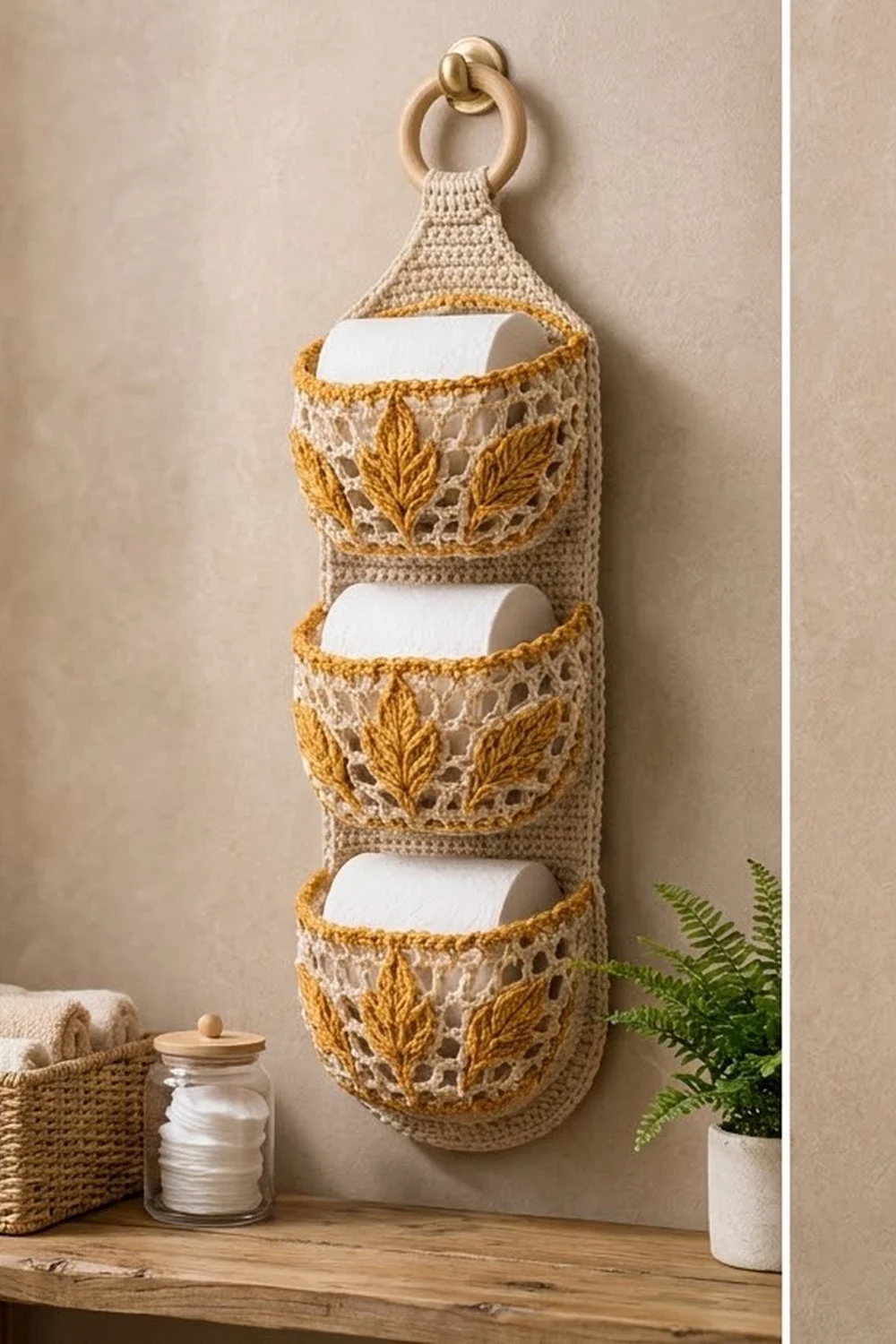
The Golden Leaf holder is a wall-hanging bathroom organizer with three pockets. Each pocket holds one standard toilet roll. A solid beige back panel carries three lacy oval baskets stacked one above the other, and the whole piece hangs from a wooden ring.
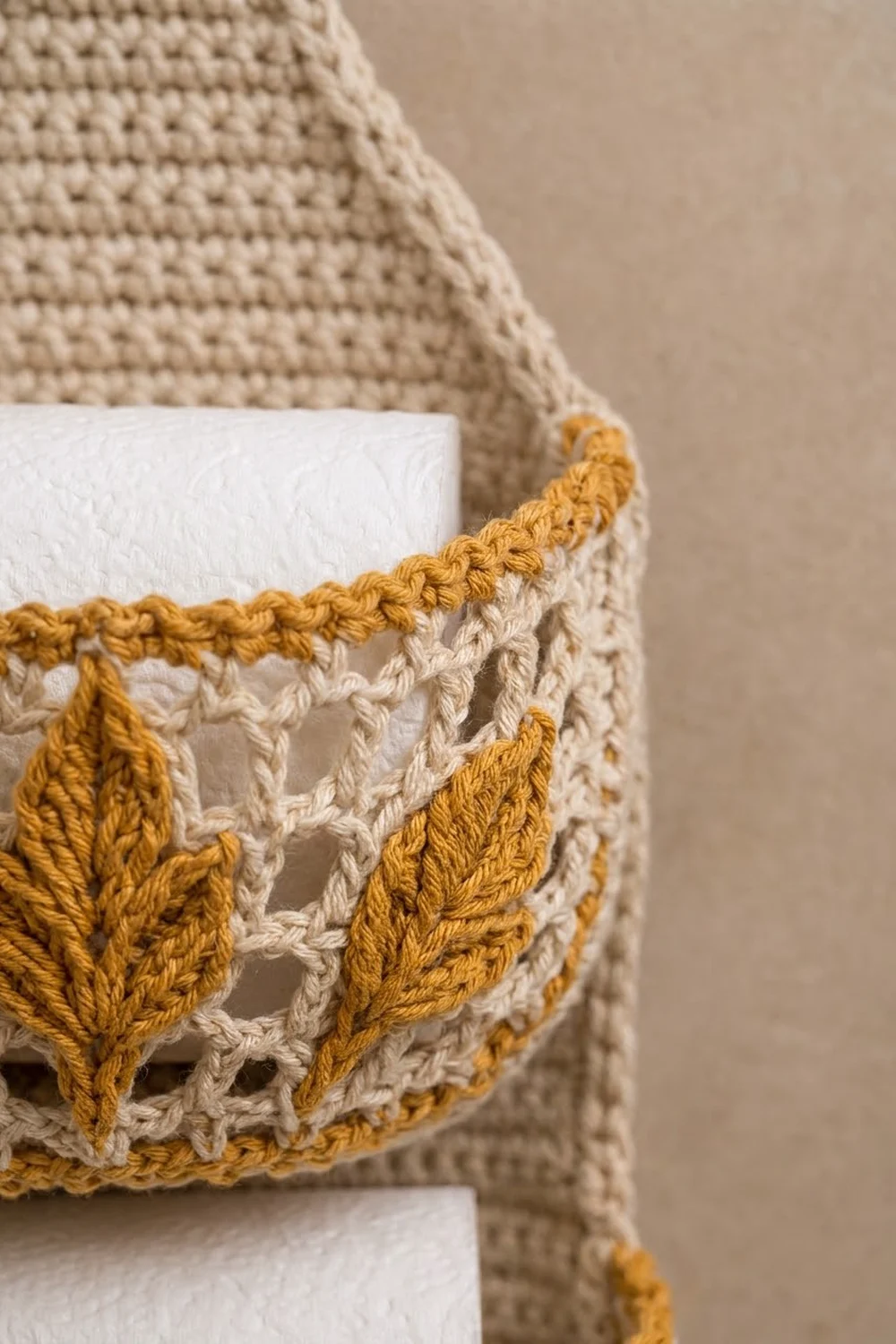
The palette is soft and warm. The panel and mesh are oatmeal beige, and mustard gold is used for the rims, the base ridges and the leaf appliqués. It suits a neutral, spa-style bathroom and looks good next to brass fixtures.
This pattern uses US crochet terms. The finished holder measures 7.5 in (19.1 cm) wide by 18.5 in (47.0 cm) long, not counting the ring.
Construction is simple. You crochet the panel flat from the bottom up, make three oval pockets in the round, and make nine small leaves. You then sew the leaves to the pockets and the pockets to the panel. After that you add a one-round border to the panel and fold the strap over the ring.
Finished Size and Construction
- Finished size: 7.5 in × 18.5 in (19.1 cm × 47.0 cm), excluding ring
- Skill level: Intermediate
- Terminology: US
- Yarn weight: Worsted (#4), cotton or cotton blend
- Hook: 4.5 mm (US 7)
- Number of pieces: 13 (1 back panel, 3 pockets, 9 leaves)
- Layout: 3 pockets in a single vertical column
- Pocket size: base 6.5 in × 2 in (16.5 cm × 5.1 cm); walls 3.75 in (9.5 cm) tall
- Panel size before border: 7 in × 18.25 in (17.8 cm × 46.4 cm) with strap folded
- Border depth: 0.25 in (0.6 cm), 1 round
Materials
Use a smooth mercerized or matte cotton. It holds its shape, washes well and takes humidity better than acrylic. The yields below assume about 190 m per 100 g.
- Color A, oatmeal beige: 250 g (475 m), for the panel, pocket bases, mesh and border
- Color B, mustard gold: 60 g (114 m), for the base ridges, rims, rope edges and leaves
Tools:
- 4.5 mm (US 7) hook
- Wooden ring, 2 in (5.1 cm) inner diameter
- Tapestry needle
- Locking stitch markers (at least 12)
- Rust-proof pins
- Measuring tape
The yarn quantities include a margin of about 15 percent for your gauge swatch and any tension differences.
Abbreviations (US Terms)
- ch – chain
- sl st – slip stitch
- sc – single crochet
- hdc – half double crochet
- dc – double crochet
- sc2tog – single crochet 2 together
- BLO – back loop only
- sp – space
- st(s) – stitch(es)
- rnd – round
Special stitch – reverse sc (crab stitch): Work from left to right (right-handers). Insert the hook into the next stitch to the right, yarn over, pull up a loop, then yarn over and pull through both loops. This makes the twisted rope edge on each pocket rim.
Gauge and Checkpoints
Gauge: 16 sc and 18 rows = 4 in (10.2 cm) in sc worked flat.
Before starting the panel, make one complete pocket as your test piece. It uses every stitch in the pattern and shows right away whether a toilet roll fits.
Checkpoints:
- Pocket base after Rnd 4: 6.5 in × 2 in (16.5 cm × 5.1 cm).
- Pocket wall after Rnd 14: 3.75 in (9.5 cm) tall from the base ridge.
- Panel after Row 7: 28 sts measure 7 in (17.8 cm) wide.
- Panel after Row 63: 14 in (35.6 cm) tall.
- Panel after Row 73: 16.25 in (41.3 cm) tall, with 8 sts measuring 2 in (5.1 cm).
Too big? Go down 0.5 mm. Too small? Go up 0.5 mm. If the pocket base is the right size but the walls flare too much, crochet the ch-3 loops tighter. Don’t change the stitch counts.
Back Panel
Use Color A. Work in rows. Ch 1 at the start of each row does not count as a stitch.
Row 1: Ch 17, sc in 2nd ch from hook and in each ch across, turn. (16 sc)
Row 2: Ch 1, 2 sc in first st, sc in next 14, 2 sc in last st, turn. (18 sc)
Rows 3–7: Repeat Row 2. (20, 22, 24, 26, 28 sc)
These increases form the rounded bottom. After Row 7 the panel is 28 sts, or 7 in (17.8 cm), wide.
Rows 8–63: Ch 1, sc in each st across, turn. (28 sc)
Checkpoint: the panel measures 14 in (35.6 cm) tall.
Row 64: Ch 1, sc2tog, sc in next 24, sc2tog, turn. (26 sc)
Rows 65–73: Ch 1, sc2tog, sc across to last 2 sts, sc2tog, turn. (24, 22, 20, 18, 16, 14, 12, 10, 8 sc)
The taper is 10 rows deep, or about 2.25 in (5.7 cm).
Rows 74–91 (strap): Ch 1, sc in each st across, turn. (8 sc)
The strap is 18 rows, or 4 in (10.2 cm), long. Don’t fasten off. Set the panel aside with the working loop on a marker.
Pocket (Make 3)
Oval Base
Use Color A. Work in joined rounds and do not turn. Ch 1 at the start of a round does not count.
Rnd 1: Ch 19. Sc in 2nd ch from hook and in next 16 ch, 3 sc in last ch. Working along the other side of the foundation, sc in next 16 ch, 2 sc in last ch. Join with sl st to first sc. (38 sc: 2 sides of 16, ends of 3)
Rnd 2: Ch 1, 2 sc in first st, sc in next 16, 2 sc in each of next 3, sc in next 16, 2 sc in each of last 2, join. (44 sc)
Rnd 3: Ch 1, sc in first st, 2 sc in next, sc in next 16, [sc in next, 2 sc in next] 3 times, sc in next 16, [sc in next, 2 sc in next] 2 times, join. (50 sc)
Rnd 4: Ch 1, sc in first 2 sts, 2 sc in next, sc in next 16, [sc in next 2, 2 sc in next] 3 times, sc in next 16, [sc in next 2, 2 sc in next] 2 times, join. Fasten off A. (56 sc)
Checkpoint: the oval measures 6.5 in × 2 in (16.5 cm × 5.1 cm).
Walls
Rnd 5: Join B. Ch 1, sc in BLO of each st around, join. Fasten off B. (56 sc)
Working into the back loops leaves a gold ridge at the fold and turns the walls upward.
Rnd 6: Join A. Ch 1, sc in each st around, join. (56 sc)
Rnd 7: Ch 1, sc in first st, ch 3, skip 1, [sc in next, ch 3, skip 1] around, join to first sc. (28 ch-3 sps)
Rnd 8: Sl st into center of first ch-3 sp, ch 1, sc in same sp, [ch 3, sc in next sp] 27 times, ch 3, join. (28 ch-3 sps)
Rnds 9–11: Repeat Rnd 8. (28 ch-3 sps each)
The five mesh rounds make the open net and are about 2.5 in (6.4 cm) tall.
Rnd 12: Ch 1, 2 sc in each ch-3 sp around, join. Fasten off A. (28 sps × 2 = 56 sc)
Rnd 13: Join B. Ch 1, sc in each st around, join. (56 sc)
Rnd 14: Ch 1, reverse sc in each st around, join. Fasten off, leaving a 24 in (61.0 cm) tail for sewing. (56 reverse sc)
Checkpoint: the walls are 3.75 in (9.5 cm) tall and the rim measures about 14 in (35.6 cm) around.
Leaves
Use Color B. Each leaf is worked on both sides of a foundation chain, which makes the ribbed edges.
Large Center Leaf (Make 3)
Ch 11.
Side 1: Sl st in 2nd ch from hook, sc in next, hdc in next, dc in next 4, hdc in next, sc in next, sl st in last ch. (10 sts)
Base: Ch 2. This is the stem.
Side 2: Working along the other side of the chain, sl st in first ch, sc in next, hdc in next, dc in next 4, hdc in next, sc in next, sl st in last ch. (10 sts)
Tip: Ch 2, sl st into the tip of Side 1 to make the point. Fasten off and leave a 12 in (30.5 cm) tail.
The large leaf is about 2.5 in (6.4 cm) long.
Small Side Leaf (Make 6)
Ch 9.
Side 1: Sl st in 2nd ch, sc in next, hdc in next, dc in next 2, hdc in next, sc in next, sl st in last ch. (8 sts)
Base: Ch 2.
Side 2: Work as Side 1 along the other side of the chain. (8 sts)
Tip: Ch 2, sl st to the tip. Fasten off with a 12 in (30.5 cm) tail.
The small leaf is about 2 in (5.1 cm) long.
Leaf placement: Place each pocket so the 16-st straight side faces you. Pin the large leaf vertically at the center of the mesh, with its stem resting on Rnd 7 and its tip just below Rnd 12. Pin one small leaf on each side, about 0.5 in (1.3 cm) from the center leaf. Angle each one about 45 degrees outward so the stems meet near the base of the center leaf. Sew around the edges with small running stitches through the mesh bars. The leaves sit on top of the mesh as surface appliqué.
Make All Pieces
Totals before assembly:
- Color A: 1 back panel; walls and bases of 3 pockets
- Color B: Rnds 5, 13 and 14 of 3 pockets; 3 large leaves; 6 small leaves
Layout on the panel, viewed from the front:
        [ ring ]
        [strap ]
       /  taper  \
  |  [ Pocket 3 ]  |   rows 42–59
  |  [ Pocket 2 ]  |   rows 23–40
  |  [ Pocket 1 ]  |   rows 4–21
   \___rounded____/
Joining
Method: Whipstitch with Color B tails, through both layers.
Stitch-to-stitch logic: Each pocket’s back half is the 16-st straight side opposite the leaves, plus 6 end stitches on each side, for 28 of the 56 rim stitches.
- Lay the panel flat, right side up. Mark the center 16 sts of the panel (sts 7–22).
- Pocket 1: Pin the 16 back stitches of the Rnd 5 ridge across sts 7–22 of Row 4. Then pin the 28 back rim stitches of Rnd 13 across sts 2–27 of Row 21. That is 28 rim sts on 26 panel sts, so ease in 1 extra st on each side. Whipstitch the base ridge first, then the rim, then the ends, going down each side.
- Pocket 2: Base on Row 23, rim on Row 40, same counts.
- Pocket 3: Base on Row 42, rim on Row 59, same counts.
Tension: Pull each whipstitch just snug. If you pull too hard the panel puckers. If you leave it loose, the pocket sags forward under the weight of a roll.
Checkpoint: Between pockets there is a gap of about 0.5 in (1.3 cm) of plain panel. The lowest base sits 0.75 in (1.9 cm) above the bottom edge. The panel should still lie flat and measure 7 in (17.8 cm) wide.
Border
Pick up the panel’s working loop at the top of Row 91. The border is worked with Color A, in sc, around the whole panel. On straight sides the border gauge is 4 sc per inch.
Rnd 1: Ch 1. Work 3 sc in the first st of Row 91, sc in the next 6, and 3 sc in the last st. That gives 12 sc on the strap top (8 sts plus 4 extra at the 2 corners). Then work down the left edge:
- Strap side (rows 91–74): 18 row ends. Sc in each row end, skipping every 9th. (16 sc)
- Taper (rows 73–64): 10 row ends. Sc in each, with 2 sc in the 3rd, 6th and 9th row ends worked. (10 + 3 = 13 sc)
- Straight side (rows 63–8): 56 row ends. Work 6 groups of [sc in next 8 row ends, skip 1], then sc in the last 2. (48 + 2 = 50 sc)
- Curve (rows 7–1): 7 row ends. Sc in each, with 2 sc in the 3rd and 6th. (7 + 2 = 9 sc)
- Bottom (Row 1 foundation): sc in each of 16 chs. (16 sc)
Work the right edge as a mirror: curve 9, straight side 50, taper 13, strap side 16. Join to the first sc and fasten off.
Total: 12 + (16 + 13 + 50 + 9) × 2 + 16 = 204 sc
Why the math works: Rows are shorter than stitches are wide (4.5 rows vs 4 sc per inch), so 1 sc per row end would stretch the straight sides. Fifty sc at 4 per inch gives 12.5 in (31.8 cm), within 1/8 in of the 12.4 in (31.5 cm) edge. The curve and taper are diagonal, so they are longer than their row count suggests and get the extra stitches instead. The curve is 9 sc, or 2.25 in (5.7 cm). The taper is 13 sc, or 3.25 in (8.3 cm). The bottom and strap top are worked 1 sc per stitch, so their counts match the rows. Only the two strap-top corners get extra stitches.
Strap: Wrap the strap from front to back through the wooden ring. Fold it so the strap top lies on the back of Row 73, and whipstitch it in place. About 2 in (5.1 cm) of strap shows above the taper.
Final Blocking
- Wet the finished holder in cool water and squeeze it out gently. Don’t wring it.
- Roll it in a towel to take out the extra water.
- Lay the panel face up and pin it to 7.5 in × 18.5 in (19.1 cm × 47.0 cm). Keep the side edges straight.
- Push a rolled washcloth into each pocket so it dries rounded.
- Pin each leaf tip flat against the mesh.
- Let it dry completely, at least 24 hours, before hanging.
Final Quality-Control Checklist
- Panel is 7.5 in (19.1 cm) wide and 18.5 in (47.0 cm) long
- All three pockets are centered and level, with equal gaps between them
- Rope edges are even, with no twisted or skipped stitches
- Each pocket has a 1-3-1 leaf layout with the large leaf upright
- Ring is secure and the strap seam is hidden on the back
- All tails are woven in at least 1.5 in (3.8 cm) and trimmed
- A toilet roll slides in and stays put
Troubleshooting
- Pocket too shallow for a roll: Add a sixth mesh round (Rnd 8 repeat). Each one adds about 0.5 in (1.3 cm).
- Panel edges ripple: Undo the border and skip one more row end per straight side.
- Panel edges pull in: Skip fewer row ends instead.
- Rope edge flares: Use a hook 0.5 mm smaller for Rnd 14 only.
- Leaves curl: Steam-block them before sewing, and pin them while sewing.
- Pockets droop forward: Add a second line of whipstitch along the rim, through the front loops.
Care
Hand wash in cool water, press out the water, and dry flat with the pockets stuffed so they keep their shape. Don’t tumble dry or hang it up wet.
Final Notes
Each stage builds on the one before:
- Gauge is 16 sc = 4 in (10.2 cm).
- Pocket bases are 6.5 in × 2 in (16.5 cm × 5.1 cm), and the walls are 3.75 in (9.5 cm) tall.
- The panel is 7 in (17.8 cm) wide, 14 in (35.6 cm) tall to the taper, and 16.25 in (41.3 cm) tall at the strap.
- Three pockets, sewn 19 rows apart, fill the panel.
- A 204-st border brings it to 7.5 in × 18.5 in (19.1 cm × 47.0 cm).
Check each measurement as you reach it, and the finished holder will hang straight with all three pockets lined up. Happy crocheting!