

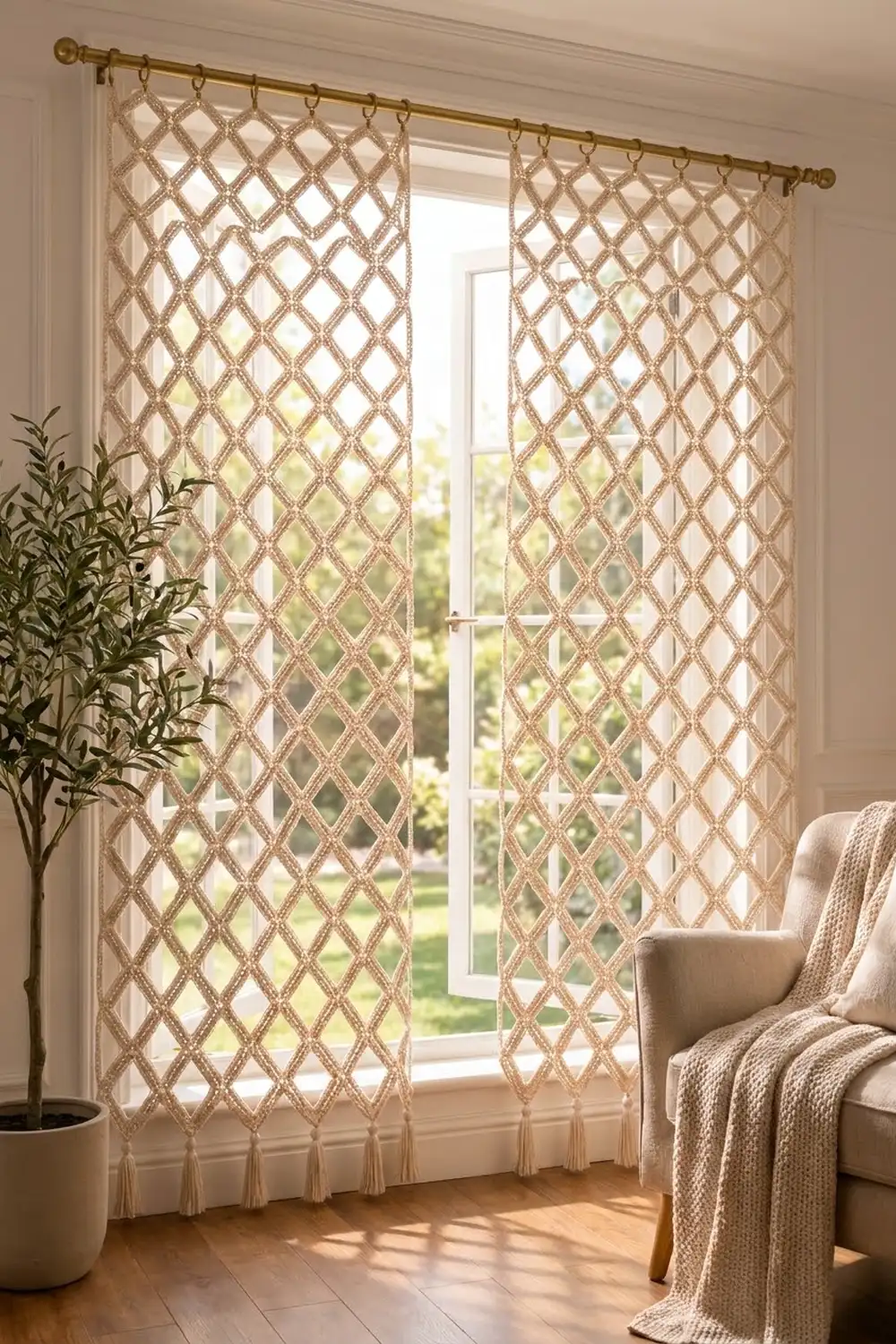
This curtain turns one simple motif into a light, open trellis. Each piece is a hollow square with crisp corners. Once the squares are joined and hung on point, they become diamonds, and sunlight shows through every window.
The whole design uses one warm cream cotton, which gives a calm boho look that suits natural wood, linen, and brass. A full tassel hangs from each bottom point, and clip rings hold each top point on the rod.
The pattern uses US crochet terms. One panel measures about 42.9 in (109.0 cm) wide and 78.3 in (198.9 cm) long after edging, or 84.3 in (214.1 cm) to the tassel tips. The photo shows two matching panels, so make two for the pair.
You work each motif in the round from a chain ring. Next, you join the motifs in staggered on-point rows. Last, you add one round of single-crochet edging around the zigzag outline and attach the tassels.
Finished Size and Construction
- Finished panel size: 42.9 in × 78.3 in (109.0 cm × 198.9 cm) after edging; 84.3 in (214.1 cm) long including tassels
- Skill level: Easy–Intermediate
- Terminology: US
- Yarn weight: Worsted (#4) cotton
- Hook: 4.5 mm (US 7)
- Number of pieces: 116 motifs per panel (232 for the pair) + 6 tassels per panel
- Layout: 21 staggered on-point rows, alternating 6 and 5 diamonds
- Motif size: 5 in (12.7 cm) per side; 7.1 in (18.0 cm) point to point
- Size before edging: 42.4 in × 77.8 in (107.7 cm × 197.6 cm)
- Edging depth: 0.25 in (0.6 cm) on every outer edge
Materials
Choose a smooth, mercerized or combed cotton in worsted weight. It gives clean stitch definition, holds square corners well, and won’t fuzz in sunlight. Stay away from very stretchy cotton blends, because a long lattice stretches when it hangs.
- Cream / natural ivory: 700 g (about 1,330 m / 1,455 yd) per panel; 1,400 g (about 2,660 m / 2,910 yd) for the pair, based on 100 g balls of about 190 m (208 yd)
These quantities include a margin of about 10% for gauge differences and tassels.
Tools:
– 4.5 mm (US 7) hook
– Tapestry needle
– Stitch markers
– Scissors
– 6 in (15.2 cm) piece of stiff card for tassels
– Rustproof pins and a blocking surface
– 6 curtain clip rings per panel (12 for the pair)
Abbreviations (US Terms)
- ch – chain
- sl st – slip stitch
- sc – single crochet
- dc – double crochet
- sc2tog – single crochet 2 together
- sp – space
- st(s) – stitch(es)
- RS / WS – right side / wrong side
Special stitch – sc2tog across a junction: Insert the hook in the corner sc of the first motif, yarn over, and pull up a loop. Insert the hook in the corner sc of the neighboring motif, yarn over, and pull up a loop. Yarn over and pull through all 3 loops on the hook.
Gauge and Checkpoints
Gauge: 16 sc = 4 in (10.2 cm) along the Round 3 edge. One dc round is about 0.5 in (1.3 cm) tall.
Make one complete motif before you buy all your yarn or start production. Measure it flat and unstretched.
- After Round 1: about 3.75 in (9.5 cm) per outer side
- After Round 2: about 4.75 in (12.1 cm) per outer side
- After Round 3: 5 in (12.7 cm) per side; 7.1 in (18.0 cm) point to point
- Inner window: about 2.75 in (7.0 cm) per side
Too big? Go down to a 4 mm hook. Too small? Go up to a 5 mm hook. Even a 0.25 in (0.6 cm) error per motif adds up to 1.5 in (3.8 cm) across 6 diamonds, and much more over 21 rows.
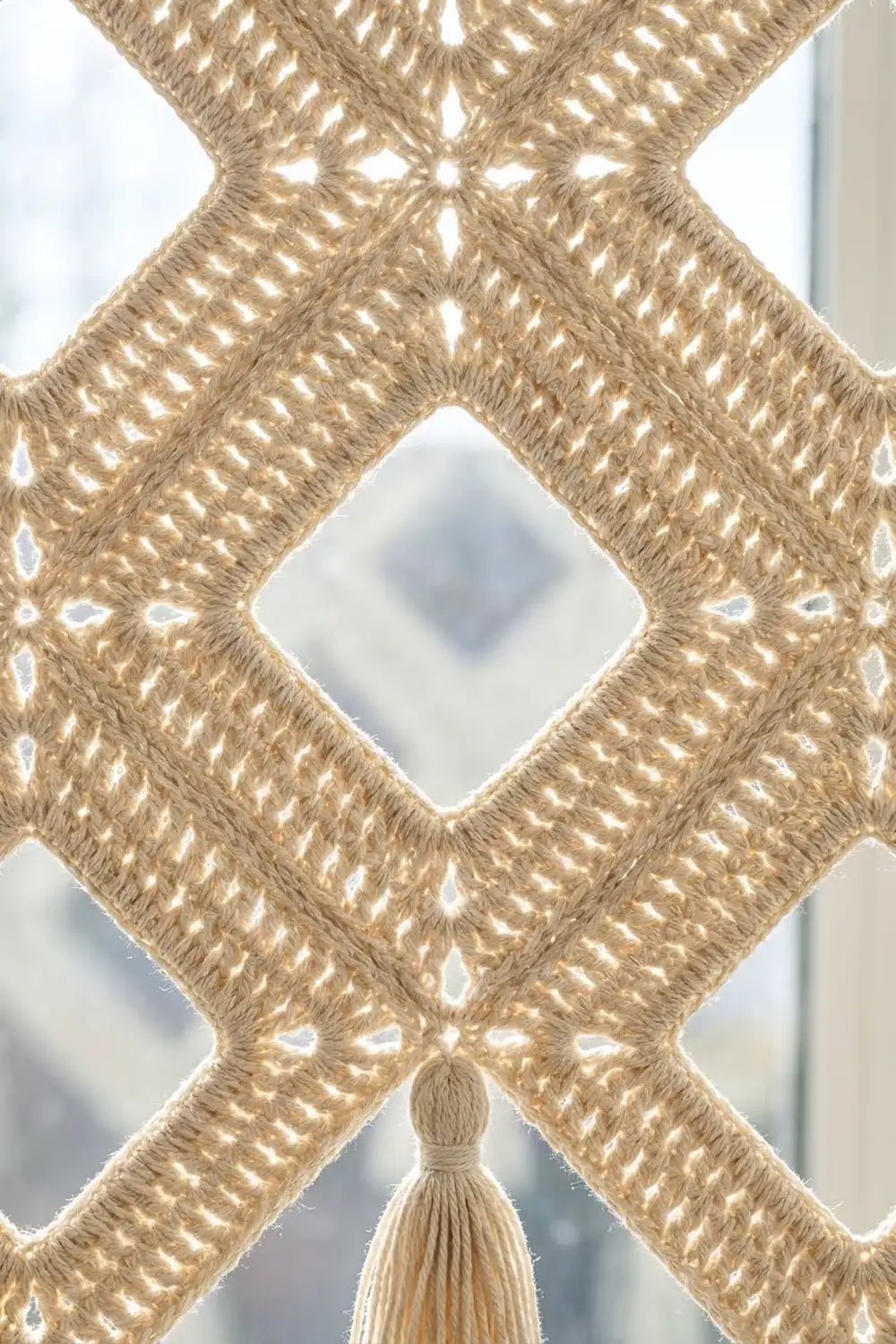
Motif (Make 116 per Panel)
The ring of 44 chains forms the inner window, with 11 chains per side. The single chain at each corner gets a corner group, so the window stays square.
Foundation: Ch 44 and sl st into the first ch to form a ring. Don’t twist the chain. The first chain counts as corner chain 1. Corner chains are chains 1, 12, 23, and 34.
Round 1 (growth): Ch 5 (counts as dc + ch 2), dc in the same ch. Dc in each of the next 10 ch, (dc, ch 2, dc) in the next ch; repeat from * 2 more times. Dc in each of the last 10 ch. Sl st in the 3rd ch of the beginning ch-5 to join.
Round 1 total: 48 dc (12 per side) + 4 ch-2 corner sps.
Round 2 (growth): Sl st into the ch-2 sp. Ch 3 (counts as dc), then (dc, ch 2, 2 dc) in the same sp. Dc in each of the next 12 dc, (2 dc, ch 2, 2 dc) in the next ch-2 sp; repeat from * 2 more times. Dc in each of the last 12 dc; the last one goes into the 3rd ch of the Round 1 beginning ch-5. Sl st in the top of the beginning ch-3 to join.
Round 2 total: 64 dc (16 per side) + 4 ch-2 corner sps.
Round 3 (trim): Ch 1. Sc in the same st as the join and in the next dc. Work 3 sc in the ch-2 sp. Sc in each of the next 16 dc, 3 sc in the next ch-2 sp; repeat from * 2 more times. Sc in each of the last 14 dc. Sl st in the first sc to join.
Round 3 total: 64 (1 sc per existing dc) + 12 (3 sc in each of 4 corner sps) = 76 sc.
Per-side count: The middle sc of each 3-sc group is the corner stitch. Each side has 20 sc, counting both of its corner stitches: 1 corner + 18 side sts + 1 corner. Check: 4 sides × 19 (the corners are shared) = 76. ✓
Fasten off and leave a 4 in (10.2 cm) tail. Weave in the ends now, along the back of the dc band.
Make All Pieces
Each panel needs 116 cream motifs, and the pair needs 232. The layout alternates wide rows (W) of 6 diamonds with narrow rows (N) of 5. Each narrow row sits in the notches of the wide rows above and below it.
Row 1  (W)  ◇ ◇ ◇ ◇ ◇ ◇     ← clip rings on 6 top points
Row 2  (N)   ◇ ◇ ◇ ◇ ◇
Row 3  (W)  ◇ ◇ ◇ ◇ ◇ ◇
Row 4  (N)   ◇ ◇ ◇ ◇ ◇
 ...         (continue alternating)
Row 20 (N)   ◇ ◇ ◇ ◇ ◇
Row 21 (W)  ◇ ◇ ◇ ◇ ◇ ◇     ← tassels on 6 bottom points
There are 11 wide rows × 6 = 66 motifs and 10 narrow rows × 5 = 50 motifs, for 116 per panel. ✓
Joining
Method: Slip-stitch join. Hold two motifs RS together and work through the back loops only, so a neat ridge stays on the WS and the RS stays smooth.
Stitch-to-stitch logic: Every joined edge pairs 20 sc with 20 sc, corner to corner. Start in the corner sc of both motifs, sl st through each matching pair of stitches, and end in the opposite corner sc. That is exactly 20 sl sts per seam, with no stitches added or skipped. Joining the corner stitches is what forms the small star where four corners meet.
Order:
1. Lay out the 6 diamonds of Row 1 on point.
2. Narrow rows: Join each diamond’s upper-left edge to the lower-right edge of the diamond above-left. Join its upper-right edge to the lower-left edge of the diamond above-right. That makes 10 seams per row.
3. Wide rows: The first diamond joins only along its upper-right edge, and the last diamond joins only along its upper-left edge. Each of the 4 middle diamonds joins along both upper edges. That also makes 10 seams per row.
4. Repeat until Row 21 is joined. Rows 2–21 give 20 rows × 10 = 200 seams.
Tension: Keep your slip stitches as loose as the sc they join. If a seam puckers, go up one hook size for joining only. Tight seams pull the windows into shields, not diamonds.
Size checkpoint: After Row 3, the work should measure 42.4 in (107.7 cm) wide from side point to side point and 14.1 in (35.8 cm) tall. The finished joined panel measures 42.4 in × 77.8 in (107.7 cm × 197.6 cm). Height = 7.1 in (18.0 cm) + 20 × 3.54 in (9.0 cm) half-steps.
Border (Edging)
Border gauge: One round of sc at 16 sc = 4 in (10.2 cm). It adds 0.25 in (0.6 cm) to each edge, so the panel grows from 42.4 in × 77.8 in (107.7 cm × 197.6 cm) to 42.9 in × 78.3 in (109.0 cm × 198.9 cm).
The outline is a zigzag of 64 exposed motif edges. Each exposed edge has 18 side sts between its corners. At every outer point, work 3 sc in the corner sc. At every valley, where two motifs meet, work 1 sc2tog across the two corner sts.
Round 1: With RS facing, join yarn in the top point of the top-left diamond. Ch 1 and work 3 sc in that point, then work the sections below. Sl st to the first sc to join, then fasten off.
- Top edge (6 motifs): Each motif’s top has 2 edges that share 1 point: 20 + 20 − 1 = 39 sts. 6 × 39 = 234 sts. The two end corners belong to the side sections, which leaves 232 to work: 216 side sts + 6 points + 10 valley corners. Work 216 sc (1 per st) + 12 extra sc at the 6 points − 5 from the 5 valley sc2togs = 239 sc.
- Right side (11 wide-row motifs): 20 edges × 18 = 360 side sts, + 11 points + 10 valleys × 2 corners = 391 sts. Work 360 sc + 33 sc at the points + 10 sc2tog = 403 sts (391 + 22 − 10).
- Bottom edge (6 motifs): This mirrors the top: 239 sts.
- Left side (11 wide-row motifs): This mirrors the right: 403 sts.
Round total: 239 + 403 + 239 + 403 = 1,284 sts.
Why the math works: Every side stitch gets exactly 1 sc, so the straight edges stay flat. The 2 extra sc at each point make up for the outward turn and keep the tips sharp. Each sc2tog removes 1 stitch at an inward turn, so the valleys don’t ruffle. Each motif’s corner stitches are counted only once.
Tassels (make 6 per panel): Wrap yarn 30 times around the 6 in (15.2 cm) card. Tie the wraps at the top and cut them at the bottom. Wrap the neck 0.75 in (1.9 cm) below the top and trim to 6 in (15.2 cm). Tie one tassel to the bottom-point corner sc of each motif in Row 21.
Final Blocking
- Soak the panel in cool water for 15 minutes, then press the water out. Don’t wring it.
- Roll it in towels to remove excess moisture.
- Lay it flat on a blocking surface, with RS up.
- Pin each top point along a straight line, 7.1 in (18.0 cm) apart.
- Pin the side and bottom points to the measurements in the size checkpoint, so every window is square.
- Pin each inner window corner, or slide a square card into each window to set it.
- Let it dry completely. Comb the tassels and trim them even.
- Attach a clip ring to each of the 6 top points.
Final Quality-Control Checklist
- [ ] Every motif has 76 sc and measures 5 in (12.7 cm) per side
- [ ] All 200 seams have 20 sl sts each and lie flat
- [ ] Each four-corner junction forms a closed star with no gaps
- [ ] The edging totals 1,284 sts, with sharp points and flat valleys
- [ ] The panel measures 42.9 in × 78.3 in (109.0 cm × 198.9 cm)
- [ ] 6 tassels are secure and trimmed to 6 in (15.2 cm)
- [ ] All ends are woven into dc bands, not seams
Troubleshooting
- Windows look round: Your Round 1 corners are loose. Work (dc, ch 2, dc) tightly and block over square cards.
- Motifs cup: Your dc is too tight, so go up a hook size. Motifs ruffle: Go down a hook size.
- Seams pucker: Join more loosely or use a hook one size bigger.
- The panel stretches when it hangs: This is normal for cotton. Block it slightly shorter, or hang it for a day before trimming the tassels.
- Gaps at the stars: Make sure every seam starts and ends in a corner sc.
Care
Hand wash cool or machine wash on a gentle cycle in a mesh bag, then reshape and dry flat. Don’t tumble dry, because that can shrink cotton and distort the diamonds.
Final Notes
Here is the measurement chain. Each motif is 76 sc and 5 in (12.7 cm) per side, or 7.1 in (18.0 cm) point to point. Six diamonds across give 42.4 in (107.7 cm), and 21 staggered rows give 77.8 in (197.6 cm). The edging brings the panel to 42.9 in × 78.3 in (109.0 cm × 198.9 cm), and the tassels take it to 84.3 in (214.1 cm). If your first motif matches the gauge, everything after it will fall into place. Make two panels for the pair.
Happy crocheting!