

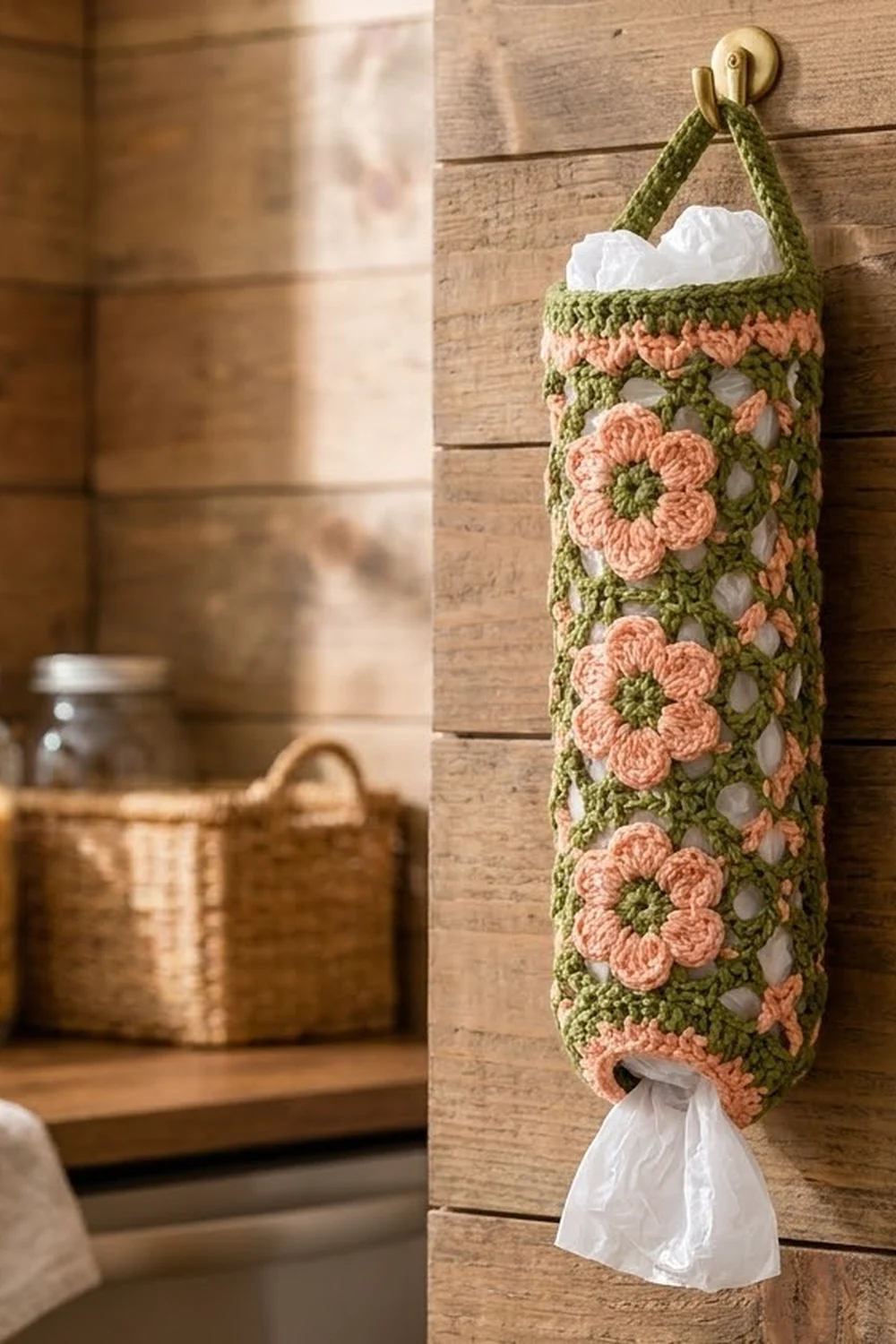
This hanging bag holder is a long, open-mesh tube in olive green with peach six-petal flowers sewn down the front and sides. You stuff plastic grocery bags into the wide top and pull them out one at a time through the narrower bottom opening. A sturdy green strap hangs it from a wall hook.
The palette is two colors. Olive green is used for the mesh, strap, rims, and flower centers. Soft peach is used for the petals, the shell band near the top, and the band around the bottom opening. The look is cottage-garden, but it is a practical piece for a kitchen or pantry.
The pattern uses US crochet terms. The finished tube is 6 in (15.2 cm) wide laid flat, which is 12 in (30.5 cm) around, and 16 in (40.6 cm) tall. The strap adds an 8 in (20.3 cm) handle that rises about 3.5 in (8.9 cm) above the rim.
Construction is simple. You work the tube from the top down in joined rounds: a solid green rim, a peach shell band, a long chain-loop mesh, and a solid tapered bottom. Each opening gets one border round, and the strap is worked straight off the top border. You make nine flowers separately and sew them on in three columns of three.
Finished Size and Construction
- Finished size: 6 in (15.2 cm) wide flat x 16 in (40.6 cm) tall, plus an 8 in (20.3 cm) strap
- Circumference: 12 in (30.5 cm) at the top; 9 in (22.9 cm) at the bottom opening
- Skill level: Easy+ (simple stitches in joined rounds, some sewing)
- Terminology: US
- Yarn weight: Worsted (#4) cotton or cotton blend
- Hook: 5.0 mm (H-8)
- Number of pieces: 1 tube (the strap is worked onto it) plus 9 appliqué flowers
- Layout: 3 flower columns of 3 flowers each, spaced evenly around the tube
- Flower size: 3 in (7.6 cm) across
- Size before border: 15.5 in (39.4 cm) tall
- Border depth: 0.25 in (0.6 cm) at each opening
Materials
Choose a smooth cotton or cotton blend. Cotton keeps its shape when the tube is full of bags and stretches less under weight than acrylic does. Avoid fuzzy or brushed yarns, because they hide the mesh. Mercerized cotton gives crisper petals, and a matte kitchen cotton gives a softer, more rustic look.
- Olive green (Color A): 100 g, about 190 m (208 yd)
- Peach (Color B): 60 g, about 115 m (126 yd)
Tools:
- 5.0 mm (H-8) crochet hook
- Tapestry needle
- Stitch markers (at least 4)
- Rustproof pins
- Scissors
- Measuring tape
- Spray bottle and a towel for blocking
The quantities include a margin of about 15% for the test flower, tails, and small differences in tension.
Abbreviations (US Terms)
- ch – chain
- sc – single crochet
- hdc – half double crochet
- dc – double crochet
- sl st – slip stitch
- sk – skip
- sc2tog – single crochet 2 together
- st(s) – stitch(es)
- rnd(s) – round(s)
- MR – magic ring
Shell: 5 dc in the same stitch.
Reverse sc (crab stitch): Work from left to right if you crochet right-handed. Insert the hook into the next stitch to the right, yarn over, and pull up a loop. Yarn over again and pull through both loops.
Gauge and Checkpoints
Solid sc gauge: 16 sc and 16 rnds = 4 in (10.2 cm).
Mesh gauge: 2 ch-3 loops and 2 mesh rnds = 1 in (2.5 cm).
Make one flower before you start the tube. It is a quick gauge test, and you will use it anyway. It should measure 3 in (7.6 cm) from petal tip to petal tip.
Checkpoints along the way:
- After Rnd 2: Flatten the tube. It should be 6 in (15.2 cm) wide.
- After Rnd 4: The top band should be 1.5 in (3.8 cm) tall.
- After Rnd 30: The mesh section should be 13 in (33.0 cm) tall.
- After Rnd 34: The bottom opening should be 4.5 in (11.4 cm) wide laid flat.
- After the border: The full tube should be 16 in (40.6 cm) tall.
If your piece is too big, go down half a hook size. If it is too small, go up half a size. Mesh sags lengthwise when it hangs, so always measure it laid flat on a table.
Make the Flowers (Make 9)
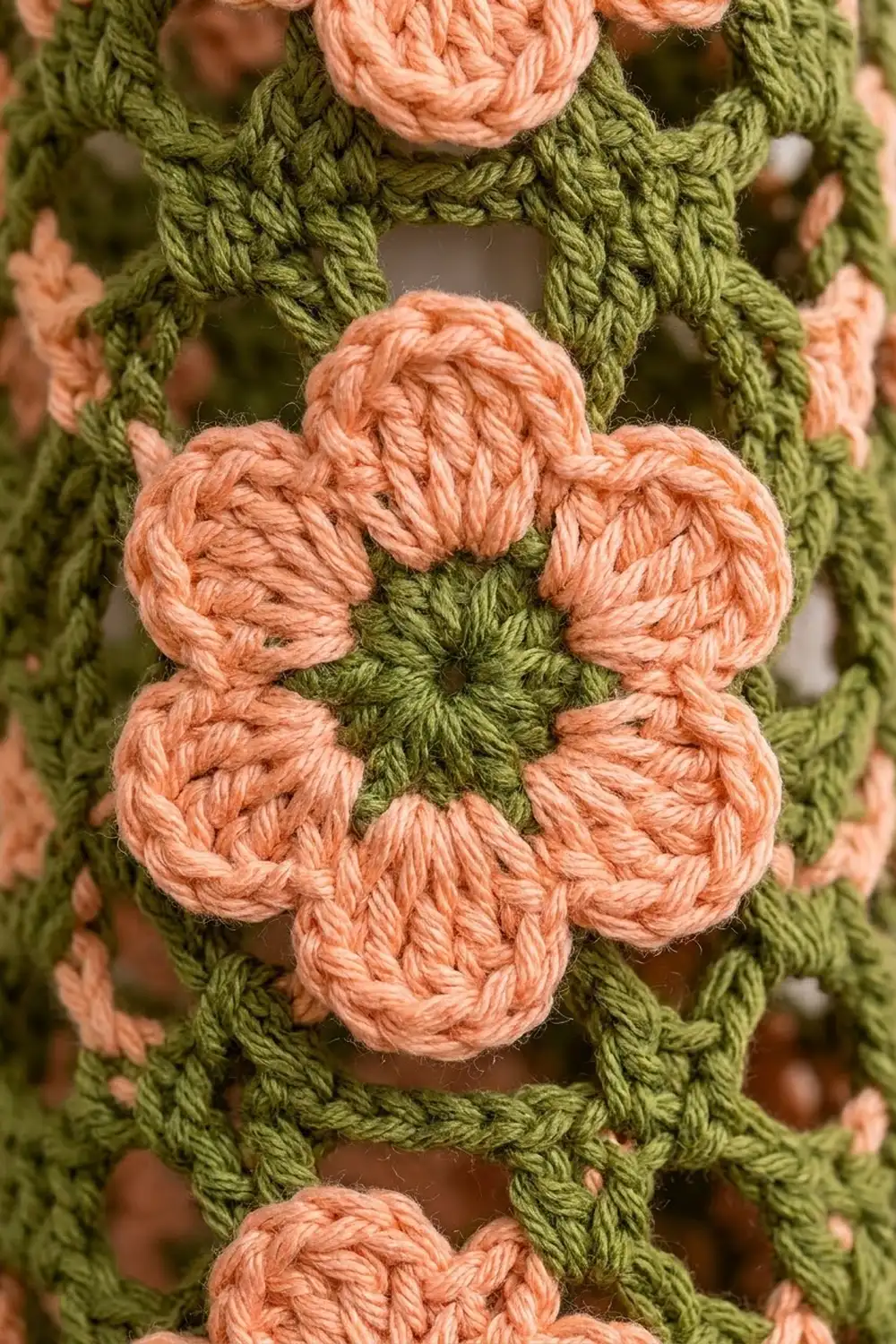
Rnd 1 (Color A): MR, ch 1, work 12 sc in the ring, sl st to the first sc to join. Fasten off. (12 sc) The green center should measure about 1 in (2.5 cm).
Rnd 2 (Color B): Join Color B in any sc. Ch 1, sc in this st, ch 3, sk next st; repeat from * 5 more times. Sl st to the first sc. (6 sc, 6 ch-3 loops)
Rnd 3 (Color B): In each ch-3 loop, work (sc, hdc, 3 dc, hdc, sc). Sl st to the first sc. (6 petals, 42 sts)
Fasten off and leave a 12 in (30.5 cm) tail of Color B for sewing. Weave in the green tails on the back.
Checkpoint: 3 in (7.6 cm) across. Make all 9 flowers the same size before you move on.
Tube Body
Work in joined rounds with the right side facing, and do not turn. The ch 1 at the start of a round does not count as a stitch. Put a marker in the first stitch of each round so the joins line up in one column. That column is the back of the tube.
When you change colors, finish the last sl st of the old round, fasten off, and join the new color as written. Leave 6 in (15.2 cm) tails and weave them into solid rounds later.
Foundation (Color A): Ch 48 and sl st to the first ch to form a ring. Make sure the chain is not twisted.
Rnd 1 (Color A): Ch 1, sc in each ch around, sl st to the first sc. (48 sc)
Rnd 2 (Color A): Ch 1, sc in each st around, sl st to the first sc. (48 sc) Fasten off.
Checkpoint: 6 in (15.2 cm) wide laid flat.
Rnd 3 (Color B, shell band): Join Color B in any st. Ch 1, sc in next st, sk 1, shell in next st, sk 1; repeat from * 11 more times. Sl st to the first sc. Fasten off. (12 sc + 60 dc = 72 sts; 12 shells)
Each repeat uses 4 stitches from Rnd 2, so 12 repeats use all 48.
Rnd 4 (Color A, mesh setup): Join Color A in any sc between shells. Ch 1, sc in this sc, ch 3, sc in the center dc of the next shell, ch 3; repeat from * 11 more times. Sl st to the first sc. (24 sc, 24 ch-3 loops)
Checkpoint: Rnds 1–4 measure 1.5 in (3.8 cm) tall.
Rnd 5 (Color A, mesh): Sl st into the first ch-3 loop. Ch 1, sc in ch-3 loop, ch 3; repeat from * around. Sl st to the first sc. (24 sc, 24 ch-3 loops)
Each sc sits in the middle of a loop from the round below. That makes the loops stagger and form the open net.
Rnds 6–30: Repeat Rnd 5. (24 sc, 24 ch-3 loops in every round)
That is 26 mesh rounds (Rnds 5–30). At 2 rnds per inch, they measure 13 in (33.0 cm).
Checkpoint: 6 in (15.2 cm) wide laid flat and 14.5 in (36.8 cm) tall so far.
Tapered Bottom
Rnd 31 (Color A, conversion): Ch 1, sc in next sc, sc in next ch-3 loop; repeat from * around. Sl st to the first sc. (24 sc worked into sc + 24 sc worked into loops = 48 sc)
Rnd 32 (Color A, decrease): Ch 1, sc in next 2 sts, sc2tog; repeat from * 11 more times. Sl st to the first sc. Fasten off. (36 sts)
Each repeat uses 4 stitches, so 12 repeats use all 48 and remove 12.
Rnd 33 (Color B): Join Color B. Ch 1, sc in each st around, sl st to the first sc. (36 sc)
Rnd 34 (Color B): Repeat Rnd 33. (36 sc) Fasten off.
Checkpoint: Rnds 31–34 measure 1 in (2.5 cm). The tube is now 15.5 in (39.4 cm) tall. The bottom opening is 4.5 in (11.4 cm) wide laid flat, which is 9 in (22.9 cm) around.
Border
Border gauge: At 16 sts = 4 in (10.2 cm), one round of sc or reverse sc adds 0.25 in (0.6 cm) of height.
Top border (Color A): With the top of the tube facing you, join Color A in the free loop of the foundation chain at the join. Ch 1, sc in each free loop around, sl st to the first sc. (48 sc; 24 per side when flattened) Do not fasten off. Mark the 1st sc and the 25th sc.
Bottom border (Color A): Join Color A in any st of Rnd 34. Ch 1, reverse sc in each st around, sl st to the first st. (36 reverse sc; 18 per side when flattened) Fasten off.
Why the math works: The foundation has 48 chains, so it has exactly 48 free loops, the same as Rnd 1. One sc in each loop keeps the rim at 12 in (30.5 cm) without flaring or pulling in. The bottom border puts 1 stitch in each of the 36 stitches of Rnd 34, so the opening stays 9 in (22.9 cm) around. Reverse sc makes a firm, corded edge that stands up to bags being pulled through. The tube has no corner stitches. Flattening it just splits each round in half: 48 ÷ 2 = 24 at the top and 36 ÷ 2 = 18 at the bottom.
Strap
Row 1 (Color A): With the top-border loop still on your hook, ch 1, then sc in the marked 1st st and in each of the next 4 sts. (5 sc)
Rows 2–32: Ch 1, turn, sc in each st across. (5 sc)
Checkpoint: The strap is 8 in (20.3 cm) long and 1.25 in (3.2 cm) wide. Leave a 12 in (30.5 cm) tail. Check that the strap is not twisted, then whipstitch Row 32 to border sts 25–29, starting at the second marker. The two ends sit 24 sts apart, directly opposite each other.
The strap carries the full weight of the bags. Whipstitch across Row 32 twice, once in each direction, so it can’t pull loose.
Attach the Flowers
Lay the tube flat with the strap ends at the two folds. Mark three columns:
- Column 1: centered on the front, halfway between the strap ends
- Columns 2 and 3: each 4 in (10.2 cm) farther around, measured center to center
12 in ÷ 3 = 4 in, so the three columns split the tube evenly. A 3 in (7.6 cm) flower in each 4 in (10.2 cm) section leaves a 1 in (2.5 cm) mesh gap between columns.
Vertically, measure down from the top of Rnd 5. Place the flower centers at 2.5 in (6.4 cm), 6.5 in (16.5 cm), and 10.5 in (26.7 cm), which is roughly Rnds 10, 18, and 26. The centers are 4 in (10.2 cm) apart, which leaves a 1 in (2.5 cm) gap between flowers.
Pin all 9 flowers before you sew. Slip a rolled towel inside the tube so you don’t sew through both layers. With the peach tail, whipstitch each petal tip and each valley between petals to the mesh behind it. Keep the stitches small and snug but not tight.
Final Blocking
- Weave in all remaining ends along solid rounds or through the backs of the flowers.
- Spritz the whole holder lightly until it is damp but not soaked.
- Slide a rolled towel about 3.8 in (9.7 cm) across, or a tall container of that size, into the tube.
- Gently pull each line of loops downward to even out the mesh.
- Pat the flowers flat and fan out the petals so all 6 are evenly spaced.
- Pin the strap flat with straight edges.
- Let it dry completely, then remove the form.
Final Quality-Control Checklist
- The tube is 6 in (15.2 cm) wide laid flat and 16 in (40.6 cm) tall
- The top border has 48 sc; the bottom border has 36 reverse sc
- Every mesh round has 24 loops
- The shell band has 12 even shells
- All 9 flowers measure 3 in (7.6 cm) and line up in straight columns
- The strap is 8 in (20.3 cm), not twisted, and sewn directly opposite where it starts
- No yarn ends show on the outside
- The bottom opening is 9 in (22.9 cm) around and a bag pulls through easily
Troubleshooting
The mesh spirals or slants. You are probably starting rounds in different loops. Always sl st into the first loop and begin there.
The top is narrower than the body. Your foundation chain is too tight. Chain with a hook one size larger, then switch back for Rnd 1.
The shells ruffle. Your dc are loose. Work each shell as 5 hdc instead. The center stitch stays in the same place for Rnd 4.
The flowers cup. Rnd 3 is too tight. Make the flowers with a hook half a size larger.
The flowers drift out of line. Re-pin them using the measured centers before sewing, not by eye.
Bags fall out of the bottom. The opening is too wide. Before the border, add one round: sc in next 4 sts, sc2tog around (30 sts). Work the reverse-sc border into those 30 sts.
The strap stretches. Use a firmer cotton, or work the strap with a hook half a size smaller.
Care
Hand wash in cool water with mild soap, then press out the water in a towel. Dry it over a rolled towel to keep the tube shape, and don’t wring it or tumble dry.
Final Notes
Here is how the measurements build on each other. 48 foundation chains give a 12 in (30.5 cm) rim. That rim becomes 12 shells, then 24 mesh loops, which make 13 in (33.0 cm) of net. The mesh converts back to 48 sc and tapers to 36 sc for a 9 in (22.9 cm) opening. Add the 48-stitch top border and the 36-stitch bottom border, and you reach the finished 16 in (40.6 cm). Check the flat width at each checkpoint, and the three columns of 3 in (7.6 cm) flowers will fit evenly.
For the reversed version, make the mesh in peach and the petals in green. The flower centers can be peach or green.
Happy crocheting!