

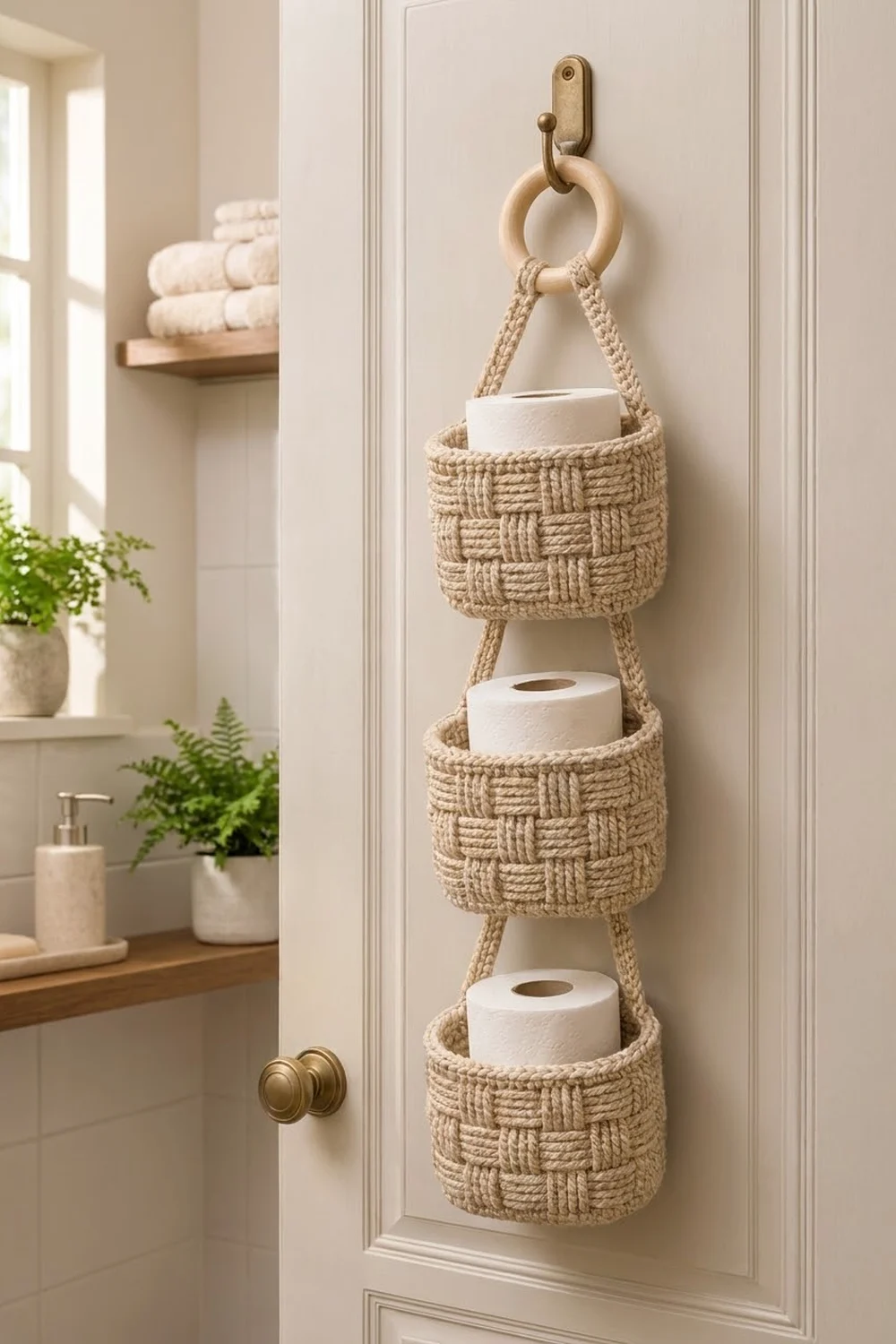
The Linen Rope holder is a hanging organizer for three toilet rolls. Three oval baskets hang one above the other on two corded straps, and a natural wooden ring lets you hang the whole thing on a door hook, towel hook or wall peg.
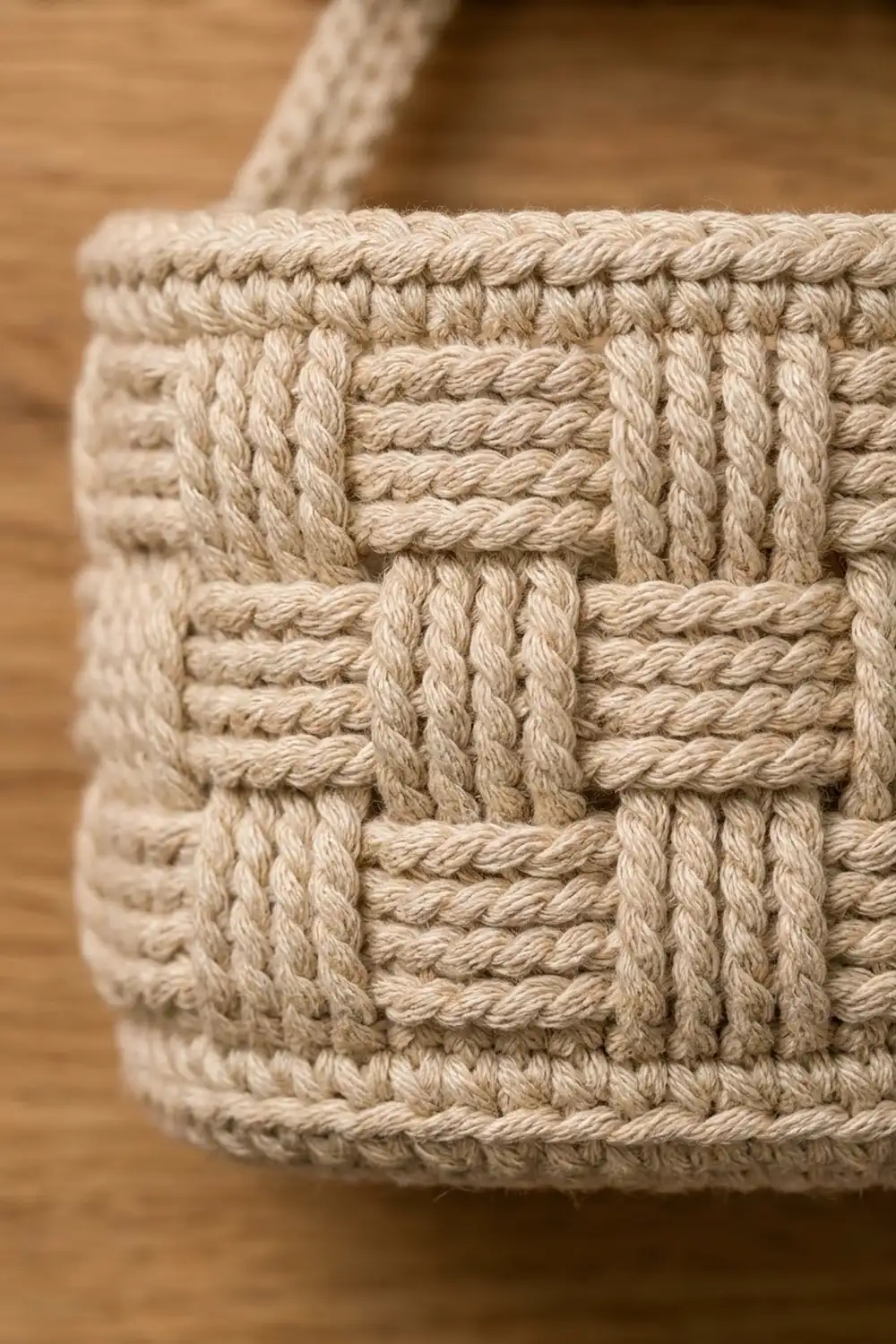
Everything is crocheted in one soft oatmeal beige. Each basket wall has a basketweave of raised and recessed post-stitch blocks, and the rim is finished with crab stitch, which looks like twisted rope. The holder looks calm and natural and suits light bathroom colours.
This pattern uses US crochet terms. Each basket measures about 7.25 in wide x 5.25 in deep x 4.25 in tall (18.4 x 13.3 x 10.8 cm). The assembled holder is about 23 in (58.4 cm) tall, ring included.
Construction overview: you crochet an oval base in single crochet, turn the wall up through the back loops, and work six rounds of basketweave in the round. Then you finish the rim with a single crochet round and a crab-stitch round. Make three baskets and two straps, then sew the straps to the narrow ends of the baskets and wrap them around the ring.
Finished Size and Construction
- Finished size: about 23 in (58.4 cm) tall x 7.25 in (18.4 cm) wide
- Skill level: Intermediate (front-post and back-post stitches, crab stitch)
- Terminology: US
- Yarn weight: Medium (#4), worsted/aran
- Hook: 5.0 mm (H-8)
- Number of pieces: 3 baskets + 2 straps, plus 1 wooden ring
- Layout: 1 column x 3 baskets, stacked vertically
- Basket size: 7.25 x 5.25 x 4.25 in (18.4 x 13.3 x 10.8 cm)
- Base size before walls: 6.75 x 5 in (17.1 x 12.7 cm)
- Rim (border) depth: 0.5 in (1.3 cm), worked in 2 rounds
Materials
Yarn: Use a firm worsted or aran cotton, or a cotton blend. Cotton holds the basket’s shape, shows the post-stitch texture clearly, and copes with bathroom humidity. Avoid very fuzzy or very stretchy yarns, because they blur the weave and let the baskets sag.
- Oatmeal beige: 90 g, about 150 m (164 yd)
- each basket: about 33 g / 55 m (60 yd)
- both straps together: about 5 g / 8 m (9 yd)
These quantities include a margin of about 15% for gauge differences and weaving in ends.
Tools:
- 5.0 mm (H-8) crochet hook
- 1 wooden ring, 2.5 in (6.4 cm) outer diameter
- 4 locking stitch markers
- Tapestry needle
- Scissors
- Tape measure
- 3 toilet rolls, or a rolled towel, to use as a blocking form
Abbreviations (US Terms)
- ch – chain
- sl st – slip stitch
- sc – single crochet
- dc – double crochet
- inc – 2 sc in the same stitch
- BLO – back loop only
- FPdc – front post double crochet: yarn over, insert the hook from front to back to front around the post of the stitch, then complete as a dc.
- BPdc – back post double crochet: yarn over, insert the hook from back to front to back around the post of the stitch, then complete as a dc.
- st(s) – stitch(es)
- rnd – round
Special stitch: reverse sc (crab stitch). Work sc from left to right (right-handed). Insert the hook into the next stitch to the right, pull up a loop, yarn over and pull through both loops. Each stitch twists slightly, which gives the rope edge.
Gauge and Checkpoints
Single crochet gauge (base): 14 sts and 16 rnds = 4 in (10.2 cm).
Basketweave gauge (walls): 14 sts and 8 rnds = 4 in (10.2 cm). One block is 4 sts by 2 rnds, about 1.1 in (2.8 cm) wide and 1 in (2.5 cm) tall.
Strap gauge: 16 sc worked into the chain back bumps = 4 in (10.2 cm).
Make one complete basket before you start the others. The base doubles as your gauge swatch.
Checkpoints:
- After Rnd 5: the oval measures about 4.25 x 2.5 in (10.8 x 6.4 cm).
- After Rnd 10: the base measures 6.75 x 5 in (17.1 x 12.7 cm) and lies flat.
- After Rnd 12: the wall is 0.75 in (1.9 cm) tall from the base ridge.
- After Rnd 18: the wall is 3.75 in (9.5 cm) tall.
- After Rnd 20: the basket is 4.25 in (10.8 cm) tall.
If your basket is too big: go down to a 4.5 mm hook. Cotton relaxes a little, so a basket that is loose before blocking stays loose.
If your basket is too small: go up to a 5.5 mm hook. Check that a roll fits inside before you go on. The inside needs to be at least 4.5 in (11.4 cm) deep.
Basket (Make 3)
Work in joined rounds. Join each round with a sl st to the first st, and ch 1 to start each sc round. The starting ch 1 or ch 2 does not count as a stitch.
The base rounds are worked in this order: end, side, end, side.
Base
Ch 9.
Rnd 1: 3 sc in the 2nd ch from hook (end), sc in the next 6 ch (side), 3 sc in the last ch (end). Rotate and work along the underside of the chain: sc in the next 6 ch (side). Join. (18 sts: ends 3, sides 6)
Rnd 2: [Inc in each of the next 3 sts, sc in the next 6 sts] twice. (24 sts: ends 6)
Rnd 3: [(Sc 1, inc) 3 times, sc 6] twice. (30 sts: ends 9)
Rnd 4: [(Sc 2, inc) 3 times, sc 6] twice. (36 sts: ends 12)
Rnd 5: [(Sc 3, inc) 3 times, sc 6] twice. (42 sts: ends 15)
Rnd 6: [(Sc 4, inc) 3 times, sc 6] twice. (48 sts: ends 18)
Rnd 7: [(Sc 5, inc) 3 times, sc 6] twice. (54 sts: ends 21)
Rnd 8: [(Sc 6, inc) 3 times, sc 6] twice. (60 sts: ends 24)
Rnd 9: [(Sc 7, inc) 3 times, sc 6] twice. (66 sts: ends 27)
Rnd 10: [(Sc 8, inc) 3 times, sc 6] twice. (72 sts: ends 30, sides 6)
Check: 30 + 6 + 30 + 6 = 72. Each end stays a smooth curve because the 3 increases on it are spaced evenly.
Walls
Rnd 11 (turning ridge): Ch 1, sc in the BLO of each st around. Join. (72 sts)
The unused front loops make the crisp edge where the base meets the wall.
Place a marker in st 15 and another in st 51. These are the centers of the two narrow ends, exactly 36 sts apart, and they show where the straps will go.
Rnd 12 (foundation): Ch 2, dc in each st around. Join to the first dc. (72 sts)
Rnds 13–14: Ch 2, [FPdc in the next 4 sts, BPdc in the next 4 sts] 9 times. Join. (72 sts, 18 blocks)
Rnds 15–16: Ch 2, [BPdc in the next 4 sts, FPdc in the next 4 sts] 9 times. Join. (72 sts)
Rnds 17–18: Repeat Rnds 13–14. (72 sts)
The 72 stitches divide into 18 blocks of 4. Because 18 is even, raised and recessed blocks alternate all the way around without breaking at the join. Switching the order every 2 rounds produces the checkerboard: three bands of blocks, each about 1 in (2.5 cm) tall.
Keep both markers in their stitch columns. Move them up each round.
Rim (Border)
The rim gauge matches the wall gauge: 14 sts = 4 in (10.2 cm). Both rim rounds are worked 1 st into each st with no increases or decreases.
Rnd 19: Ch 1, sc in each st around. Join. (72 sts: 30 across each end, 6 along each side)
Rnd 20: Ch 1, do not turn. Reverse sc in each st around. Join. (72 sts: 30 across each end, 6 along each side)
Fasten off and weave in the ends.
Why the math works: the rim has the same 72 stitches as the walls, at the same 3.5 sts per inch. That gives a circumference of about 20.5 in (52.1 cm) at every height from Rnd 12 up. The rim cannot flare or pull in. Rnd 19 gives the crab stitch a smooth, even row of tops to work into.
The rim adds 0.5 in (1.3 cm): 0.25 in (0.6 cm) per round. Total basket height: 0.25 + 0.5 + 3 + 0.5 = 4.25 in (10.8 cm).
Straps (Make 2)
Ch 90.
Row 1: Sc in the back bump of the 2nd ch from hook and in each ch across. (89 sts)
Row 2 (cord edge): Ch 1. Rotate the work and loosely sl st in each free loop along the other side of the chain. (89 sl sts)
Fasten off and leave a 24 in (61 cm) tail for sewing. The strap is about 0.4 in (1.0 cm) wide and 22.25 in (56.5 cm) long. The sl st edge gives it the corded, braided look.
Strap map (sts counted from the starting end):
| Strap sts | Section | Length |
|---|---|---|
| 1–17 | Bottom basket wall | 4.25 in (10.8 cm) |
| 18–23 | Gap | 1.5 in (3.8 cm) |
| 24–40 | Middle basket wall | 4.25 in (10.8 cm) |
| 41–46 | Gap | 1.5 in (3.8 cm) |
| 47–63 | Top basket wall | 4.25 in (10.8 cm) |
| 64–83 | Drop to ring | 5 in (12.7 cm) |
| 84–89 | Wrap around ring | 1.5 in (3.8 cm) |
Check: 17 + 6 + 17 + 6 + 17 + 20 + 6 = 89 sts.
Make All Pieces
All pieces use the oatmeal beige:
- 3 baskets: about 33 g each
- 2 straps: about 2.5 g each
- 1 wooden ring: purchased
Layout:
        ( ring )
        /      \
   [  Basket C  ]   top
    |          |
   [  Basket B  ]   middle
    |          |
   [  Basket A  ]   bottom
Each vertical line is one strap. The straps run up the narrow ends of the baskets, along the marked center columns.
Joining
Method: whipstitch with the strap tails, sewing each strap flat against the outside of the baskets.
Stitch-to-stitch logic: each basket wall is 17 strap stitches tall. Match them to the basket rounds like this:
- Rnd 11 (sc ridge, 0.25 in / 0.6 cm) = 1 strap st
- Rnd 12 (dc, 0.5 in / 1.3 cm) = 2 strap sts
- Rnds 13–18 (6 weave rounds) = 12 strap sts, 2 per round
- Rnd 19 = 1 strap st
- Rnd 20 = 1 strap st
Total: 1 + 2 + 12 + 1 + 1 = 17. ✓
Steps:
- Lay Basket A on its back. Place strap st 1 on the marked column at Rnd 11 and strap st 17 at the crab-stitch rim.
- Whipstitch along both edges of the strap, catching one strand of the basket in each round. Sew 3 extra stitches through the rim and 3 through the base ridge. These are the load points.
- Leave strap sts 18–23 free. They make the 1.5 in (3.8 cm) gap.
- Sew strap sts 24–40 to Basket B in the same way, then sts 47–63 to Basket C.
- Repeat steps 1–4 with the second strap on the opposite marked column.
- Pass strap sts 84–89 of each strap through the ring from front to back. Fold them down and sew them over sts 78–83 of the same strap.
Tension: sew firmly enough that the strap lies flat but loosely enough that the basket wall doesn’t pucker. If the fabric dimples, take out the last few stitches and sew them again more loosely.
Size checkpoint: lay the holder flat. Each gap should measure 1.5 in (3.8 cm), each basket 4.25 in (10.8 cm), and the total length about 23 in (58.4 cm). Fix any uneven gap now, before blocking.
Final Blocking
- Remove all markers.
- Lightly mist each basket with water until it is damp but not soaked.
- Push a toilet roll, or a rolled towel, into each basket to fill it out.
- Pinch the base ridge (Rnd 11) all the way around so it stands crisp.
- Gently roll the crab-stitch rim with your fingers to even out the twists.
- Hang the holder from the ring so the straps dry straight and even.
- Let it dry completely, usually 24 hours.
Final Quality-Control Checklist
- [ ] Every basket has 72 sts in every round from Rnd 10 to Rnd 20.
- [ ] Each base measures 6.75 x 5 in (17.1 x 12.7 cm).
- [ ] The checkerboard alternates cleanly around the whole basket, including at the join.
- [ ] All three baskets are 4.25 in (10.8 cm) tall.
- [ ] Both straps have 89 sts and are 22.25 in (56.5 cm) long before sewing.
- [ ] Both gaps are 1.5 in (3.8 cm), and the baskets hang level.
- [ ] Rims and base ridges are reinforced where the straps attach.
- [ ] The ring wraps are sewn down securely and all ends are woven in.
Troubleshooting
The base curls up like a bowl. Your sc is too tight or you have missed increases. Recount each round against the totals, or go up a hook size for the base only.
The base ruffles. You have extra stitches. Check that each end has exactly 30 sts after Rnd 10.
The checkerboard is off by one. You worked into the join or the starting ch 2. Start every weave round in the first real stitch.
The rim flares. Your crab stitch is loose. Work Rnd 20 with a 4.5 mm hook.
The baskets tilt forward. The straps are off-center. Move them onto the marked center columns, sts 15 and 51.
A roll doesn’t fit. Your gauge is tight. The inside depth must be at least 4.5 in (11.4 cm). Remake the basket with a larger hook.
Care
Hand wash in cool water and lay flat to dry, with each basket filled with a towel so it keeps its shape. Wipe the wooden ring dry; don’t soak it.
Final Notes
Everything in this holder follows one measurement chain. A 72-stitch base measures 6.75 x 5 in (17.1 x 12.7 cm). The 72-stitch walls rise to 4.25 in (10.8 cm), with three bands of blocks 1 in (2.5 cm) tall. The 72-stitch rim adds 0.5 in (1.3 cm) without changing the width.
Each 89-stitch strap divides into three 17-stitch basket sections, two 6-stitch gaps, a 20-stitch drop and a 6-stitch ring wrap, for a holder about 23 in (58.4 cm) tall. If you check your gauge on the first base, the rest of the measurements will fall into place.
Happy crocheting!