

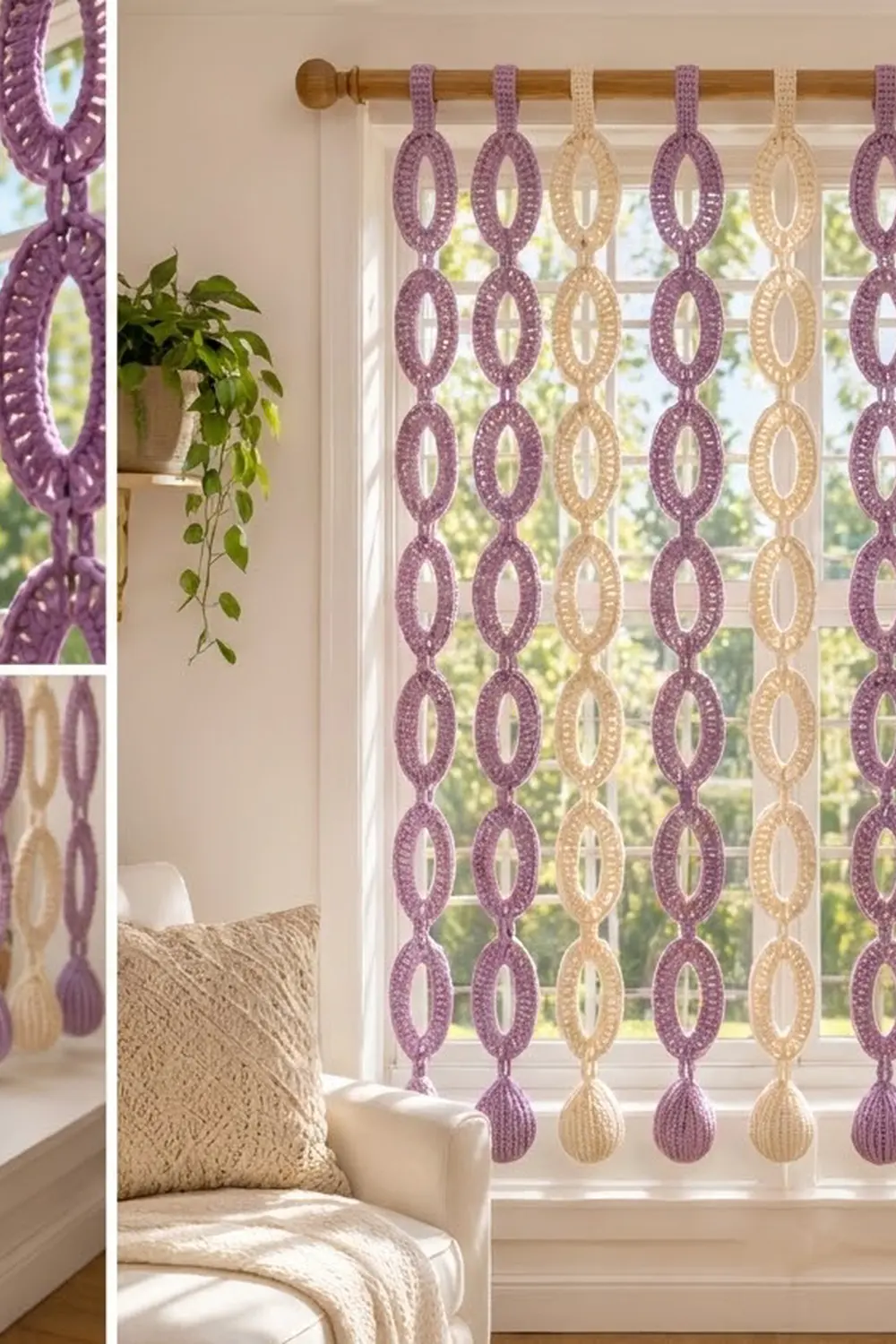
This crocheted window curtain is made of eight long, separate strands of oval links. Each strand hangs from its own folded tab on a wooden rod and ends in a small stuffed drop. Light shows through every link, so the curtain softens a sunny window without darkening the room.
The strands alternate between soft lavender and warm cream. Each oval link is a thick ring: a single crochet edge around the inner opening, a middle round of double crochet stitches that fan outward like spokes, and a neat single crochet outer edge. Short, solid connector strips join the links into a chain.
The pattern uses US crochet terms. Each finished strand is about 61 in (154.9 cm) long from the top of the rod to the tip of the drop. Each link is 5 in (12.7 cm) long and 3 in (7.6 cm) wide. With strand centers 5 in (12.7 cm) apart, the curtain covers about 38 in (96.5 cm) of rod.
Construction is simple and repeatable. You crochet each oval link separately in three rounds, join the links into strands with a crocheted connector strip, add a rod tab to the top link, and sew a small stuffed drop to the bottom link.
Finished Size and Construction
- Finished curtain: about 38 in (96.5 cm) wide x 61 in (154.9 cm) long
- Skill level: Advanced beginner
- Terminology: US crochet terms
- Yarn weight: Worsted weight (#4)
- Hook: 5 mm (H-8)
- Number of pieces: 72 oval links, 64 connector strips, 8 rod tabs and 8 drops, forming 8 separate strands
- Layout: 8 strands side by side, 9 links per strand, alternating lavender and cream
- Link size: 5 in (12.7 cm) long x 3 in (7.6 cm) wide; inner opening about 3 in (7.6 cm) x 1 in (2.5 cm)
- Link size before the outer edge round (after Round 2): 4.5 in (11.4 cm) x 2.5 in (6.4 cm)
- Edge finishing depth: the rod tab adds 2 in (5.1 cm) at the top; the drop adds 2 in (5.1 cm) at the bottom
The strands are not joined to each other. Each one hangs on its own, so you can space them however your window needs.
Materials
Choose a smooth worsted weight cotton or cotton blend. Cotton holds the oval shape well, shows the double crochet spokes clearly and doesn’t stretch much under its own weight. Avoid fuzzy yarns, which blur the stitches.
- Lavender: 150 g / 300 m (about 330 yd), for 4 strands
- Cream: 150 g / 300 m (about 330 yd), for 4 strands
Each strand uses about 56 m (61 yd), or about 28 g. The amounts above include a margin of about one third for gauge differences, swatching and weaving in ends.
Tools:
- 5 mm (H-8) crochet hook
- Tapestry needle
- Locking stitch markers (at least 4)
- Small amount of polyester fiberfill for the drops
- Scissors
- Blocking mat, rust-proof pins and a spray bottle
- Wooden curtain rod up to 1 in (2.5 cm) in diameter
Abbreviations (US Terms)
- ch = chain
- sl st = slip stitch
- sc = single crochet
- dc = double crochet
- sc2tog = single crochet 2 together
- st(s) = stitch(es)
- Rnd = round
- inc = 2 sc in the same stitch
Special technique: working into the chain ring. In Round 1 you work into the chain stitches themselves (under the top loop and back bump), not into the center hole. This keeps the inner opening a clean, firm oval instead of a puckered circle.
sc2tog: Insert hook in next st, yarn over, pull up a loop; insert hook in following st, yarn over, pull up a loop; yarn over and pull through all 3 loops on hook.
Gauge and Checkpoints
Gauge: 16 sc and 18 sc rows = 4 in (10.2 cm). In double crochet, 14 dc = 4 in (10.2 cm), and one dc round is about 0.5 in (1.3 cm) tall.
Make one complete link before anything else. Lay it flat and measure it without stretching.
- Foundation ring laid flat: about 3 in (7.6 cm) long
- After Rnd 1: 3.5 in (8.9 cm) x 1.5 in (3.8 cm)
- After Rnd 2: 4.5 in (11.4 cm) x 2.5 in (6.4 cm)
- After Rnd 3: 5 in (12.7 cm) x 3 in (7.6 cm)
If your link is more than 0.25 in (0.6 cm) too large, go down half a hook size. If it’s too small, go up half a hook size. If the length is right but the ends ruffle, your end increases are too loose, so tighten your tension on the end stitches only.
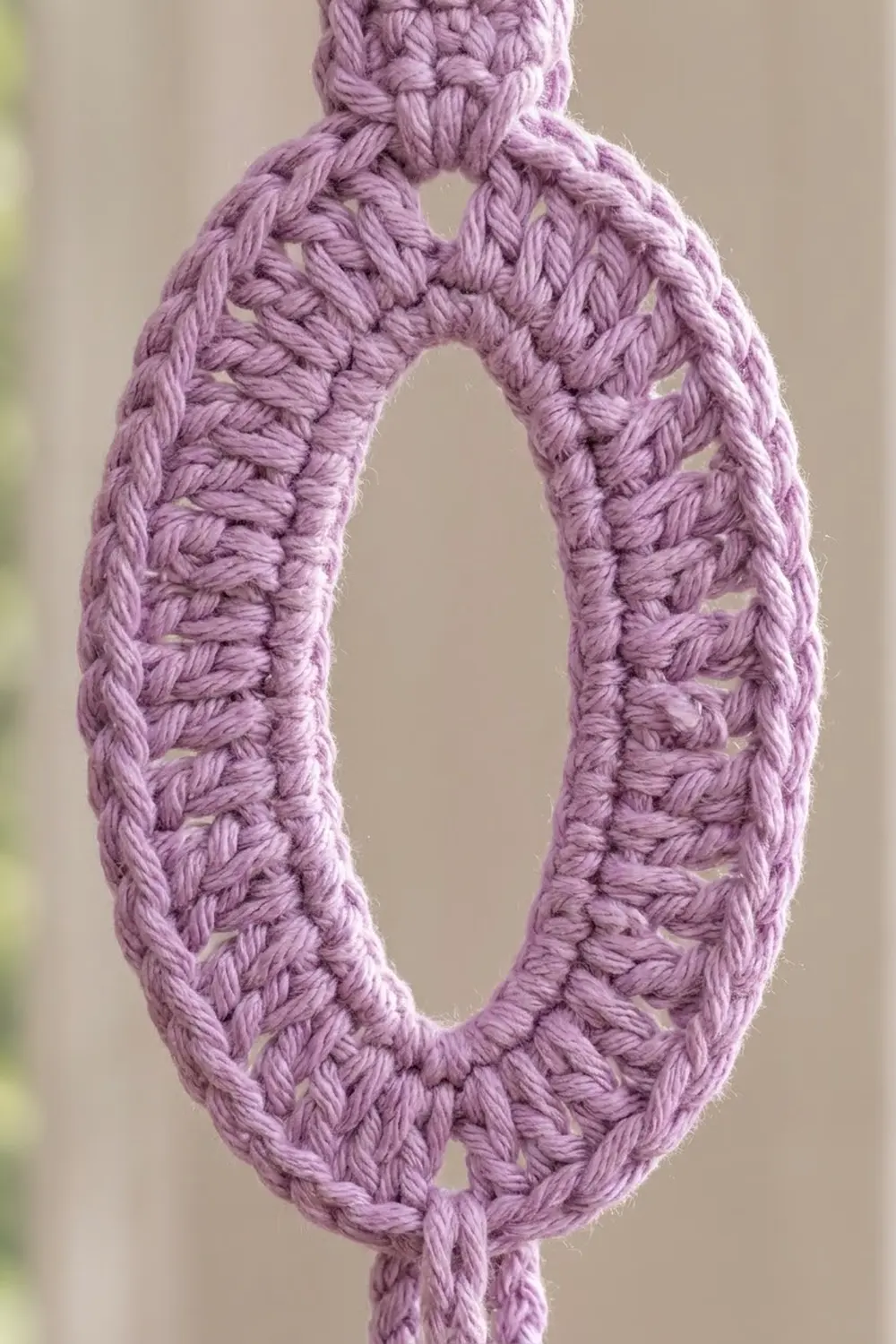
Oval Link (make 72: 36 lavender, 36 cream)
Foundation: Ch 24, sl st in first ch to form a ring. Make sure the chain isn’t twisted.
Lay the ring flat as a long oval and think of it in four sections:
- Side A: ch 1–10
- End 1: ch 11–12
- Side B: ch 13–22
- End 2: ch 23–24
Rnd 1 (growth round): Ch 1 (does not count as a st). Working into each ch of the ring, sc in ch 1–10, 2 sc in each of ch 11 and 12, sc in ch 13–22, 2 sc in each of ch 23 and 24. Sl st in first sc to join. (28 sc)
Section check: 10 + 4 + 10 + 4 = 28.
Rnd 2 (growth round): Ch 3 (counts as first dc), dc in next 9 sts, 2 dc in each of next 4 sts, dc in next 10 sts, 2 dc in each of next 4 sts. Sl st in top of ch-3 to join. (36 dc)
Section check: 10 + 8 + 10 + 8 = 36. These dc stitches stand up from the inner edge and fan around the curved ends, which creates the spoke texture.
Rnd 3 (growth round): Ch 1, sc in first 10 sts, (sc in next st, inc in next st) 4 times, sc in next 10 sts, (sc in next st, inc in next st) 4 times. Sl st in first sc to join. (44 sc)
Section check: 10 + 12 + 10 + 12 = 44.
Fasten off, leaving a 4 in (10.2 cm) tail. Weave in all ends.
Mark the end centers. In Rnd 3, sts 11–22 form End 1 and sts 33–44 form End 2. The center of End 1 falls between st 16 and st 17. The center of End 2 falls between st 38 and st 39. Place a marker in st 16 and in st 38 of every link now, so joining goes quickly later.
Make All Pieces
For the full curtain, make:
- Lavender: 36 links, 32 connectors, 4 tabs, 4 drops
- Cream: 36 links, 32 connectors, 4 tabs, 4 drops
Layout from left to right, as seen from inside the room (L = lavender strand, C = cream strand, each strand 9 links tall):
Rod:   ====================================
       |    |    |    |    |    |    |    |
Tabs:  L    C    L    C    L    C    L    C
Links: O    O    O    O    O    O    O    O   (x9 each)
Drops: o    o    o    o    o    o    o    o
Keep each strand in one color. Sort finished links into color piles of 9 so each strand is ready to put together.
Joining
Links are joined end to end with a small solid strip in the strand’s own color.
Connector (make 8 per strand):
- With End 2 of Link A at the bottom, join yarn with a sl st in st 38.
- Ch 6.
- Sl st in st 17 of Link B (the top end of the next link). Turn.
- Sc in each of the 6 ch. (6 sc)
- Sl st in st 39 of Link A. Fasten off and weave in ends.
Stitch logic: Each connector holds 2 center stitches at each end: sts 38–39 at the bottom of Link A and sts 16–17 at the top of Link B. Because these stitches sit exactly at the end centers, the links hang straight with no twist.
Tension: Keep the 6 ch at gauge. Loose chains make a connector longer than planned, and the strand will sag. Tight chains pull the links together so they buckle.
Size checkpoint: Each connector should measure 1.5 in (3.8 cm) between the two links. After joining 9 links with 8 connectors, the linked section measures 9 x 5 in = 45 in (114.3 cm) plus 8 x 1.5 in = 12 in (30.5 cm), for 57 in (144.8 cm) in total.
Edge Finishing: Rod Tabs and Drops
This curtain has no traditional border. Instead, the top and bottom of every strand are finished with a rod tab and a stuffed drop.
Edge gauge: 16 sc and 18 sc rows = 4 in (10.2 cm), the same as the main gauge.
Rod tab (make 1 per strand, worked on the top link):
Row 1: With End 1 of the top link facing up, join yarn in st 14. Ch 1, sc in sts 14, 15, 16, 17, 18 and 19. Turn. (6 sc)
Rows 2–18: Ch 1, sc in each st across. Turn. (6 sc each row)
Fasten off, leaving a 12 in (30.5 cm) tail. Fold the tab back over the rod toward the front of the link and whipstitch Row 18 to the base of Row 1.
Why the math works: End 1 has 12 stitches (sts 11–22). Sts 14–19 are the center 6, with 3 unused stitches on each side, so the tab sits exactly over the end center between sts 16 and 17. Six sc at 16 sc per 4 in gives a tab 1.5 in (3.8 cm) wide, the same width as the connectors. Eighteen rows give 4 in (10.2 cm) of length. When folded, that makes a loop with a 4 in (10.2 cm) circumference. That’s enough to slide over a rod up to 1 in (2.5 cm) in diameter, which has a circumference of about 3.1 in (8.0 cm). The folded loop hangs about 2 in (5.1 cm) deep.
Drop (make 1 per strand):
Rnd 1: 6 sc in a magic ring. (6 sc)
Rnd 2: Inc in each st around. (12 sc)
Rnd 3: (Sc in next st, inc in next st) 6 times. (18 sc)
Rnds 4–6: Sc in each st around. (18 sc each round)
Rnd 7: (Sc in next st, sc2tog) 6 times. (12 sc)
Stuff firmly with fiberfill.
Rnd 8: Sc2tog 6 times. (6 sc)
Rnds 9–10: Sc in each st around. (6 sc each round) These two rounds form the neck.
Fasten off, leaving a 12 in (30.5 cm) tail. Sew the top of the neck to sts 38–39 at the bottom center of the last link.
Why the math works: Eighteen sc around at gauge give a 4.5 in (11.4 cm) circumference, so the drop is about 1.5 in (3.8 cm) wide. With the neck, it adds 2 in (5.1 cm) of length. Sewing it to sts 38–39 puts it on the same center line as every connector, so the strand hangs straight.
Full strand length: 2 in (5.1 cm) tab + 57 in (144.8 cm) of links and connectors + 2 in (5.1 cm) drop = 61 in (154.9 cm).
Final Blocking
- Lay each finished strand flat on a blocking mat.
- Mist the strand evenly with water until it’s damp but not soaked.
- Shape each link into a smooth oval, 5 in (12.7 cm) x 3 in (7.6 cm).
- Pin the inner opening at 3 in (7.6 cm) x 1 in (2.5 cm), using two pins at each end.
- Straighten each connector so it runs exactly along the center line of the strand.
- Check the full length: 61 in (154.9 cm), including the tab and drop.
- Let the strand dry completely before unpinning. Don’t block the drops; just roll them gently to round them.
Final Quality-Control Checklist
- Every link has 28, 36 and 44 stitches in Rnds 1, 2 and 3.
- Every link measures 5 in (12.7 cm) x 3 in (7.6 cm).
- Each strand has 9 links, 8 connectors, 1 tab and 1 drop.
- All connectors measure 1.5 in (3.8 cm) and sit on the end centers.
- Each tab is 6 sc wide, 18 rows long and sewn securely.
- All 8 strands are 61 in (154.9 cm) long and within 1 in (2.5 cm) of each other.
- Colors alternate L, C, L, C, L, C, L, C across the rod.
- All ends are woven in and can’t be seen from either side.
Troubleshooting
Links curl or cup. Rnd 3 is too tight. Go up half a hook size for Rnd 3 only.
Link ends ruffle. Your end increases are too loose. Keep the increase stitches the same height as the rest of the round.
The inner opening is round instead of oval. Rnd 1 was worked into the center hole. Work it into the chain stitches themselves.
A strand twists when hanging. A connector is off center. Check that it uses sts 38–39 and 16–17.
Strands are different lengths. Measure each connector and rework any that are longer than 1.5 in (3.8 cm).
A tab won’t fit the rod. Add 2 more rows to each tab for every extra 0.5 in (1.3 cm) of rod diameter.
Care
Hand wash in cool water with a mild detergent. Press the water out in a towel and dry flat, reshaping the links while damp if needed.
Final Notes
The whole curtain depends on one chain of measurements. A 24-chain ring grows to 28, then 36, then 44 stitches, making a link of 5 in (12.7 cm) x 3 in (7.6 cm). Nine links and eight 1.5 in (3.8 cm) connectors make 57 in (144.8 cm). A 2 in (5.1 cm) tab and a 2 in (5.1 cm) drop bring each strand to 61 in (154.9 cm). Eight strands spaced 5 in (12.7 cm) apart cover 38 in (96.5 cm) of rod. Check your first link carefully, and every link after it will follow.
Happy crocheting!