

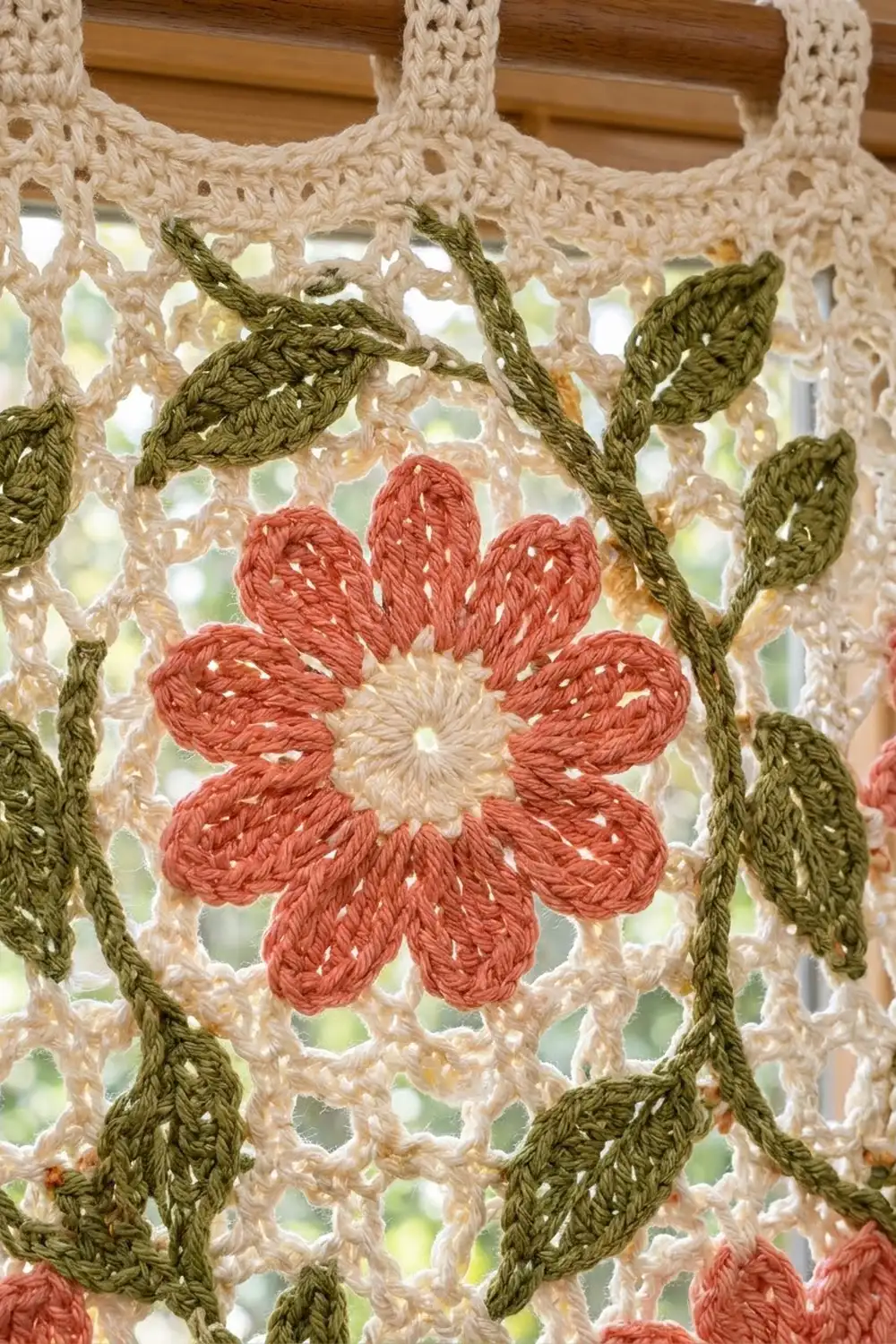
The Coral Vine Café Valance is a light, cottage-style window topper. It has an airy cream mesh base with coral daisy-style flowers and winding olive green vines sewn on top. Light comes through the mesh, so the flowers look like they are climbing across the window.
There are three colors: cream for the mesh, borders, tabs and flower centers; coral for the petals; and olive green for the vines and leaves. The style is relaxed and a little vintage, and it suits a kitchen or breakfast nook.
The finished valance is about 35 in (88.9 cm) wide and 14.5 in (36.8 cm) deep, not counting the tabs. With the tabs, the total length is about 17.5 in (44.5 cm). This pattern uses US crochet terms.
Construction is simple. You work one rectangular chain-mesh panel in rows, then add a single-crochet border round, a short top band, ten tabs and a scalloped hem. After that, you make the flowers, leaves and vine cords separately and sew them onto the mesh.
Finished Size and Construction
- Finished size: about 35 in × 14.5 in (88.9 cm × 36.8 cm), plus 3 in (7.6 cm) tab loops
- Skill level: Intermediate
- Terminology: US
- Yarn weight: DK (#3) cotton
- Hook: 4.0 mm (G-6)
- Number of pieces: 1 mesh panel + 11 flowers + 28 leaves + 7 vine cords (appliqués)
- Layout: flowers in two staggered rows, 6 on top and 5 below, with one vine beside each pair
- Flower size: 3 in (7.6 cm) across
- Panel size before border: 34.4 in × 12.5 in (87.4 cm × 31.8 cm)
- Border depth: 0.25 in (0.6 cm) at the sides, 0.75 in (1.9 cm) top band, 1.25 in (3.2 cm) scalloped hem
Materials
Use a smooth, mercerized or matte DK cotton. Cotton keeps the mesh crisp, takes blocking well and does not stretch on a sunny window.
- Cream: 120 g / 275 m
- Coral: 30 g / 70 m
- Olive green: 25 g / 55 m
You will also need:
- 4.0 mm (G-6) crochet hook
- Tapestry needle
- Locking stitch markers
- Rust-proof pins and a blocking board or towels
- Measuring tape
- Washable fabric marker or tailor’s chalk
These quantities include a margin of about 25%, so dye-lot shortages and a swatch are covered.
Abbreviations (US Terms)
- ch – chain
- sl st – slip stitch
- sc – single crochet
- hdc – half double crochet
- dc – double crochet
- tr – treble crochet
- sk – skip
- sp – space
- st(s) – stitch(es)
- RS / WS – right side / wrong side
Picot: ch 3, then sl st into the top of the sc you just made.
Gauge and Checkpoints
Mesh gauge: 5 ch-5 loops × 8 rows = 4 in × 4 in (10.2 cm × 10.2 cm), measured after light blocking. Each loop is 0.8 in (2.0 cm) wide and each row is 0.5 in (1.3 cm) tall.
Border gauge: 19 sc = 5 in (12.7 cm), and 4 sc rows = 1 in (2.5 cm).
Make one test flower first. It should measure 3 in (7.6 cm) across. If you can, keep it and use it as one of your eleven.
Checkpoints:
- After Row 1: the foundation should measure 34.4 in (87.4 cm) when relaxed.
- After Row 8: the mesh should measure 4 in (10.2 cm) tall.
- After Row 25: the panel should measure 34.4 in × 12.5 in (87.4 cm × 31.8 cm).
- After Border Round 1: the piece should measure about 35 in × 13 in (88.9 cm × 33.0 cm).
- After the hem and top band: the piece should measure 35 in × 14.5 in (88.9 cm × 36.8 cm).
If your swatch is too big, go down one hook size. If it is too small, go up one size. Mesh is forgiving, but a difference of 1 in (2.5 cm) over the width will show on the rod.
Mesh Panel
Use cream.
Foundation: Ch 174. This is a multiple of 4 + 2.
Row 1: Sc in the 2nd ch from the hook. Ch 5, sk 3 ch, sc in the next ch. Repeat from * 43 times. (43 ch-5 loops, 44 sc)
Row 2: Ch 5 (counts as dc + ch 2), turn. Sc in the first ch-5 sp. (Ch 5, sc in the next ch-5 sp) 42 times. Ch 2, dc in the last sc. (42 ch-5 loops + 2 half loops)
Row 3: Ch 1, turn. Sc in the first dc. (Ch 5, sc in the next ch-5 sp) 42 times. Ch 5, sc in the 3rd ch of the turning ch-5. (43 ch-5 loops, 44 sc)
Rows 4–25: Repeat Rows 2 and 3 eleven more times, ending with a Row 3 repeat. Do not fasten off.
The panel has 25 rows and measures 34.4 in × 12.5 in (87.4 cm × 31.8 cm). Every odd row has exactly 43 full loops. That loop count is what the border math depends on.
Border
Each side count below runs from corner stitch to corner stitch, and includes both corner stitches. In each 3-sc corner group, the middle sc is the corner stitch.
Round 1 (cream, all around): Ch 1. Work 3 sc in the last sc of Row 25 (top-right corner).
- Top edge: 3 sc in each of the 43 loops (129 sc), then 3 sc in the final sc (top-left corner).
- Left side: 2 sc around each row end from Row 24 to Row 2 (46 sc).
- Bottom edge: 3 sc in the free loop of the corner foundation ch. Then work 1 sc in the free loop of each of the 3 skipped chs in every segment (43 × 3 = 129 sc), skipping the chs that sit under Row 1 sc. Work 3 sc in the last corner ch.
- Right side: 2 sc around each row end from Row 2 to Row 24 (46 sc).
Sl st to the first sc. Fasten off.
Stitch counts for Round 1:
- Top: 1 + 1 + 129 + 1 + 1 = 133 sts
- Bottom: 133 sts
- Each side: 1 + 1 + 46 + 1 + 1 = 50 sts
- Total: 133 + 133 + 50 + 50 − 4 shared corners = 362 sts
Scalloped Hem
Turn the panel so the bottom edge is at the top, with the RS facing you.
Row S1: Join cream in the bottom-right corner st and sc in the same st. Sk 5 sts, 13 dc in the next st, sk 5 sts, sc in the next st. Repeat from * 11 times, ending in the opposite corner st. (11 shells, 12 sc)
Row S2: Ch 1, turn, sl st in the first sc. Sc in the first dc of the shell, (picot, sc in the next 2 dc) 6 times, sl st in the next sc. Repeat from * 11 times. Each scallop has 13 sc and 6 picots. Fasten off.
Each scallop measures about 3.2 in (8.1 cm) wide.
Top Band
Row T1: With the RS facing, join cream in the top-right corner st. Ch 1, sc in each of the 133 sts.
Row T2: Ch 1, turn, sc in each st. (133 sts) Fasten off.
Tabs
Tab Row 1: With the RS facing, join cream in st 1 of Row T2. Ch 1, sc in sts 1–7. (7 sc)
Tab Rows 2–24: Ch 1, turn, sc in each st. (7 sc)
Fasten off, leaving a 12 in (30.5 cm) tail. The tab measures 6 in × 1.8 in (15.2 cm × 4.6 cm).
Skip 7 sts. Work the next tab over sts 15–21. Continue this way, placing tabs over sts 29–35, 43–49, 57–63, 71–77, 85–91, 99–105, 113–119 and 127–133. That gives 10 tabs.
Fold each tab to the WS and whipstitch the last row to Row T1. This forms a 3 in (7.6 cm) loop that fits rods up to 1.5 in (3.8 cm) across.
Why the Math Works
- Top and bottom counts: 43 loops × 3 sc = 129, plus 4 corner-group sts, gives 133.
- Scallops: the hem uses 1 + (11 × 12) = 133 sts, so it starts and ends exactly on the corners.
- Tabs: 10 tabs × 7 sts plus 9 gaps × 7 sts = 133, so the first and last tabs sit flush with the edges.
- Width: at the border gauge, 133 sc spans 35 in (88.9 cm). That equals the 34.4 in (87.4 cm) panel plus a 0.25 in (0.6 cm) border on each side, with the corner stitches easing in.
Flowers (Make 11)
Rnd 1 (cream): Make a magic ring. Ch 1, then work 12 sc in the ring. Sl st to the first sc. (12 sc)
Rnd 2 (cream): Ch 1, 2 sc in each st, sl st to the first sc. Fasten off. (24 sc) The center measures 1.25 in (3.2 cm).
Rnd 3 (coral): Join coral with a sl st in any sc. Ch 3, sk 1 sc, sl st in the next sc. Repeat from * 12 times, working the last sl st into the joining st. (12 ch-3 sps)
Rnd 4 (coral): In each ch-3 sp, work (hdc, dc, 2 tr, dc, hdc), then sl st in the next sl st. Each petal has 6 sts. (12 petals, 72 sts + 12 sl sts)
Fasten off, leaving a 16 in (40.6 cm) tail for sewing. The flower measures 3 in (7.6 cm) across.
Leaves (Make 28)
Use olive green.
Ch 8. Sc in the 2nd ch from the hook, hdc in the next ch, dc in the next 2 ch, hdc in the next ch, sc in the next ch. Work (sc, ch 2, sc) in the last ch for the tip.
Rotate the leaf and work along the other side of the chain: sc, hdc, 2 dc, hdc, sc. Sl st to the first sc. (14 sts + ch-2 tip)
Fasten off, leaving a 10 in (25.4 cm) tail. The leaf measures 1.75 in × 0.75 in (4.4 cm × 1.9 cm).
Vine Cords (Make 7)
Use olive green.
Ch 76. Sl st in the back bump of the 2nd ch from the hook and of each ch across. (75 sl sts)
The cord measures about 15 in (38.1 cm). Leave tails at both ends.
Make All Pieces
| Piece | Qty | Color |
|---|---|---|
| Mesh panel with border, hem, band and tabs | 1 | Cream |
| Flowers | 11 | Cream centers, coral petals |
| Leaves | 28 | Olive green |
| Vine cords | 7 | Olive green |
Layout. Loops are numbered 1–43 from right to left, and rows are numbered from the bottom. F marks a flower, V marks a vine and · marks plain mesh.
Row 18:  V · F · V · F · V · F · V · F · V · F · V
Row 7:   V · · F · V · F · V · F · V · F · V · F · · V
- Top-row flowers: centered on Row 18, between loops 4/5, 11/12, 18/19, 25/26, 32/33 and 39/40.
- Bottom-row flowers: centered on Row 7, on loops 8, 15, 22, 29 and 36.
- Spacing: flowers in each row are 5.6 in (14.2 cm) apart, center to center.
Joining (Attaching the Appliqués)
Method: Sew with a tapestry needle and the matching yarn tail, catching only the mesh strands. Do not pass through the solid border.
Vines first: Pin each vine as a gentle S-curve. It should start at Row T1, swing beside a top-row flower, curve around the side of the lower flower beneath it and end at Border Round 1. Mark the curves with chalk first.
Tack the vine every 0.5 in (1.3 cm), stitching into the nearest mesh strand. Two adjacent vine sl sts should land on one mesh sc or chain.
Flowers: Whipstitch Rnd 2 of each flower to the mesh all the way around. Then tack the tip of each petal at its center tr to the nearest mesh strand. That makes 12 tacks per flower, and keeps the petals from flipping up.
Leaves: Sew 4 leaves to each vine, alternating sides. Anchor each leaf at its base and at its ch-2 tip so it stays flat.
Tension: Each stitch should snug the piece against the mesh without puckering it. If the mesh pulls into dimples, your stitches are too tight.
Checkpoint: Measure again after sewing. The valance should still be 35 in (88.9 cm) wide. If the width has dropped by more than 0.5 in (1.3 cm), loosen the vine tacks.
Final Blocking
- Soak the valance in cool water for 15 minutes.
- Press out the water in a towel. Do not wring it.
- Lay it RS up on a blocking board.
- Pin the top band straight to 35 in (88.9 cm).
- Pin the sides square to 14.5 in (36.8 cm).
- Pin out each scallop at its center picot.
- Ease the mesh loops open into even hexagons.
- Flatten the petals and leaves by hand.
- Let it dry completely, which takes about 24 hours.
- Unpin it and hang it straight away.
Final Quality-Control Checklist
- Odd rows each have 43 loops.
- The panel measures 34.4 in × 12.5 in (87.4 cm × 31.8 cm) before the border.
- Border Round 1 has 362 sts.
- There are 11 scallops, each with 6 picots.
- There are 10 tabs, evenly spaced and folded to the WS.
- All 11 flowers have 12 petals, each tacked down.
- There are 28 leaves, 4 per vine.
- The vines curve smoothly with no gaps.
- The finished size is 35 in × 14.5 in (88.9 cm × 36.8 cm).
- All yarn ends are woven in.
Troubleshooting
- The mesh leans to one side: You may be missing the final half loop on even rows. Count the 2 half loops on every even row.
- The border ruffles: Your sc is looser than the gauge. Go down one hook size for the border only.
- The border pulls in: Go up one hook size and check that you worked 3 sc per loop.
- The scallops cup: Work the shells loosely, or block them more firmly.
- The flowers cup: Rnd 3 chains are too tight. Use ch 4 instead of ch 3.
- The leaves curl: Steam-block them flat before sewing.
- The tabs stretch: Work them firmly, or add a Row 25 to strengthen the fold.
Care
Hand wash in cool water and dry flat, re-shaping the scallops and petals. Keep the valance out of the dryer so the mesh does not shrink.

Final Notes
The sizes all build from one count. Row 1 gives 43 loops at 0.8 in (2.0 cm) each, which makes a 34.4 in (87.4 cm) panel. Twenty-five rows bring it to 12.5 in (31.8 cm) tall. Border Round 1 has 133 sts per long side. The 0.75 in (1.9 cm) top band and the 1.25 in (3.2 cm) scalloped hem bring the depth to 14.5 in (36.8 cm), and the ten tabs add 3 in (7.6 cm). Check your gauge, count your loops, and the flowers will land where they should.
Happy crocheting!