

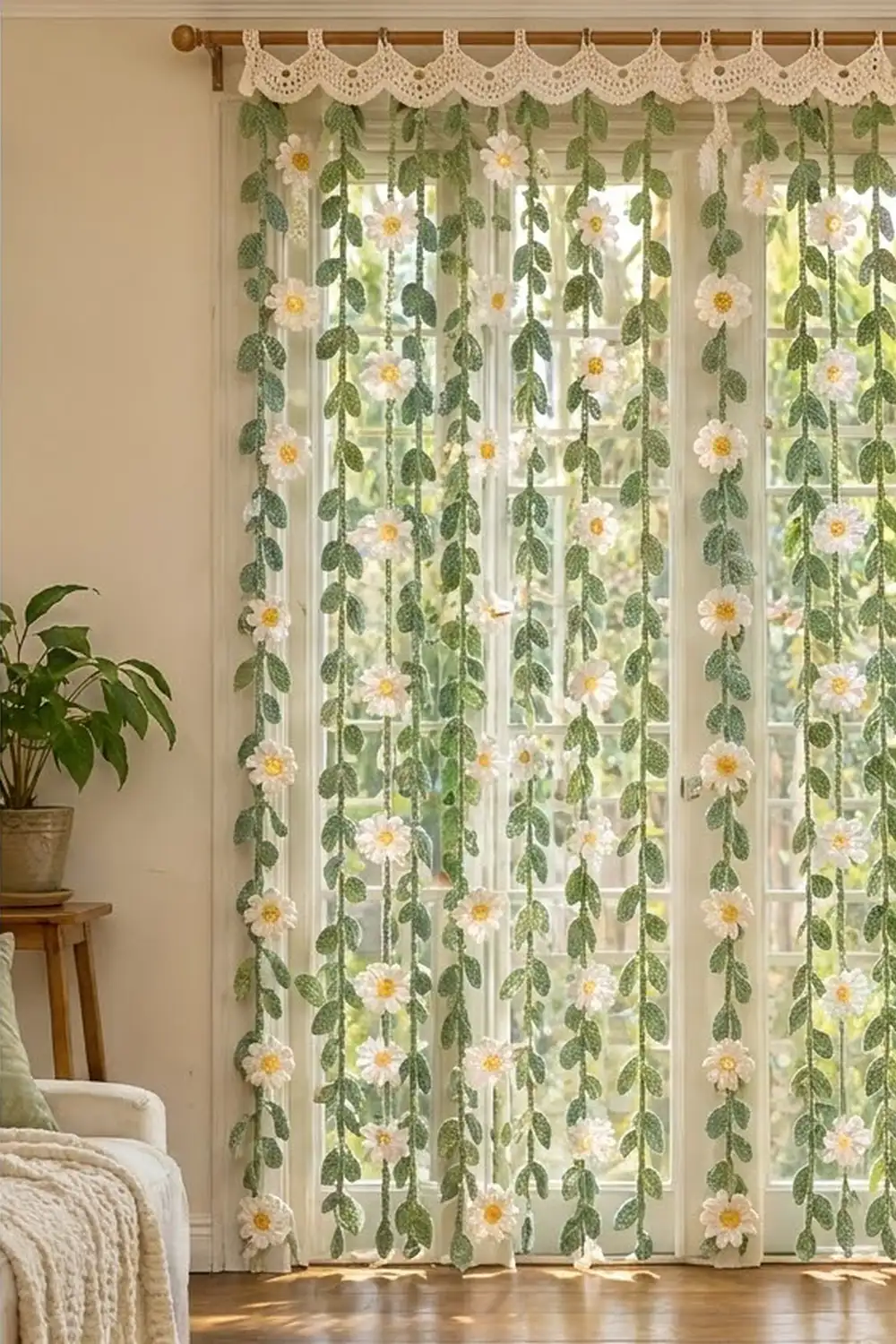
This curtain brings a summer meadow to your window. A soft ivory header band with lacy, picot-trimmed scallops hangs from a wooden rod on crochet loops. Below it, 16 sage-green vines fall toward the floor. Each vine is lined with plump two-sided leaves and dotted with white daisies with sunny yellow centers.
The palette is soft and natural: ivory, sage green, white, and golden yellow. The style is cottage-garden. The curtain lets light through rather than blocking it, so it suits French doors, a sunny window, or use as a room divider.
The pattern uses US crochet terms. The finished curtain measures 48¼ in (122.6 cm) wide and 77 in (195.6 cm) long, measured from the top of the header band to the vine tips. The rod loops add about 1¾ in (4.4 cm) above that.
Construction is straightforward. First you crochet one header band in rows and finish its lower edge with scallops. Next you make 16 vines from a chain spine, working the leaves in as you go. Then you make 112 small daisies and sew them on. Finally, you join each vine to a scallop tip, add the rod-loop border along the top, and block.
Finished Size and Construction
- Finished size: 48¼ in (122.6 cm) wide x 77 in (195.6 cm) long, plus 1¾ in (4.4 cm) rod loops
- Skill level: Intermediate
- Terminology: US crochet terms
- Yarn weight: Worsted (#4) cotton
- Hook: 4.5 mm (US 7)
- Number of pieces: 129 (1 header band, 16 vines, 112 daisies)
- Layout: 16 vines in a single row, one per scallop tip, 3 in (7.6 cm) apart
- Header band size before border: 48¼ in (122.6 cm) x 4½ in (11.4 cm), including scallops
- Vine length: 72 in (182.9 cm)
- Daisy size: 2½ in (6.4 cm) across
- Border depth: ½ in (1.3 cm) sc band, plus loops about 1¾ in (4.4 cm) tall
Materials
Use a smooth 100% cotton or cotton-blend worsted yarn of about 180 m (197 yd) per 100 g. Cotton holds the leaf and petal shapes crisply and stretches very little while it hangs. Avoid fuzzy or splitty yarns. They hide the stitch definition and snag when you work into chain back bumps.
- Sage green (vines and leaves): 560 g, about 1,000 m (1,094 yd)
- White (petals): 290 g, about 520 m (569 yd)
- Ivory (header and border): 85 g, about 150 m (164 yd)
- Golden yellow (daisy centers): 75 g, about 130 m (142 yd)
These quantities include a margin of about 15%.
Tools:
– 4.5 mm (US 7) crochet hook
– Tapestry needle
– 20 or more locking stitch markers
– Tape measure and scissors
– Blocking mats, rust-proof pins, and a spray bottle
– Curtain rod up to 1¼ in (3.2 cm) in diameter
Abbreviations (US Terms)
- ch – chain
- sl st – slip stitch
- sc – single crochet
- hdc – half double crochet
- dc – double crochet
- st(s) – stitch(es)
- sk – skip
- sp – space
- RS – right side
- rep – repeat
Special stitches:
– Back bump: the horizontal bar on the back of a chain. Working the vine spine into the back bumps gives a neat, round cord.
– Picot: ch 3, sl st in the same space.
– Surface vein sl st: insert the hook through the leaf along its center line, between the bases of side 1 and side 2. Yarn over and pull the loop through the leaf and the loop on the hook.
Gauge and Checkpoints
Make one test piece of each type before you start making all the pieces.
- Header gauge: 16 hdc and 12 rows = 4 in (10.2 cm). To swatch, ch 18 and work 16 hdc for 12 rows.
- Vine gauge: 5 spine sts = 1 in (2.5 cm). To swatch, ch 41 and work the return row as written below with 3 leaves. The spine should measure 8 in (20.3 cm).
- Leaf: 1¾ in (4.4 cm) long and about 1 in (2.5 cm) wide.
- Daisy: 2½ in (6.4 cm) across, with a yellow center about 0.6 in (1.5 cm) across.
If your swatch is too big, switch to a 4.0 mm hook. If it is too small, switch to a 5.0 mm hook. Vine gauge matters most, because any error repeats over the full 72 in (182.9 cm).
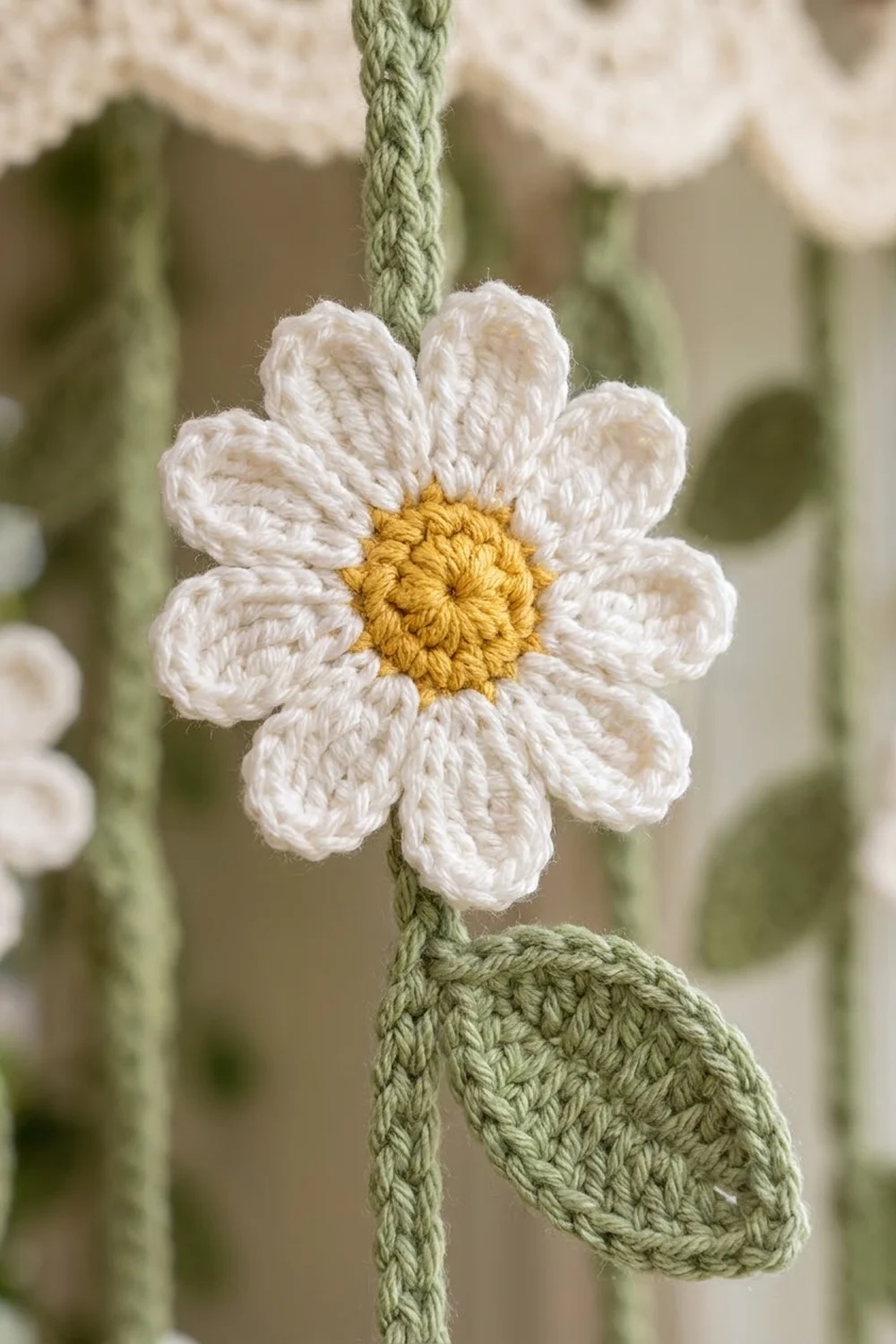
Daisy (make 112)
Rnd 1 (yellow): Make a magic ring, ch 1, and work 10 sc in the ring. Pull the ring closed and join with a sl st to the first sc. (10 sc) Fasten off yellow.
Checkpoint: the center measures about 0.6 in (1.5 cm) across.
Rnd 2 (white): Join white with a sl st in any sc. *Ch 7, sl st in next sc; rep from * around, working the last sl st into the joining st. (10 ch-7 loops)
Rnd 3: Sl st into the first ch-7 loop. In each loop, work (sc, hdc, 2 dc, ch 1, 2 dc, hdc, sc). Join with a sl st to the first sc. (10 petals: 80 sts plus 10 ch-1 tip spaces)
Fasten off, leaving a 12 in (30.5 cm) white tail for sewing.
Checkpoint: the daisy is 2½ in (6.4 cm) across and lies flat, with 10 rounded petals.
Vine (make 16)
Each vine is a chain worked back along itself in sl sts, which makes a firm spine. The leaves are worked off the spine as you go. Spine sts are numbered from the bottom tip (st 1) to the top (st 360).
Foundation: With sage green, ch 361. Place a marker every 50 ch to make counting easier.
Return row: Sl st in the back bump of the 2nd ch from the hook and in the back bump of each of the next 9 ch. (10 spine sts)
*Make Leaf, then sl st in the back bump of each of the next 10 ch; rep from * 34 more times. (35 leaves; 10 + 35 x 10 = 360 spine sts)
The leaves sit after spine sts 10, 20, 30, and so on up to 350. The top 10 sts (351–360) stay bare, so the highest leaf hangs 2 in (5.1 cm) below the scallop. Fasten off, leaving a 12 in (30.5 cm) tail for joining.
Leaf (worked within the return row)
- Stem chain: Ch 8.
- Side 1 (tip to base): Sl st in the 2nd ch from the hook, sc in the next ch, hdc in the next ch, dc in each of the next 2 ch, hdc in the next ch, sc in the last ch. (7 sts) Sl st in the spine st the leaf grows from.
- Side 2 (base to tip): Rotate the leaf and work into the free loops of the same chain: sc, hdc, dc, dc, hdc, sc, then sl st in the last free loop. (7 sts)
- Tip: Sl st in the skipped tip ch to round the point. (1 st)
- Vein: Work 7 surface vein sl sts down the center line of the leaf. Then sl st into the same spine st. (7 sts)
Each leaf has 22 sts. The stitch heights (sc–hdc–dc–dc–hdc–sc) make the pointed oval shape, and the surface sl sts form the raised vein.
Push odd-numbered leaves to the left and even-numbered leaves to the right. That gives 18 leaves on the left and 17 on the right. Blocking sets them in place.
Checkpoint: the finished spine measures 72 in (182.9 cm).
Header Band (make 1)
Row 1: With ivory, ch 195. Hdc in the 3rd ch from the hook and in each ch across. (193 hdc) The turning ch does not count as a stitch.
Rows 2–9: Ch 2, turn, hdc in each st across. (193 hdc)
Checkpoint: the band measures 48¼ in (122.6 cm) x 3 in (7.6 cm).
Row 10 (fans): Ch 1, turn, sc in the first st. *Sk 5 sts, 11 dc in the next st, sk 5 sts, sc in the next st; rep from * 15 more times. (16 fans; 176 dc + 17 sc = 193 sts)
Row 11 (open scallop): Ch 1, turn, sc in the first sc. *Ch 1, (dc in the next dc, ch 1) 11 times, sc in the next sc; rep from * across. (176 dc + 17 sc = 193 sts, plus 192 ch-1 sps)
Row 12 (picot trim): Ch 1, turn, sl st in the first sc. *(Sl st in the next ch-1 sp, picot, sl st in the next dc) 11 times, sl st in the next ch-1 sp, picot, sl st in the next sc; rep from * across. (192 picots, 12 per scallop) Fasten off.
Mark the 6th dc of Row 11 in each fan. These 16 fan tips are 12 sts, or 3 in (7.6 cm), apart.
Checkpoint: the band is 48¼ in (122.6 cm) wide and 4½ in (11.4 cm) deep at the scallop tips.
Make All Pieces
- Ivory: 1 header band
- Sage green: 16 vines. The vines are identical; 8 are Type A and 8 are Type B, which differ only in daisy placement.
- Yellow and white: 112 daisies (7 per vine)
Daisy positions (spine st numbers, counted from the bottom):
– Type A: 25, 75, 125, 175, 225, 275, 325
– Type B: 45, 95, 145, 195, 245, 295, 345
Each daisy sits halfway between two leaves. Center the daisy over its spine st. Sew around the back of Rnd 1, then take 2 small stitches through the petals so the daisy can’t flip. On each vine, the daisies are 10 in (25.4 cm) apart. On neighboring vines they are offset by 4 in (10.2 cm), which gives the scattered meadow look.
Layout grid (left to right, as hung):
Fan:   1  2  3  4  5  6  7  8  9 10 11 12 13 14 15 16
Vine:  A  B  A  B  A  B  A  B  A  B  A  B  A  B  A  B
Joining
Each vine joins to one fan tip, one stitch to one stitch.
- Lay the header RS up with the scallops toward you. Arrange the vines below it in A/B order.
- Insert the hook from front to back through the marked 6th dc of Row 11. Pull up a loop using the vine’s top tail, then sl st through spine st 360.
- Thread the tail onto a needle. Whipstitch 3 times around the dc post and through the top 2 spine sts, then weave the tail into the fan.
Tension advice: keep each join snug, but don’t let it pucker the fan. The vine should hang straight down from the scallop tip without pulling the tip into a point. Make sure no vine is twisted at the join.
Checkpoint: the vines hang 3 in (7.6 cm) apart. The header is still 48¼ in (122.6 cm) wide, and each vine tip hangs 72 in (182.9 cm) below its scallop.
Border: Rod Loops
The border is worked into the free loops of the Row 1 foundation chain, along the top edge of the header. Border gauge is the same as the header gauge: 16 sts = 4 in (10.2 cm).
Border Row 1: With RS facing, join ivory in the first free loop. Ch 1, sc in each free loop across. (193 sc)
Border Row 2 (loops): Ch 1, turn, sc in the first 4 sts. *Ch 18, sk 5 sts, sc in the next 7 sts; rep from * 14 more times. Ch 18, sk 5 sts, sc in the last 4 sts. (113 sc + 16 ch-18 loops)
Border Row 3: Ch 1, turn. Sc in each sc and 1 sc in each ch of every loop. (113 sc worked 1 per existing sc + 288 sc over the loops = 401 sts) Fasten off.
Border Row 4 (short ends): With RS facing, join ivory at one top corner. Work 1 sc in each of the 3 border row-ends, then 2 sc in each of the 9 hdc row-ends. (3 + 18 = 21 sc) Fasten off. Repeat on the other short end. (21 sc)
Why the math works: the foundation chain has 193 free loops, the same as the header’s 193 sts, so Row 1 neither stretches nor gathers the edge. Row 2 uses 4 + (15 x 12) + 5 + 4 = 193 sts. Each loop is centered on st 7, 19, 31, and so on, which are the same sts the fans are centered on. Because the row is symmetrical, every rod loop sits directly above a vine, and each vine’s weight hangs straight from its own loop. Each loop is 18 sc, or 4½ in (11.4 cm), around, so it fits rods up to 1¼ in (3.2 cm) across.
Final Blocking
- Weave in all the remaining ends securely.
- Mist the header and pin it to 48¼ in (122.6 cm) x 5 in (12.7 cm), not counting the loops. Pin out each scallop and picot.
- Lay the vines out on mats or a clean floor and mist them. Straighten each spine to 72 in (182.9 cm) and pin it.
- Push each leaf to its side, pin the tip, and flatten the vein.
- Flatten each daisy and pin out the petal tips.
- Let everything dry completely, then unpin.
- Hang the curtain on the rod for 24 hours so any remaining twist drops out.
Final Quality-Control Checklist
- Header is 193 sts and 48¼ in (122.6 cm) wide
- 16 fans with 11 dc each, and 12 picots per scallop
- 16 rod loops, each centered above a vine
- 16 vines, each with 360 spine sts and 35 leaves
- Vines alternate A/B across the curtain
- 112 daisies, all sitting between leaves
- No twisted joins and no loose ends
- Finished length is 77 in (195.6 cm)
Troubleshooting
- Header slants or narrows: don’t work into the turning ch. Recount to 193 sts every 3 rows.
- Fans ruffle: go down half a hook size for Rows 10–11 only.
- Vine spirals: your foundation chain is too tight. Make the chain with a hook one size larger.
- Leaves curl: work the vein sl sts more loosely.
- Daisies cup: lengthen the Rnd 2 loops to ch 8.
- Vines too long or too short: add or remove a 10-st repeat. Each repeat changes the vine by 2 in (5.1 cm) and adds or removes 1 leaf.
Care
Hand wash in cool water with a mild detergent and roll in a towel to remove excess water. Dry flat before hanging, and don’t tumble dry.
Final Notes
The measurement chain runs like this. At 16 hdc = 4 in (10.2 cm), the 193-st band is 48¼ in (122.6 cm) wide. Fans every 12 sts place the vines 3 in (7.6 cm) apart. At 5 spine sts = 1 in (2.5 cm), each 360-st vine is 72 in (182.9 cm) long. Added to the 5 in (12.7 cm) header, that gives a finished length of 77 in (195.6 cm). Check your gauge at each stage, and the whole curtain will come out to size.
Happy crocheting!