

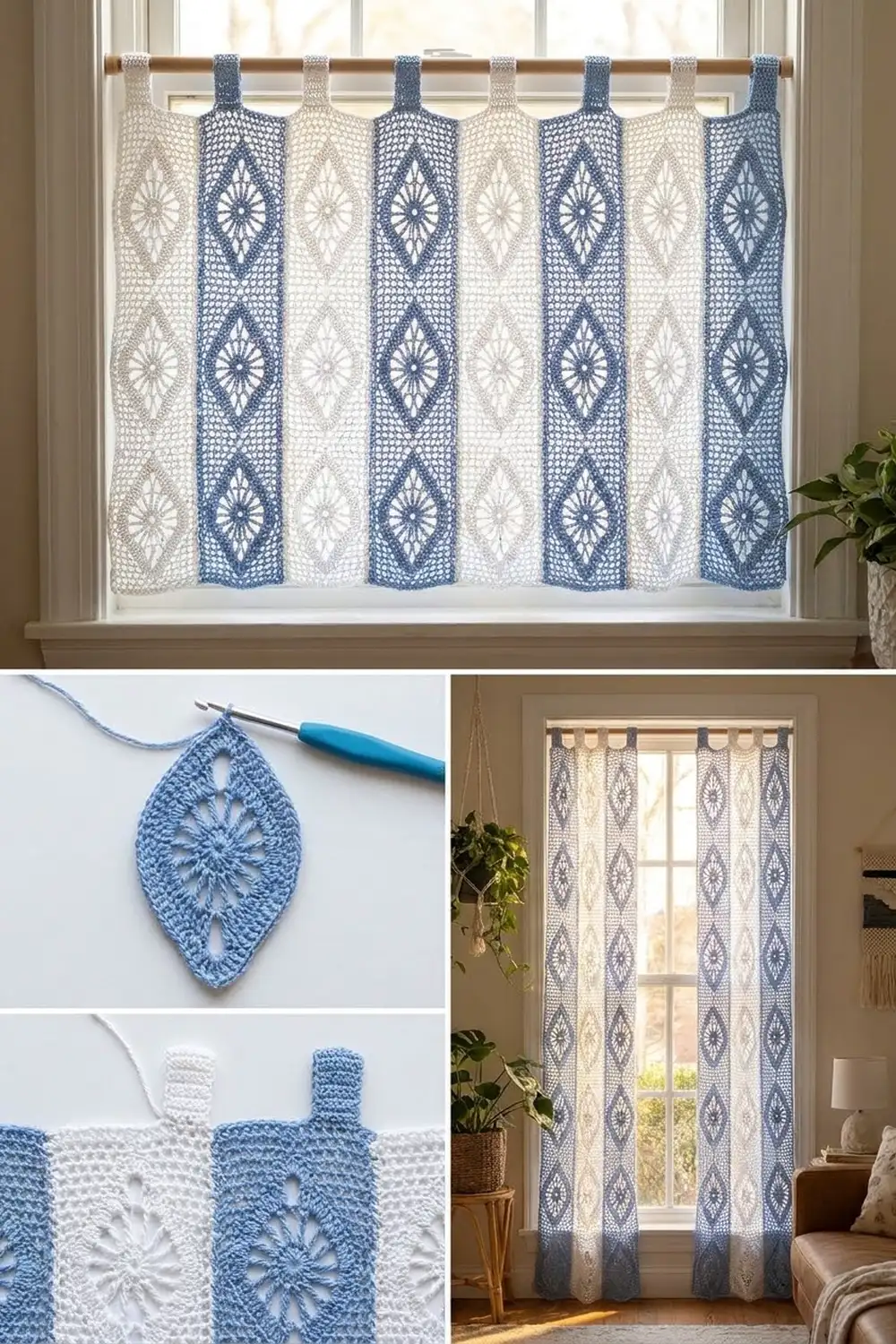
This café curtain lets light through a lattice of tall diamonds. Columns of white and cornflower blue alternate across the panel. Every diamond has a spoked wheel at its center, and the diamonds touch tip to tip down each column, so the curtain reads as long vertical chains of lace.
The style is cottage lace: mercerized cotton, open chain mesh, and crisp white scallops along the bottom. Folded tabs in the column colors hang the panel straight from a rod.
This pattern uses US crochet terms. The finished curtain measures 37 in (94.0 cm) wide by 28.5 in (72.4 cm) tall. The tabs add a loop of about 2¼ in (5.7 cm) above that.
You make 36 rectangular motifs in the round, join them into 9 columns of 4, join the columns side by side, and then add a two-round border with scallops and tabs.
Finished Size and Construction
- Finished size: 37 in × 28.5 in (94.0 cm × 72.4 cm), not counting tabs
- Skill level: Intermediate
- Terminology: US
- Yarn weight: DK (#3 light) mercerized cotton
- Hook: 4.0 mm (US G-6)
- Number of pieces: 36 motifs (20 white, 16 blue)
- Layout: 9 columns × 4 motifs, colors alternating by column
- Motif size: 4 in × 6¾ in (10.2 cm × 17.1 cm)
- Size before border: 36 in × 27 in (91.4 cm × 68.6 cm)
- Border depth: ½ in (1.3 cm) at the sides and top; 1 in (2.5 cm) at the bottom
Materials
Choose a smooth mercerized cotton in DK weight, about 115 m (126 yd) per 50 g. Cotton gives crisp stitch definition, holds its shape after blocking, and doesn’t fade much in sunlight.
- Color A, white: 200 g, about 460 m
- Color B, cornflower blue: 150 g, about 345 m
The quantities include a margin of about 15% for gauge swatching and tension differences.
Tools:
– 4.0 mm (US G-6) crochet hook
– Tapestry needle
– Stitch markers
– Rust-proof pins and a blocking board or foam mats
– Spray bottle
– Measuring tape
Abbreviations (US Terms)
- ch – chain
- sl st – slip stitch
- sc – single crochet
- hdc – half double crochet
- dc – double crochet
- tr – treble crochet
- dtr – double treble crochet
- sk – skip
- sp – space
- st(s) – stitch(es)
- rnd – round
- BLO – back loop only
- RS / WS – right side / wrong side
Double treble (dtr): Yarn over 3 times, insert hook in the st, yarn over and pull up a loop (5 loops on hook), then [yarn over, pull through 2 loops] 4 times.
Flat slip-stitch seam: Lay two pieces RS up with their edges touching. Insert the hook through the back loop of a st on the right-hand piece, then through the back loop of the matching st on the left-hand piece. Yarn over and pull through everything.
Gauge and Checkpoints
Make one complete motif before you start the others, then block it gently and measure.
- Edge gauge: 17 sc = 4 in (10.2 cm) across a short side, and 29 sc = 6¾ in (17.1 cm) along a long side
- After Rnd 2: the wheel is about 2¼ in (5.7 cm) across
- After Rnd 4: the diamond is about 2¾ in (7.0 cm) wide × 4¼ in (10.8 cm) tall
- After Rnd 6: the motif is 4 in × 6¾ in (10.2 cm × 17.1 cm)
If the motif is too big, go down to a 3.75 mm hook. If it’s too small, go up to a 4.5 mm hook. A difference of ⅛ in (0.3 cm) per motif adds up to 1⅛ in (2.9 cm) across 9 columns, so it’s worth getting the test motif right.
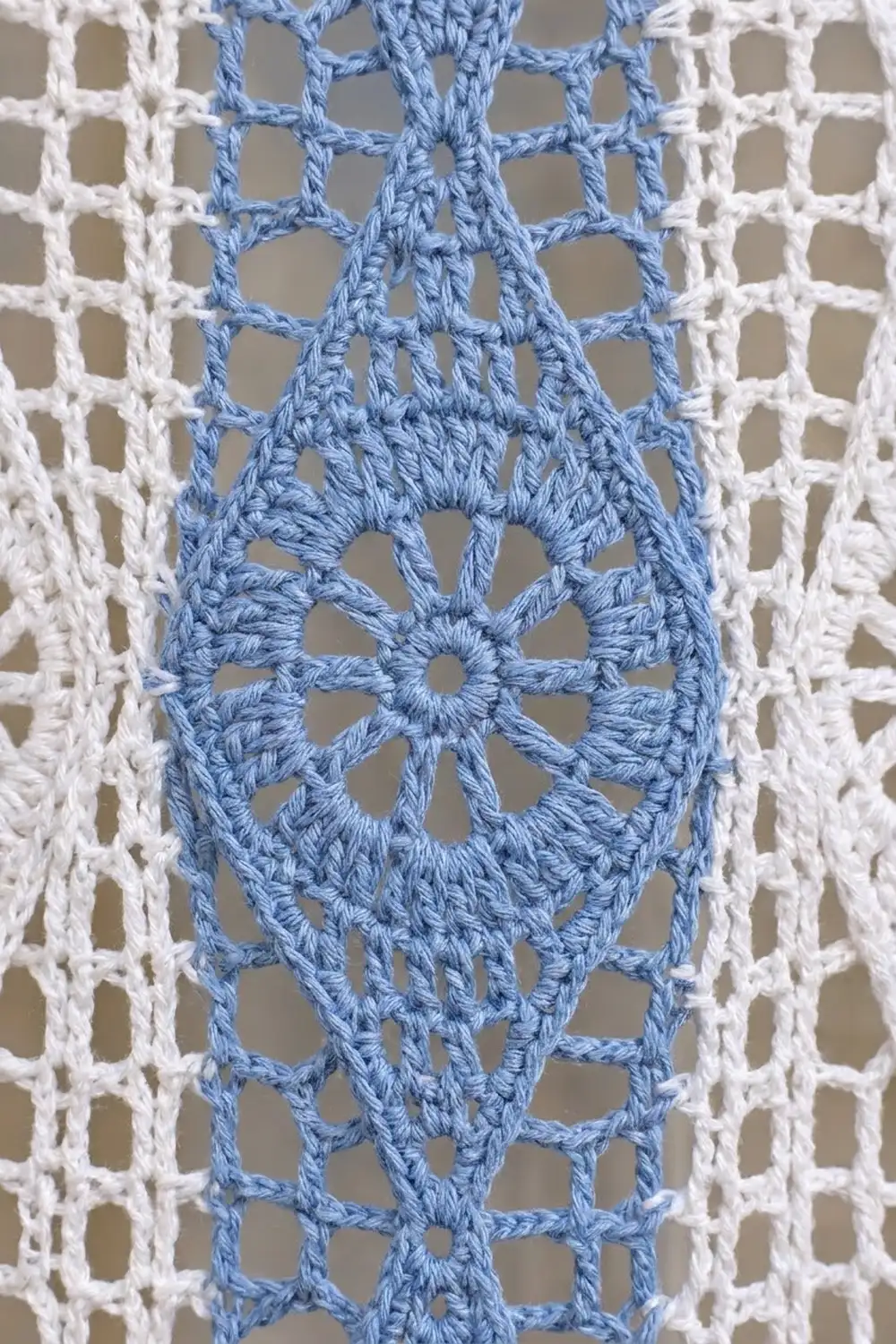
Motif (make 36)
Each motif is worked in one color from start to finish.
Rnd 1 (RS): Make a magic ring. Ch 3 (counts as dc), work 15 dc in the ring. Join with a sl st to the top of the beg ch-3. (16 dc)
Rnd 2: Ch 5 (counts as dc + ch 2), dc in next dc, ch 2; rep from * 14 more times. Join with a sl st to the 3rd ch of the beg ch-5. (16 dc, 16 ch-2 sps)* These are the wheel spokes.
Rnd 3 (diamond): Sl st into the first ch-2 sp. Ch 4 (counts as tr), work (tr, ch 3, 2 tr) in the same sp for the top point. Then work 3 dc in the next sp, 3 hdc in the next sp, and 3 sc in the next sp. Work (2 sc, ch 2, 2 sc) in the next sp for a side point. Then work 3 sc in the next sp, 3 hdc in the next sp, 3 dc in the next sp, and (2 tr, ch 3, 2 tr) in the next sp for the bottom point. Finish with 3 dc, 3 hdc, and 3 sc in the next 3 sps, (2 sc, ch 2, 2 sc) in the next sp for the second side point, and 3 sc, 3 hdc, and 3 dc in the last 3 sps. Join to the top of the beg ch-4. (52 sts, 2 ch-3 point sps, 2 ch-2 point sps)
The tall trebles at the top and bottom and the short sc at the sides are what stretch the diamond vertically.
Rnd 4 (outline): Ch 1. Sc in the same st and in the next st, then work (sc, ch 3, sc) in the top ch-3 sp. Continue with sc in each st around. Work (sc, ch 2, sc) in each side-point ch-2 sp and (sc, ch 3, sc) in the bottom ch-3 sp. Join to the first sc. (60 sc = 52 worked 1 per existing st + 8 added at the points; 15 sc on each diamond edge, plus 4 point sps)
Rnd 5 (mesh fill): Sl st in the next 2 sc and into the top ch-3 sp. Ch 5 (counts as dtr), ch 2.
Sk 2 sc, dtr in next sc, ch 2, sk 2 sc, (dtr, ch 4, dtr) in next sc for a corner, ch 2, sk 2 sc, tr in next sc, ch 2, sk 2 sc, dc in next sc, ch 2, sk 2 sc, hdc in next sc, ch 2, sc in the side-point ch-2 sp, ch 2, hdc in next sc, ch 2, sk 2 sc, dc in next sc, ch 2, sk 2 sc, tr in next sc, ch 2, sk 2 sc, (dtr, ch 4, dtr) in next sc for a corner, ch 2, sk 2 sc, dtr in next sc, ch 2, sk 2 sc*.
Dtr in the bottom-point ch-3 sp, ch 2. Repeat from * to ** once. Join to the top of the beg ch-5.
(28 sts, 24 ch-2 sps, 4 ch-4 corner sps) Each short side now has 5 sts and 4 ch-2 sps between corner sps. Each long side has 9 sts and 8 ch-2 sps. The stitches step down in height from dtr at the corners to sc at the side points, which turns the diamond into a rectangle.
Rnd 6 (edge): Ch 1, sc in the same st. Work around: sc in each st, 2 sc in each ch-2 sp, and 3 sc in each ch-4 corner sp. Join to the first sc. Fasten off, leaving a 6 in (15.2 cm) tail.
(88 sc: 17 per short side and 29 per long side.) Each side count includes both of its corner sc (the middle sc of each 3-sc group). Check: 28 sts + (24 × 2) + (4 × 3) = 88, and 2 × 17 + 2 × 29 − 4 shared corners = 88.
Make All Pieces
- Color A (white): 20 motifs
- Color B (blue): 16 motifs
Weave in the tails on each motif, then lightly steam-block all of them to 4 in × 6¾ in (10.2 cm × 17.1 cm) before joining.
Layout (W = white, B = blue; each motif sits upright, short sides at top and bottom):
W  B  W  B  W  B  W  B  W
W  B  W  B  W  B  W  B  W
W  B  W  B  W  B  W  B  W
W  B  W  B  W  B  W  B  W
Joining
Use Color A and the flat slip-stitch seam for every seam. Joining this way adds no stitches to the panel’s edges.
Step 1 – Columns: Join 4 motifs of the same color short side to short side. Match corner sc to corner sc and work 17 sl sts per seam, so the diamond points meet. Make 9 columns. Each column is 4 in × 27 in (10.2 cm × 68.6 cm), with 4 × 29 = 116 sts along each long edge.
Step 2 – Columns together: Join the columns in layout order along their long edges. Work stitch to stitch for 116 sl sts per seam, matching motif seams to motif seams.
Tension: Keep your sl sts as loose as the sc edge. Pull a seam lengthwise after a few inches. If it puckers, switch to a hook one size larger for the seams.
Checkpoint: After joining 3 columns, the width should be 12 in (30.5 cm). The finished body is 36 in × 27 in (91.4 cm × 68.6 cm). The top and bottom edges each have 9 × 17 = 153 sts, and each side has 116 sts. These counts include the 4 panel corner sts.
Border
The border is worked in Color A and keeps the motif edge gauge of about 4¼ sc per in (2.54 cm).
Border Rnd 1: With RS facing, join yarn in any st on the left side. Sc in each st around, working (sc, ch 2, sc) in each of the 4 panel corner sts. Join.
- Top and bottom: 153 sc each (151 non-corner sts + 1 sc from each corner)
- Each side: 116 sc
- Total: 538 sc (534 worked 1 per existing st + 4 extra at the corners), plus 4 corner ch-2 sps
Border Rnd 2: Sl st to the bottom-left corner ch-2 sp. Ch 1, sc in the sp, and sc in the first bottom st.
Scallops: *sk 3 sts, 9 dc in next st, sk 3 sts, sc in next st; rep from * 18 more times. That’s 19 scallops, and the last sc lands in the last bottom st. Sc in the bottom-right corner sp.
Then sc in each of the 116 side sts, (sc, ch 2, sc) in the top-right corner sp, sc in each of the 153 top sts, (sc, ch 2, sc) in the top-left corner sp, and sc in each of the 116 side sts. Join to the first sc.
Why the math works: The scallops use 1 + (19 × 8) = 153 sts, exactly the bottom count. With 19 scallops across 9 columns, you get about 2 scallops per column. The top keeps 153 sc, which is 17 per column, so the tabs sit evenly.
Tabs (make 9): Number the top sc from right to left. On column k, work into sts 17(k − 1) + 7 through 17(k − 1) + 11, which are the center 5 sts of that column’s 17. Use the column’s color.
- Row 1: Join the yarn and sc in each of the 5 sts. (5 sc)
- Rows 2–22: Ch 1, turn, sc in each sc. (5 sc)
Fasten off, leaving a 12 in (30.5 cm) tail. Fold the tab to the WS and sew the last row behind the same 5 sts on Border Rnd 1. Each tab is 1¼ in (3.2 cm) wide and about 4½ in (11.4 cm) long before folding, which makes a loop that fits a rod up to 1 in (2.5 cm) in diameter.
Final Blocking
- Weave in all the remaining tails along seams or inside the solid diamond outlines.
- Soak the curtain in cool water for 15 minutes, then press out the water in a towel. Don’t wring it.
- Lay it flat on the mats with RS up.
- Pin the body to 36 in × 27 in (91.4 cm × 68.6 cm), checking that the seams run straight.
- Pin each scallop into a round curve, so the full height is 28.5 in (72.4 cm).
- Pin the width to 37 in (94.0 cm) at the top, middle, and bottom.
- Let it dry completely, then unpin it.
Final Quality-Control Checklist
- [ ] Every motif measures 4 in × 6¾ in (10.2 cm × 17.1 cm)
- [ ] All 36 motifs have 17 sts per short side and 29 per long side
- [ ] The diamond points meet tip to tip in every column
- [ ] The colors alternate W-B-W-B-W-B-W-B-W
- [ ] The seams lie flat, with no puckering or gaps
- [ ] There are 19 even scallops with no extra stitches at the ends
- [ ] The 9 tabs are centered on the columns and match the column colors
- [ ] The curtain measures 37 in × 28.5 in (94.0 cm × 72.4 cm)
Troubleshooting
- Motif is square, not tall: Your trebles at the top and bottom points are too short. Pull up the first loop of each tr and dtr to full height.
- Corners ruffle: Your Rnd 5 chains are too loose. Make the ch-2 sps snugger.
- Corners cup inward: The ch-4 corner chains are too tight. Loosen them, or use ch 5 in the corners and keep 3 sc in Rnd 6.
- Short-side count isn’t 17: Check that you worked 2 sc in every ch-2 sp in Rnd 6 and 3 sc in each corner.
- Scallops don’t end evenly: Recount the bottom edge. It must be exactly 153 sts between the corner sps.
- Curtain leans: Re-block it, and pin the seams to a straight line.
Care
Hand wash in cool water with a mild detergent and dry flat. Re-block lightly after washing to restore the scallops and keep the columns straight.
Final Notes
The measurement chain is simple. One motif is 4 in × 6¾ in (10.2 cm × 17.1 cm), with 17 × 29 edge sts. Nine columns of four make a 36 in × 27 in (91.4 cm × 68.6 cm) body, with 153 sts across and 116 down. The border brings the curtain to 37 in × 28.5 in (94.0 cm × 72.4 cm). If your test motif is the right size, every later count and measurement will match.
Happy crocheting!