

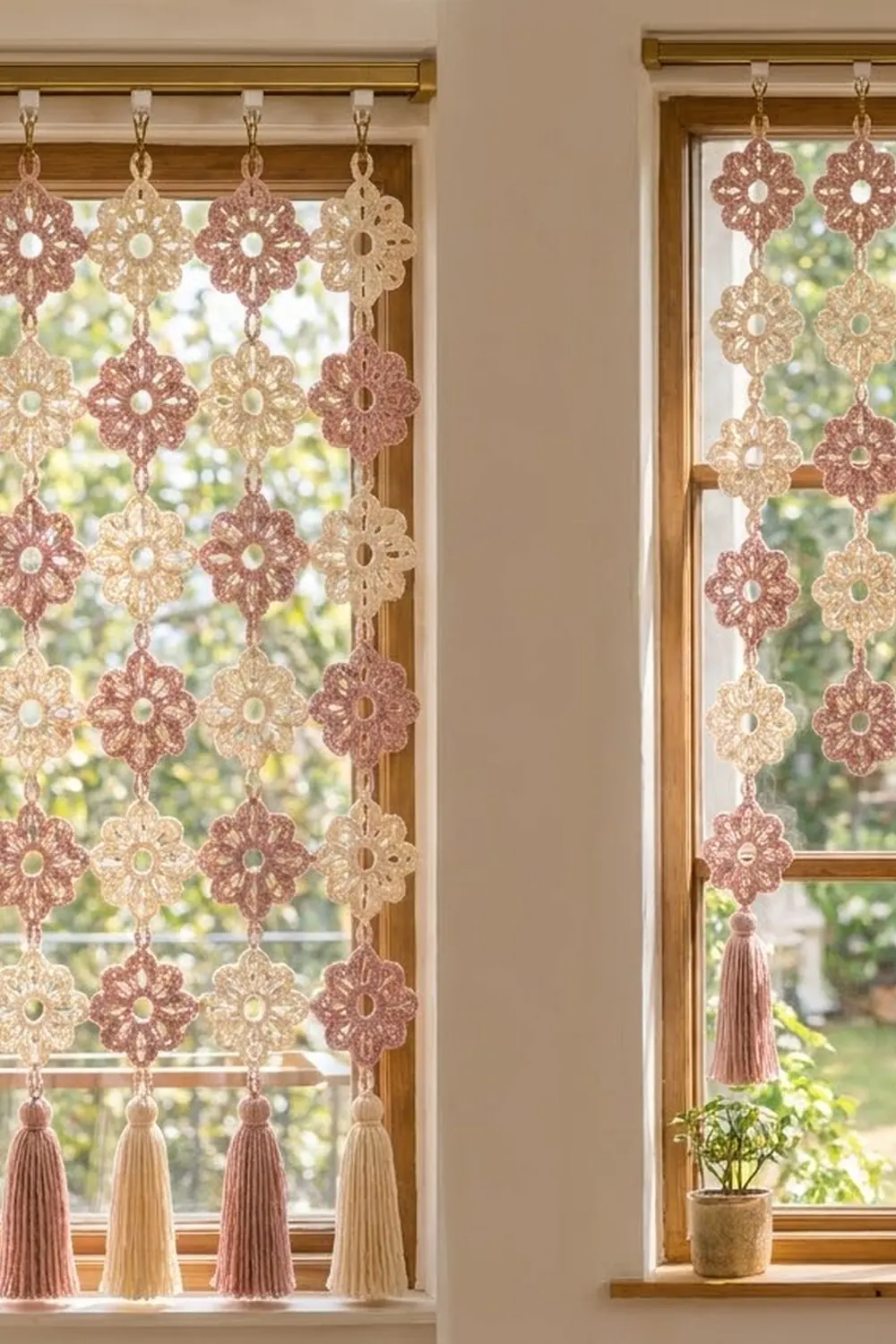
The Rosewater Bloom curtain is a light, airy window hanging made from lacy eight-petal flowers. Each flower has an open center ring and pointed petals with a small window in each one, so sunlight shines through the whole panel.
The design uses two colors: dusty rose and soft cream. The flowers alternate color down every strand, and each strand is offset from the one next to it, so the curtain reads as a gentle checkerboard. A long wrapped tassel weights the bottom of each strand and helps it hang straight.
This pattern uses US crochet terms. The finished curtain measures about 49.5 in (125.7 cm) wide and 51 in (129.5 cm) long, including hanging loops and tassels.
The construction is simple and repetitive. You crochet one flower in four rounds. Each new flower joins to the one above it on its last round with a short chain link. Eight flowers make a strand, ten strands make the curtain, and a tassel finishes each strand.
Finished Size and Construction
- Finished curtain size: 49.5 in (125.7 cm) wide x 51 in (129.5 cm) long
- Skill level: Easy-intermediate
- Terminology: US crochet terms
- Yarn weight: DK (weight 3) cotton or cotton blend
- Hook: 4.0 mm (G-6)
- Number of pieces: 80 flower motifs (40 rose, 40 cream) and 10 tassels
- Layout: 10 strands x 8 motifs each, colors alternating
- Motif size: 4.5 in (11.4 cm) tip to tip
- Strand length before finishing: 43 in (109.2 cm)
- Finishing depth: hanging loop 1.5 in (3.8 cm) at the top, tassel 6.5 in (16.5 cm) at the bottom
Materials
Choose a smooth, mercerized or combed cotton in DK weight. Cotton gives crisp stitch definition, holds the petal points, and doesn’t stretch much under the weight of the tassels. Avoid fuzzy or very stretchy acrylic, which will let the strands lengthen over time.
- Dusty rose: 250 g, about 600 m (656 yd)
- Soft cream: 250 g, about 600 m (656 yd)
Each color covers 40 motifs (about 4.5 g / 11 m each) plus 5 tassels (about 7 g / 17 m each). These quantities include a margin of about 15% for gauge differences and test pieces.
Tools:
- 4.0 mm (G-6) crochet hook
- Tapestry needle
- Sharp scissors
- Stiff cardboard cut to 6.5 in (16.5 cm) tall, for the tassels
- Rustproof pins and a blocking mat
- Spray bottle
- Curtain rod with 10 ring clips or hooks, at least 52 in (132.1 cm) long
Abbreviations (US Terms)
- ch: chain
- sl st: slip stitch
- sc: single crochet
- hdc: half double crochet
- dc: double crochet
- tr: treble crochet
- sp: space
- st(s): stitch(es)
- Rnd: round
Special stitch – Tip Link (TL): Use this at a petal tip in place of ch 3. Ch 2, sl st into the ch-3 tip sp of the motif above, ch 2. This makes a short, flexible link of about 1 in (2.5 cm) between the two petal tips.
Gauge and Checkpoints
Make one complete test motif before you start the curtain. Gauge matters here because 8 motifs and 7 links stack up into a long strand, so small errors multiply.
Checkpoints for one motif:
- After Rnd 1: 1.75 in (4.4 cm) across
- After Rnd 2: 2.75 in (7.0 cm) across
- After Rnd 3: 3.75 in (9.5 cm) across
- After Rnd 4: 4.5 in (11.4 cm) from one tip to the opposite tip, lightly blocked
Too big? Go down to a 3.75 mm (F-5) hook. Too small? Go up to a 4.5 mm (7) hook. Check your chain tension too: the ch-6 loops in Rnd 2 should lie flat, without cupping or ruffling.
Measure your test motif after blocking. If it’s within 0.25 in (0.6 cm) of the target, you’re ready to go.
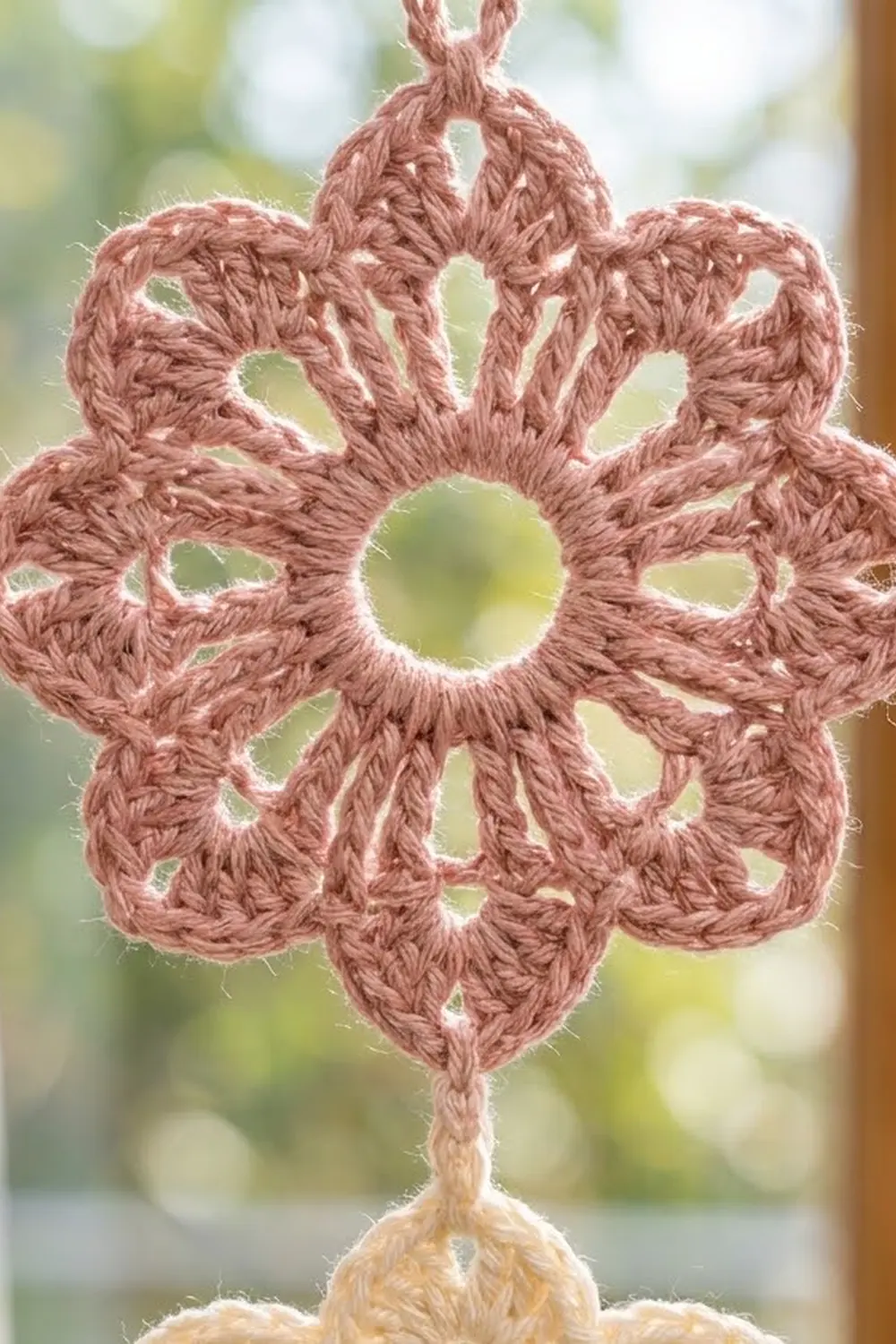
Flower Motif
Make 40 in rose and 40 in cream. Rnds 1–3 are the same for every motif. Rnd 4 changes slightly depending on where the motif sits in the strand.
Rnd 1: Ch 10, sl st in the first ch to form a ring. Ch 3 (counts as dc), 23 dc in the ring, sl st in the top of the beginning ch-3. (24 dc)
This round forms the open center ring of the flower.
Rnd 2: Ch 1, sc in the same st, ch 6, skip next 2 dc, sc in next dc, ch 6, skip next 2 dc; repeat from * 6 more times, sl st in first sc. (8 sc, 8 ch-6 loops)*
Each ch-6 loop becomes the base of one petal.
Rnd 3: Sl st in the first ch-6 loop, ch 1. In each ch-6 loop work (sc, hdc, dc, ch 5, dc, hdc, sc). Sl st in the first sc. (48 sts and 8 ch-5 arches; 6 sts per petal)
The ch-5 arch sits above the ch-6 loop, which leaves a small open window inside each petal.
Rnd 4 (petal outline): Sl st in next hdc, sl st in next dc, sl st in the ch-5 arch. Ch 3 (counts as dc), 2 dc in the same arch, ch 2, tr in the same arch, ch 3, tr in the same arch, ch 2, 3 dc in the same arch. Sc in the sp between the last sc of this petal and the first sc of the next petal, then in the next ch-5 arch work (3 dc, ch 2, tr, ch 3, tr, ch 2, 3 dc); repeat from * 6 more times. Sc in the sp between petal 8 and petal 1, sl st in the top of the beginning ch-3. Fasten off and weave in ends. (72 sts: 9 per petal = 6 dc, 2 tr, 1 sc; plus 16 ch-2 sps and 8 ch-3 tip sps)*
The petal you work first is Petal 1 (the top tip). Petal 5 is directly opposite it (the bottom tip). On every motif, mark Petal 5’s ch-3 tip with a removable marker as you finish it.
Rnd 4 changes by position:
- Motif 1 (top of strand): At Petal 1, replace the ch-3 tip with ch 14, sl st in the top of the tr you just made, then work the second tr. This forms the hanging loop.
- Motifs 2–8: At Petal 1, replace the ch-3 tip with a Tip Link into the marked Petal 5 tip of the motif above (see Joining).
- Motif 8 (bottom of strand): At Petal 5, replace the ch-3 tip with ch 5. The tassel ties through this loop.
Make All Pieces
Each strand alternates colors, starting with either rose (Strand A) or cream (Strand B). Hang the strands A, B, A, B across the rod.
- Strand A (make 5): Rose, cream, rose, cream, rose, cream, rose, cream; rose tassel
- Strand B (make 5): Cream, rose, cream, rose, cream, rose, cream, rose; cream tassel
Totals: 40 rose motifs, 40 cream motifs, 5 rose tassels, 5 cream tassels.
Layout grid (R = rose, C = cream; columns are strands 1–10, left to right):
Row 1:   R C R C R C R C R C
Row 2:   C R C R C R C R C R
Row 3:   R C R C R C R C R C
Row 4:   C R C R C R C R C R
Row 5:   R C R C R C R C R C
Row 6:   C R C R C R C R C R
Row 7:   R C R C R C R C R C
Row 8:   C R C R C R C R C R
Tassel:  R C R C R C R C R C
Joining
You join each strand as you go, one motif at a time, from top to bottom. Work Motif 1 completely, including its hanging loop. Then work Rnds 1–3 of Motif 2 and begin Rnd 4.
Stitch-to-stitch logic: On Motif 2, Rnd 4, work Petal 1 up to and including the first tr. Instead of ch 3, work the Tip Link: ch 2, sl st into the marked ch-3 tip of Petal 5 on Motif 1, ch 2. Then work the second tr and finish the round as written. Each pair of motifs joins at only one point, tip to tip, top to bottom. No other petals touch.
Repeat for Motifs 3 through 8, always joining Petal 1 of the new motif to Petal 5 of the motif above.
Tension advice: Keep the Tip Link chains relaxed but even. Tight links pull the petals out of shape and shorten the strand. Loose links let the motifs twist. Before you sl st, lay both motifs flat and check that the tips line up in a straight vertical line.
Size checkpoint: Each motif plus its link adds 5.5 in (14.0 cm) to the strand. After Motif 4, the strand should measure about 21 in (53.3 cm) from Motif 1’s top tip to Motif 4’s bottom tip (4 motifs of 4.5 in plus 3 links of 1 in). A finished 8-motif strand measures 43 in (109.2 cm): 8 x 4.5 in + 7 x 1 in = 36 in + 7 in.
Border
This curtain has no fabric border. Instead, each strand is finished at both ends, with a hanging loop at the top and a tassel at the bottom. These ends set the final length, so treat them with the same care as a border.
Border gauge: 5 ch = 1 in (2.5 cm) in DK cotton on a 4.0 mm hook. Check this on the ch-6 loops of your test motif.
Top edge – hanging loop (1 per strand, 10 total): You work this in Motif 1, Rnd 4, as described above. The ch-14 loop folds in half and hangs about 1.5 in (3.8 cm) above the top petal tip. Clip a ring or hook through the loop.
Bottom edge – tassels (1 per strand, 10 total):
- Wrap yarn 50 times around the 6.5 in (16.5 cm) card.
- Slide a 12 in (30.5 cm) tie strand under the wraps at the top and knot it tightly.
- Cut the wraps at the bottom edge. You now have 50 strands, each 13 in (33.0 cm) long, folded in half.
- Wrap a 20 in (50.8 cm) strand around the bundle 1 in (2.5 cm) below the top, about 8 times. Knot it and bury the ends inside the tassel.
- Thread the tie ends through the ch-5 loop at Motif 8’s Petal 5 tip, knot securely, and hide the ends inside the tassel head.
- Trim the skirt evenly to 6 in (15.2 cm).
Why the math works: Each strand totals a 1.5 in hanging loop + 43 in of motifs and links + a 6.5 in tassel (6 in skirt plus 0.5 in of tie) = 51 in (129.5 cm). Across the rod, 10 strands spaced 5 in (12.7 cm) apart, center to center, give 9 x 5 in + 4.5 in = 49.5 in (125.7 cm) of width. That leaves 0.5 in (1.3 cm) of air between the petal points of strands next to each other.
Final Blocking
- Lay each strand flat on a blocking mat with Motif 1 at the top.
- Run a straight edge or tape measure down the center so every top and bottom tip lines up.
- Pin every petal tip, easing each motif to 4.5 in (11.4 cm) across.
- Check that each link is 1 in (2.5 cm) and the strand is 43 in (109.2 cm).
- Mist evenly with water until damp but not soaked.
- Let it dry completely, at least 12 hours.
- Steam the tassel skirts lightly, comb them with your fingers, and trim again to 6 in (15.2 cm).
- Hang the strands on the rod and let them settle for a day before making final adjustments.
Final Quality-Control Checklist
- 80 motifs total: 40 rose, 40 cream
- Every motif has 72 sts and 8 ch-3 tips in Rnd 4
- Each motif measures 4.5 in (11.4 cm) after blocking
- Colors alternate down every strand and form a checkerboard across the curtain
- All 70 Tip Links join Petal 1 to Petal 5, with no twisted motifs
- 10 hanging loops, each about 1.5 in (3.8 cm) deep
- 10 tassels trimmed to 6 in (15.2 cm), alternating rose and cream
- Each strand is 51 in (129.5 cm) long, within 0.5 in (1.3 cm) of the others
- All ends woven in securely
Troubleshooting
Center ring puckers: Rnd 1 has too many dc for your ring. Start with ch 11 instead, or loosen your dc.
Petals ruffle: Your ch-6 loops or ch-5 arches are too long. Go down a hook size or tighten your chains.
Petals cup inward: Your chains are too tight. Go up a hook size for the chain sections only.
Strand twists when hung: A Tip Link was joined to the wrong petal. Count petals from Petal 1 and rejoin at Petal 5.
Strands are different lengths: Measure each one. Block the short strands again with slightly firmer pinning, or trim the tassels so every bottom edge sits level.
Tassel looks thin: Increase to 60 wraps. Allow about 1.5 g of extra yarn per tassel.
Care
Hand wash in cool water with mild soap, press the water out in a towel, and dry flat with the motifs pinned to shape. Don’t hang wet strands, because the weight of the tassels will stretch them.
Final Notes
The whole curtain depends on one chain of measurements. A 4.5 in (11.4 cm) motif plus a 1 in (2.5 cm) link gives a 5.5 in (14.0 cm) repeat. Eight motifs with seven links make a 43 in (109.2 cm) strand. Add a 1.5 in (3.8 cm) loop and a 6.5 in (16.5 cm) tassel for 51 in (129.5 cm) of total length. Ten strands spaced 5 in (12.7 cm) apart give 49.5 in (125.7 cm) of width.
Check your first motif and your first strand, and the rest of the curtain will follow. Enjoy the light pouring through your rose and cream flowers.
Happy crocheting!