

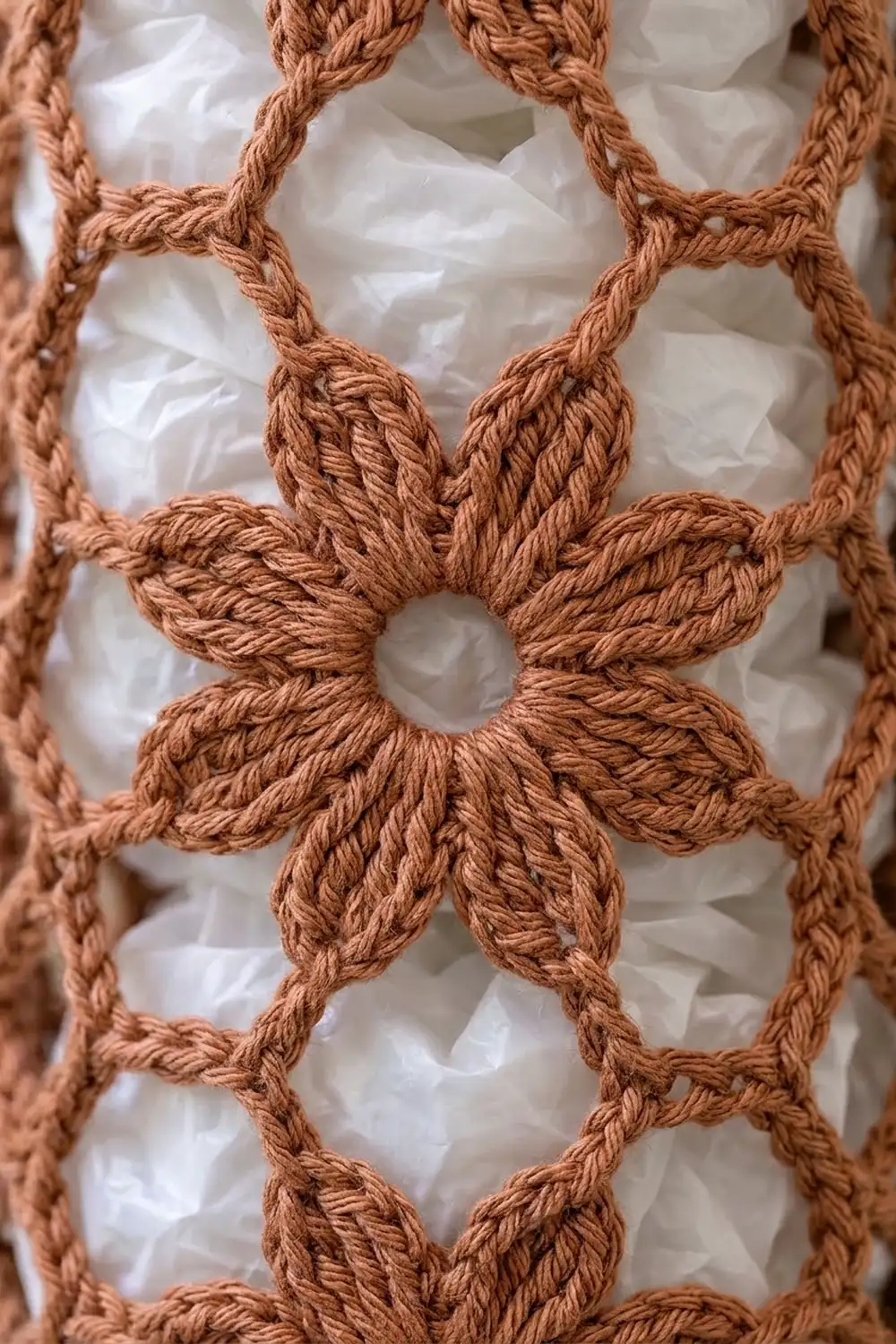
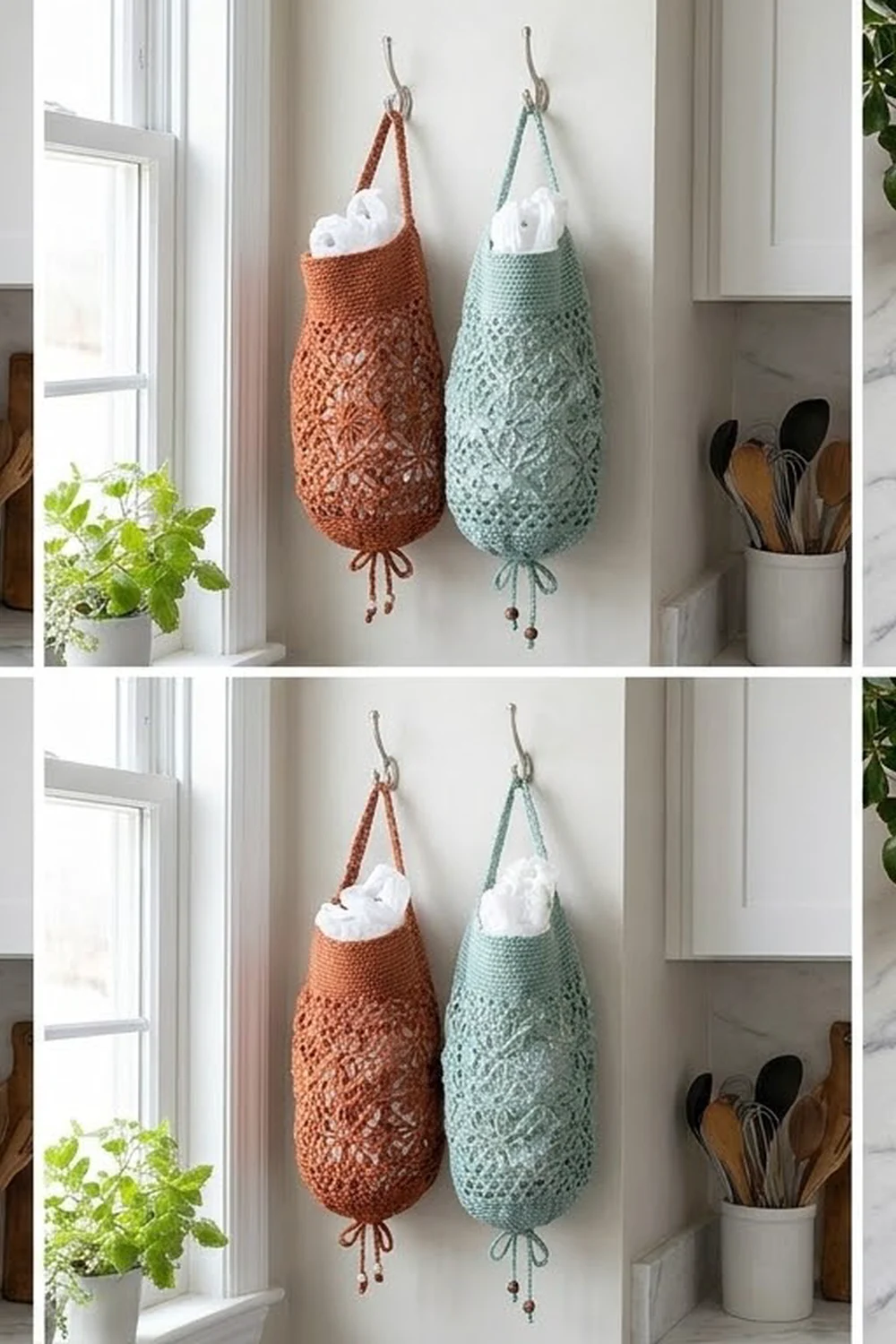
This Daisy Lattice Bag Holder is a tall, open tube for storing plastic grocery bags. The lace body has staggered 8-petal flowers set in a light chain mesh, so you can see the bags through it and the flowers stand out. You push bags in at the top and pull them out through the drawstring opening at the bottom.
The sample is shown in warm rust and in soft seafoam. Each holder uses one color, so it’s a good project for a single cotton skein in a color that suits your kitchen.
The pattern uses US crochet terms. The finished body measures 15.4 in (39.1 cm) tall and 12 in (30.5 cm) around, which is 6 in (15.2 cm) wide when flat. The hanging strap adds about 3 in (7.6 cm), so the holder is about 18.4 in (46.7 cm) tall overall.
The holder is worked top-down in joined rounds as one piece. You start with a solid top band, then work five bands of flower lace and a solid bottom band with eyelets. The strap and drawstring are added at the end. There is no sewing and no joining.
Finished Size and Construction
- Finished size: 6 in (15.2 cm) wide flat × 15.4 in (39.1 cm) tall, plus a 3 in (7.6 cm) strap
- Circumference: 12 in (30.5 cm)
- Skill level: Intermediate
- Terminology: US
- Yarn weight: Worsted (#4), cotton or cotton blend
- Hook: 4.5 mm (US 7)
- Number of pieces: 1 (a seamless tube)
- Layout: top band → mesh round → 5 flower bands → bottom band
- Top band: 1.6 in (4.1 cm)
- Lace body: 12 in (30.5 cm), made up of a 0.75 in (1.9 cm) mesh round plus 11.25 in (28.6 cm) of flower bands
- Bottom “border” band: 1.8 in (4.8 cm)
Materials
Use a smooth mercerized or matte worsted cotton. Cotton holds the lace shape, doesn’t stretch much when the holder is full, and washes well. Avoid very fuzzy yarn, because it hides the petals.
- Colorway A, Rust: 100 g / about 180 m (197 yd)
- Colorway B, Seafoam (optional second holder): 100 g / about 180 m (197 yd)
A holder uses about 85 g. The amounts above include a margin for your gauge swatch and tension differences.
Tools:
– 4.5 mm (US 7) crochet hook
– 1 stitch marker
– Tapestry needle
– Scissors
– 2 wooden beads, about 12 mm (0.5 in / 1.3 cm), with holes large enough for the cord (optional)
– Measuring tape
– Rust-proof pins and a rolled towel for blocking
Abbreviations (US Terms)
- ch = chain
- sl st = slip stitch
- sc = single crochet
- hdc = half double crochet
- dc = double crochet
- sk = skip
- sp = space
- st(s) = stitch(es)
- rnd = round
2-dc cluster (2-dc cl): [Yo, insert hook in the ring, yo, pull up a loop, yo, pull through 2 loops] twice. Yo and pull through all 3 loops on hook.
3-dc cluster (3-dc cl): Work as above, but three times, then yo and pull through all 4 loops.
Flower: Ch 5, sl st in the 5th ch from hook to form a ring. Ch 2, 2-dc cl in the ring (petal 1). [Ch 3, 3-dc cl in the ring] 7 times (petals 2–8). Ch 3, then sl st in the top of petal 1. This gives 8 petals and 8 ch-3 sps. Sp 1 follows petal 1, sp 2 follows petal 2, and so on. To exit, sl st in sp 1, sl st in the top of petal 2, then sl st in sp 2. You are now on the leading side of the flower, and the flower measures about 2 in (5.1 cm) across.
Gauge and Checkpoints
Gauge: 16 hdc and 10 rnds = 4 in (10.2 cm) in hdc worked in the round.
Lace gauge: One repeat of 4 ch-5 loops = 3 in (7.6 cm) wide. One flower band (a Flower Round plus an Anchor Round) = 2.25 in (5.7 cm) tall.
Work the top band first and treat it as your swatch. It only takes a few minutes and shows exactly how the tube will fit.
Checkpoints:
– After Rnd 4: the band is 12 in (30.5 cm) around, 6 in (15.2 cm) flat, and 1.6 in (4.1 cm) tall.
– After Rnd 7 (first flower band): 4.6 in (11.7 cm) from the top edge.
– After Rnd 15 (last flower band): 13.6 in (34.5 cm) from the top edge.
– After Rnd 20: 15.4 in (39.1 cm) total.
If your band is too big (more than 6.25 in / 15.9 cm flat), go down to a 4 mm (US G-6) hook. If it’s too small (less than 5.75 in / 14.6 cm flat), go up to a 5 mm (US H-8) hook. Don’t change the stitch counts, because the lace repeat depends on exactly 48 sts.
Top Band
Ch 48. Join with a sl st in the first ch to form a ring, taking care not to twist the chain. Place a marker in the first st of each rnd.
Rnd 1: Ch 2 (doesn’t count as a st). Hdc in each ch around. Join with a sl st in the first hdc. (48 hdc)
Rnds 2–4: Ch 2, hdc in each st around, join. (48 hdc each rnd)
Checkpoint: 12 in (30.5 cm) around and 1.6 in (4.1 cm) tall.
Lace Body
Rnd 5 (mesh set-up): Ch 1, sc in the first st. Ch 5, sk 2 sts, sc in the next st. Repeat from * 14 more times. Ch 5, sk 2 sts, and join with a sl st in the first sc. (16 sc, 16 ch-5 loops)
The math: 48 sts ÷ 3 sts per repeat = 16 loops, which makes 4 flower repeats of 4 loops each.
To move into position, sl st in the first 3 ch of the next loop.
Flower Round (Rnds 6, 8, 10, 12, 14)
Ch 1. Sc in the current loop (S1), ch 5, sc in the next loop (S2), ch 5, sc in the next loop (S3, the anchor). Work a Flower. Ch 5, sc in the next loop (S4), ch 5. Repeat from * 3 more times, working the next S1 in the next loop each time. Join with a sl st in the first sc.
Count: 16 sc, 16 ch-5 loops, and 4 Flowers.
Each repeat produces four loops, which this pattern calls La (S1→S2), Lb (S2→S3), Lc (Flower exit→S4) and Ld (S4→next S1). The Flower hangs from S3, with its petals sitting over the mesh.
To move into position, sl st in the first 3 ch of the next loop (La).
Anchor Round (Rnds 7, 9, 11, 13, 15)
Ch 1. Sc in La. Ch 5, sc in sp 6 of the Flower. Ch 5, sc in sp 3 of the same Flower. Ch 5, sc in Ld, ch 5. Repeat from * 3 more times. Join with a sl st in the first sc.
Count: 16 sc and 16 ch-5 loops. The two upper arches, Lb and Lc, are left free on each side of the Flower.
Sp 6 and sp 3 are the lower side spaces of the Flower and mirror each other, so the ch-5 between them sits below petal 5 and holds the Flower firmly in place.
The fourth loop of each repeat (Ld→La) is centered between two Flowers, and that is where the next band’s Flowers go. To set up the next Flower Round, sl st in each of the next 5 ch, sl st in the next sc, then sl st in the first 3 ch of the next loop (9 sl sts). The S1 of the next round goes in that loop, which puts the new anchor S3 exactly between the Flowers below.
Checkpoint after Rnd 7: 4.6 in (11.7 cm) from the top. The Flowers should be 3 in (7.6 cm) apart, center to center.
Work Rnds 8–15 by alternating the Flower Round and the Anchor Round. This gives 5 flower bands in total, staggered from band to band. After Rnd 15, don’t make the 9 sl sts. Sl st in the first 3 ch of the next loop instead.
Checkpoint after Rnd 15: 13.6 in (34.5 cm) from the top. Each band adds 2.25 in (5.7 cm): 5 × 2.25 = 11.25 in (28.6 cm).
Border: Bottom Band, Drawstring and Hanging Strap
The bottom band acts as this holder’s border. It closes the lace back into solid fabric and holds the drawstring.
Border gauge: the same 16 sts = 4 in (10.2 cm). Flattened, the tube has two “sides” of 24 sts each (front and back), with fold points at st 1 and st 25. There are no corner stitches, because the tube has no corners.
Rnd 16 (conversion round): Ch 1, 3 sc in each ch-5 loop around. Join. That is 16 loops × 3 sc = 48 sc, or 24 sts per flattened side.
Rnds 17–18: Ch 2, hdc in each st around, join. (48 hdc, 24 per side)
Rnd 19 (eyelets): Ch 3 (counts as dc), dc in the next st, ch 1, sk 1. Dc in the next 2 sts, ch 1, sk 1. Repeat from * 14 more times. Join with a sl st in the top of the ch-3. That is 32 dc + 16 ch-1 sps = 48 sts, or 8 eyelets per side.
Rnd 20: Ch 1, sc in each dc and in each ch-1 sp around, join. (48 sc, 24 per side) Fasten off and weave in the end.
Why the math works: the top band has 48 sts, the mesh has 16 loops × 3 sts = 48, and the bottom band comes back to 48. Because the count matches from top to bottom, the tube hangs straight with no flare or pucker. The bottom band height is 0.25 + 0.8 + 0.5 + 0.25 = 1.8 in (4.6 cm). (The 4.8 cm in the quick facts uses the rounded 1.9 in nominal; 1.8 in = 4.6 cm.)
Drawstring
Ch 95. Sl st in the back bump of the 2nd ch from the hook and in each ch across (94 sl sts). The cord should be about 24 in (61.0 cm) long.
Starting at the center front, weave the cord over and under through all 16 eyelets. Since there’s an even number of eyelets, both ends come out next to each other. Slide a bead onto each end, tie an overhand knot, and trim to leave 0.5 in (1.3 cm) tails.
Hanging Strap
Flatten the tube so that foundation st 1 sits on one fold and foundation st 25 sits on the opposite fold.
Row 1: Join the yarn with a sl st in the remaining loop of foundation st 1. Ch 36, then sl st in foundation st 25 and in st 26. Turn.
Row 2: Sc in each ch across (36 sc), then sl st in foundation st 2. Fasten off.
The strap is 9 in (22.9 cm) long and forms an arch about 3 in (7.6 cm) high above the 6 in (15.2 cm) rim.
Final Blocking
- Wash the holder gently in lukewarm water and squeeze it out. Don’t wring it.
- Roll it in a towel and press to remove the extra water.
- Push a rolled towel or a cardboard tube wrapped in plastic into the holder so it’s 12 in (30.5 cm) around.
- Lay it flat and pat it to 6 in (15.2 cm) wide and 15.4 in (39.1 cm) tall.
- Open each Flower with your fingertips so that all 8 petals spread evenly. Pin any that curl.
- Straighten the drawstring band and lay the strap flat.
- Let it dry completely before you take the pins out.
Final Quality-Control Checklist
- 48 sts in Rnds 1–4 and in Rnds 16–20
- 16 ch-5 loops in every lace round
- 20 Flowers in total (4 per band × 5 bands), each with 8 petals
- Each band’s Flowers sit between the Flowers of the band before it
- Every Flower is anchored at sp 6 and sp 3
- 16 eyelets, and the cord goes through all of them
- Strap is fixed at opposite folds (sts 1–2 and 25–26)
- Measures 6 in (15.2 cm) flat × 15.4 in (39.1 cm) tall
- All ends are woven in securely
Troubleshooting
- The tube twists in a spiral: keep your joins neat, and check that the round starts at the same marker each time.
- The Flowers cup or ruffle: you’ve made the clusters too tall. Pull each cluster snug, or use a 5-ch ring instead of a looser one.
- The Flowers aren’t staggered: count the 9 sl sts again between rounds. S3 has to land in the loop that’s centered between the Flowers below.
- The mesh sags when the holder is full: tighten the ch-5 loops, or go down 0.5 mm in hook size for the lace.
- The drawstring won’t close the bottom fully: rethread it so that it goes over and under through every eyelet, not every other one.
- The strap leans to one side: check that it’s attached exactly 24 sts apart.
Care
Hand wash or machine wash on gentle in cool water, reshape, and dry flat. Don’t tumble dry, because heat can make cotton shrink and pull the lace out of shape.
Final Notes
Here is how the measurements fit together: 48 sts at 16 sts per 4 in (10.2 cm) gives a 12 in (30.5 cm) tube. Splitting those 48 sts into 16 loops gives 4 flower repeats, each 3 in (7.6 cm) wide. Five bands at 2.25 in (5.7 cm) each add 11.25 in (28.6 cm). Together with the 1.6 in (4.1 cm) top band, the 0.75 in (1.9 cm) mesh round and the 1.8 in (4.6 cm) bottom band, the body comes to 15.4 in (39.1 cm). If you check your gauge at each checkpoint, the holder will come out the right size.
Happy crocheting!