

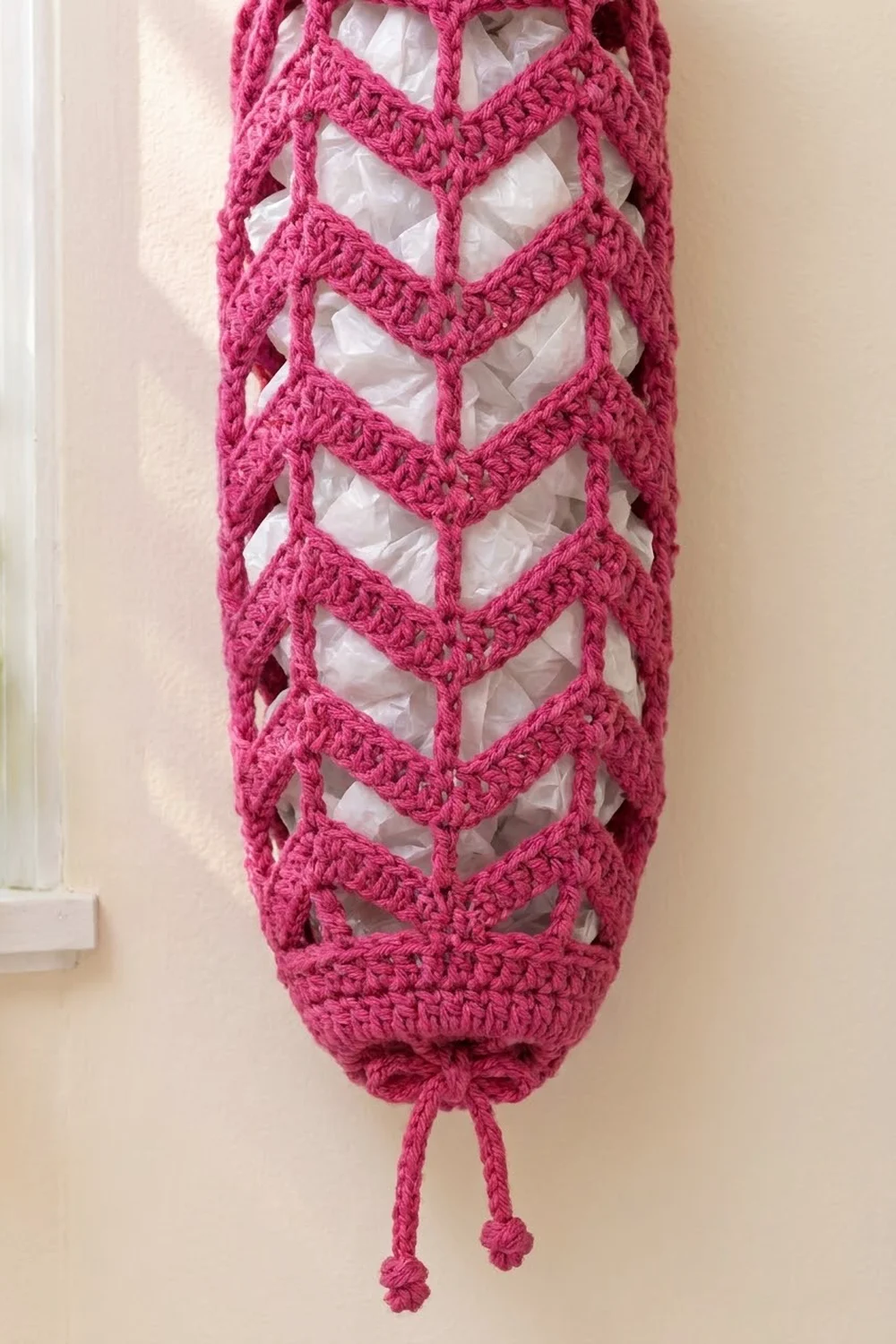
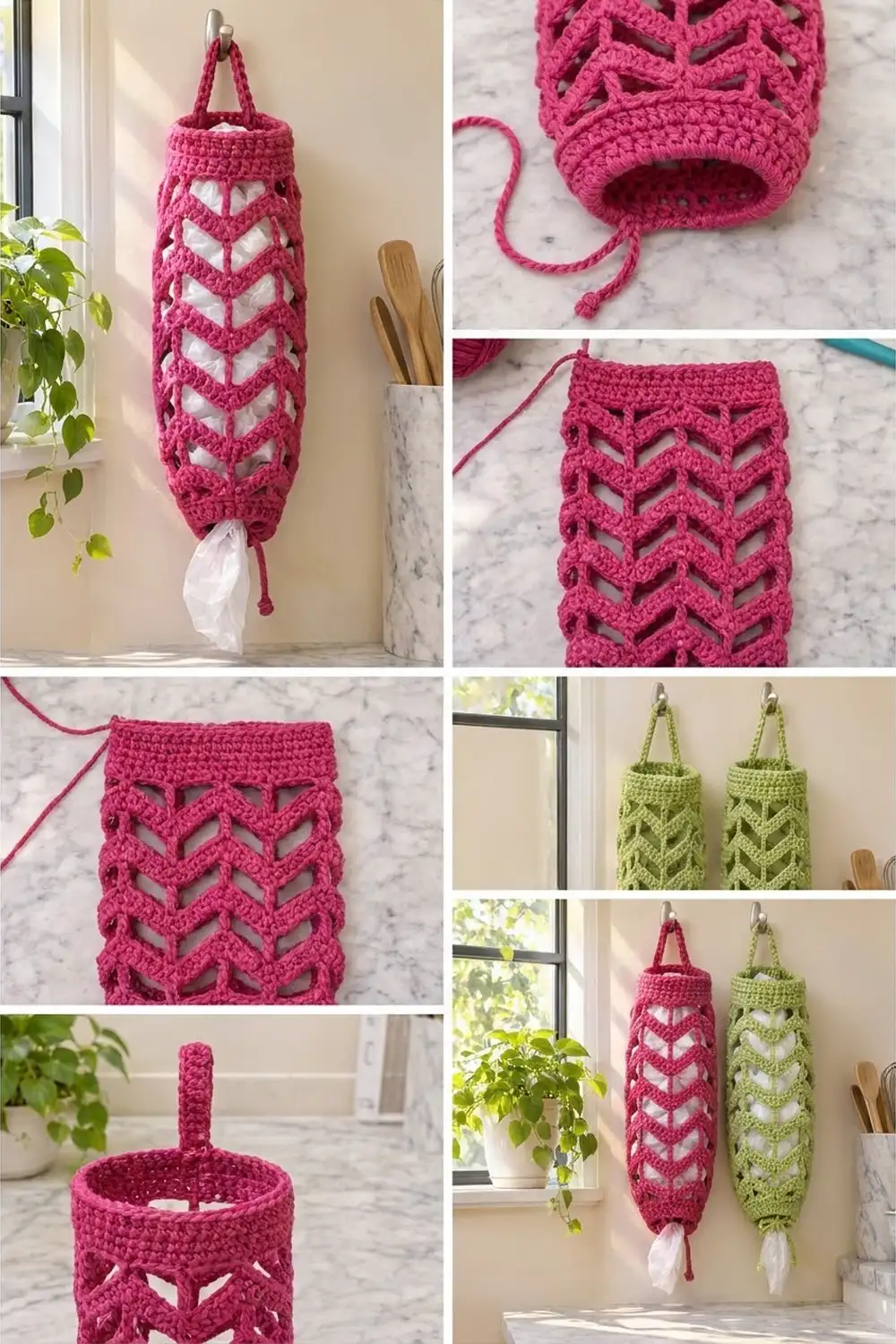
This plastic bag holder is a tall tube with zigzag chevron bands and open windows between them. You can see the white bags through the windows, which keeps the holder light and airy. Stuff bags in at the top and pull them out one at a time through the cinched bottom.
The sample is raspberry pink. A soft lime green version from the same pattern looks just as good, and the two make a nice pair in a kitchen or laundry room. Cotton yarn holds the chevron shape well and doesn’t stretch out when the holder is full.
This pattern uses US crochet terms. The finished holder is about 15 in (38.1 cm) around, or 7.5 in (19.1 cm) wide flat, and 16.75 in (42.5 cm) tall, not counting the handle.
You work the holder from the bottom up in joined rounds. Start with a solid band that has a drawstring eyelet round. Then make an openwork chevron body, a leveling round, and a solid top band. Finish with a strap worked straight off the rim and sewn to the opposite side. A chained cord goes through the eyelets.
Finished Size and Construction
- Finished size: 15 in (38.1 cm) around; 7.5 in (19.1 cm) wide flat; 16.75 in (42.5 cm) tall without the handle
- Skill level: Easy-Intermediate
- Terminology: US
- Yarn weight: Worsted (#4) cotton
- Hook: 5.0 mm (H-8)
- Number of pieces: 1 main piece (tube plus strap) and 1 chained drawstring cord
- Layout: One vertical tube, 60 stitches around, 35 rounds tall
- Piece size before top band (border): 15 in (38.1 cm) around × 15.5 in (39.4 cm) tall
- Top band (border) depth: 1.25 in (3.2 cm)
- Handle: 1 in (2.5 cm) wide × 7 in (17.8 cm) long
Materials
Use a smooth worsted cotton or cotton blend. Cotton keeps the chevron peaks crisp and won’t sag under the weight of the bags. Acrylic also works, but the holder will be stretchier, so you may want to drop down one hook size.
- Raspberry pink (sample color): 150 g, about 230 m (252 yd)
- Optional second holder in lime green: another 150 g, about 230 m (252 yd)
These amounts include a margin of about 15% for your gauge swatch and tails.
Tools:
– 5.0 mm (H-8) crochet hook
– 1 stitch marker for the start of the round
– 1 locking marker for the strap position
– Tapestry needle
– Scissors
– Measuring tape
– Spray bottle and a rolled towel for blocking
Abbreviations (US Terms)
- ch – chain
- sl st – slip stitch
- sc – single crochet
- hdc – half double crochet
- dc – double crochet
- tr – treble crochet
- sk – skip
- sp – space
- beg – beginning
- rep – repeat
- st(s) – stitch(es)
Special stitches:
- dc3tog (double crochet 3 together): [Yarn over, insert hook in next st, yarn over, pull up a loop, yarn over, pull through 2 loops] 3 times. Yarn over and pull through all 4 loops on the hook. This uses 3 sts and makes 1.
- tr3tog (treble crochet 3 together): [Yarn over twice, insert hook in next st, yarn over, pull up a loop, (yarn over, pull through 2 loops) twice] 3 times. Yarn over and pull through all 4 loops on the hook. This uses 3 sts and makes 1.
Counting note: In the open rounds, count every chain as a stitch. That keeps the count at 60 every round, and the next chevron round works into each chain one at a time.
Gauge and Checkpoints
Gauge: 16 sc × 16 sc rounds = 4 in (10.2 cm) with a 5.0 mm hook.
Stitch heights: One sc round is 0.25 in (0.6 cm). One dc chevron round is 0.5 in (1.3 cm), and one tr open round is 0.75 in (1.9 cm). Measure stitch heights straight up a column, not along the slope of the zigzag.
Make Rounds 1–6 and check the result before going further. The bottom band should measure 15 in (38.1 cm) around.
- Round 6 done: 15 in (38.1 cm) around, 1.75 in (4.4 cm) tall
- Round 9 done: 3.5 in (8.9 cm) tall
- Round 29 done: 15 in (38.1 cm) tall
- Round 30 done: 15.5 in (39.4 cm) tall
- Round 35 done: 16.75 in (42.5 cm) tall
If your band is too big: go down a hook size, to 4.5 mm (US 7). If it’s too small: go up to 5.5 mm (I-9). Don’t change the stitch count. The 60 stitches have to stay a multiple of 10 for the chevron repeat to work.
Pattern
Bottom Band
Foundation: Ch 60. Join with a sl st to the first ch to form a ring, making sure the chain isn’t twisted.
Round 1: Ch 1, sc in each ch around. Join with a sl st to the first sc. (60 sc)
Place a marker in the first stitch of the round and move it up as you go.
Rounds 2–3: Ch 1, sc in each st around. Join. (60 sc)
Round 4 (eyelet round): Ch 4 (counts as dc and ch 1), sk next st. Dc in next st, ch 1, sk next st; rep from * around. Join with a sl st to the 3rd ch of beg ch-4. (30 dc + 30 ch-1 sps = 60 sts)*
Rounds 5–6: Ch 1, sc in each st and each ch-1 sp around. Join. (60 sc)
Checkpoint: 15 in (38.1 cm) around, 1.75 in (4.4 cm) tall.
Chevron Lattice Body
Each repeat is 10 sts wide, and the tube has 6 repeats. A chevron round (A) adds 2 sts at every peak and takes away 2 sts at every valley, so the count stays at 60. An open round (B) keeps the same peaks and valleys, but chains replace the solid stitches. Those chains make the windows.
Round 7 (first A round): Ch 3 (counts as dc), 2 dc in same st. Dc in next 3 sts, dc3tog over next 3 sts, dc in next 3 sts, 3 dc in next st. Rep from * around, ending the last rep at . Join to the top of beg ch-3. (60 sts: 6 peaks, 6 valleys)*
The center stitch of each peak group is now the 2nd stitch of that group.
Round 8 (A round): Sl st in next st (center dc of the peak). Ch 3 (counts as dc), 2 dc in same st. Dc in next 3 sts, dc3tog over next 3 sts (centered on the valley), dc in next 3 sts, 3 dc in next st (center of next peak). Rep from * around, ending at . Your last dc goes into the top of the previous round’s beg ch-3. Join to the top of beg ch-3. (60 sts)*
Round 9 (B round, open): Sl st in next st (center of the peak). Ch 5 (counts as tr and ch 1), tr in same st. Ch 3, sk next 3 sts, tr3tog over next 3 sts, ch 3, sk next 3 sts, (tr, ch 1, tr) in next st. Rep from * around, ending at . Join to the 4th ch of beg ch-5. (12 tr + 6 ch-1 + 6 tr3tog + 36 ch = 60 sts)*
Round 10 (A round after an open round): Sl st in next ch-1 sp. Ch 3, 2 dc in same sp. Dc in next tr and next 2 ch, dc3tog over (next ch, tr3tog, next ch), dc in next 2 ch and next tr, 3 dc in next ch-1 sp. Rep from * around, ending at . The last dc goes into the top of beg ch-5. Join to the top of beg ch-3. (60 sts)*
Round 11: Work as Round 8. (60 sts)
Rounds 12–29: Repeat Rounds 9–11 six more times. (60 sts every round)
You now have 8 solid chevron bands (Rounds 7–8, 10–11, 13–14, 16–17, 19–20, 22–23, 25–26, 28–29) and 7 rows of windows (Rounds 9, 12, 15, 18, 21, 24, 27).
Body height: 13.25 in (33.7 cm). That comes from 16 dc rounds × 0.5 in plus 7 tr rounds × 0.75 in.
Checkpoint: 15 in (38.1 cm) tall from the bottom edge.
Leveling Round
Round 30: Sl st in next st (center of the peak). Ch 1, sc in same st. Sc in next st, hdc in next 2 sts, dc in next st, tr in next st (the valley), dc in next st, hdc in next 2 sts, sc in next 2 sts. Rep from * around, ending at . Work sc in the top of beg ch-3. Join to the first sc. (60 sts)*
Each repeat uses 10 sts and makes 10. Short stitches sit on the peaks and tall stitches fill the valleys, so the top edge comes out straight.
Checkpoint: 15.5 in (39.4 cm) tall.
Drawstring Cord
Ch 100, which comes to about 25 in (63.5 cm) long. Fasten off. Tie a double overhand knot about 0.5 in (1.3 cm) from each end and trim the tails to 0.25 in (0.6 cm).
Border: Top Band and Hanging Strap
Border gauge: 16 sc = 4 in (10.2 cm), the same as the bottom band.
Rounds 31–35: Ch 1, sc in each st around. Join. (60 sc each round. Flattened, that’s 30 sc across the front and 30 sc across the back.)
Why the math works: The leveling round turns the 6 peak-and-valley repeats back into 60 even stitches, which is exactly the bottom band count. At 16 sc per 4 in (10.2 cm), 60 sc makes 15 in (38.1 cm) around, so the top and bottom are the same size and the tube stays straight. The band adds 1.25 in (3.2 cm), bringing the total to 16.75 in (42.5 cm).
Strap: Don’t fasten off. Fold the tube flat so the round’s starting point sits at one side fold. Count 30 sts around and mark stitches 31–34 with the locking marker. Those are directly opposite your start.
- Row 1: Ch 1, sc in the first 4 sts. Turn. (4 sc)
- Rows 2–28: Ch 1, sc in each st across. Turn. (4 sc)
The strap should measure 7 in (17.8 cm) long and 1 in (2.5 cm) wide. Fasten off, leaving a 12 in (30.5 cm) tail. Without twisting the strap, sew Row 28 to the marked stitches 31–34 with a whipstitch through both loops.
Weave in all ends along stitch columns of the solid bands.
Final Blocking
- Lightly mist the whole holder with water until it’s damp but not wet.
- Roll a towel to about 4.75 in (12.1 cm) across and slide it inside the tube.
- Pull the body to 16.75 in (42.5 cm) long. Gently pinch each peak up and each valley down so the zigzags line up in straight columns.
- Open each window with your fingertips so the chains sit evenly.
- Flatten the strap and shape it into a smooth arch.
- Leave it to dry completely, standing upright or lying on its side.
- Weave the drawstring in and out through the 30 ch-1 eyelets of Round 4, starting and ending at the same eyelet. Pull to cinch the opening to about 1.5 in (3.8 cm) across, then tie a bow.
Final Quality-Control Checklist
- Every round has 60 sts, including chains in the open rounds.
- There are 6 peaks and 6 valleys, stacked in straight vertical columns.
- You have 8 solid chevron bands and 7 rows of windows.
- The tube measures 15 in (38.1 cm) around at the bottom band, the middle, and the top band.
- Total height is 16.75 in (42.5 cm).
- The strap is 28 rows long, attached at stitches 1–4 and 31–34, and not twisted.
- The drawstring goes through all 30 eyelets and the knots are secure.
- All tails are woven in invisibly.
Troubleshooting
The chevrons spiral to one side. You probably skipped the opening sl st that moves the round start to the center of the peak. Rip back and start each round in the center stitch of a peak.
The tube flares or pulls in. Count again. A missing dc3tog or an extra 3-dc peak changes the count by 2. Every repeat must use exactly 10 sts.
The windows sag. Your chains are looser than your stitches. Make each ch-3 a bit tighter, or use a hook 0.5 mm smaller for the open rounds only.
The top edge is wavy. Check that you worked tr in each valley and sc at each peak in Round 30.
The strap pulls the rim out of shape. Sew it exactly opposite the start, at stitches 31–34, and stitch it loosely.
Bags slip out of the bottom. Pull the drawstring tighter, or make a 110-ch cord so the bow has more to grip.
Care
Machine wash cold on a gentle cycle in a mesh bag, then reshape and dry flat. Don’t put it in a hot dryer, which can shrink the cotton and distort the chevrons.
Final Notes
All the measurements in this holder come from one gauge. At 16 sc per 4 in (10.2 cm), 60 sts make a 15 in (38.1 cm) tube. The 1.75 in (4.4 cm) bottom band and 13.25 in (33.7 cm) chevron body come to 15 in (38.1 cm). The leveling round brings that to 15.5 in (39.4 cm), and the 1.25 in (3.2 cm) top band finishes it at 16.75 in (42.5 cm). The 7 in (17.8 cm) strap hangs it. Check your gauge first and the rest of the measurements should come out right.
Happy crocheting!