

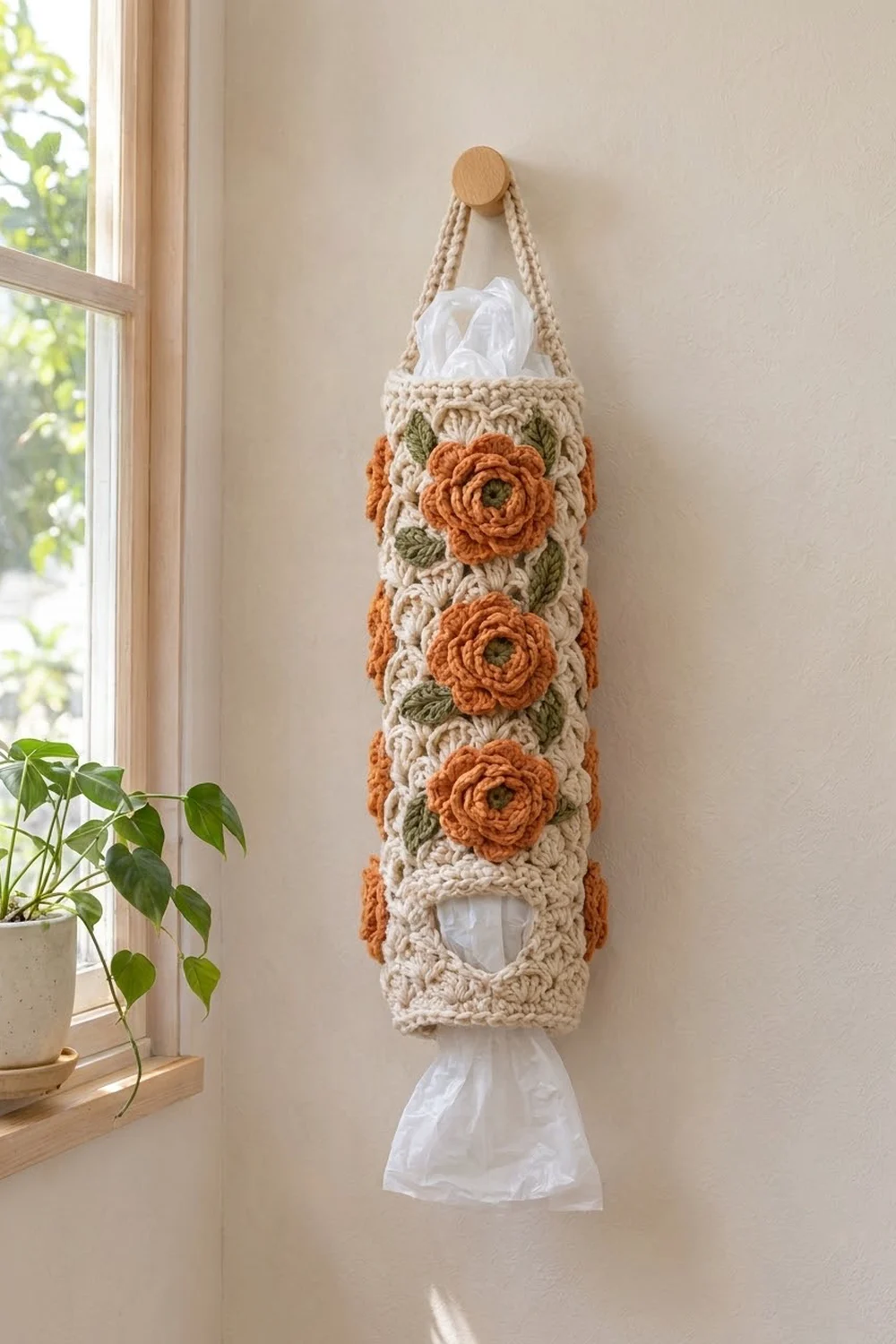
This bag holder is a cream tube of stacked shell stitches with layered rust-orange roses sewn onto it. It hangs from a wall peg by a single-crochet strap. You stuff plastic bags in the top and pull them out one at a time through the slightly narrower bottom opening.
The colors are cream, terracotta orange and olive green. The shells give the tube a soft, scalloped texture, and the three-layer roses stand out against it.
The pattern uses US crochet terms. Laid flat, the finished holder measures 7.5 in (19.1 cm) wide by 17.75 in (45.1 cm) long, not counting the strap. The strap rises 7 in (17.8 cm) above the rim.
How it’s made: you start at the bottom with a chain ring and a single-crochet band. Then you work 24 rounds of shells, a single-crochet top band, and a slip-stitch edge on both openings. Last, you add the strap, make nine roses and eighteen leaves, and sew them on.
Finished Size and Construction
- Finished size (flat): 7.5 in (19.1 cm) x 17.75 in (45.1 cm)
- Circumference: body 15 in (38.1 cm); bottom opening 13.5 in (34.3 cm)
- Skill level: Intermediate
- Terminology: US terms
- Yarn weight: Worsted (#4) cotton
- Hook: 5.0 mm (US H-8)
- Number of pieces: 1 tube (strap worked onto it), plus 9 rose and 18 leaf appliqués
- Layout: 3 rose columns evenly spaced around the tube, 3 roses each
- Piece size: rose 3.75 in (9.5 cm) across; leaf 1.75 in (4.4 cm) long
- Size before border: 7.5 in (19.1 cm) x 16.5 in (41.9 cm)
- Border depth: top band 1.25 in (3.2 cm); the slip-stitch edging adds no measurable height
Materials
Use a smooth worsted-weight cotton. It shows the shell shapes clearly, resists stretching under the weight of the bags, and can be washed. The amounts below assume about 85 m per 50 g.
- Cream (body, bands, strap): 200 g, about 340 m
- Rust-orange (roses): 100 g, about 170 m
- Olive green (centers, leaves): 50 g, about 85 m
These quantities include a margin of about 15 percent.
Tools: 5.0 mm (US H-8) hook, tapestry needle, 4 locking stitch markers, rust-proof pins, tape measure, scissors, blocking mat, spray bottle.
Abbreviations (US Terms)
- ch – chain
- sl st – slip stitch
- sc – single crochet
- hdc – half double crochet
- dc – double crochet
- st(s) – stitch(es)
- rnd(s) – round(s)
- sk – skip
- BPsc – back post single crochet: insert the hook from back to front to back around the post of the stitch, then complete a sc
- Shell – 5 dc in the same stitch
Gauge and Checkpoints
Single crochet gauge: 16 sts and 16 rnds = 4 in (10.2 cm).
Shell gauge: 2 shell repeats (12 sts) = 3 in (7.6 cm), and 4 shell rnds = 2.5 in (6.4 cm).
Make one test rose before you start the tube. It uses all three colors and shows your tension quickly. It should measure 3.75 in (9.5 cm) across. If it’s over 4 in (10.2 cm), go down half a hook size. If it’s under 3.5 in (8.9 cm), go up half a size. Then work a small cream sc swatch and check it against the gauge above.
Tube checkpoints:
– After Rnd 1, the ring lies flat at 6.75 in (17.1 cm) wide.
– After Rnd 6, the band is 1.5 in (3.8 cm) tall.
– After Rnd 14, the total length is 6.5 in (16.5 cm).
– After Rnd 30, the length is 16.5 in (41.9 cm) and the flat width is 7.5 in (19.1 cm).
– After Rnd 35, the length is 17.75 in (45.1 cm).
If your tube is too wide or too narrow, change the hook size. Don’t change the stitch count: the shells only line up if the round is a multiple of 6 stitches.
Tube Body
Work in joined rounds with the right side facing you, without turning. Each round starts on one side fold of the tube.
Bottom Band
With cream, ch 54 and join with a sl st to the first ch, taking care not to twist the chain.
Rnd 1: Ch 1, sc in each ch around, sl st to first sc. (54 sts)
Rnds 2–5: Ch 1, sc in each st around, sl st to first sc. (54 sts)
Rnd 6 (conversion): Ch 1, sc in next 8 sts, 2 sc in next st; repeat from * 5 more times, sl st to first sc. Count: 54 sts worked 1 per stitch + 6 added = 60 sts.
Shell Body
Rnd 7 (first shell round): Ch 1, sc in first st, sk 2, shell in next st, sk 2, sc in next st; repeat from * 8 more times. Then sk 2, shell in next st, sk 2, sl st to first sc. (10 shells + 10 sc = 60 sts)
Rnd 8 (B round): Ch 3 (counts as dc), 2 dc in same st to make a half shell. Sk 2 dc, sc in center dc of next shell, sk 2 dc, shell in next sc; repeat from * 8 more times. Then sk 2 dc, sc in center dc of last shell, sk 2 dc, 2 dc in same st as beginning ch-3, sl st to top of beginning ch-3. The two half shells make one full shell. (10 shells + 10 sc = 60 sts)
Rnd 9 (A round): Ch 1, sc in same st (the center of the split shell). Sk 2 dc, shell in next sc, sk 2 dc, sc in center dc of next shell; repeat from * 8 more times. Then sk 2 dc, shell in last sc, sk 2 dc, sl st to first sc. (10 shells + 10 sc = 60 sts)
Rnds 10–30: Repeat Rnd 8 on even rounds and Rnd 9 on odd rounds, ending with Rnd 30 (a B round). Every round has 60 sts. You now have 24 shell rounds, which measure 15 in (38.1 cm).
Each shell sits on the sc between two shells of the round below. That offset is what makes the staggered fans.
Roses (Make 9)
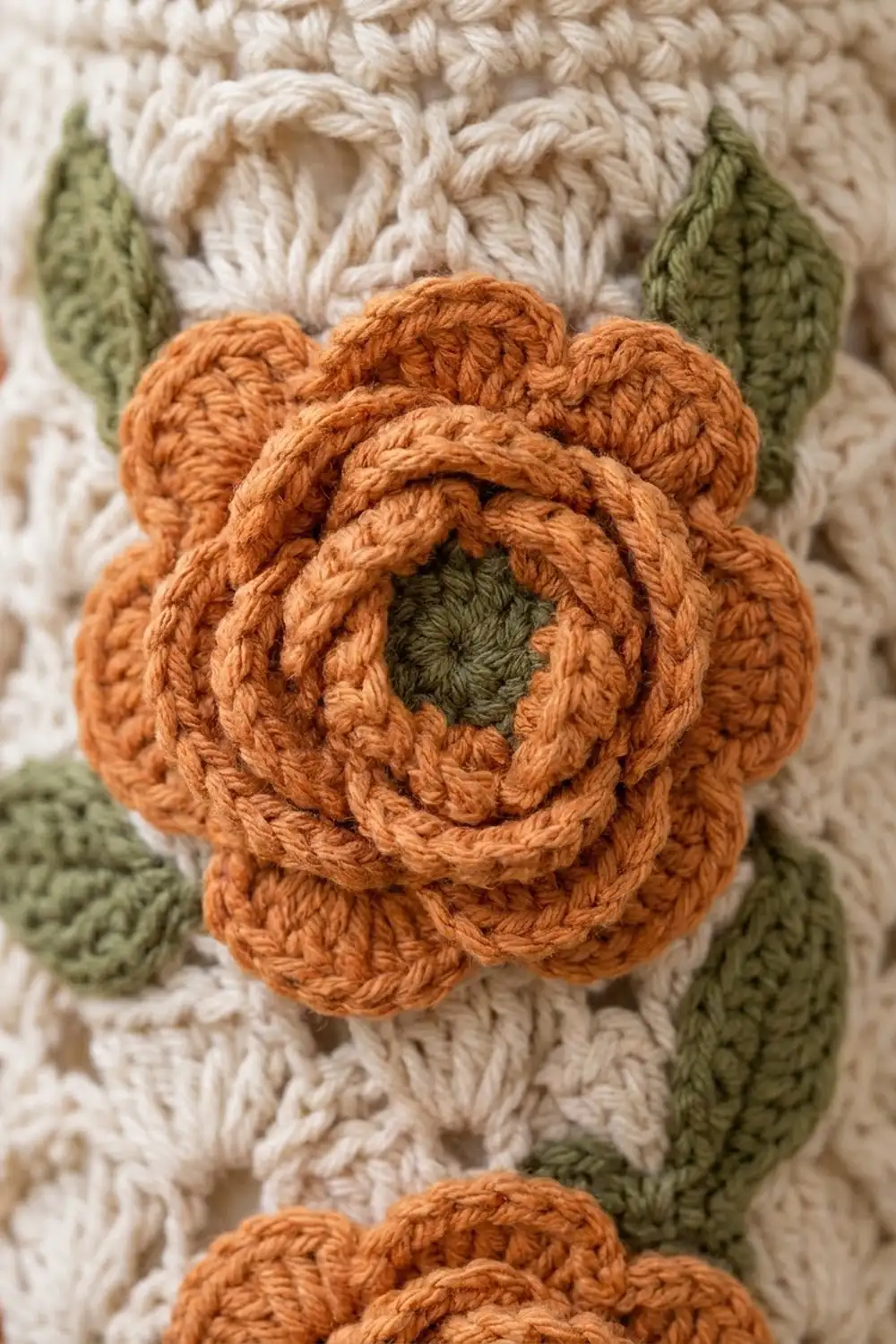
Rnd 1: With olive green, make a magic ring. Ch 1, 8 sc in the ring, sl st to first sc. (8 sts)
Rnd 2: Ch 1, 2 sc in each st, sl st to first sc. (16 sts) Fasten off.
Rnd 3: Join orange in any st. Ch 1, sc in same st, ch 3, sk 1, sc in next st; repeat from * 6 more times, ch 3, sl st to first sc. (8 sc + 8 ch-3 loops)
Rnd 4 (small petals): Work (sc, hdc, 3 dc, hdc, sc) in each ch-3 loop, sl st to first sc. (8 petals x 7 sts = 56 sts)
Rnd 5: Fold the petals forward and work behind them. Ch 1, BPsc around first sc of Rnd 3, ch 5, BPsc around next sc of Rnd 3; repeat from * 6 more times, ch 5, sl st to first BPsc. (8 BPsc + 8 ch-5 loops)
Rnd 6 (medium petals): Work (sc, hdc, 5 dc, hdc, sc) in each ch-5 loop, sl st to first sc. (8 petals x 9 sts = 72 sts)
Rnd 7: Working behind again, ch 1, BPsc around first BPsc of Rnd 5, ch 6, BPsc around next BPsc of Rnd 5; repeat from * 6 more times, ch 6, sl st to first BPsc. (8 BPsc + 8 ch-6 loops)
Rnd 8 (large petals): Work (sc, hdc, 7 dc, hdc, sc) in each ch-6 loop, sl st to first sc. (8 petals x 11 sts = 88 sts) Fasten off, leaving a 12 in (30.5 cm) tail.
Each ring of petals sits behind the one before it. The result is three stacked petal layers around the green center, 3.75 in (9.5 cm) across.
Leaves (Make 18)
With olive green, ch 8.
First side: Sc in 2nd ch from hook, hdc in next ch, dc in next 2 ch, hdc in next ch, sc in next ch, sl st in last ch. (7 sts)
Second side: Ch 1, then rotate to work along the other side of the foundation chain. Sl st in first ch, sc in next ch, hdc in next ch, dc in next 2 ch, hdc in next ch, sc in next ch. (7 sts) Sl st into the turning ch at the tip.
Each leaf has 14 sts plus a pointed tip and is 1.75 in (4.4 cm) long. Fasten off, leaving an 8 in (20.3 cm) tail.
Border: Top Band, Edging, and Strap
Border gauge: sc at 4 sts and 4 rnds per inch (2.5 cm).
Flatten the tube so the start of the round sits on the left fold. Each flat side then holds half the round: 30 sts on the front and 30 on the back.
Rnd 31 (conversion): Ch 1, sc in each dc and each sc around, sl st to first sc. Count: 60 sts worked 1 per stitch + 0 added = 60 sts (30 per side).
Rnds 32–35: Ch 1, sc in each st around, sl st to first sc. (60 sts; 30 per side) The top band now measures 1.25 in (3.2 cm).
Rnd 36 (top edging): Loosely sl st in each st around. (60 sts; 30 per side) Fasten off.
Bottom edging: Turn the tube upside down. Join cream at a side fold and loosely sl st in each foundation ch around. (54 sts; 27 per side) Fasten off.
Why the math works:
– 60 sts is exactly 10 shell repeats of 6, so the shells never shift.
– Rnd 31 places one sc on each existing stitch, so the top band stays 15 in (38.1 cm) around, the same as the body.
– At 4 sts per inch, 30 sts per side gives a flat width of 7.5 in (19.1 cm).
– The bottom has 27 sts per side, which gives 6.75 in (17.1 cm). That 0.75 in (1.9 cm) taper holds the bags in without gripping them too tightly.
Strap: With the tube flat, join cream in st 59 of Rnd 36.
- Row 1: Ch 1, sc in sts 59, 60, 1 and 2. (4 sts, centered on the left fold)
- Rows 2–56: Ch 1, turn, sc in each st across. (4 sts)
The strap is 14 in (35.6 cm) long and 1 in (2.5 cm) wide. Fasten off, leaving a 12 in (30.5 cm) tail. Make sure the strap isn’t twisted, then sew the last row to the inside of the rim at sts 29–32, centered on the right fold. The loop rises 7 in (17.8 cm) above the rim.
Placing the Appliqués
Mark three rose columns on Rnd 31 with stitch markers at st 15 (front center), st 35 and st 55. The columns are 20 sts, or 5 in (12.7 cm), apart. That leaves about 1.25 in (3.2 cm) between roses in neighboring columns.
In each column, position the rose centers at 3 in (7.6 cm), 7.5 in (19.1 cm) and 12 in (30.5 cm) above the top of the bottom band. The centers are 4.5 in (11.4 cm) apart, which leaves a 0.75 in (1.9 cm) gap between roses in the same column.
Tuck two leaves behind each rose, one at 10 o’clock and one at 4 o’clock, with each leaf base 0.5 in (1.3 cm) under the outer petals. Pin everything in place and check the layout.
Sew each leaf down its center line. Sew each rose around its Rnd 2 center and at the base of each large petal, leaving the petal tips free so they keep their depth. Sew through only the cream fabric so no stitches show inside the tube.
Final Blocking
- Slide a folded towel inside the tube.
- Spray the cream fabric until damp, avoiding the roses.
- Pat it to 7.5 in (19.1 cm) wide and 17.75 in (45.1 cm) long.
- Shape each shell into a rounded fan with your fingertips.
- Fluff the petals so the three layers stand apart.
- Let it dry completely, then remove the towel.
Final Quality-Control Checklist
- Body has 60 sts per round and 24 shell rounds
- Bottom band has 54 sts and top band has 60 sts
- Flat size is 7.5 in (19.1 cm) x 17.75 in (45.1 cm)
- Strap is 4 sts wide, untwisted and secure at both folds
- 9 roses, each 3.75 in (9.5 cm) across with three petal layers
- 18 leaves, two per rose
- No sewing shows inside the tube
- All tails are woven in
Troubleshooting
Shells lean or drift: Check that you skip exactly 2 sts on each side of every shell, and that each shell goes into a sc.
Top flares: Work Rnds 31–35 with a 4.5 mm hook.
Bags fall out on their own: Weave a length of cream yarn through Rnd 2 and pull it in slightly before tying it off.
Roses cup forward: Your back-post chain loops are too tight. Chain more loosely or add 1 ch per loop.
Strap stretches: Sew a length of cotton ribbon along the back of the strap.
Care
Hand wash in cool water and lay flat to dry, reshaping the petals while damp. Don’t tumble dry.
Final Notes
Each measurement depends on the one before it:
– At 4 sts per inch, the 54-st ring is 13.5 in (34.3 cm) around.
– The 60-st body is 15 in (38.1 cm) around and 7.5 in (19.1 cm) wide when flat.
– 24 shell rounds make 15 in (38.1 cm) of body, and the two bands bring the total length to 17.75 in (45.1 cm).
– Three columns of 3.75 in (9.5 cm) roses fill the body evenly.
Check each number at its checkpoint as you go and the holder will match the design.
Happy crocheting!