

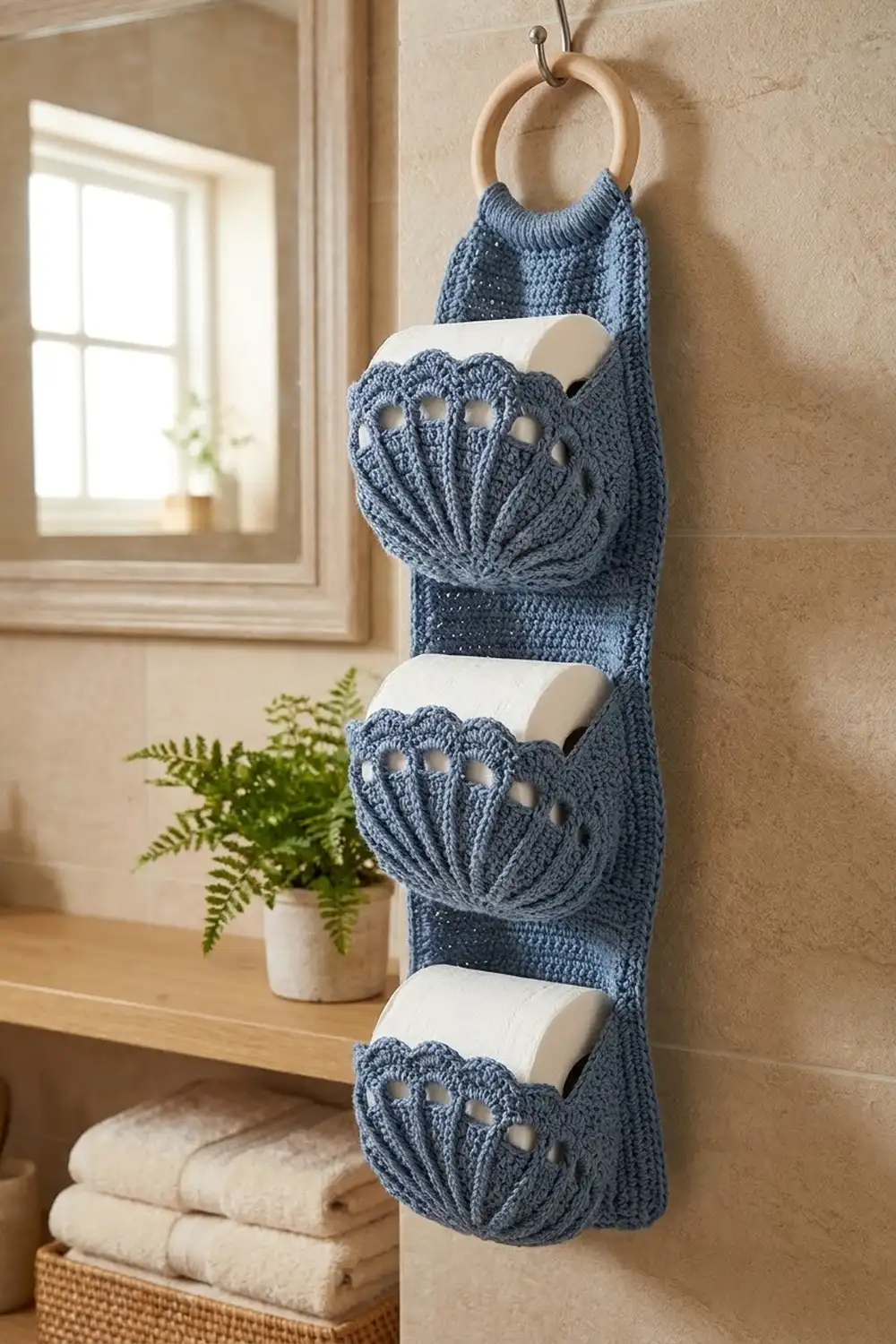
This hanging holder stacks three scalloped seashell pockets in one narrow strip of wall space. Each pocket holds one standard toilet roll. Raised ribs fan up from a firm base, and a ring of open arches sits just under a wavy scalloped rim. Two ridged side straps hold the pockets in a neat column and meet at a natural wooden ring at the top.
The sample is worked in one color, a soft dusty denim blue in worsted-weight cotton. It suits a calm, coastal bathroom, and it works just as well in sand, sage or white. All terms are US crochet terms.
The finished holder is about 9 in (22.9 cm) wide across the straps and about 22 in (55.9 cm) long from the top of the ring to the bottom of the lowest pocket. Each pocket has a 7 x 3.5 in (17.8 x 8.9 cm) oval base and stands about 3.6 in (9.1 cm) tall at the sides.
You crochet three identical pockets in the round, starting from an oval base. Then you crochet two straps in rows, fold the top of each strap around the ring, and whipstitch the pockets between the straps. A slip-stitch border around each strap finishes the edges and hides the seams.
Finished Size and Construction
- Finished size: about 9 in (22.9 cm) wide x 22 in (55.9 cm) long, including the ring
- Skill level: Intermediate (front post stitches, working in the round, seaming)
- Terminology: US
- Yarn weight: Worsted (#4), cotton or cotton blend
- Hook: 5 mm (H-8)
- Number of pieces: 5 (3 pockets + 2 straps), plus 1 wooden ring
- Layout: 1 column of 3 pockets, with a strap on each side
- Piece size: pocket base 7 x 3.5 in (17.8 x 8.9 cm), pocket height 3.6 in (9.1 cm); strap 1 x 22.2 in (2.5 x 56.4 cm) before folding
- Size before border: 9 x 22 in (22.9 x 55.9 cm)
- Border depth: a surface slip-stitch edge that adds less than 1/8 in (0.3 cm)
Materials
Choose a smooth, firm cotton or cotton blend. Cotton keeps the ribs crisp and the pockets upright, and it handles bathroom humidity well. Avoid very soft acrylic, because the pockets will sag under the weight of the rolls.
- Dusty denim blue: 180 g, about 340 m, worsted-weight cotton
That covers three pockets at about 40 g each and two straps at about 12 g each. The quantities include a margin of about 20% for swatching and differences in tension.
Tools:
- 5 mm (H-8) crochet hook
- 1 wooden macramé ring, 3 in (7.6 cm) across
- 4 locking stitch markers
- Yarn needle
- Scissors
- Measuring tape
- Rustproof pins and a blocking mat or folded towel
Abbreviations (US Terms)
- ch – chain
- sl st – slip stitch
- sc – single crochet
- dc – double crochet
- BLO – back loop only
- fpdc – front post double crochet
- sp(s) – space(s)
- st(s) – stitch(es)
- RS / WS – right side / wrong side
Special stitch – fpdc: Yarn over and insert the hook from front to back to front around the post of the stitch indicated. Yarn over and pull up a loop, then [yarn over, pull through 2 loops] twice. Skip the stitch behind the fpdc. Each fpdc counts as 1 stitch.
Gauge and Checkpoints
- Single crochet: 16 sts x 18 rows = 4 in (10.2 cm)
- Double crochet: 16 sts x 8 rounds = 4 in (10.2 cm)
Make one strap and one pocket first and measure them before you make the rest. That way you catch any tension problem on the first piece, not the fifth.
Checkpoints:
- Strap, after Row 18: 1 in (2.5 cm) wide and 4 in (10.2 cm) long.
- Pocket base, after Rnd 8: 7 x 3.5 in (17.8 x 8.9 cm).
- Pocket, after Rnd 14: about 2.4 in (6.1 cm) tall, measured from the base ridge.
- Pocket, after Rnd 17: about 3.6 in (9.1 cm) tall at the sides.
If your piece is too big, switch to a 4.5 mm hook. If it is too small, switch to a 5.5 mm hook. The base matters most. If the base comes out the right size, the walls usually do too.
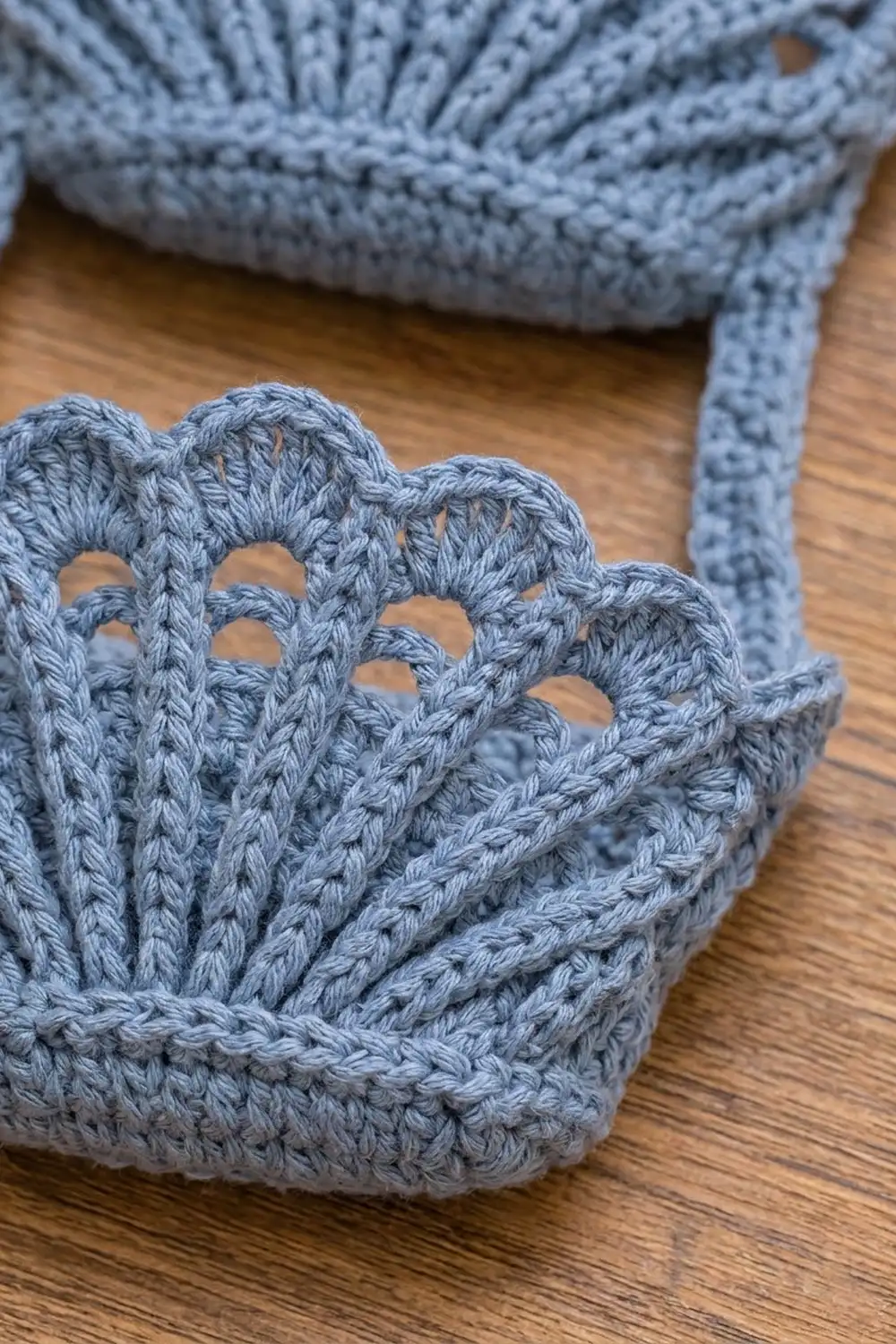
Pocket (Make 3)
Work in joined rounds with the RS facing, and do not turn. Join each round with a sl st to the first st. On sc rounds, start with ch 1 (does not count as a st).
Oval Base
Foundation: Ch 15.
Rnd 1: Sc in 2nd ch from hook and in next 12 ch, 3 sc in last ch. Rotate and work along the opposite side of the foundation: sc in next 12 ch, 2 sc in last ch (this ch already holds the first sc). Join. (30 sts)
Rnd 2: 2 sc in first st, sc in next 12, 2 sc in each of next 3, sc in next 12, 2 sc in each of last 2. Join. (36 sts)
Rnd 3: [Sc in next, 2 sc in next] once, sc in next 12, [sc in next, 2 sc in next] 3 times, sc in next 12, [sc in next, 2 sc in next] 2 times. Join. (42 sts)
Rnd 4: [Sc in next 2, 2 sc in next] once, sc in next 12, [sc in next 2, 2 sc in next] 3 times, sc in next 12, [sc in next 2, 2 sc in next] 2 times. Join. (48 sts)
Rnd 5: [Sc in next 3, 2 sc in next] once, sc in next 12, [sc in next 3, 2 sc in next] 3 times, sc in next 12, [sc in next 3, 2 sc in next] 2 times. Join. (54 sts)
Rnd 6: [Sc in next 4, 2 sc in next] once, sc in next 12, [sc in next 4, 2 sc in next] 3 times, sc in next 12, [sc in next 4, 2 sc in next] 2 times. Join. (60 sts)
Rnd 7: [Sc in next 5, 2 sc in next] once, sc in next 12, [sc in next 5, 2 sc in next] 3 times, sc in next 12, [sc in next 5, 2 sc in next] 2 times. Join. (66 sts)
Rnd 8: [Sc in next 6, 2 sc in next] once, sc in next 12, [sc in next 6, 2 sc in next] 3 times, sc in next 12, [sc in next 6, 2 sc in next] 2 times. Join. (72 sts)
Each round adds exactly 6 sts, 3 at each curved end. Check the base against Checkpoint 2. Then fold the base in half lengthwise and place a marker in the center st of each curved end. These two markers show where the pocket will meet the straps.
Base Band
Rnd 9: Sc in BLO of each st around. Join. (72 sts) The unused front loops form the crisp ridge where the base turns up into the wall.
Rnd 10: Sc in each st around. Join. (72 sts)
Move the side markers up into Rnd 10, directly above where they were.
Ribbed Shell Wall
On dc rounds, start with ch 2 (does not count as a st) and work the first st into the same st as the join.
Rnd 11: Dc in each st around. Join. (72 sts)
Rnd 12: [Fpdc around next st, dc in next 2] 24 times. Join. (72 sts: 24 fpdc, 48 dc)
Rnd 13: [Fpdc around next fpdc, dc in next 2] 24 times. Join. (72 sts)
Rnd 14 (growth round): [Fpdc around next fpdc, dc in next, 2 dc in next] 24 times. Join. (96 sts: 24 fpdc, 72 dc)
The 24 ribs now run up from the base band, and the added dc between them makes the wall flare outward like a shell. Check Checkpoint 3.
Arch Round
Rnd 15: [Fpdc around next fpdc, ch 3, skip next 3 dc] 24 times. Join to the first fpdc. (24 fpdc and 24 ch-3 sps; 96 sts counting each chain)
The ch-3 spaces form the ring of open windows under the scallops.
Scallop Rim
Rnd 16: Ch 1. [Sc in next fpdc, 3 dc in next ch-3 sp, dc in next fpdc, 3 dc in next ch-3 sp] 12 times. Join. (96 sts: 12 sc, 84 dc)
Each repeat makes one 7-dc fan. Its center dc sits on top of a rib, and the sc between fans pulls the rim down into a valley. That gives 12 scallops around the pocket, with about 6 on the front.
Rnd 17 (trim round): Ch 1. [Sl st in next sc, sc in next 3 dc, 2 sc in next dc, sc in next 3 dc] 12 times. Join. 96 sts worked 1-per-stitch + 12 added at the scallop peaks = 108 sts.
Fasten off, leaving a 24 in (61.0 cm) tail for seaming. Check Checkpoint 4. The markers should still sit at the two sides of the pocket.
Strap (Make 2)
The straps are worked in rows. The BLO rows create the horizontal ridges.
Foundation: Ch 5.
Row 1: Sc in 2nd ch from hook and in each remaining ch. (4 sts)
Rows 2–100: Ch 1, turn. Sc in BLO of each st across. (4 sts)
Fasten off and weave in the ends. Each strap should be 1 x 22.2 in (2.5 x 56.4 cm).
Strap map (counted from Row 1 at the top):
- Rows 1–8: ring tab, 1.8 in (4.6 cm)
- Rows 9–32: hanger section, 5.3 in (13.5 cm)
- Rows 33–48: top pocket zone, 16 rows
- Rows 49–58: gap, 10 rows, 2.2 in (5.6 cm)
- Rows 59–74: middle pocket zone, 16 rows
- Rows 75–84: gap, 10 rows
- Rows 85–100: bottom pocket zone, 16 rows
On the inner edge of each strap, mark Rows 33, 49, 59, 75 and 85.
Make All Pieces
- Pockets: 3 in dusty denim blue
- Straps: 2 in dusty denim blue
- Wooden ring: 1
Layout grid:
            ( RING )
           /        \
     [Strap]        [Strap]   rows 9-32
     [Strap] POCKET [Strap]   rows 33-48
     [Strap]  gap   [Strap]   rows 49-58
     [Strap] POCKET [Strap]   rows 59-74
     [Strap]  gap   [Strap]   rows 75-84
     [Strap] POCKET [Strap]   rows 85-100
Joining
Attach the ring. Pass Rows 1–8 of one strap through the ring from front to back. Fold the tab down onto the WS so the foundation edge lies across Row 16, and whipstitch the 4 foundation sts to Row 16. Repeat with the second strap, placing it right beside the first on the ring.
Attach the pockets. Lay the straps RS up with their inner edges facing each other. Line up one marked side of a pocket with the inner edge of the top pocket zone (Rows 33–48). Rnd 17 sits at Row 33, and the base edge of Rnd 8 sits at Row 48.
Using the pocket’s yarn tail, whipstitch 1 stitch per strap row, 16 stitches in all:
- Rnd 17: 1 row
- Rnds 16, 15, 14, 13, 12 and 11 (dc height): 2 rows each, 12 rows total
- Rnd 10: 1 row
- Rnd 9: 1 row
- Rnd 8 (base edge): 1 row
That is 1 + 12 + 1 + 1 + 1 = 16 rows, which fills the zone exactly. Join the other side of the pocket to the second strap the same way. Then attach the middle pocket to Rows 59–74 and the bottom pocket to Rows 85–100.
Tension: Pull each whipstitch just snug. If you pull too hard, the strap edge puckers and the pocket tilts. If you leave the stitches loose, the pocket gapes away from the strap.
Size checkpoint: Hang the empty holder. It should be about 9 in (22.9 cm) wide at the straps and 22 in (55.9 cm) long, and all three pockets should sit level.
Border
Border gauge: 18 sl sts = 4 in (10.2 cm) along the row-ends, which matches the strap’s row gauge.
Work the border on each strap with the RS facing, in one continuous pass of surface slip stitches.
- Outer edge: Join yarn at the outer edge of Row 9, just below the ring. Sl st in each row-end from Row 9 to Row 100, working through both layers for Rows 9–16. (92 sl sts)
- Bottom end: Sl st in each of the 4 sts of Row 100. These 4 already include the corner sts, so do not add any extra. (4 sl sts)
- Inner edge: Sl st in each row-end from Row 100 back up to Row 9. Work into the strap edge only, just in front of the seams. (92 sl sts)
Fasten off. Total per strap: 92 + 4 + 92 = 188 sl sts.
Why the math works: Each long edge has 92 free rows (Rows 9–100), and each row gets 1 sl st. On the inner edge, those 92 rows break down as 24 hanger rows + 3 pocket zones x 16 rows + 2 gaps x 10 rows = 24 + 48 + 20 = 92. No stitches are added at the seams. Slip stitches are short and narrow, so one per row lies flat without ruffling and hardly changes the width.
Final Blocking
- Weave in all remaining ends along the seams.
- Spray the holder lightly with water until it is damp but not soaked.
- Lay it flat RS up and pin the straps straight, 9 in (22.9 cm) apart at their outer edges.
- Fill each pocket with a rolled hand towel, or a toilet roll in a plastic bag, to round out the shell.
- Pin out each of the 12 scallop peaks, and use your fingers to straighten the ribs into even fan lines.
- Let it dry completely, then remove the pins and hang the holder.
Final Quality-Control Checklist
- Each pocket has 72 sts at Rnd 8, 96 at Rnd 14 and 108 at Rnd 17
- All 24 ribs run unbroken from Rnd 12 to Rnd 15
- Each pocket has 12 even scallops
- Each strap has 100 rows and is 4 sts wide
- Each pocket side seam covers exactly 16 strap rows
- Both gaps measure 10 rows on both straps
- Each strap has a 188-st border
- The ring tabs are secure, and the straps sit side by side on the ring
- The holder hangs straight and the pockets sit level
Troubleshooting
- The base cups before Rnd 9: Your tension is too tight. Loosen your sc, or use a larger hook for the base only.
- The base ruffles: The increases are stacking too sharply. Shift each bracket’s increase by 1 st every other round.
- The ribs lean sideways: Check that every fpdc goes around the fpdc directly below it.
- The scallops look flat: Make sure Rnd 16 has 3 dc in each ch-3 sp and 1 dc on top of each rib.
- The pocket sags when filled: Use a firmer cotton, or add an oval of plastic canvas cut to 6.5 x 3 in (16.5 x 7.6 cm).
- The straps are different lengths: Count the rows on both straps. Each needs exactly 100.
Care
Hand wash in cool water with mild soap. Reshape the scallops while the holder is damp and lay it flat to dry. Do not tumble dry.
Final Notes
Everything in this pattern follows from one chain of measurements. A gauge of 16 sc = 4 in (10.2 cm) gives a 7 x 3.5 in (17.8 x 8.9 cm) base. The base grows into a 72-st band, then a 96-st ribbed wall, then a 108-st scalloped rim about 3.6 in (9.1 cm) tall. Each pocket fills exactly 16 strap rows. Each 100-row strap holds 24 hanger rows, three pocket zones and two 10-row gaps, then gets a 188-st slip-stitch border. Check each step as you go, and the finished holder will hang straight and even.
Happy crocheting!