

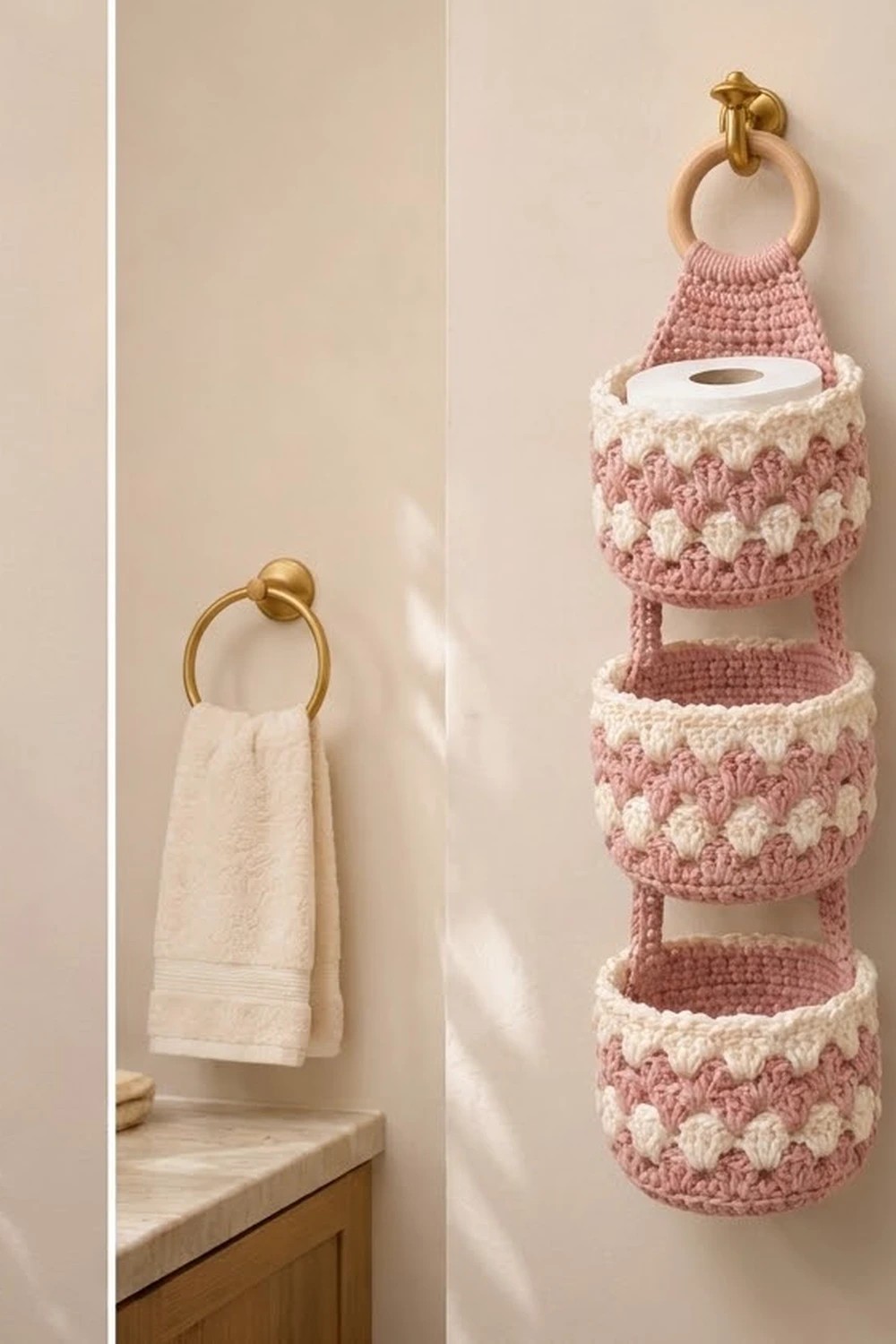
This three-tier hanging holder stores three standard toilet rolls in a narrow column, so it fits beside a vanity, behind a door, or in a small gap next to a towel bar. Each basket is round and roomy, with dense single crochet at the base and a wall of staggered granny clusters.
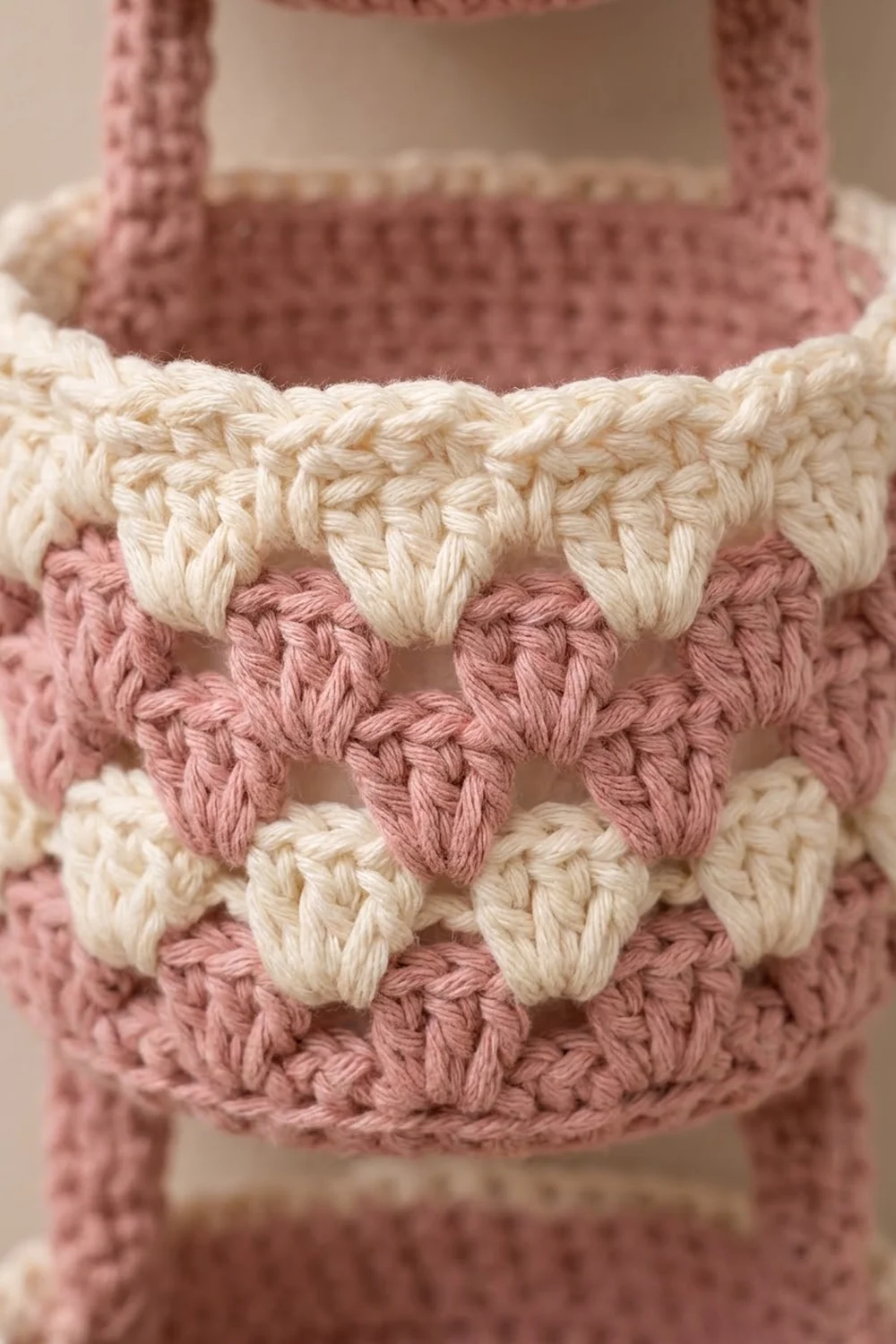
The palette is dusty rose pink and soft cream. The bands alternate color each round, so the cream clusters sit in the gaps between the pink ones and form a scalloped, shell-like pattern. A cream rim finished with reverse single crochet gives each basket a firm, rope-like top edge.
The pattern uses US crochet terms. The finished holder measures 20.5 in (52.1 cm) long without the ring. Each basket is 4 in (10.2 cm) tall and about 5.5 in (14.0 cm) across.
You make three identical baskets, four small straps, and one tapered hanger tab. The straps are sewn between the baskets at the sides. The tab is sewn inside the back of the top basket and wraps around a 3 in (7.6 cm) wooden ring.
Finished Size and Construction
- Finished length: 20.5 in (52.1 cm), not counting the ring
- Skill level: Easy-intermediate
- Terminology: US
- Yarn weight: Worsted (#4 medium) cotton
- Hook: 5.0 mm (H-8)
- Number of pieces: 8 (3 baskets, 4 straps, 1 hanger tab)
- Layout: One vertical column of 3 baskets with 2 in (5.1 cm) gaps
- Piece size (one basket): 5.5 in (14.0 cm) diameter x 4 in (10.2 cm) tall
- Basket height before rim (border): 3.5 in (8.9 cm)
- Rim (border) depth: 0.5 in (1.3 cm)
Materials
Use a smooth, mercerized or combed cotton in worsted weight, about 170 m per 100 g. Cotton holds its shape well, takes the humidity of a bathroom, and gives the clusters a crisp outline. Avoid fuzzy or very soft acrylic, because the walls will sag.
- Color A, dusty rose pink: 150 g (255 m)
- Color B, cream: 75 g (128 m)
These quantities include a margin of roughly 20% for gauge swatches and differences between dye lots.
Tools:
- 5.0 mm (H-8) crochet hook
- One wooden ring, 3 in (7.6 cm) outer diameter
- Tapestry needle
- 4 locking stitch markers
- Scissors
- Measuring tape
- Pins and a blocking surface
Abbreviations (US Terms)
- ch: chain
- sc: single crochet
- dc: double crochet
- sl st: slip stitch
- st(s): stitch(es)
- sp: space
- sk: skip
- BLO: back loop only
- sc2tog: single crochet 2 together
- rev sc: reverse single crochet
- MR: magic ring
Special stitches:
- Cluster group: 3 dc worked into the same stitch or space.
- Reverse single crochet (rev sc): Working from left to right (right-handed), insert the hook into the next stitch to the right, yarn over, pull up a loop, yarn over, and pull through both loops. It produces a twisted, corded edge.
Gauge and Checkpoints
Gauge: 14 sc and 16 rounds = 4 in (10.2 cm). In the granny rounds, 14 dc (about 4⅔ cluster groups) and 8 rounds = 4 in (10.2 cm).
Make one complete basket before you start the others, and treat it as your gauge swatch. Check it at each stage:
- After Round 5 (30 sts): base measures about 2.75 in (7.0 cm) across.
- After Round 10 (60 sts): base measures 5.5 in (14.0 cm) across and lies flat.
- After Round 18: wall measures 3.5 in (8.9 cm) high from the base fold.
- After Round 21: basket measures 4 in (10.2 cm) high, and a toilet roll drops in with a little ease.
Base is too big or ruffled: go down to a 4.5 mm hook. Base is too small or cupping: go up to a 5.5 mm hook. If the base is right but the wall is too short, keep your dc tension looser and pull the first loop of each dc a little taller. Check gauge again after changing hooks.
Basket (Make 3)
Every basket is worked in joined rounds with the right side facing. Do not turn.
Base
With Color A:
Round 1: MR, ch 1, 6 sc in ring, sl st to first sc. (6 sts)
Round 2: Ch 1, 2 sc in each st around, sl st to first sc. (12 sts)
Round 3: Ch 1, sc in next st, 2 sc in next st; repeat from * around, sl st to first sc. (18 sts)
Round 4: Ch 1, sc in next 2 sts, 2 sc in next st; repeat around, sl st to first sc. (24 sts)
Round 5: Ch 1, sc in next 3 sts, 2 sc in next st; repeat around, sl st to first sc. (30 sts)
Rounds 6-10: Continue in the same way, working one more sc between increases each round. Round 6 has 36 sts, Round 7 has 42 sts, Round 8 has 48 sts, Round 9 has 54 sts, and Round 10 has 60 sts. Join each round with a sl st to the first sc.
The base is now 5.5 in (14.0 cm) across.
Wall
Round 11 (turning round): Ch 1, sc in BLO of each st around, sl st to first sc. (60 sts: 60 worked 1-per-stitch + 0 added)
The unworked front loops create a crisp fold, so the wall stands upright.
Round 12: Ch 1, sc in each st around, sl st to first sc. Fasten off Color A. (60 sts)
Round 13 (Color B, conversion): Join Color B in any st. Ch 3 (counts as dc), 2 dc in same st, sk 2 sts, 3 dc in next st; repeat from * 18 more times, sk 2 sts, sl st to top of ch-3. Fasten off. (20 cluster groups, 60 dc)
This round turns 60 sc into 20 cluster groups: every third stitch holds one group, and the 2 skipped stitches leave a space between groups.
Round 14 (Color A): Join Color A in any sp between groups. Ch 3 (counts as dc), 2 dc in same sp, 3 dc in each remaining sp around (19 sps), sl st to top of ch-3. Fasten off. (20 cluster groups, 60 dc)
Round 15 (Color B): Repeat Round 14 in Color B. (20 groups, 60 dc)
Round 16 (Color A): Repeat Round 14 in Color A. (20 groups, 60 dc)
Round 17 (Color B): Repeat Round 14 in Color B. (20 groups, 60 dc)
Round 18 (Color A): Repeat Round 14 in Color A. Fasten off. (20 groups, 60 dc)
Each new round sits in the spaces of the round below it, so the colors stagger and the cream groups look like shells nestled between the pink ones. Move the join point a few spaces each round so the seams don’t stack.
Checkpoint: The wall is 3.5 in (8.9 cm) high from the fold.
Straps (Make 4)
With Color A, ch 4.
Row 1: Sc in second ch from hook and in each ch across, turn. (3 sts)
Rows 2-18: Ch 1, sc in each st across, turn. (3 sts)
Fasten off and leave a 12 in (30.5 cm) tail. Each strap measures 0.9 in (2.3 cm) wide and 4.5 in (11.4 cm) long.
Hanger Tab (Make 1)
With Color A, ch 19.
Row 1: Sc in second ch from hook and in each ch across, turn. (18 sts)
Rows 2-4: Ch 1, sc in each st across, turn. (18 sts)
Row 5: Ch 1, sc2tog, sc in each st across to last 2 sts, sc2tog, turn. (16 sts)
Row 6: Ch 1, sc in each st across, turn. (16 sts)
Rows 7-16: Repeat Rows 5 and 6 five more times, ending with 6 sts. The odd rows decrease to 14, 12, 10, 8, and 6 sts, and each even row matches the row before it.
Rows 17-28: Ch 1, sc in each st across, turn. (6 sts)
Fasten off and leave an 18 in (45.7 cm) tail.
The tab is 5.1 in (13.0 cm) wide at the bottom and tapers to 1.7 in (4.3 cm). Rows 1-4 are 1 in (2.5 cm) of overlap, Rows 5-16 are the 3 in (7.6 cm) taper, and Rows 17-28 are the 3 in (7.6 cm) strip that folds over the ring.
Make All Pieces
- Baskets: 3 (Color A for Rounds 1-12 and Rounds 14, 16, 18; Color B for Rounds 13, 15, 17, and 19-21)
- Straps: 4 (Color A)
- Hanger tab: 1 (Color A)
Layout (front view):
            ( ring )
          /  tab  \
   [ Basket 1 - top    ]
    |strap|      |strap|
   [ Basket 2 - middle ]
    |strap|      |strap|
   [ Basket 3 - bottom ]
Rim (Border)
Each basket gets a 3-round cream rim. The rim gauge matches the base, 14 sc = 4 in (10.2 cm), so it lies flat against the cluster wall without flaring.
Round 19 (Color B, conversion): Join Color B in any st. Ch 1, sc in each dc around, sl st to first sc. (60 sts: 60 worked 1-per-stitch + 0 added)
Round 20: Ch 1, sc in each st around, sl st to first sc. (60 sts)
Round 21: Ch 1, rev sc in each st around, sl st to first rev sc. Fasten off. (60 sts)
Why the math works: Round 18 has 20 groups of 3 dc, which is exactly 60 stitches. One sc in each dc gives 60 sc, the same count as the base edge, so the rim circumference equals the wall circumference: 60 sts / 3.5 sts per in = 17.1 in (43.4 cm). Seen from the front, the basket is still 5.5 in (14.0 cm) across.
For placement, split the 60 rim stitches into a front half and a back half of 30 sts each. Count the Round 19 join as st 1. The back center falls between sts 30 and 31.
Joining
Mark the following on every basket with locking markers:
- Side straps: sts 14-16 and sts 45-47. Each set is centered 15.5 sts from the back center, so the straps sit exactly at the sides.
- Hanger zone (top basket only): sts 22-39, which is 18 sts centered on the back.
Straps: Use whipstitch and the strap tails. The 3 sts at the end of a strap line up stitch-to-stitch with the 3 marked stitches, because both use the same 3.5 sts per in gauge.
- Lay the upper end of a strap on the outside of Basket 1, over the marked side stitches, so it covers 1.25 in (3.2 cm) of the lower wall above the fold.
- Whipstitch around all 4 edges of the overlap.
- Lay the lower end of the strap on the outside of Basket 2, directly below, covering 1.25 in (3.2 cm) down from the top of the rim.
- Whipstitch as before. The open strap between baskets is 2 in (5.1 cm).
- Repeat for the second side, then join Basket 2 to Basket 3 the same way.
Hanger tab: Place Rows 1-4 inside the back of Basket 1, with the 18 bottom stitches lined up stitch-to-stitch with sts 22-39 just below the rim. Whipstitch the bottom edge and both sides of the overlap. Pass Rows 17-28 through the wooden ring, fold them toward the back, and whipstitch the last row to Row 16.
Tension: Sew firmly enough that no gap shows, but don’t pull hard enough to pucker the wall. Every seam should lie flat.
Checkpoint: Hang the holder empty. From the bottom of Basket 3 to the fold at the ring, it should measure 20.5 in (52.1 cm): 3 baskets x 4 in (10.2 cm) + 2 gaps x 2 in (5.1 cm) + 3 in (7.6 cm) taper + 1.5 in (3.8 cm) folded strip.
Final Blocking
- Weave in all ends on the inside of the baskets, running each one through stitches of its own color.
- Spray the whole holder lightly with water until it is damp but not soaked.
- Put a toilet roll, or a cylinder the same size, in each basket to set the round shape.
- Lay the holder flat with the straps straight. Pin the gaps to 2 in (5.1 cm) and shape the tab into a clean, symmetrical taper.
- Use your fingers to shape each cream rim into an even roll.
- Let it dry completely, at least 24 hours, before you remove the forms.
Final Quality-Control Checklist
- Each basket has 60 sts in Rounds 10-12 and 19-21.
- Each granny round has 20 groups and no missed spaces.
- The colors alternate cleanly, from cream Round 13 to pink Round 18.
- All three baskets measure 4 in (10.2 cm) tall and 5.5 in (14.0 cm) across.
- The straps sit at matching side positions on all baskets.
- Both gaps measure 2 in (5.1 cm).
- The tab is centered on the back and the ring hangs straight.
- No ends show on the outside.
Troubleshooting
- Base ripples: You’ve added extra stitches. Recount each round and check that the increases are spaced evenly.
- Base curls up like a bowl: Your tension is too tight. Go up a hook size for Rounds 1-10.
- Wall flares outward: Your dc rounds are looser than gauge. Use a smaller hook for Rounds 13-18 only.
- Clusters slant: You joined in a stitch instead of a space. Rejoin in a space between groups.
- Holder hangs crooked: The straps are not symmetrical. Re-center them on sts 14-16 and 45-47.
- Tab stretches: Reinforce it with a second line of whipstitch around the ring fold.
Care
Hand wash in cool water with mild soap, press out the water in a towel, and dry flat with a roll inside each basket. Do not tumble dry.
Final Notes
The measurement chain is short. A gauge of 14 sc = 4 in (10.2 cm) gives a 60-stitch base 5.5 in (14.0 cm) across. Those 60 stitches become 20 cluster groups and then 60 rim stitches, so the circumference never changes. Six granny rounds and the rim make each basket 4 in (10.2 cm) tall. Three baskets, two 2 in (5.1 cm) gaps, and the tab add up to 20.5 in (52.1 cm). Check your first basket at every checkpoint, and the other two will match it.
Happy crocheting!