

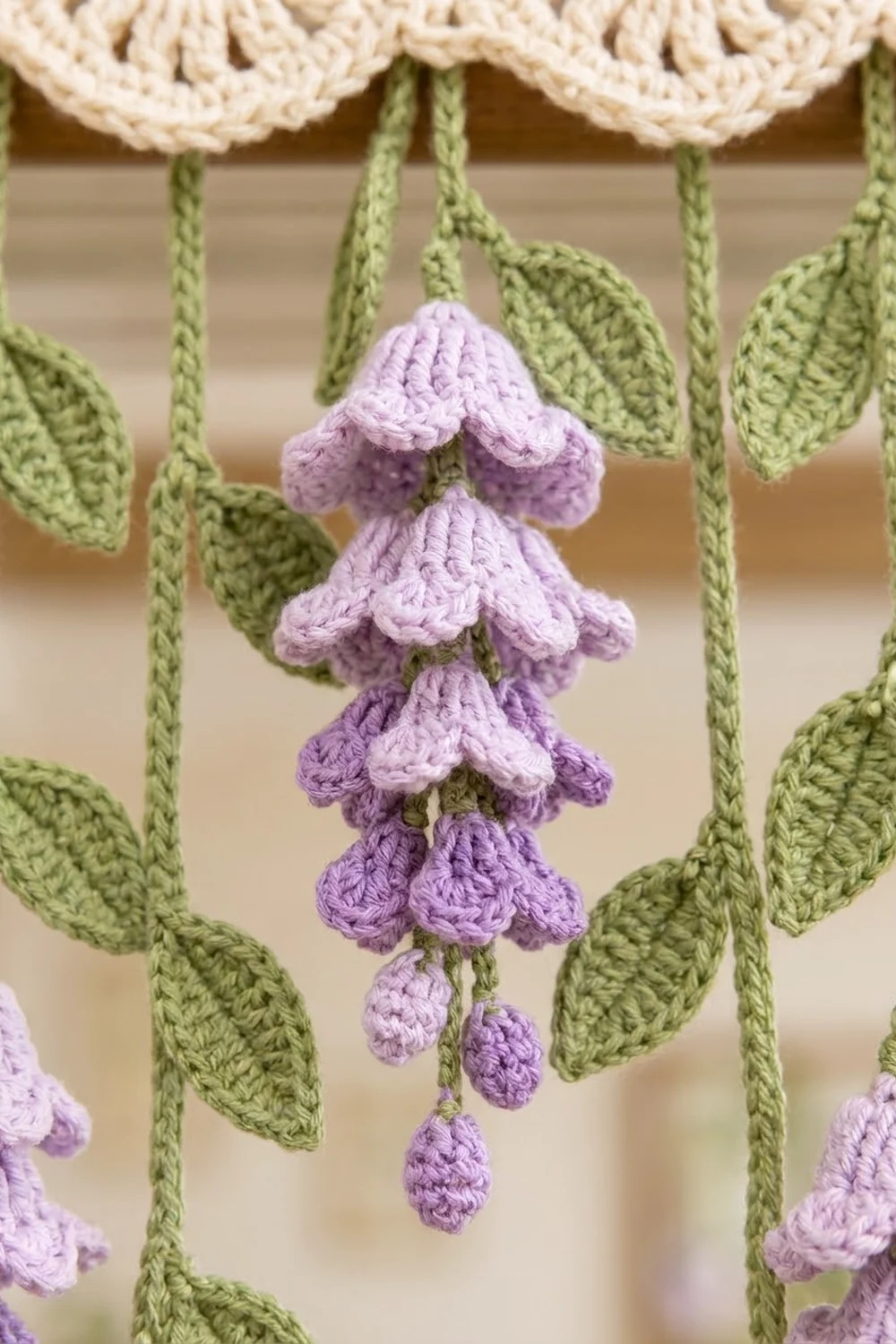
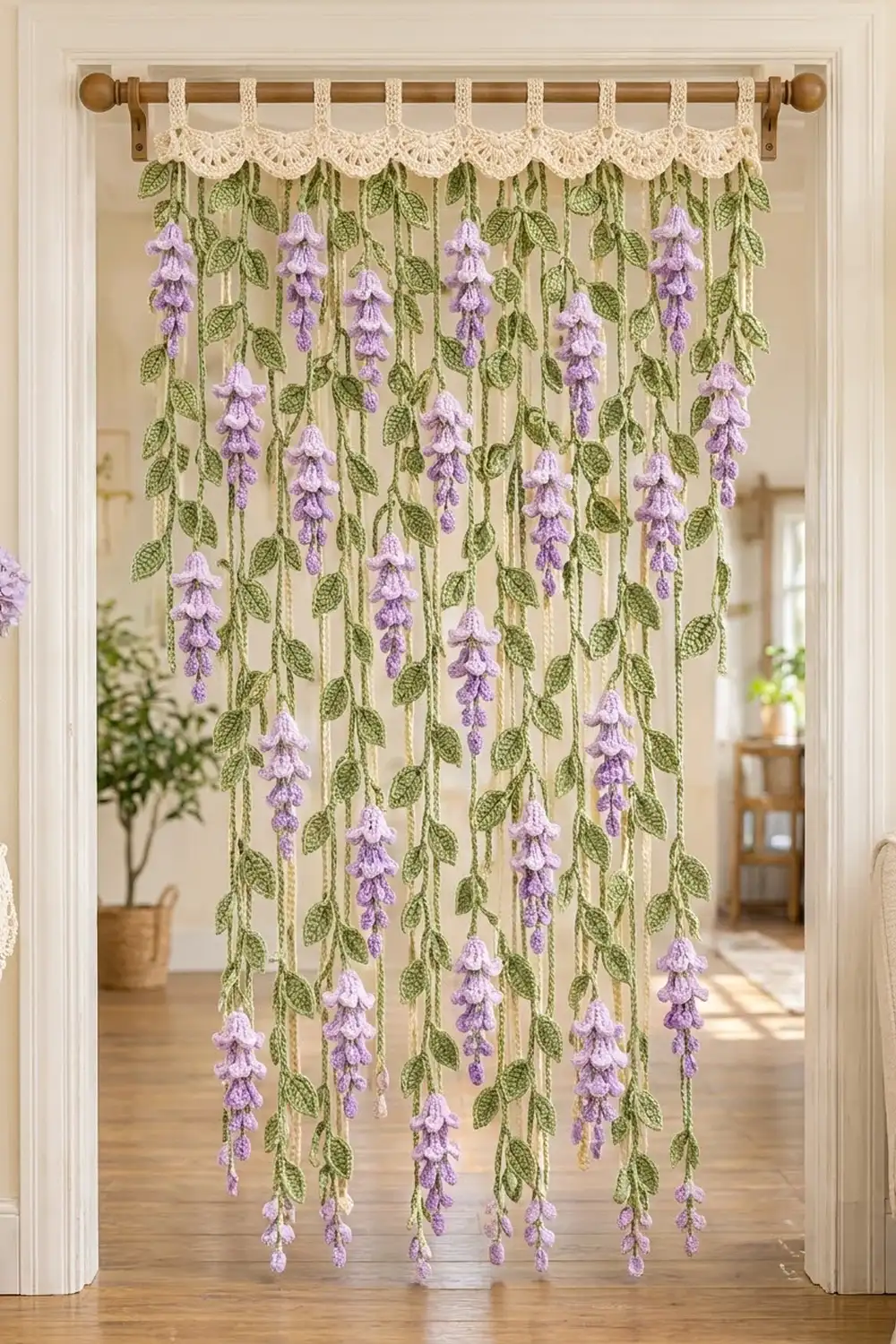
This doorway curtain turns a plain opening into a soft cottage garden. A cream lace header carries 25 trailing green vines. Each vine has pointed leaves and three hanging clusters of stacked lavender bells.
The colors are gentle: warm cream for the header, sage green for the vines and leaves, and two purples for the flowers. Pale lilac bells sit at the top of each cluster, with deeper lavender bells and a tiny bud below them, so every cluster shades from light to dark.
The pattern uses US crochet terms. The finished curtain is 32.2 in (81.8 cm) wide and 72 in (182.9 cm) long, measured from the top edge of the header to the tip of the lowest flower. Eleven tabs above the header slide over a rod.
Construction is simple and repetitive. You work a flat header in rows. Then you chain each vine straight down from the header and slip stitch back up, making leaves as you go. Bells are made separately, threaded onto short spines, and sewn to the vines. A two-row scallop edge and the rod tabs finish the header.
Finished Size and Construction
- Finished size: 32.2 in (81.8 cm) wide x 72 in (182.9 cm) long, plus tabs
- Skill level: Intermediate (easy stitches, many repeats, careful counting)
- Terminology: US
- Yarn weight: DK (#3), cotton or cotton blend
- Hook: 4 mm (G-6)
- Number of pieces: 1 header, 25 vine strands (worked onto the header), 75 flower clusters
- Layout: 25 strands in a single row, one every 6 header stitches
- Piece size: header body 32.2 x 2 in (81.8 x 5.1 cm); vine 67 in (170.2 cm); cluster 3.5 in (8.9 cm)
- Size before border: 32.2 x 2 in (81.8 x 5.1 cm)
- Border depth: 1.25 in (3.2 cm) scallop; tabs fold into 2.4 in (6.1 cm) loops
Materials
Choose a smooth DK cotton. Cotton keeps the vines from stretching under their own weight, and it helps the bells hold their flare. The amounts below assume about 2.4 m per gram (roughly 120 m per 50 g).
- Cream (A): 75 g / 180 m
- Sage green (B): 300 g / 720 m
- Light lilac (C): 175 g / 420 m
- Lavender (D): 175 g / 420 m
All quantities include a margin of about 10 to 15 percent for swatching and tails.
Tools: 4 mm (G-6) hook, tapestry needle, 30 or more locking stitch markers, scissors, measuring tape, blocking mat and pins, spray bottle, and a curtain rod up to 1.25 in (3.2 cm) in diameter.
Abbreviations (US Terms)
- ch chain
- sl st slip stitch
- sc single crochet
- hdc half double crochet
- dc double crochet
- tr treble crochet
- sc2tog single crochet 2 together
- st(s) stitch(es)
- FLO / BLO front loop only / back loop only
- RS / WS right side / wrong side
Surface slip stitch: Hold the yarn behind the work. Insert the hook from front to back, pull up a loop, and draw it through the loop on the hook. This draws a line on the surface of the fabric. Here it makes the leaf vein.
Gauge and Checkpoints
Gauge:
– 18 sts and 10 rows in dc = 4 in (10.2 cm)
– 18 sts and 20 rows in sc = 4 in (10.2 cm)
– On the finished vine, 4 sl sts = 1 in (2.5 cm)
Test before you commit. Work the header first, then make one complete vine and one cluster. Check these measurements:
- After Row 1, the header is 32.2 in (81.8 cm) wide.
- After Row 7, the header body is 2 in (5.1 cm) deep.
- The first 40 sl sts of a vine measure 10 in (25.4 cm), gently straightened.
- One leaf is 2 in (5.1 cm) long and about 1 in (2.5 cm) wide.
- A large bell rim is 1.25 in (3.2 cm) across.
- A finished cluster is 3.5 in (8.9 cm) long.
If your header is too wide or your vines are too long, go down one hook size. If they are too small or short, go up one size. Check your slip stitch tension separately: tight slip stitches make a vine noticeably shorter over 268 stitches.
Header
With A, ch 146.
Row 1 (WS): Sc in 2nd ch from hook and in each ch across. (145 sc)
Row 2: Ch 3 (counts as dc), turn, dc in each st across. (145 dc)
Row 3: Ch 1, turn, sc in each st across. (145 sc)
Rows 4 and 6: Repeat Row 2. (145 dc)
Rows 5 and 7: Repeat Row 3. (145 sc)
Row 7 is a WS row. Keep the yarn attached if you want to work the scallop border now; otherwise fasten off. The header body is 32.2 x 2 in (81.8 x 5.1 cm).
In Row 7, place a marker in sts 1, 7 and 13, then in every 6th st through st 145. That gives 25 markers, 6 sts or 1.33 in (3.4 cm) apart. These are the vine positions.
Vine Strands
Each vine hangs from the back loop of a marked Row 7 stitch. The scallop border uses the front loops, so the back loops stay free whichever you work first.
Leaf (worked during the vine):
- Ch 9.
- Side 1: sc in 2nd ch from hook, hdc in next ch, dc in next 3 ch, hdc in next ch, sc in next ch, sl st in last ch. (8 sts; you are now at the leaf base)
- Side 2: rotate and work into the free loops of the same chains: sl st in first ch, sc in next ch, hdc in next ch, dc in next 3 ch, hdc in next ch, sc in next ch. (8 sts)
- Tip: (sl st, ch 2, sl st) in the skipped ch.
- Vein: work 8 surface sl sts down the center line to the base.
The leaf has 16 sts plus the tip.
Vine: Join B with a sl st in the BLO of a marked st. Ch 269. Let the chain hang straight down.
Work back up the chain toward the header, into the back bumps:
- Sl st in 2nd ch from hook and in next 11 ch. (12 sl sts)
- Make a Leaf, then sl st into the base of the leaf to anchor it.
- [Sl st in next 16 ch, make a Leaf] 15 times.
- Sl st in next 16 ch. (268 sl sts total)
- Sl st in the same BLO where you joined. Fasten off and weave in.
Count check: 12 + (15 x 16) + 16 = 268 sl sts. The leaves sit at sl sts 12, 28 and 44, then every 16 sts up to 252, for 16 leaves. The top leaf is 63 in (160.0 cm) up the vine and 4 in (10.2 cm) below the header. Alternate the leaves to the left and right of the stem.
Cluster positions: Mark these slip stitches on the stem, counting from the bottom:
- Strand A: sl st 88 (22 in / 55.9 cm) and sl st 176 (44 in / 111.8 cm)
- Strand B: sl st 132 (33 in / 83.8 cm) and sl st 212 (53 in / 134.6 cm)
Every strand also gets a cluster at its bottom tip. None of these points lands on a leaf.
Flower Clusters
Work the bells in a continuous spiral and mark the first st of each round. Leave a 6 in (15.2 cm) starting tail on every bell.
Large Bell (make 2 per cluster, C):
- Rnd 1: 6 sc in a magic ring; leave the ring slightly open for now. (6)
- Rnd 2: 2 sc in each st. (12)
- Rnd 3: Sc in each st. (12)
- Rnd 4: [Sc in next st, 2 sc in next st] 6 times. (18)
- Rnd 5: Sc in each st. (18)
- Rnd 6 (petal trim): [Sl st in next st, (hdc, dc, hdc) in next st, sl st in next st] 6 times. Count: 18 sts worked + 12 extra = 30 sts, 6 petals. Sl st to first st, fasten off.
The rim is 1.25 in (3.2 cm) across and the bell is 1 in (2.5 cm) tall.
Medium Bell (make 2 per cluster, D):
- Rnds 1–3: Work as for the Large Bell. (12)
- Rnd 4 (petal trim): [Sl st in next st, (hdc, dc, hdc) in next st, sl st in next st] 4 times. Count: 12 sts worked + 8 extra = 20 sts, 4 petals. Fasten off.
Size: 1 in (2.5 cm) across and 0.75 in (1.9 cm) tall.
Bud (make 1 per cluster, D):
- Rnd 1: 6 sc in a magic ring. (6)
- Rnd 2: Sc in each st. (6)
- Rnd 3: Sc2tog 3 times. (3) Fasten off and close the hole.
Size: 0.5 in (1.3 cm) long.
Spine (make 1 per cluster, D): Ch 15. Sl st in 2nd ch from hook and in each ch across. (14 sl sts, 3.5 in / 8.9 cm)
Assemble the cluster:
- Thread the bells onto the spine like beads. Push the bottom end of the spine down through the magic ring and out through the rim. Thread them in this order: Large, Large, Medium, Medium.
- Position each ring, counting slip stitches from the bottom of the spine: Medium at sl st 3, Medium at sl st 6, Large at sl st 9, Large at sl st 12.
- Pull each ring tail snug around the spine and stitch through the spine twice.
- Sew the ring end of the bud to the bottom tip of the spine.
The top 2 sl sts, 0.5 in (1.3 cm), stay bare as the hanger. Each bell rim overlaps the top of the bell below it, which gives the tiered look.
Make All Pieces
- Header: 1, color A
- Vines: 25, color B (13 Strand A, 12 Strand B), with 400 leaves in total
- Large bells: 150, color C
- Medium bells: 150, color D
- Buds: 75, color D
- Spines: 75, color D (one per cluster)
Layout across Row 7 (stitch number and strand type):
st:  1   7  13  19  25  31  37  43  49  55  61  67  73
     A   B   A   B   A   B   A   B   A   B   A   B   A
st: 79  85  91  97 103 109 115 121 127 133 139 145
     B   A   B   A   B   A   B   A   B   A   B   A
Strand A hangs below the scallop valleys and Strand B hangs from the scallop tips. The alternating cluster heights create the staggered, cascading look.
Joining
Vines to header: Each vine is joined as you make it: you chain out of a back loop and slip stitch back into the same loop. One loop holds one vine. No stitches are added to the header, so it stays at 145 sts.
Keep the header flat on a table while you chain and let the chain hang off the edge. This stops twisting. Make the return sl sts the same size as your chains and don’t pull them tight.
Clusters to vines: Lay a strand flat. For the tip cluster, overlap the 0.5 in (1.3 cm) hanger with the last 0.5 in (1.3 cm) of the vine and whipstitch it in place with D. For the middle clusters, sew the tip of the hanger to the marked sl st so the cluster hangs beside the vine.
Size checkpoint: Hang the header. Each vine plus its tip cluster should reach 70 in (177.8 cm) below the bottom of the header body: 67 in (170.2 cm) of vine plus 3 in (7.6 cm) of cluster.
Border
The border has two parts: a scallop edge along the bottom and rod tabs along the top. The border gauge matches the header at 4.5 sts per inch, so one 12-st scallop is 2.67 in (6.8 cm) wide.
Bottom scallop (worked into the FLO of Row 7):
Row 8 (RS): Ch 1, turn, sc in first st, [skip 5 sts, 9 tr in next st, skip 5 sts, sc in next st] 12 times. Count: 13 sc + 108 tr = 121 sts.
Row 9 (WS): Ch 1, turn, sc in first sc, [(tr in next tr, ch 1) 8 times, tr in next tr, sc in next sc] 12 times. Count: 121 sts worked 1 per existing st + 96 ch-1 spaces added = 217 sts. Fasten off.
Why the math works: each scallop uses 12 header sts, and 12 x 12 = 144, plus 1 closing sc = 145. The fans land on sts 7, 19 and so on, right above the Strand B positions. The scallop is 1.25 in (3.2 cm) deep and hides the tops of the vines.
Top tabs (RS facing, worked into the free loops of the foundation chain):
The tabs sit at sts 1–5, 15–19, 29–33 and so on, starting every 14 sts and ending at sts 141–145. That makes 11 tabs of 5 sts with 10 gaps of 9 sts: 55 + 90 = 145.
Each tab:
- Join A in the first st of the tab.
- Row 1: Ch 1, sc in same st and next 4 sts. (5 sc)
- Rows 2–24: Ch 1, turn, sc in each st. (5 sc)
- Fasten off with a 12 in (30.5 cm) tail.
Each strip is 4.8 in (12.2 cm) long and 1.1 in (2.8 cm) wide. Fold it to the WS and sew Row 24 to the back of header Rows 1–2. Each loop stands 2.4 in (6.1 cm) tall, and the gaps between tabs are 2 in (5.1 cm).
Final Blocking
- Weave in all ends first. Hide the bell tails inside the bells.
- Pin the header flat to 32.2 x 2 in (81.8 x 5.1 cm), plus the scallops.
- Open each fan evenly with pins in the ch-1 spaces.
- Mist with water and let it dry completely.
- Lay the strands flat in groups, straighten them and open the leaves. Mist and let dry.
- While the bells are damp, shape the petals outward with your fingers.
- Hang the curtain for 24 hours and check that all the tips are level.
Final Quality-Control Checklist
- Header is 145 sts wide and 32.2 in (81.8 cm) across.
- 12 even scallops, with 217 sts in Row 9.
- 11 tabs, all 24 rows, sewn level.
- 25 vines, each with 268 sl sts and 16 leaves.
- 75 clusters, each with 2 large bells, 2 medium bells and a bud.
- Strand A clusters at 22 and 44 in (55.9 and 111.8 cm); Strand B clusters at 33 and 53 in (83.8 and 134.6 cm).
- All tips reach 72 in (182.9 cm) from the top of the header.
Troubleshooting
- Header narrows or ruffles: The foundation chain is tighter or looser than your stitches. Re-chain with a hook one size up or down.
- Vines twist: You are rotating the chain as you work. Work into the back bumps only, steam lightly and hang.
- Vines too short: Your slip stitches are tight. Loosen them, or chain with a hook one size larger.
- Leaves cup: The vein slip stitches are pulling. Work them more loosely.
- Bells won’t flare: Go up one hook size for the petal trim only.
- Scallops ripple: Check the 5-st skips and the 9-tr count.
- Bells slide on the spine: Tighten the ring tails and stitch through the spine again.
Care
Hand wash in cool water with mild soap, roll in a towel, and dry flat with the vines straightened. Don’t tumble dry; wet vines are heavy and can stretch.
Final Notes
Each stage of the curtain is easy to measure:
- 145 sts make a 32.2 in (81.8 cm) wide header.
- Seven rows make it 2 in (5.1 cm) deep.
- Vines sit every 6 sts, 1.33 in (3.4 cm) apart.
- Each 268-st vine is 67 in (170.2 cm) long.
- A 3 in (7.6 cm) tip cluster brings the full length to 72 in (182.9 cm).
- The 12-st scallops add 1.25 in (3.2 cm) of lace at the front.
Check each stage before moving on, and the curtain will hang straight and even.
Happy crocheting!