
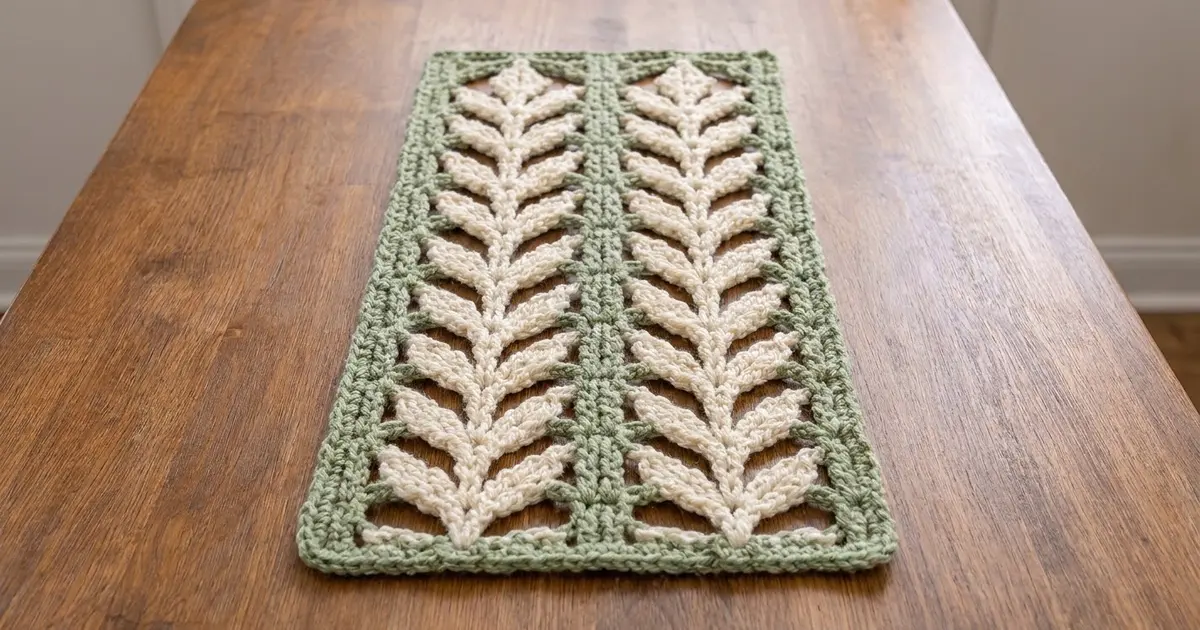
The Sage Wheat Ladder Panel is a single rectangle with two tall columns of cream wheat leaves. A sage green ladder runs between the columns and a green frame goes all the way around. Each leaf row forms a V that points down to a raised center spine. Small eyelets at the outer edges open into narrow slits between the leaves, so the fabric looks light and botanical.
It uses two colors: cream for the leaves and sage green for the ladder and frame. The style is calm farmhouse with a soft cottage feel. Use the panel as a decorative mat, a small wall hanging, or a practice piece for the stitch pattern.
This pattern uses US crochet terms. The finished panel measures 7 in x 13.5 in (17.8 cm x 34.3 cm) after blocking.
You work the panel flat in rows from the bottom up, changing colors intarsia-style for the leaf, ladder, and leaf sections. One green row closes off the bottom of the body and one closes off the top. Two rounds of green single crochet make the frame. It is one piece, so there’s no joining.
Finished Size and Construction
- Finished size: 7 in x 13.5 in (17.8 cm x 34.3 cm)
- Skill level: Intermediate (intarsia color changes, dc5tog)
- Terminology: US crochet terms
- Yarn weight: Worsted (#4) cotton or cotton blend
- Hook: 5.0 mm (H-8)
- Number of pieces: 1
- Layout: two leaf columns of 11 sts each, with a 3-st ladder between them (25 sts across)
- Piece size before border: 6 in x 12.5 in (15.2 cm x 31.8 cm)
- Border depth: 0.5 in (1.3 cm) per side, 2 rounds
Materials
Choose a smooth combed or mercerized worsted cotton, about 90 m per 50 g. Cotton shows the leaf texture clearly and blocks crisply. Acrylic also works, but the eyelets will look softer.
- Cream (Color A): 45 g, about 81 m, for the leaves
- Sage green (Color B): 30 g, about 54 m, for the ladder, the top and bottom rows, and the border
Tools:
- 5.0 mm (H-8) crochet hook
- Tapestry needle
- Scissors
- 4 stitch markers
- Measuring tape
- Blocking mat, rust-proof pins, and a spray bottle
These quantities include a margin of about 15 percent for checking gauge and weaving in ends.
Abbreviations (US Terms)
- ch – chain
- sc – single crochet
- dc – double crochet
- sk – skip
- sl st – slip stitch
- st(s) – stitch(es)
- sp – space
- RS / WS – right side / wrong side
dc5tog (double crochet 5 together): [Yarn over, insert hook in next st, yarn over and pull up a loop, yarn over and pull through 2 loops] 5 times. You now have 6 loops on the hook. Yarn over and pull through all 6. Counts as 1 st.
Intarsia color change: Work the last st of a section until 2 loops remain. Drop the old color to the WS, then pull the new color through both loops. Never carry yarn across the row. Each section gets its own small ball.
Gauge and Checkpoints
Gauge: 25 sts = 6 in (15.2 cm) wide. 8 pattern repeats (16 rows, alternating dc and sc rows) = 6 in (15.2 cm) tall. One two-row repeat is 0.75 in (1.9 cm).
Because this is a single piece, the first part of the panel is your test piece. Work Rows 1–9 and measure before continuing.
Checkpoints (unblocked, measured lightly stretched):
- After Row 1: width 6 in (15.2 cm)
- After Row 9: height 3.25 in (8.3 cm)
- After Row 17: height 6.25 in (15.9 cm)
- After Row 33: height 12.25 in (31.1 cm)
- After Row 34: 6 in x 12.5 in (15.2 cm x 31.8 cm)
- After Border Round 1: 6.5 in x 13 in (16.5 cm x 33.0 cm)
- After Border Round 2: 7 in x 13.5 in (17.8 cm x 34.3 cm)
If your piece is too big, go down 0.5 mm in hook size. If it’s too small, go up 0.5 mm. If only the height is off, look at your dc height. Pull the first loop up to full hook height and don’t tug the loops tight.
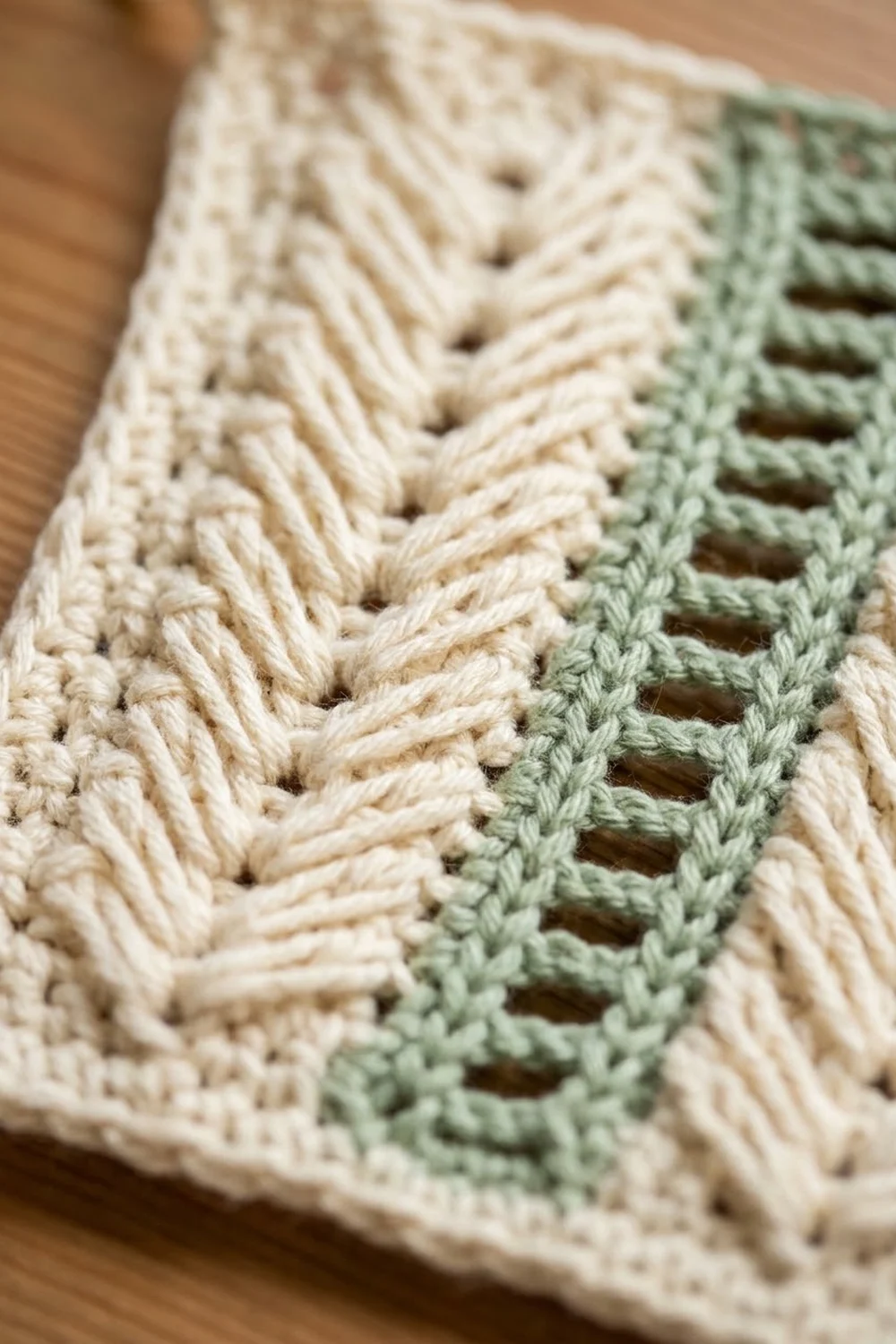
Pattern: The Panel
Setup: Wind 2 small balls of cream, about 22 g each, and 1 small ball of green, about 4 g, for the ladder. Use the main green ball for Row 1, Row 34, and the border.
Section layout for every pattern row: Left leaf (11 sts, cream) | Ladder (3 sts, green) | Right leaf (11 sts, cream).
Row 1 (WS, green)
With the main green ball, ch 26. Sc in the 2nd ch from the hook and in each ch across, changing to the first cream ball on the last yarn over. Cut the main green, leaving a 6 in (15.2 cm) tail. (25 sc)
Row 2 (RS, Row A – leaf row)
Left leaf, cream: Ch 3 (does not count as a st). (Dc, ch 1, dc) in the first st, dc in the next 2 sts, dc5tog over the next 5 sts, dc in the next 2 sts. Work (dc, ch 1, dc) in the next st, changing to the green ladder ball on the last yarn over. (11 sts)
Ladder, green: Dc in the next st, ch 1, sk the next st, dc in the next st, changing to the second cream ball on the last yarn over. (3 sts)
Right leaf, cream: (Dc, ch 1, dc) in the next st, dc in the next 2 sts, dc5tog over the next 5 sts, dc in the next 2 sts, (dc, ch 1, dc) in the last st. (11 sts)
Leaf count check: 3 + 2 + 1 + 2 + 3 = 11 sts made, counting each ch-1 as a st. Base sts used: 1 + 2 + 5 + 2 + 1 = 11. The leaf stays 11 sts wide.
Row 2 total: 25 sts (11 + 3 + 11).
Each outer edge gains 2 sts and the spine loses 4. That pulls every row into a V pointing down to the center, which makes the wheat leaf.
Row 3 (WS, Row B – spine row)
Right leaf, cream (worked first on WS rows): Ch 1. Sc in the first dc, ch 1, sk the ch-1 sp, sc in the next 7 sts (the dc5tog is one of them), ch 1, sk the ch-1 sp, sc in the next dc. Change to green on the last yarn over. (11 sts)
Ladder, green: Sc in the dc, ch 1, sk the ch-1 sp, sc in the next dc, changing to cream on the last yarn over. (3 sts)
Left leaf, cream: Sc in the first dc, ch 1, sk the ch-1 sp, sc in the next 7 sts, ch 1, sk the ch-1 sp, sc in the last dc. (11 sts)
Row 3 total: 25 sts.
The skipped ch-1 sps stack up to form the open slits beside the leaves. In the ladder, they form the gap between the two green posts.
Rows 4–33
Repeat Rows 2 and 3 fifteen more times. Even rows are Row A and odd rows are Row B, which gives 16 leaf rows in each column.
From Row 4 onward, the “dc in next 2 sts” on each side of the dc5tog includes one ch-1 sp. Work that dc into the sp. The dc5tog always goes over the center 5 sc, so the spine stays straight.
Every row: 25 sts. At the end of Row 33, cut both cream balls and the ladder green, leaving 6 in (15.2 cm) tails. Join the main green ball on the last yarn over.
Row 34 (RS, green)
Ch 1, sc in each st across, working into the ch-1 sps. (25 sc) Don’t fasten off.
The body now measures 6 in x 12.5 in (15.2 cm x 31.8 cm).
Border
Border gauge: about 4 sc per 1 in (2.5 cm) along the sides, and 25 sts per 6 in (15.2 cm) across the top and bottom. Each round adds 0.25 in (0.6 cm) per side.
A side’s count includes both of its corner sts. Each corner st is the center sc of a 3-sc group and is shared by the two sides that meet there.
Round 1 (green)
Ch 1, but don’t turn. Rotate the panel so you can work down the long side.
- Side 1: Work down the row ends of Rows 33 through 2. Put 2 sc in each dc row end and 1 sc in each sc row end: 16 x 2 + 16 x 1 = 48 sc.
- Bottom: Working into the foundation chain, 3 sc in the first ch, sc in the next 23 chs, 3 sc in the last ch.
- Side 2: Work up the row ends of Rows 2 through 33 the same way. (48 sc)
- Top: 3 sc in the first sc of Row 34, sc in the next 23 sts, 3 sc in the last sc. Sl st to the first sc.
Mark the 4 corner sts.
Per side, corners included:
- Top and bottom: 1 + 1 + 23 + 1 + 1 = 27 sts
- Long sides: 1 + 1 + 48 + 1 + 1 = 52 sts
Round 1 total: 154 sts (12 corner sts + 23 + 23 + 48 + 48). Check: 27 + 27 + 52 + 52 − 4 shared corners = 154.
Round 2 (green)
Ch 1. Sc in each st around, with 3 sc in each marked corner st. Move the markers up to the new center sts. Sl st to the first sc and fasten off.
Round 2 total: 162 sts = 154 worked 1 per existing st + 8 added (2 extra at each of 4 corners).
Per side, corners included: top and bottom 29 sts, long sides 54 sts. Check: 29 + 29 + 54 + 54 − 4 = 162.
Why the math works: A dc row is about 0.5 in (1.3 cm) tall and gets 2 sc. An sc row is about 0.25 in (0.6 cm) and gets 1 sc. That keeps the sides at about 4 sc per inch, close to the body’s width gauge of about 4.2 sts per inch. The top and bottom take exactly 1 sc per st. The 3-sc corners add just enough for the edge to turn flat without cupping or rippling.
Final Blocking
- Weave each tail into its own color section so no cream shows on green and no green shows on cream.
- Soak the panel in cool water for 10 minutes, then gently press the water out. Don’t wring it.
- Roll the panel in a towel to remove extra moisture.
- Lay it RS up and pin the corners to 7 in x 13.5 in (17.8 cm x 34.3 cm).
- Pin along the long sides every 1 in (2.5 cm), keeping the green edges straight.
- Open each eyelet slightly with your fingertip and straighten the center ladder.
- Dry completely, at least 24 hours, before unpinning.
Final Quality-Control Checklist
- The panel measures 7 in x 13.5 in (17.8 cm x 34.3 cm).
- Each column has 16 V-shaped leaf rows.
- The dc5tog spines stack in a straight line.
- The eyelets line up along the outer edges of each leaf column.
- The ladder has 2 green posts, open gaps, and green rungs.
- No color blips show on the RS.
- The border has 162 sts: 29 on the top and bottom and 54 on each long side.
- All 4 corners are flat and square.
Troubleshooting
Leaves lean or the spine wanders: The dc5tog is over the wrong sts. It always starts on the 4th base st of each 11-st leaf section.
A column gets wider or narrower: Each (dc, ch 1, dc) group should go into one st. On Row B, skip each ch-1 sp. Recount to 11.
Color peeks through at changes: Change color on the last yarn over and keep dropped yarns on the WS.
Tangled balls: Turn the work clockwise on one row and counterclockwise on the next.
Sides ripple or pull in: Recount the row-end sts. There should be 48 sc per side on Round 1.
Corners curl: Make sure every corner st gets 3 sc on both rounds.
Care
Hand wash in cool water with a mild detergent, reshape, and dry flat. Cotton can be lightly steamed from the WS.

Final Notes
Here’s the measurement chain:
- 25 sts give a body width of 6 in (15.2 cm).
- Each two-row repeat adds 0.75 in (1.9 cm). Sixteen repeats plus 2 green rows give a body height of 12.5 in (31.8 cm).
- Border Round 1 brings the panel to 6.5 in x 13 in (16.5 cm x 33.0 cm).
- Border Round 2 finishes it at 7 in x 13.5 in (17.8 cm x 34.3 cm).
If you match gauge at Row 9, the rest of the measurements will follow. Take your time with the first few leaf rows and the wheat pattern will settle into a steady rhythm.
Happy crocheting!