

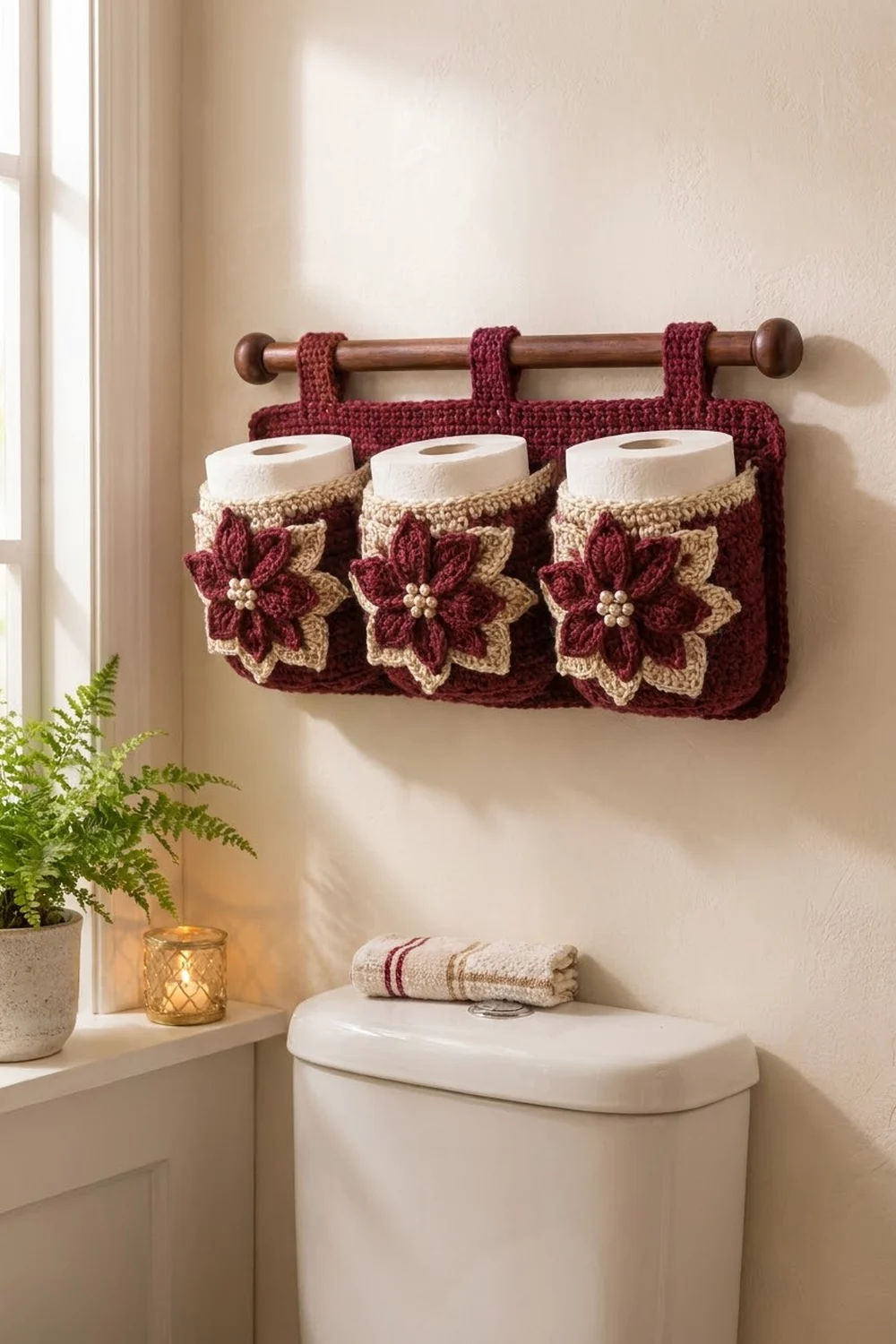
This hanging toilet paper holder is useful all year and festive in December. A burgundy back panel hangs from a wooden rod on three tabs, and three round pockets across the lower half each hold one standard roll.
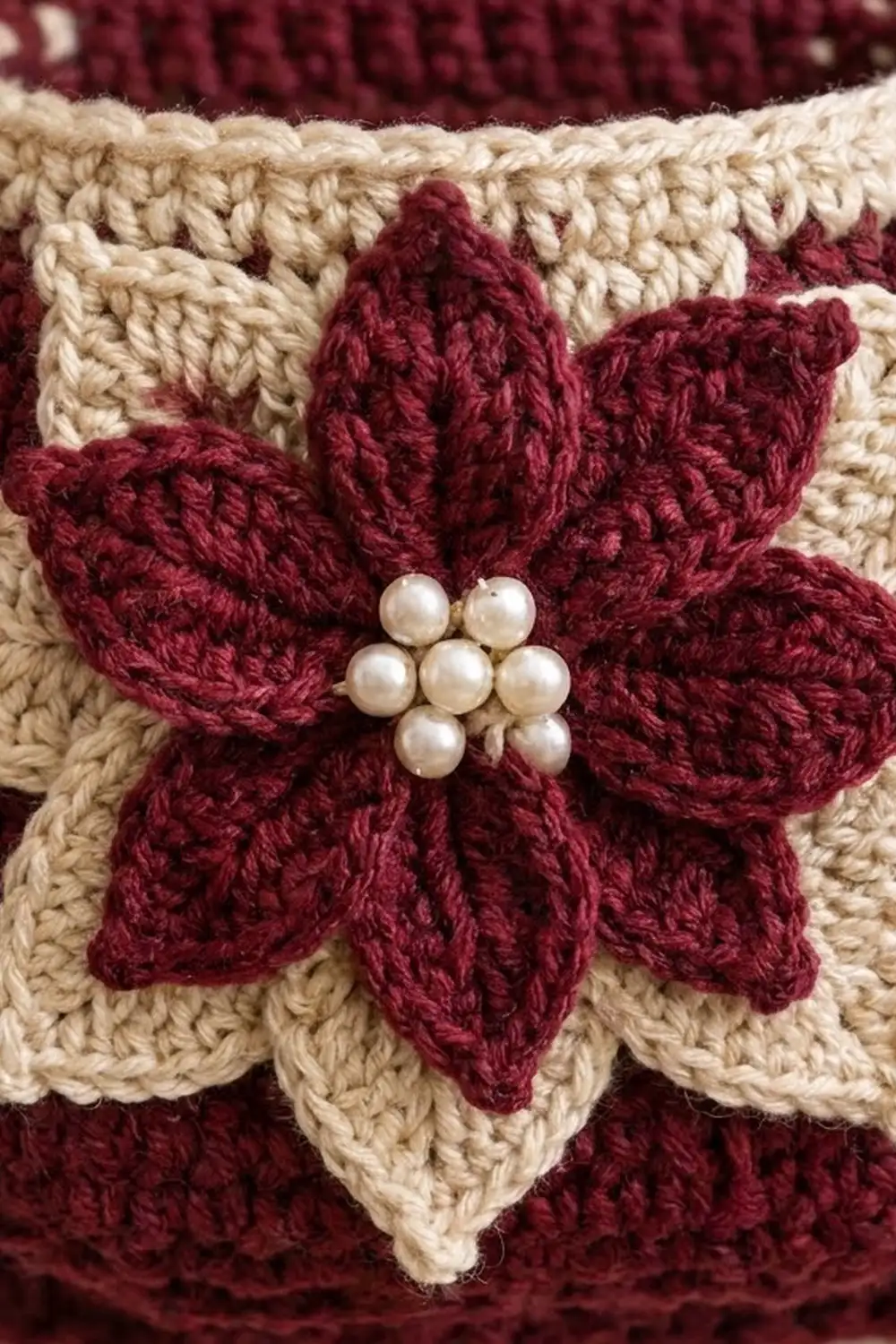
The colors are deep burgundy and soft cream. Each pocket has a cream rim band and a layered poinsettia on the front: cream leaves behind, burgundy petals on top, and pearl beads in the center. The fabric is dense and sturdy, so it keeps its shape.
The pattern uses US crochet terms. The finished holder measures 17 in (43.2 cm) wide and 7 in (17.8 cm) tall, not counting the tabs.
You crochet the panel flat in rows, then make the pockets in the round from a flat base. The two-layer flowers are sewn to the pockets, and the pockets are sewn to the panel. A two-round border goes around the panel, and the tabs go on last.
Finished Size and Construction
- Finished size: 17 in x 7 in (43.2 cm x 17.8 cm), tabs not included
- Skill level: Easy/Intermediate
- Terminology: US
- Yarn weight: Worsted (#4)
- Hook: 5.0 mm (H-8)
- Number of pieces: 13 (1 panel, 3 pockets, 3 tabs, 3 flowers, 3 leaf layers)
- Layout: 3 pockets in one row
- Pocket size: 4.75 in (12.1 cm) across x 4 in (10.2 cm) tall
- Panel size before border: 16 in x 6 in (40.6 cm x 15.2 cm)
- Border depth: 0.5 in (1.3 cm) per side
Materials
Use a smooth worsted-weight acrylic or cotton-acrylic blend. Acrylic stays bright and copes well with bathroom humidity.
- Burgundy: 200 g, about 360 m (394 yd)
- Cream: 50 g, about 90 m (98 yd)
These quantities include a margin of about 20 percent.
Tools:
- 5.0 mm (H-8) hook
- Tapestry needle and 4 stitch markers
- 21 cream pearl beads, 6 mm, with sewing thread and a sharp needle
- Pins and a measuring tape
- Rod up to 1 in (2.5 cm) thick and at least 20 in (50.8 cm) long, with end caps
- Blocking mat and spray bottle
Abbreviations (US Terms)
- ch – chain
- sl st – slip stitch
- sc – single crochet
- hdc – half double crochet
- dc – double crochet
- tr – treble crochet
- inc – 2 sc in the same stitch
- BLO – back loop only
- MR – magic ring
- st(s) – stitch(es)
- rev sc – reverse single crochet
Reverse single crochet (rev sc): Work from left to right. Insert the hook into the next stitch to the right, yarn over, pull up a loop, yarn over, and draw through both loops. This makes the corded pocket rims.
Gauge and Checkpoints
Gauge: 16 sc and 18 rows = 4 in (10.2 cm), worked in rows. That is 4 sts and 4.5 rows per inch.
Test one pocket first. It is the best gauge test, because it has to fit a real roll, which is about 4.5 in (11.4 cm) across.
Checkpoints:
- Pocket base after Rnd 10: 4.75 in (12.1 cm) across
- Pocket wall after Rnd 28: 4 in (10.2 cm) tall
- Panel after Row 1: 16 in (40.6 cm) wide
- Panel after Row 27: 6 in (15.2 cm) tall
- Panel after border: 17 in x 7 in (43.2 cm x 17.8 cm)
If your pieces are too big, go down to a 4.5 mm hook. If they are too small, go up to a 5.5 mm hook. A base that is too small matters most, because the roll will not fit.
Back Panel
Use burgundy.
Foundation: Ch 65.
Row 1: Sc in 2nd ch from hook and in each ch across, turn. (64 sc)
Rows 2–27: Ch 1 (does not count as a st), sc in each st across, turn. (64 sc)
Fasten off. Checkpoint: 16 in x 6 in (40.6 cm x 15.2 cm).
Pockets (Make 3)
Work in joined rounds without turning. Ch 1 does not count as a stitch.
Base (burgundy):
Rnd 1: 6 sc in MR, join with sl st. (6)
Rnd 2: Ch 1, inc in each st around, join. (12)
Rnd 3: Ch 1, sc in next st, inc; repeat 6 times, join. (18)
Rnd 4: Ch 1, sc in next 2 sts, inc; repeat 6 times, join. (24)
Rnd 5: Ch 1, sc in next st, inc, sc in next 3 sts, inc; repeat 4 more times, sc in next 2 sts, join. (30)
Rnd 6: Ch 1, sc in next 4 sts, inc; repeat 6 times, join. (36)
Rnd 7: Ch 1, sc in next 2 sts, inc, sc in next 5 sts, inc; repeat 4 more times, sc in next 3 sts, join. (42)
Rnd 8: Ch 1, sc in next 6 sts, inc; repeat 6 times, join. (48)
Rnd 9: Ch 1, sc in next 3 sts, inc, sc in next 7 sts, inc; repeat 4 more times, sc in next 4 sts, join. (54)
Rnd 10: Ch 1, sc in next 8 sts, inc; repeat 6 times, join. (60)
The increases move on odd rounds so the base stays round. Checkpoint: 4.75 in (12.1 cm) across.
Walls (burgundy):
Rnd 11: Ch 1, sc in BLO of each st around, join. (60) This makes a ridge that turns the edge upward.
Rnds 12–24: Ch 1, sc in each st around, join. (60) On the last join, switch to cream.
Rim band (cream):
Rnds 25–27: Ch 1, sc in each st around, join. (60)
Rnd 28: Ch 1, rev sc in each st around, join. (60) Fasten off.
The wall is 18 rounds, which is 4 in (10.2 cm) at 4.5 rounds per inch. Checkpoint: a roll slides in easily and stands about 0.5 in (1.3 cm) above the rim.
Poinsettia Leaf Layer (Make 3)
Use cream.
Rnd 1: 6 sc in MR, join. (6)
Rnd 2: Ch 1, inc in each st around, join. (12)
Rnd 3: Sl st in next st, ch 7, then work back down the chain starting in the 2nd ch from hook: sl st, sc, hdc, dc, dc, tr; skip next st; repeat 5 more times, join. (6 leaves)
Each leaf uses 2 sts, and 6 x 2 = 12. The sl st at the tip makes a sharp point. The layer is about 4 in (10.2 cm) across.
Poinsettia Flower (Make 3)
Use burgundy.
Rnd 1: 8 sc in MR, join. (8)
Rnd 2: Ch 1, inc in each st around, join. (16)
Rnd 3: Sl st in next st, ch 6, then work back down the chain starting in the 2nd ch from hook: sl st, sc, hdc, dc, tr; skip next st; repeat 7 more times, join. (8 petals)
Each petal uses 2 sts, and 8 x 2 = 16. The flower is about 3.75 in (9.5 cm) across.
Assemble: Center the flower on the leaf layer and turn it so leaf tips show between the petals. Sew around Rnd 2 through both layers, and tack down each petal base. Sew 7 beads to the center: one in the middle and six in a ring around it.
Sew each poinsettia to the front of a pocket, centered side to side, with its center 2 in (5.1 cm) above the base ridge. Tack down the leaf tips.
Hanging Tabs (Make 3)
Use burgundy.
Foundation: Ch 7.
Row 1: Sc in 2nd ch from hook and in each ch across, turn. (6 sc)
Rows 2–24: Ch 1, sc in each st across, turn. (6 sc)
Each tab is 1.5 in (3.8 cm) wide and about 5.3 in (13.5 cm) long.
Make All Pieces
- Burgundy: 1 panel, 3 pockets (with cream rims), 3 tabs, 3 flowers
- Cream: 3 leaf layers
     [Tab]          [Tab]          [Tab]
+-------------------------------------------+
|                Back panel                 |
|  +---------+   +---------+   +---------+  |
|  | Pocket 1|   | Pocket 2|   | Pocket 3|  |
|  +---------+   +---------+   +---------+  |
+-------------------------------------------+
Joining
Sew the pockets on with a burgundy whipstitch before you work the border.
Placement: Three pockets at 4.75 in (12.1 cm) each come to 14.25 in (36.2 cm). On the 16 in (40.6 cm) panel, that leaves two side margins of 0.5 in (1.3 cm) and two gaps of 0.375 in (1.0 cm). Each pocket base sits 0.5 in (1.3 cm) above the panel’s bottom edge.
Stitch-to-stitch: Mark the 15 sts directly opposite the flower on Rnd 28, and the 15 matching sts on the Rnd 11 ridge. Together they make a flat back 3.75 in (9.5 cm) wide (15 ÷ 4).
- Pin the pocket in place.
- Whipstitch the 15 ridge sts to the panel in a straight line, one stitch each.
- Whipstitch up both sides of the flat back, one stitch per round (18 each).
- Whipstitch the 15 rim sts to the panel.
Tension: Keep the stitches snug but not tight. If the panel puckers, loosen your stitches.
Checkpoint: The panel still measures 16 in (40.6 cm) and lies flat, and the rims are level.
Border
Use burgundy. The border uses the same gauge, 4 sts per inch.
Rnd 1: Join yarn in the first st of Row 27, ch 1.
- Top: 3 sc in first st, sc in next 62 sts, 3 sc in last st.
- Side: 24 sc down the 27 row ends, skipping every 9th row end.
- Bottom: In the foundation chain loops, 3 sc in first ch, sc in next 62 ch, 3 sc in last ch.
- Side: 24 sc up the row ends, skipping every 9th row end.
- Join. (184 sts)
Counting the corner center stitches at both ends of each side, the long sides have 66 sts and the short sides have 28. Check: 2 x 66 + 2 x 28 − 4 shared corners = 184.
Rnd 2: Ch 1, sc in each st around, with 2 sc in each corner center st, join. (188 sts)
Between corner centers, the long sides have 64 sts and the short sides have 26. Check: 2 x 64 + 2 x 26 + 4 corners x 2 = 188. Working 2 sc instead of 3 at the corners rounds them gently.
Why the math works: The panel has 4.5 rows but only 4 sts per inch. So 27 rows (6 in) take 24 sc (6 in), and the side edges stay flat. Two rounds add 0.5 in (1.3 cm) per side, for a finished size of 17 in x 7 in (43.2 cm x 17.8 cm).
Tabs: Center one tab over each pocket. The tab centers are 3.375 in (8.6 cm) in from each side edge, plus one in the middle. Sew 1 in (2.5 cm) of one tab end to the front top edge and 1 in (2.5 cm) of the other end to the back. That leaves a 3.3 in (8.4 cm) loop, which fits a 1 in (2.5 cm) rod.
Final Blocking
- Weave in all ends.
- Pin the panel face down to 17 in x 7 in (43.2 cm x 17.8 cm).
- Mist it lightly. Do not soak it.
- Turn it face up and put a roll wrapped in plastic in each pocket.
- Shape the petal and leaf tips with your fingers.
- Let it dry for at least 12 hours.
Final Quality-Control Checklist
- Panel is 17 in x 7 in (43.2 cm x 17.8 cm) and flat
- Border Rnd 2 has 188 sts and the corners match
- Pockets are 4 in (10.2 cm) tall with level rims
- Margins are 0.5 in (1.3 cm) and gaps are 0.375 in (1.0 cm)
- Leaf tips show between the petals
- All 21 beads are secure
- Tabs are lined up over the pocket centers
Troubleshooting
The base cups or ruffles: Recount Rnds 1–10. Cupping means too few increases, and ruffling means too many.
The roll does not fit: The base is under 4.75 in (12.1 cm). Use a larger hook.
The panel sides wave: Use exactly 24 sc per side.
The pockets lean forward: Tighten the rim seam.
The petals curl: Steam them lightly and pin them flat to dry.
Care
Hand wash in cool water, press out the water in a towel, and dry flat. Do not tumble dry, because heat can damage the beads.
Final Notes
Everything starts from the gauge of 16 sc and 18 rows = 4 in (10.2 cm). The 60-stitch base makes a 4.75 in (12.1 cm) pocket, and 18 wall rounds make it 4 in (10.2 cm) tall. Three pockets plus the margins and gaps fill the 16 in (40.6 cm) panel exactly. The 0.5 in (1.3 cm) border brings the panel to 17 in x 7 in (43.2 cm x 17.8 cm).
Happy crocheting!