

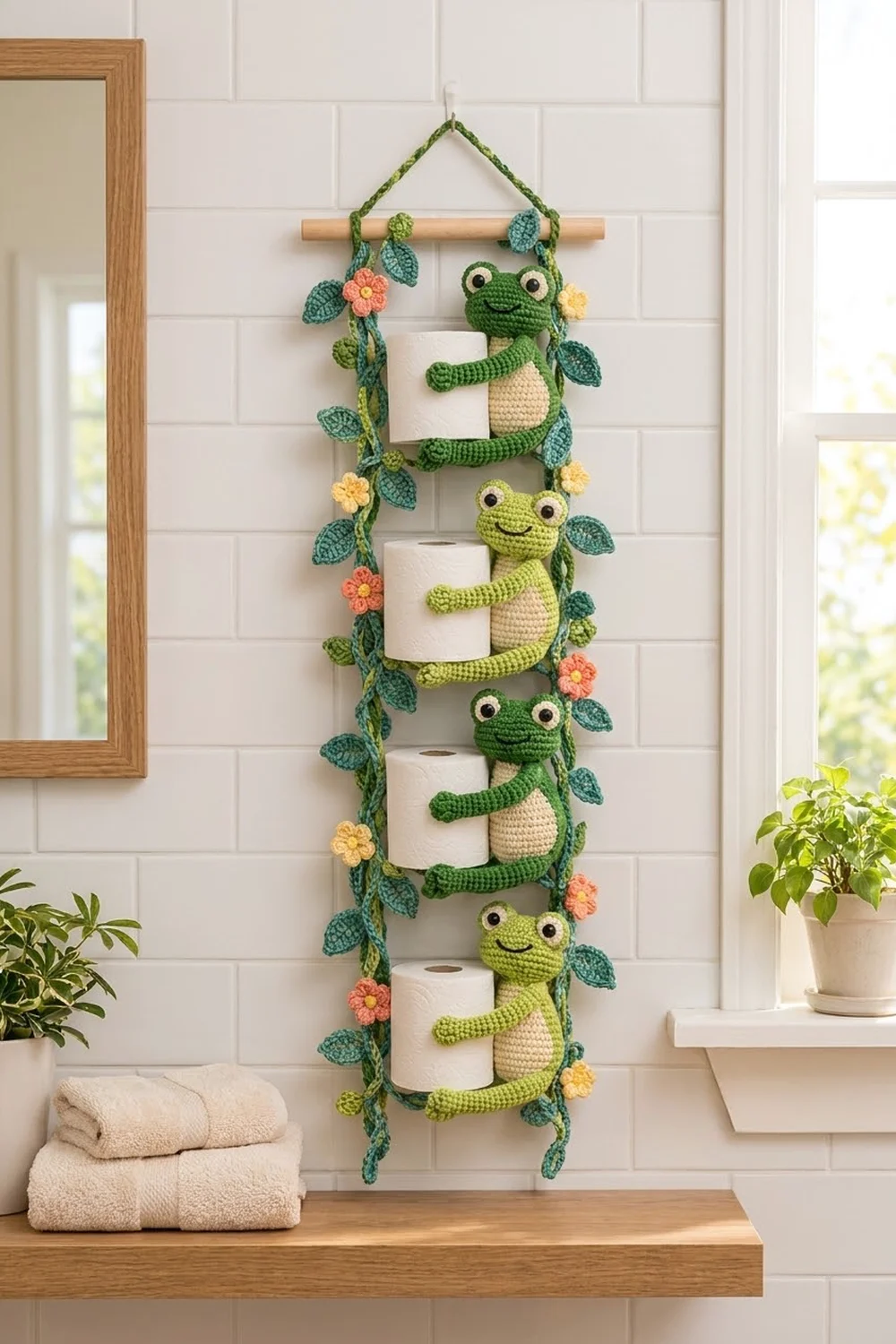
Four cheerful frogs climb a leafy vine ladder in this hanging toilet paper holder, and each one hugs a spare roll. The frogs alternate forest green and lime green and have soft cream bellies. Teal leaves and small coral and yellow flowers fill the space between them.
The style is cottage-garden amigurumi: smooth single crochet, firm stuffing and simple appliqués. This pattern uses US crochet terms throughout.
The finished holder measures about 9 in (22.9 cm) wide and 31.5 in (80.0 cm) long from the dowel to the tip of the bottom leaf. A chain-cord hanger adds about 4.5 in (11.4 cm) above the dowel.
You’ll make two slip-stitch cord rails, four frogs, leaves, flowers and buds. The rails fold over a wooden dowel. Each frog’s back is sewn to the right rail, and its feet are sewn to the left rail, so the legs form a shelf. Each roll sits on a pair of legs and is held by bendable arms.
Finished Size and Construction
- Finished size: 9 in × 31.5 in (22.9 × 80.0 cm), plus the hanger
- Skill level: Intermediate
- Terminology: US
- Yarn weight: DK (light, 3), cotton
- Hook: 3.0 mm (C/2–D/3)
- Number of pieces: 4 frogs (10 parts each), 2 rail cores, 2 wrap cords, 30 leaves, 10 flowers, 6 buds, 1 hanger cord
- Layout: 2 vertical rails, 6 in (15.2 cm) apart center to center, with 4 frog stations of 7 in (17.8 cm) each
- Piece size: each frog is about 5.5 in (14.0 cm) tall
- Size before trim: rails are 30 in (76.2 cm) long below the dowel
- Trim depth: leaves stand out about 1.5 in (3.8 cm) past each rail
Materials
Use a smooth, mercerized DK cotton of about 125 m per 50 g. Cotton holds its shape and doesn’t fuzz in a humid bathroom.
- Forest Green: 70 g / 175 m (2 frogs, 2 wrap cords, hanger)
- Lime Green: 60 g / 150 m (2 frogs, buds, leaf veins)
- Teal: 70 g / 175 m (rail cores, 30 leaves)
- Cream: 20 g / 50 m (bellies, eye rings)
- Coral: 10 g / 25 m (petals, centers)
- Pale Yellow: 10 g / 25 m (petals, centers)
- Black embroidery floss for the smiles
These quantities include a margin of about 20%.
Tools: 3.0 mm hook, 8 black 12 mm safety eyes, 16 chenille stems 12 in (30.5 cm) long, polyester fiberfill, a wooden dowel 9 in × 3/8 in (22.9 × 1.0 cm), tapestry needle, stitch markers, rustproof pins.
Abbreviations (US Terms)
- MR – magic ring
- ch – chain
- sl st – slip stitch
- sc – single crochet
- hdc – half double crochet
- dc – double crochet
- inc – 2 sc in the same stitch
- dec – invisible decrease (sc2tog through front loops only)
- FO – fasten off
Special stitch – Back-Bump Cord: Chain the stated number. Then work 1 sl st into the back bump of the 2nd ch from the hook and of each ch across. This gives a firm cord that doesn’t stretch.
Gauge and Checkpoints
- Amigurumi gauge: 6 sc × 6 rnds = 1 in (2.5 cm), worked in a tight spiral.
- Cord gauge: 5 sl st = 1 in (2.5 cm).
Test one piece first. Make one arm (below). Before stuffing, it should measure 5 in (12.7 cm) long and about 0.5 in (1.3 cm) wide when flattened. Then chain 26 and work a Back-Bump Cord of 25 sl st. It should measure 5 in (12.7 cm).
Checkpoints:
– Head after Rnd 8, lying flat: about 2.75 in (7.0 cm) across. Stuffed: about 2.5 in (6.4 cm) wide.
– Body: about 3.25 in (8.3 cm) tall and 2.5 in (6.4 cm) wide.
– Leg: about 5.25 in (13.3 cm).
– Rail core: 32 in (81.3 cm).
If your piece is too big, go down 0.25–0.5 mm in hook size. If it’s too small, go up the same amount. The rail spacing depends on the leg length, so match the gauge before you make all four frogs.
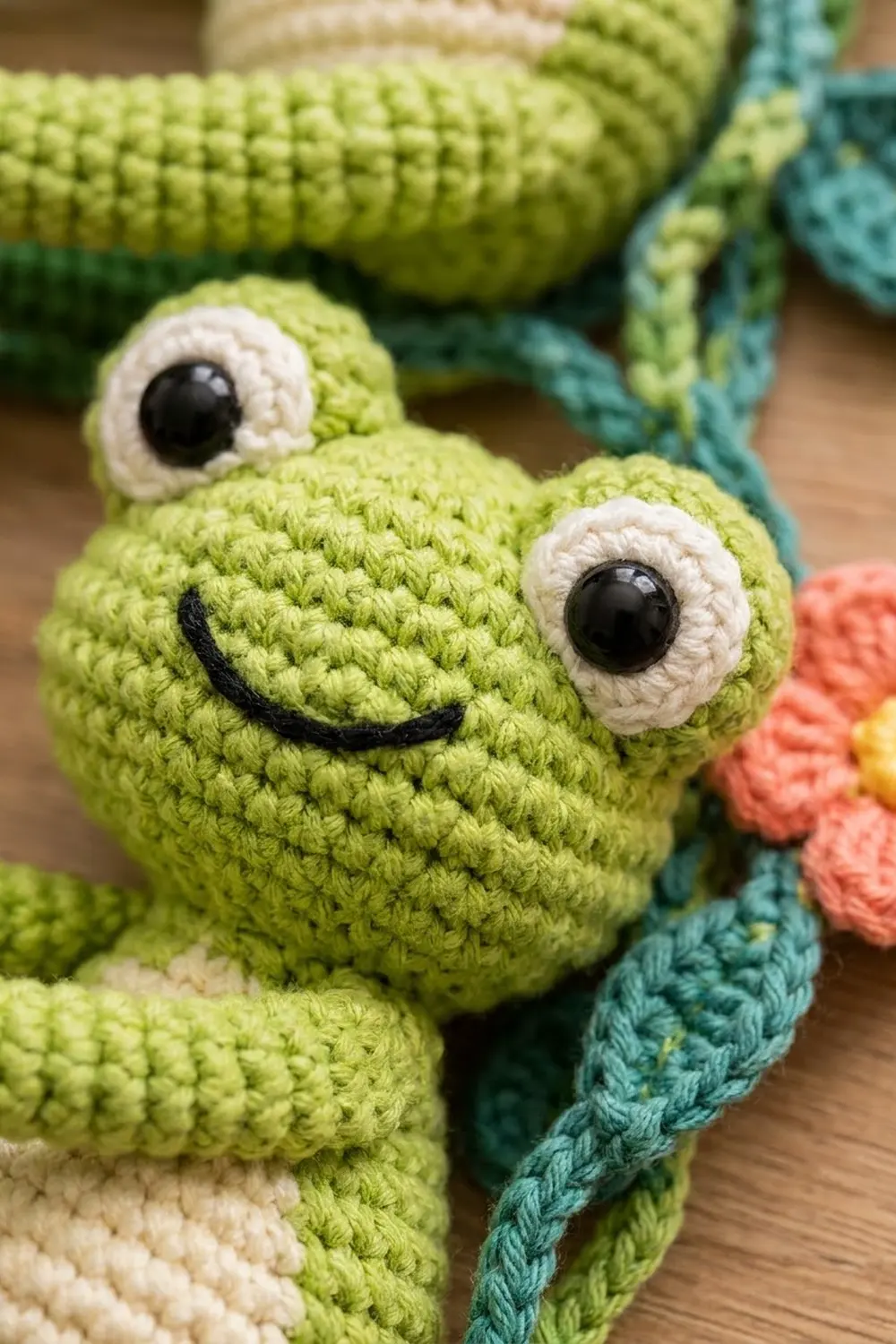
Frog (make 4: 2 Forest Green, 2 Lime Green)
Head
Work in a continuous spiral.
- Rnd 1: 6 sc in MR. (6)
- Rnd 2: inc in each st. (12)
- Rnd 3: (sc, inc) ×6. (18)
- Rnd 4: (sc 2, inc) ×6. (24)
- Rnd 5: (sc 3, inc) ×6. (30)
- Rnd 6: (sc 4, inc) ×6. (36)
- Rnd 7: (sc 5, inc) ×6. (42)
- Rnd 8: (sc 6, inc) ×6. (48)
- Rnds 9–16: sc in each st. (48)
- Rnd 17: (sc 6, dec) ×6. (42)
- Rnd 18: (sc 5, dec) ×6. (36)
- Rnd 19: (sc 4, dec) ×6. (30)
- Rnd 20: (sc 3, dec) ×6. (24) Stuff firmly.
- Rnd 21: (sc 2, dec) ×6. (18)
- Rnd 22: (sc, dec) ×6. (12)
- Rnd 23: dec ×6. (6) FO, close the hole and weave in the end.
Eye Bumps (make 2 in the frog color)
- Rnd 1: 6 sc in MR. (6)
- Rnd 2: inc ×6. (12)
- Rnd 3: (sc, inc) ×6. (18)
- Rnds 4–5: sc in each st. (18) FO and leave a tail.
Eye Rings (make 2 in Cream)
- Rnd 1: 6 sc in MR. (6)
- Rnd 2: inc ×6. (12) Sl st to the first st and FO.
Each ring is about 0.75 in (1.9 cm) across. Push a safety eye through the center of the ring and through Rnd 2 of a bump, then lock the washer. Stuff the bump lightly. Sew both bumps to the top front of the head between Rnds 3 and 7, with 6 sts between them.
Smile: Using black floss, backstitch a curve 6 sts wide across Rnds 13–14, centered under the eyes.
Body
- Rnds 1–7: work as Head Rnds 1–7. (42)
- Rnds 8–18: sc in each st, 11 rnds. (42)
- Rnd 19: (sc 5, dec) ×6. (36)
- Rnd 20: (sc 4, dec) ×6. (30)
- Rnd 21: (sc 3, dec) ×6. (24)
FO and leave a long tail. Stuff firmly. Sew the open end to the underside of the head, so that the body overlaps the head by about 0.25 in (0.6 cm).
Belly (make 1 in Cream)
Ch 7.
- Rnd 1: sc in the 2nd ch from the hook, sc in the next 4 ch, 3 sc in the last ch. Working along the opposite side of the chain, sc in the next 4 ch, then 2 sc in the last ch. (14)
- Rnd 2: inc, sc 4, inc ×3, sc 4, inc ×2. (20)
- Rnd 3: at each end (sc, inc) ×3; on each side sc 4. (26)
- Rnd 4: at each end (sc 2, inc) ×3; on each side sc 4. (32)
- Rnd 5: at each end (sc 3, inc) ×3; on each side sc 4. (38)
Sl st and FO. The belly measures about 1.75 × 2.75 in (4.4 × 7.0 cm). Sew it to the front of the body with the long side running vertically.
Arms (make 2)
- Rnd 1: 6 sc in MR. (6)
- Rnd 2: inc ×6. (12)
- Rnds 3–4: sc in each st. (12)
- Rnd 5: (sc 2, dec) ×3. (9) Stuff the hand lightly.
- Rnds 6–30: sc in each st, 25 rnds. (9)
Fold one chenille stem in half and insert it into the arm, leaving 0.5 in (1.3 cm) of wire to anchor in the body. Pad it with a little fiberfill. FO. Each arm is 5 in (12.7 cm) long. Sew the arms to the sides of the body at Rnd 17, then bend them forward and to the left.
Legs (make 2)
- Rnds 1–5: work as the Arm. (9)
- Rnds 6–31: sc in each st, 26 rnds. (9)
Insert a folded chenille stem as for the arms. FO. Each leg is about 5.25 in (13.3 cm). Sew the legs side by side under the belly, 0.75 in (1.9 cm) left of the body’s center back, pointing left.
Rails, Leaves, Flowers and Buds
Rail core (make 2 in Teal): Ch 161 and work a Back-Bump Cord. (160 sl st = 32 in / 81.3 cm)
Wrap cord (make 2 in Forest Green): Ch 171 and work a Back-Bump Cord. (170 sl st = 34 in / 86.4 cm)
Hanger cord (make 1 in Forest Green): Ch 71 and work a Back-Bump Cord. (70 sl st = 14 in / 35.6 cm)
Leaf (make 30 in Teal): Ch 9.
– Side 1: starting in the 2nd ch from the hook, work sl st, sc, hdc, dc, dc, hdc, sc, sl st. (8)
– Stem: ch 3.
– Side 2: working along the opposite side of the chain, work sl st, sc, hdc, dc, dc, hdc, sc, sl st. (8)
Sl st into the tip. Each leaf has 16 sts plus a ch-3 stem and measures about 1.5 in (3.8 cm). Backstitch a center vein in Lime.
Flower (make 5 coral with yellow centers and 5 yellow with coral centers):
– Rnd 1 (center color): 5 sc in MR, sl st to join, FO. (5)
– Rnd 2 (petal color): this is a conversion round, where every sc becomes one petal. In each sc, work (sl st, ch 2, 2 dc, ch 2, sl st). (5 sc used + 0 extra = 5 petals)
FO. Each flower is about 1.25 in (3.2 cm) across.
Bud (make 6 in Lime):
– Rnd 1: 6 sc in MR. (6)
– Rnd 2: sc in each st. (6)
Stuff with a pinch of fiberfill and gather closed. Each bud is about 0.5 in (1.3 cm).
Make All Pieces
- Forest Green: 2 frogs, 2 wrap cords, 1 hanger
- Lime Green: 2 frogs, 6 buds, all leaf veins
- Teal: 2 rail cores, 30 leaves
- Cream: 4 bellies, 8 eye rings
- Coral / Pale Yellow: 5 flowers each, plus the centers for the opposite color
Rail positions are counted in rail stitches, starting at the dowel fold (0).
         LEFT RAIL            RIGHT RAIL
  0 ======== wooden dowel =============
  0–35    roll space  <--  Frog 1 (Forest)
 35–70    roll space  <--  Frog 2 (Lime)
 70–105   roll space  <--  Frog 3 (Forest)
105–140   roll space  <--  Frog 4 (Lime)
140–150   tail + tip leaf   tail + tip leaf
Joining
- Fold over the dowel. Fold the first 10 sts of each rail core over the dowel and whipstitch st 1 to st 10. Position the rails 6 in (15.2 cm) apart center to center, with 1.5 in (3.8 cm) of dowel showing at each end. This leaves 150 sts (30 in / 76.2 cm) hanging on each rail.
- Wrap the rails. Spiral one wrap cord down each 30 in (76.2 cm) rail, with one full turn every 2 in (5.1 cm). Tack both ends to the core. This decorates the rail without shortening it.
- Attach the frogs. For Frog N, the station starts at st 35 × (N − 1). Sew the frog’s center back to the right rail from station +15 to station +31, and tack the back of the head at station +9. This gives:
- Frog 1: sts 15–31
- Frog 2: sts 50–66
- Frog 3: sts 85–101
- Frog 4: sts 120–136
- Attach the feet. Whipstitch both toes to the left rail at station +31 (sts 31, 66, 101, 136), so the legs run level.
- Tension. Use stitches about 0.25 in (0.6 cm) long and pull only until the pieces touch. Tight stitches pucker the rail and shorten it.
Size checkpoint: Hang the holder empty. The rails should measure 30 in (76.2 cm) and stay 6 in (15.2 cm) apart at every leg shelf.
Border: Leaf-and-Flower Vine Trim
Trim gauge: 5 rail sts = 1 in (2.5 cm). Both sides start with 150 hanging sts.
Round 1 – Leaves:
– Left rail: 15 leaves at sts 10, 20, 30 … 150, alternating outer and inner (8 outer, 7 inner). Sew the inner leaves flat against the front of the rail.
– Right rail: 15 leaves at the same positions, all on the outer side.
– Total: 30 leaves. The leaf at st 150 on each rail points down as the tip leaf.
Round 2 – Flowers:
– Left rail: 5 flowers at sts 15, 45, 75, 105 and 135, in the order coral, yellow, coral, yellow, coral.
– Right rail: 5 flowers at the same sts, in the order yellow, coral, yellow, coral, yellow.
– Total: 10 flowers (5 coral, 5 yellow).
Round 3 – Buds:
– Each rail: 3 buds at sts 25, 85 and 145.
– Total: 6 buds.
Why the math works:
– 10 dowel sts + (4 stations × 35 sts) + 10 tail sts = 160 sts = 32 in (81.3 cm).
– Leaves sit on multiples of 10, while flowers and buds sit on numbers ending in 5. No two trim pieces land on the same stitch.
– Each station is 35 sts = 7 in (17.8 cm). That holds a frog about 5.5 in (14.0 cm) tall plus a 4.5 in (11.4 cm) roll beside it, with headroom below the shelf above.
Final Blocking
- Before sewing, mist the leaves and flowers lightly with water.
- Pin the leaves flat with their points sharp and the flower petals spread evenly.
- Let them dry completely, then unpin.
- Hang the joined rails with a light weight clipped to each bottom tip for a few hours to straighten the cords.
- Don’t wet the frogs. Shape them by hand and bend the arms into a 4.25 in (10.8 cm) curve.
Final Quality-Control Checklist
- Both rails are 30 in (76.2 cm) below the dowel.
- The rails are 6 in (15.2 cm) apart at each shelf.
- The frogs alternate Forest, Lime, Forest, Lime from the top.
- The safety eyes are locked and the smiles are even.
- Each leg shelf sits level and is sewn at the correct stitch.
- There are 30 leaves, 10 flowers and 6 buds.
- No wire ends poke through the fabric.
- A roll slides in and out easily.
Troubleshooting
- Shelf sags: add a second chenille stem to each leg, or tack the two legs together along their length.
- Rail puckers: remove the tight joining stitches and resew more loosely.
- Gaps show stuffing: use a smaller hook and the invisible decrease.
- Roll won’t fit: bend the arms wider, or check that the legs reach 6 in (15.2 cm).
- Flowers cup: re-block them flat while damp.
- Wrap cord too short: space the turns 2.25 in (5.7 cm) apart instead of 2 in.
Care
Spot clean with mild soap and cool water, and let the holder air dry flat. Don’t machine wash, because the chenille stems can rust or kink.
Final Notes
The measurements build on each other:
– The amigurumi gauge of 6 sc per inch makes a 48-st head about 2.5 in (6.4 cm) wide, and frogs about 5.5 in (14.0 cm) tall.
– Legs of about 5.25 in (13.3 cm) set the 6 in (15.2 cm) rail spacing.
– The cord gauge of 5 sl st per inch turns 160 sts into 32 in (81.3 cm): 10 dowel sts, four 35-st stations and a 10-st tail.
– The trim lands on fixed stitch numbers, so every leaf, flower and frog falls where it should.
Check each link in that chain and your frogs will hold their rolls neatly. Happy crocheting!