

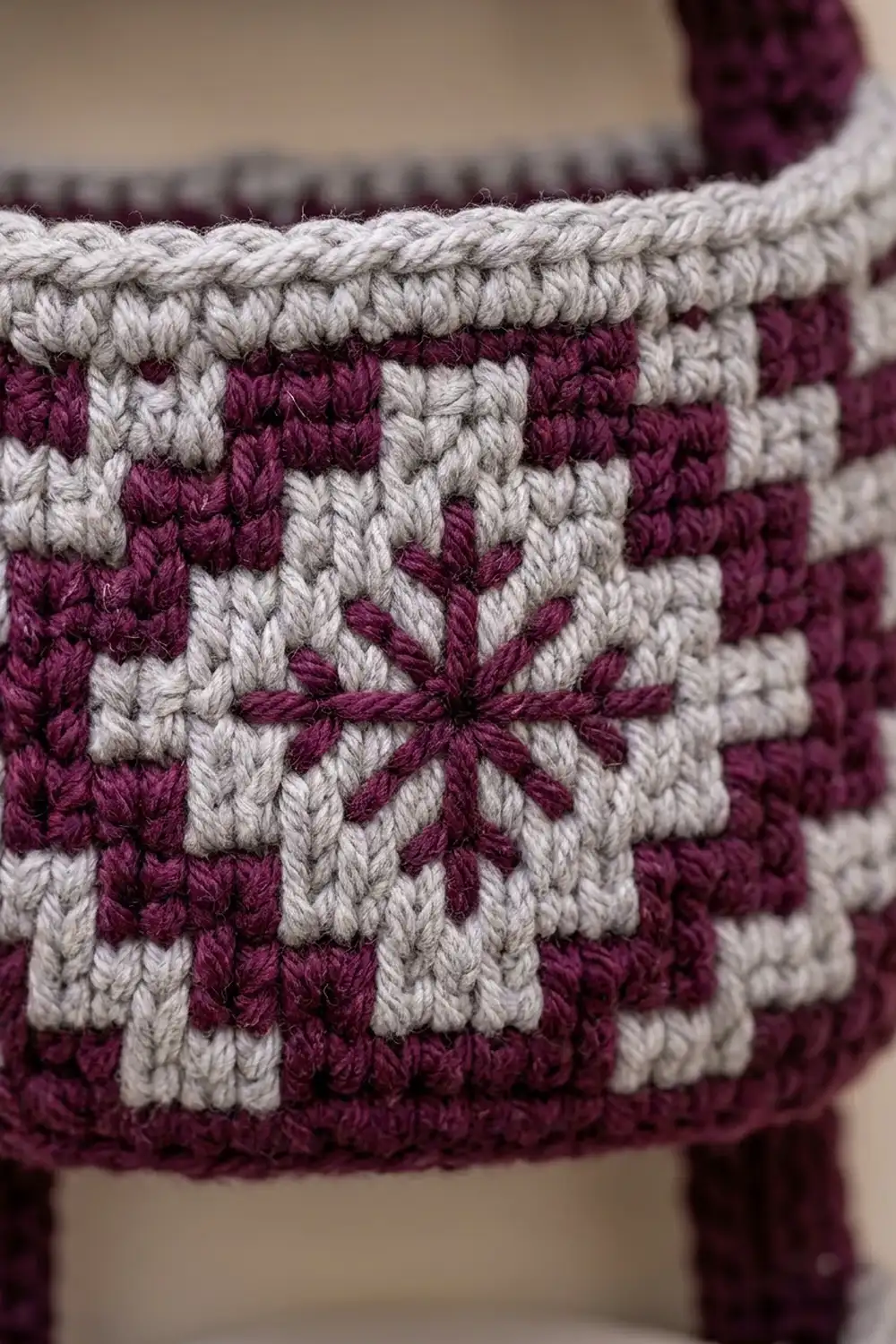
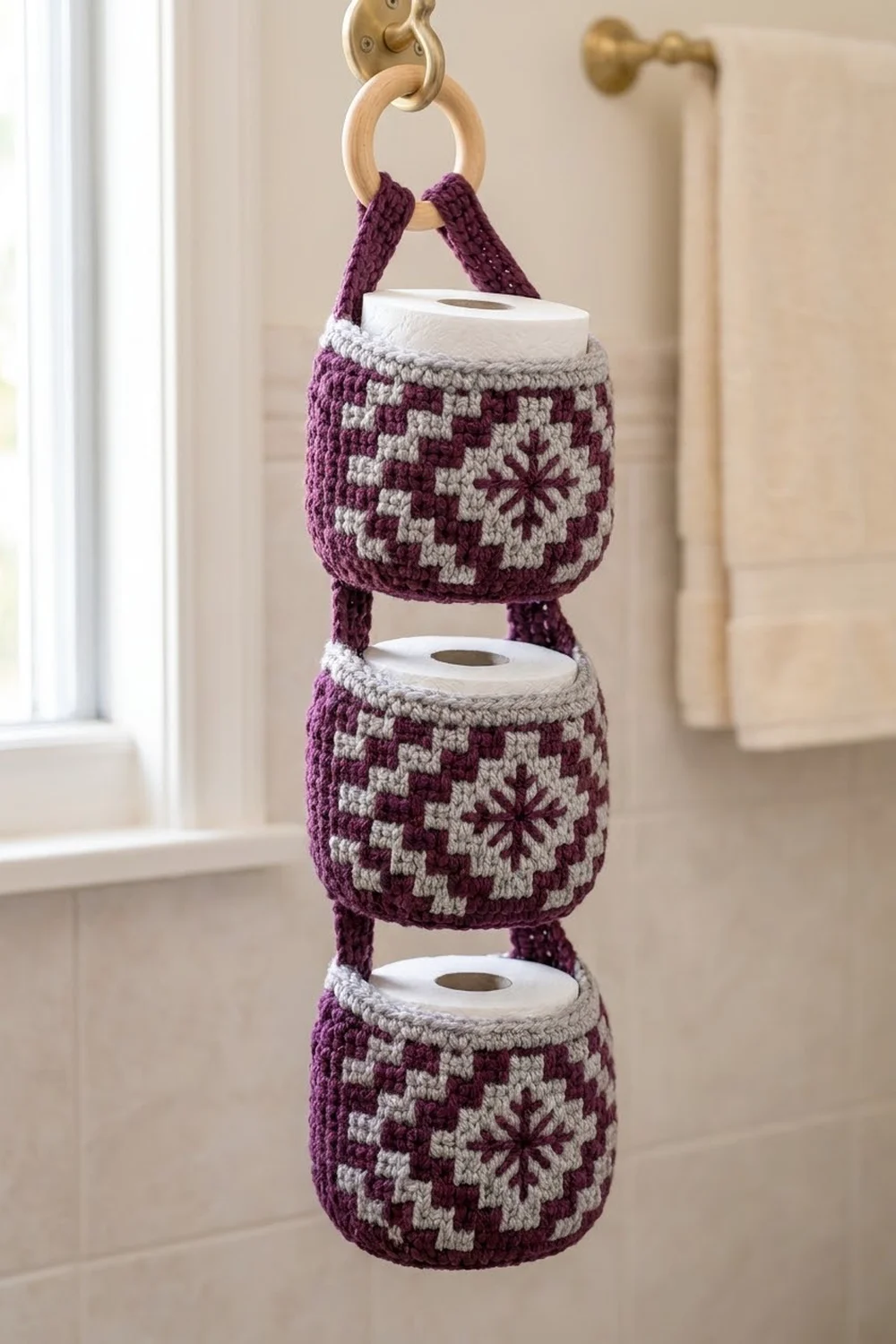
This hanging holder stacks three roomy pockets in a vertical column, and each one holds a standard toilet roll. Each pocket has a stepped, blocky diamond in light gray tapestry crochet on a deep plum background, with a small snowflake embroidered in the gray center. A rope-like gray rim finishes each opening.
The palette is just two colors, plum and light gray. It looks festive in December but is quiet enough to leave up all winter. The style is graphic and Nordic, with chunky two-stitch blocks that look almost like a pixel grid.
This pattern uses US crochet terms. The finished holder hangs about 26 in (66.0 cm) from the top of the ring to the bottom of the lowest pocket. Each pocket is about 6.4 in (16.3 cm) wide, 5.2 in (13.2 cm) deep and 5 in (12.7 cm) tall.
Each pocket starts with a flat oval base, turns upward with a back-loop round and continues in joined tapestry rounds. A gray rim closes it. Narrow plum straps then link the pockets and carry the stack up to a wooden ring.
Finished Size and Construction
- Finished length: about 26 in (66.0 cm), ring included
- Pocket size: 6.4 in (16.3 cm) wide x 5.2 in (13.2 cm) deep x 5 in (12.7 cm) tall
- Skill level: Intermediate (tapestry color changes, surface embroidery)
- Terminology: US
- Yarn weight: Worsted (#4)
- Hook: 4.5 mm (US 7)
- Number of pieces: 9 (3 pockets, 4 connector straps, 2 top straps), plus 1 wooden ring
- Layout: 1 column of 3 pockets, hanging from a ring
- Pocket height before border: 4.5 in (11.4 cm)
- Border (rim) depth: 0.5 in (1.3 cm), 2 rounds
Materials
Choose a smooth worsted acrylic or cotton blend with good stitch definition. A firm, non-fuzzy yarn keeps the tapestry blocks crisp and helps the pockets hold their shape.
- Color A, plum: 130 g, about 240 yd (219.5 m)
- Color B, light gray: 40 g, about 80 yd (73.2 m)
These quantities include a margin of about 15 percent for gauge swatching, carried strands and embroidery.
Tools:
- 4.5 mm (US 7) crochet hook
- Wooden ring, 3 in (7.6 cm) diameter
- Tapestry needle
- 4 stitch markers
- Scissors and a measuring tape
- Rust-proof pins and a blocking mat
Abbreviations (US Terms)
- ch – chain
- sc – single crochet
- sl st – slip stitch
- BLO – back loop only
- rev sc – reverse single crochet (crab stitch)
- st(s) – stitch(es)
- Rnd(s) – round(s)
- P / G – work sc in plum / gray
Tapestry sc: Work sc in the working color. Lay the unused color along the top of the previous round and enclose it inside each stitch. To change color, work the last yarn-over of the stitch before the change with the new color.
Reverse sc: Work from left to right (if you crochet right-handed). Insert the hook in the next st to the right, pull up a loop, yarn over and pull through both loops.
Gauge and Checkpoints
Gauge: 16 sc x 17 rnds = 4 in (10.2 cm) in tapestry sc, worked in the round with one color carried.
Make one full pocket before starting the others. It works as your real gauge swatch and confirms that the roll fits.
- After Rnd 6: the base measures about 4 in (10.2 cm) long x 2.8 in (7.1 cm) wide.
- After Rnd 11: the base measures about 6.4 in (16.3 cm) x 5.2 in (13.2 cm), with a circumference of 18 in (45.7 cm).
- After Rnd 22 (motif center): the gray center diamond spans 10 sts, about 2.5 in (6.4 cm).
- After Rnd 30: the wall is about 4.5 in (11.4 cm) high, measured from the base fold.
- After Rnd 32: the total pocket height is about 5 in (12.7 cm).
If your base is too large, go down 0.5 mm. If it is too small or cups upward, go up 0.5 mm. Tapestry crochet tends to tighten, so check gauge again after the color rounds, not just on the base.
Pocket (Make 3)
Oval Base
Work the base with plum. Join each round with a sl st to the first sc. The ch 1 at the start of each round does not count as a stitch.
Rnd 1: Ch 6. Work 3 sc in 2nd ch from hook, sc in next 3 ch, 3 sc in last ch. Rotate and, working in the opposite side of the foundation chain, sc in next 3 ch. Join. (12 sts)
The round now has four sections: end A (3 sts), side 1 (3 sts), end B (3 sts) and side 2 (3 sts). Only the ends grow.
Rnds 2–11: Ch 1, *[sc in next (round number minus 2) sts, 2 sc in next st] 3 times, sc in next 3 sts; rep from * once more. Join.
For example, Rnd 2 is [2 sc in next st] 3 times, sc 3 twice, and Rnd 5 is [sc 3, 2 sc in next st] 3 times, sc 3 twice. Each round adds exactly 6 sts.
Round totals: Rnd 2 (18), Rnd 3 (24), Rnd 4 (30), Rnd 5 (36), Rnd 6 (42), Rnd 7 (48), Rnd 8 (54), Rnd 9 (60), Rnd 10 (66), Rnd 11 (72).
In Rnd 11, end A is sts 1–33, side 1 is sts 34–36, end B is sts 37–69 and side 2 is sts 70–72. Side 1 is the front. Place a marker in st 35 (front center) and one in st 71 (back center).
Turning Round
Rnd 12: Ch 1, sc in BLO of each st around. Join. (72 sts)
The unworked front loops form a clean ridge where the base meets the wall.
Tapestry Wall
Join gray at the start of Rnd 13 and carry it inside every stitch through Rnd 30. Each round has 72 sts. The motif covers sts 26–43, centered on the front. Everything else is plum.
Each motif block is 2 sts wide and 2 rounds tall, so you work every line below twice.
Rnds 13–14: P33, G2, P37. (72 sts)
Rnds 15–16: P31, G2, P2, G2, P35. (72 sts)
Rnds 17–18: P29, G2, P2, G2, P2, G2, P33. (72 sts)
Rnds 19–20: P27, G2, P2, G6, P2, G2, P31. (72 sts)
Rnds 21–22: P25, G2, P2, G10, P2, G2, P29. (72 sts)
Rnds 23–24: Repeat Rnds 19–20.
Rnds 25–26: Repeat Rnds 17–18.
Rnds 27–28: Repeat Rnds 15–16.
Rnds 29–30: Repeat Rnds 13–14. Finish the final sc of Rnd 30 with gray. Fasten off plum.
The result is a stepped diamond with a single gray point at the top and bottom, an outer gray ring of blocks, a plum ring and a solid gray center diamond. The center diamond is 10 sts wide and 10 rounds tall. The whole motif is 18 sts x 18 rnds, about 4.5 in (11.4 cm) x 4.25 in (10.8 cm).
The round join sits at the back left, so the color jog is hidden against the wall.
Border (Rim)
Border gauge: 2 rounds = 0.5 in (1.3 cm). The rev sc should sit as a firm twisted cord, not a flared edge.
Rnd 31: With gray, ch 1, sc in each st around. Join. (72 sts: 72 worked 1-per-existing-stitch + 0 added)
Rnd 32: Ch 1, rev sc in each st around. Join. (72 sts: 72 worked 1-per-existing-stitch + 0 added)
Fasten off and weave in ends.
Why the math works: The wall is 72 sts around, and both rim rounds keep exactly 72. With no increases, the rim cannot ruffle. With no decreases, the opening stays 18 in (45.7 cm) around, so a 4.5 in (11.4 cm) roll drops in and lifts out easily.
Snowflake Embroidery
The snowflake center sits between sts 34 and 35, on the line between Rnds 21 and 22. Thread about 24 in (61.0 cm) of plum.
- Work one vertical straight stitch 4 rnds up from the center and one 4 rnds down.
- Work one horizontal straight stitch 4 sts to the left and one 4 sts to the right.
- Work four diagonal straight stitches, each 3 sts across and 3 rnds up or down.
- At the tip of each vertical and horizontal arm, add a small V of two 1-st stitches.
The finished snowflake is about 2 in (5.1 cm) across and stays inside the gray center diamond. Keep the stitches flat rather than tight.
Straps
Work the straps in plum. Leave a 10 in (25.4 cm) tail at the start and end of each strap for sewing.
Connector Straps (Make 4)
Row 1: Ch 5, sc in 2nd ch from hook and each ch across. Turn. (4 sts)
Rows 2–15: Ch 1, sc in each st across. Turn. (4 sts)
Fasten off. Each strap measures 1 in (2.5 cm) wide x about 3.5 in (8.9 cm) long.
Top Straps (Make 2)
Work as for the connector straps, but continue through Row 38. (4 sts)
Each top strap measures 1 in (2.5 cm) x about 9 in (22.9 cm).
Make All Pieces
- Pockets: 3, each using about 32 g plum and 11 g gray
- Connector straps: 4, plum
- Top straps: 2, plum
- Wooden ring: 1
Layout (front view):
        ( RING )
        /      \
   [Top strap] [Top strap]
   [  POCKET 1 (top)    ]
     |conn|      |conn|
   [  POCKET 2 (middle) ]
     |conn|      |conn|
   [  POCKET 3 (bottom) ]
Joining
Sew all straps to the back wall of each pocket so that nothing shows from the front.
Strap positions: On each pocket, the back center is st 71. The two straps sit over sts 61–64 and sts 6–9 of the wall rounds. Their centers are 17 sts apart, about 4.25 in (10.8 cm). Mark these columns before sewing.
Connectors: Lay the top 4 rows of a connector over Rnds 12–15 of the upper pocket. Whipstitch all four edges, with 1 sewing stitch per sc and 1 per row end. Lay the bottom 4 rows over Rnds 27–30 of the lower pocket and sew them the same way. Each overlap is about 1 in (2.5 cm). Sew the second connector the same way, then repeat to join Pocket 3 to Pocket 2.
Top straps: Sew the bottom 4 rows of each top strap over Rnds 27–30 of Pocket 1, in the same columns. Angle both straps inward, wrap the top 6 rows of each strap around the ring and sew the end flat to the back of the same strap.
Tension: Sew firmly enough that the strap lies flat, but don’t pull the fabric into puckers. Keep the strap’s 4 sts lined up over exactly 4 wall sts.
Size checkpoint: Hang the holder. The visible gap between pockets should be about 1.2 in (3.0 cm), the visible part of each top strap about 6 in (15.2 cm) and the total length about 26 in (66.0 cm). If one gap is longer, resew that connector with the same overlap.
Final Blocking
- Spray each pocket lightly with water until damp, not soaked.
- Fill each pocket with a toilet roll wrapped in a plastic bag, or with a folded towel.
- Ease the oval base flat and straighten the motif so its center column runs straight up.
- Pin the rim into an even oval and press the rev sc cord gently with your fingers.
- Lay the straps flat and pin them straight.
- Let everything dry completely, then remove the forms.
Final Quality-Control Checklist
- Every base has 72 sts after Rnd 11 and measures about 6.4 in (16.3 cm) x 5.2 in (13.2 cm).
- Every wall round has 72 sts.
- All three diamonds are centered on the front and line up vertically.
- No gray strands show between plum stitches.
- Each rim is 2 rounds, flat, with 72 rev sc.
- Each snowflake is centered inside the gray diamond.
- The straps are hidden on the back and sewn in matching columns.
- The total hanging length is about 26 in (66.0 cm).
Troubleshooting
The base cups like a bowl: Your gauge is too tight. Go up a hook size, or check that each round really adds 6 sts.
The base ruffles: Your gauge is too loose, or extra increases slipped in. Recount each round.
The motif leans to one side: Joined tapestry rounds slant slightly. Block firmly, or work the sc by yarning under instead of over.
Gray shows through the plum: Keep the carried strand snug on top of the round and enclose it fully.
The rim flares: Your rev sc is too loose. Work Rnd 32 with a 4 mm (US G/6) hook.
The pockets hang crooked: One strap is sewn higher than its partner. Check its rounds and columns against the positions in Joining.
Care
Hand wash in cool water with mild soap, roll in a towel and dry flat over a roll-shaped form. Avoid the dryer, which can loosen tapestry stitches.
Final Notes
The measurements build on each other. A 72-stitch base of 6.4 in (16.3 cm) x 5.2 in (13.2 cm) sets a wall of 72 sts, 18 in (45.7 cm) around. After Rnd 30 the wall is 4.5 in (11.4 cm) high, and the 72-stitch rim brings each pocket to 5 in (12.7 cm). Three pockets, two 1.2 in (3.0 cm) gaps and the strap-and-ring top add up to about 26 in (66.0 cm).
Check your first pocket against each checkpoint, and the other two will follow.
Happy crocheting!