

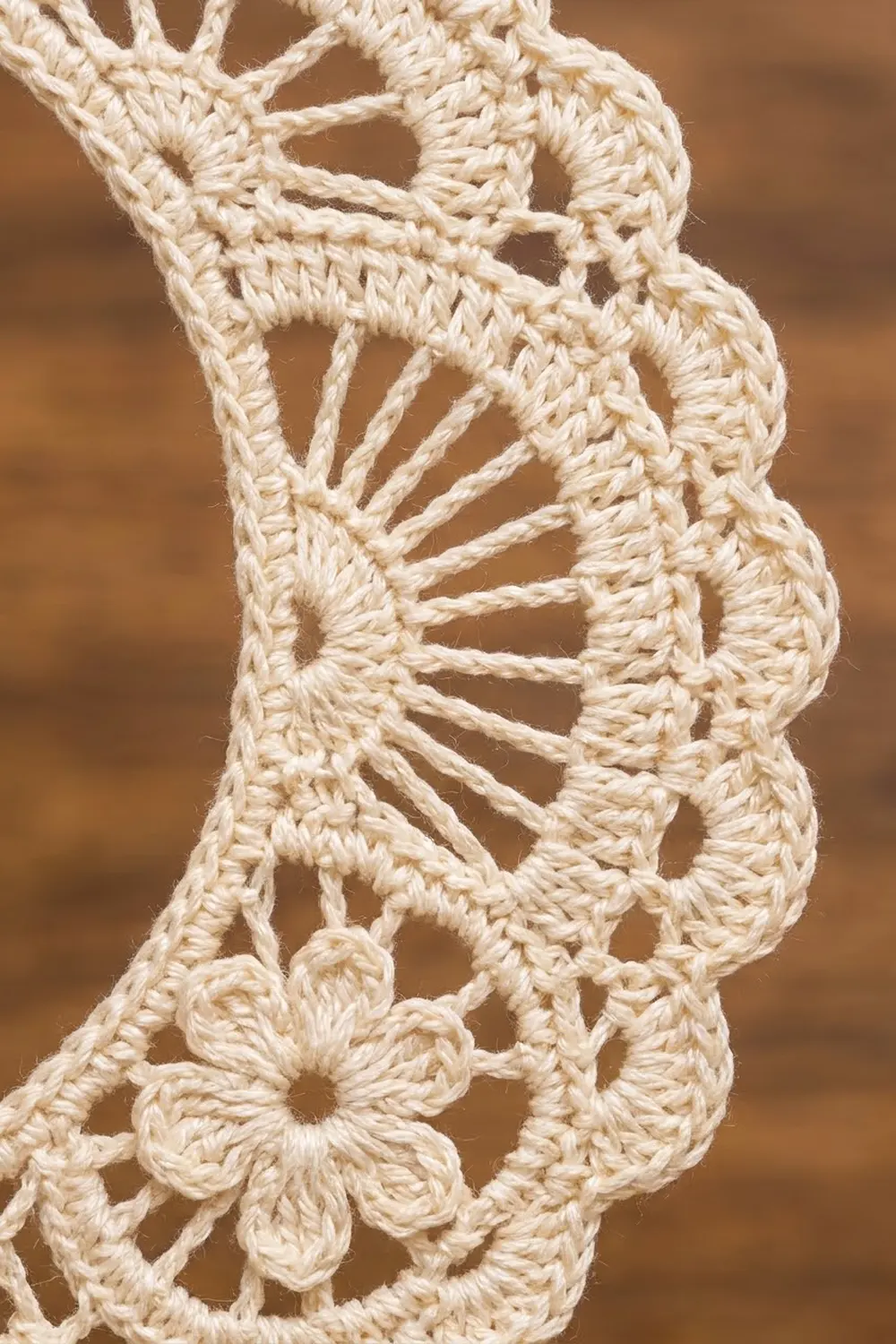
The Moonflower Lace Crescent is a small, airy ornament shaped like a waxing moon. Its band of lace curves from one sharp tip to the other. Three half-wheels of long spokes fan out across it, and each one holds a small five-petal flower. A row of tiny shell scallops softens the outer curve, while the inner curve stays clean and smooth.
The ornament is worked in one color: a warm cream or ivory cotton thread. The single color lets the texture carry the design, so it looks at home on a tree with gold baubles, on a window, or tied onto a gift. This pattern uses US crochet terms throughout.
The finished ornament measures 5 in (12.7 cm) from tip to tip and 3 in (7.6 cm) across. The lace band is 2 in (5.1 cm) deep at its widest point. The hanging loop adds about 1 in (2.5 cm).
Construction overview: You work the body in flat rows, starting from a straight foundation chain that becomes the inner curve. Each row is shorter than the one before, so the ends taper into points. A shell row and a single edging round form the border. Then you make three small flowers and sew one onto the base of each spoke wheel. Blocking bends the straight strip into a crescent.
Finished Size and Construction
- Finished size: 5 in (12.7 cm) tip to tip × 3 in (7.6 cm) wide
- Band depth: 2 in (5.1 cm) at the center
- Skill level: Intermediate (lace, working into chain spaces, light blocking)
- Terminology: US
- Yarn weight: Size 3 crochet cotton thread
- Hook: 2.25 mm (US B-1)
- Number of pieces: 1 ornament body plus 3 small flower appliqués, sewn into one finished ornament
- Layout: a single crescent with 3 spoke wheels in a row along the outer curve
- Piece size before blocking: inner edge 6 in (15.2 cm) long, straight
- Size before border (after Row 5): band depth 1.5 in (3.8 cm)
- Border depth: 0.5 in (1.3 cm)
Materials
Yarn: Use a smooth, mercerized size 3 cotton thread. Mercerized cotton shows stitch detail clearly and holds starch well. Avoid fuzzy or very soft blends, because they blur the spokes and the flower petals.
- Cream / ivory: 8 g (about 15 m) for one ornament, including the 3 flowers and the hanging loop.
These quantities include a margin of roughly 25 percent for gauge swatching and weaving in ends. To make a set of ornaments, multiply by the number you need.
Tools:
- 2.25 mm (US B-1) crochet hook
- Tapestry needle with a small eye
- Scissors
- Rustproof pins and a foam blocking board
- Spray starch or a fabric stiffener (optional, but recommended)
- Printed or hand-drawn crescent template, 5 in (12.7 cm) tip to tip
Abbreviations (US Terms)
- ch – chain
- sl st – slip stitch
- sc – single crochet
- hdc – half double crochet
- dc – double crochet
- tr – treble crochet (yarn over twice)
- sk – skip
- sp(s) – space(s)
- st(s) – stitch(es)
- RS – right side
Special stitches:
- Spoke fan: (dc, ch 2) 4 times, then dc, all worked in the same stitch. This makes 5 dc and 4 ch-2 spaces radiating from one point.
- Shell: 5 dc in the same stitch.
Gauge and Checkpoints
Gauge: 7 sc and 8 sc rows = 1 in (2.5 cm) with a 2.25 mm hook.
Before you start, work one complete ornament as your test piece. Lace gauge is easiest to judge on the real shape, and the checkpoints below let you catch problems early.
Checkpoints (measured flat, before blocking):
- After Row 1: 42 sc = 6 in (15.2 cm).
- After Row 2: depth at the center = 0.5 in (1.3 cm).
- After Row 4: depth at the center = about 1.125 in (2.9 cm).
- After Row 5: depth at the center = 1.5 in (3.8 cm). Each dc arc spans about 1.4 in (3.6 cm) at its base.
- After the border: depth at the center = 2 in (5.1 cm).
- Each flower: 0.75 in (1.9 cm) across.
If your piece is too big: Change to a 2 mm hook, or tighten the long spokes by pulling each tr loop snug before you finish it.
If your piece is too small: Change to a 2.5 mm hook. Don’t add stitches, because the repeat counts set the spacing of the wheels.
Ornament Body
Row 1 (inner edge)
Ch 43.
Sc in the 2nd ch from the hook and in each ch across. Turn. (42 sc)
The foundation chain becomes the inner curve of the moon. Keep it at the same tension as your sc so the edge doesn’t pucker.
Row 2 (height shaping)
Ch 1 (does not count as a st).
Sc in the first 3 sts, hdc in the next 3 sts, dc in the next 30 sts, hdc in the next 3 sts, sc in the last 3 sts. Turn. (42 sts: 6 sc, 6 hdc, 30 dc)
The center is taller than the ends, which starts the taper toward the tips.
Row 3 (spoke fans)
Don’t chain.
Sl st in the first 3 sts, then sc in the next 3 sts.
Ch 3, sk 4 sts, spoke fan in the next st, ch 3, sk 4 sts, sc in the next st. Repeat from * to * 2 more times.
Sc in the next 3 sts, sl st in the last 3 sts. Turn.
Count: 3 spoke fans (15 dc and 12 ch-2 sps in total), 6 ch-3 sps, 9 sc, and 6 sl st.
Check: each repeat uses 10 sts (4 + 1 + 4 + 1), so 3 repeats use 30 sts. The 6 end sts on each side make 30 + 12 = 42.
Row 4 (long spokes)
Sl st in the first 6 sts (3 sl st and 3 sc), then sl st in the next sc.
3 sc in the next ch-3 sp, tr in the first dc of the fan, (ch 3, tr in the next dc) 4 times, 3 sc in the next ch-3 sp, sl st in the next sc. Repeat from * to * once more, then repeat from * to ** once.
Sl st in the next 3 sc. Leave the remaining 3 sl st unworked. Turn.
Count: each wheel has 5 tr, 4 ch-3 sps, and 6 sc. For the whole row, that makes 15 tr, 12 ch-3 sps, and 18 sc.
The tr spokes are the radiating lines you’ll see around each flower. Make them all the same height.
Row 5 (wheel arcs)
Sk 3 sc, dc in the next tr, (4 dc in the next ch-3 sp, dc in the next tr) 4 times, sk 3 sc, sl st in the next sl st. Repeat from * to * once more, then repeat from * to ** once.
Sl st in the 7th sl st of Row 4, which sits at the start of that row. Turn.
Count: each arc has 21 dc (5 dc on the spokes + 16 dc in the spaces). That makes 63 dc in 3 arcs, with 2 valley sl sts between them.
The arcs are the solid semicircles that frame each wheel. The 3 sc you skipped at each valley stay visible between the arcs.
Border
Border gauge: each shell group (sc + shell) uses 4 dc of Row 5 and spans about 0.3 in (0.8 cm). Five shell groups fill one 1.4 in (3.6 cm) arc.
Row 6 (shell scallops)
Sk 3 sc.
Sc in the first dc of the arc, (sk 1 dc, shell in the next dc, sk 1 dc, sc in the next dc) 5 times, sl st in the next valley sl st, sk 3 sc. Repeat from * to * once more, then repeat from * to ** once. Don’t turn.
Count: 5 shells on each arc, 15 shells in total, plus 18 sc and 2 valley sl sts.
Why the math works: each arc has 21 dc. The first sc uses 1 dc, and each of the 5 repeats uses 4 dc. That’s 1 + (5 × 4) = 21, so every arc begins and ends with an sc anchored on a spoke and the scallops sit evenly.
Edging Round (tips and inner edge)
Keep working in the same direction, down the first tapered tip:
- Tip side A: sc in each of the next 3 sc of Row 4, sc in the 3 sl st of Row 4, sc in the next 2 unworked sl st of Row 3, and 2 sc in the last sl st. (10 sc)
- Point A: 3 sc in the first free loop of the foundation chain. (3 sc)
- Inner edge: sc in each of the next 40 free loops of the chain. (40 sc)
- Point B: in the last free loop, work sc, then (sc, ch 15, sl st in the same sc) for the hanging loop, then sc. (3 sc; the loop is not counted)
- Tip side B: sc in the 6 sl st of Row 4, sc in the anchor sl st from Row 5, and sc in the next 3 sc of Row 4. (10 sc)
Join with a sl st to the first sc of Row 6. Fasten off.
Edging count: 10 + 3 + 40 + 3 + 10 = 66 sc.
Why the math works: the foundation has 42 free loops. The 2 point loops each take 3 sc and the other 40 take 1 sc, giving 46 sc on the inner edge. Each tip side gets the same 10 sc, so the two points are mirror images.
Flower Appliqués (make 3)
Ch 4. Join with a sl st to form a ring.
Rnd 1: Ch 1, 10 sc in the ring. Join with a sl st to the first sc. (10 sc)
Rnd 2: (Ch 2, 3 dc, ch 2, sl st) in the next sc, sl st in the next sc. Repeat from * to * 4 more times. (5 petals)
Fasten off and leave a 6 in (15.2 cm) tail for sewing. Each flower measures 0.75 in (1.9 cm) across. The ring leaves a small open hole at the center.
Attaching: Center one flower over the base of each spoke wheel, about 0.5 in (1.3 cm) from the inner edge, so the spokes fan out around it. Use the tail to tack the center ring down with 4 small stitches through the Row 3 fan, then tack the tip of each petal. Weave the tail in on the wrong side.
Final Blocking
- Lightly dampen the ornament, or soak it in diluted fabric stiffener and squeeze out the excess.
- Place it RS up on the blocking board, over your crescent template.
- Pin the two points first, 5 in (12.7 cm) apart.
- Curve the inner edge evenly and pin it every 0.5 in (1.3 cm). The 6 in (15.2 cm) edge will settle into an arc.
- Pin the tip of each spoke, then pin the center of each shell to open the scallops.
- Check that the band is 2 in (5.1 cm) deep at the center and the full width is 3 in (7.6 cm).
- Lift each flower’s petals slightly with a pin so they sit flat but defined.
- Starch the piece if you like, and let it dry completely before unpinning.
Final Quality-Control Checklist
- The ornament measures 5 in (12.7 cm) tip to tip and 3 in (7.6 cm) wide.
- There are 3 wheels, each with 5 spokes and a 21-dc arc.
- There are 15 shells, 5 on each arc.
- The edging round has 66 sc, and both points are sharp and symmetric.
- The hanging loop sits at one point and is about 1 in (2.5 cm) long.
- The 3 flowers are centered, firmly tacked, and have open centers.
- All ends are woven in, with no tails showing on the RS.
Troubleshooting
The inner edge ruffles: the foundation chain is too loose. Redo Row 1 with a smaller hook for the chain only.
The crescent won’t curve: it needs more blocking. Pin the inner edge into a tighter arc and use stiffener.
The spokes are uneven: pull each tr up to the same height before you yarn over. Spokes that differ by more than 0.125 in (0.3 cm) will show.
The scallops look crowded: check that you skipped exactly 1 dc on each side of every shell.
The tips are lopsided: recount the tip sides. Each must have 10 sc.
The flowers cup: you worked Rnd 1 too tightly. Use 11 sc instead and spread them evenly.
Care
Hand wash in cool water with mild soap, press out the water in a towel, and re-pin the ornament to its template to dry. Re-starch it after washing if you want it to stay crisp.

Final Notes
The measurement chain is simple. Your 42-sc foundation sets the 6 in (15.2 cm) inner edge, and three 10-stitch repeats place three equal wheels. Each wheel’s 21-dc arc holds exactly 5 shells. The 66-sc edging finishes both points evenly. Blocking turns the straight strip into a 5 in (12.7 cm) crescent with a 2 in (5.1 cm) lace band. If you check each stage as you go, every Moonflower Lace Crescent will match the last, which is useful if you plan to make a whole set for your tree.
Happy crocheting!