

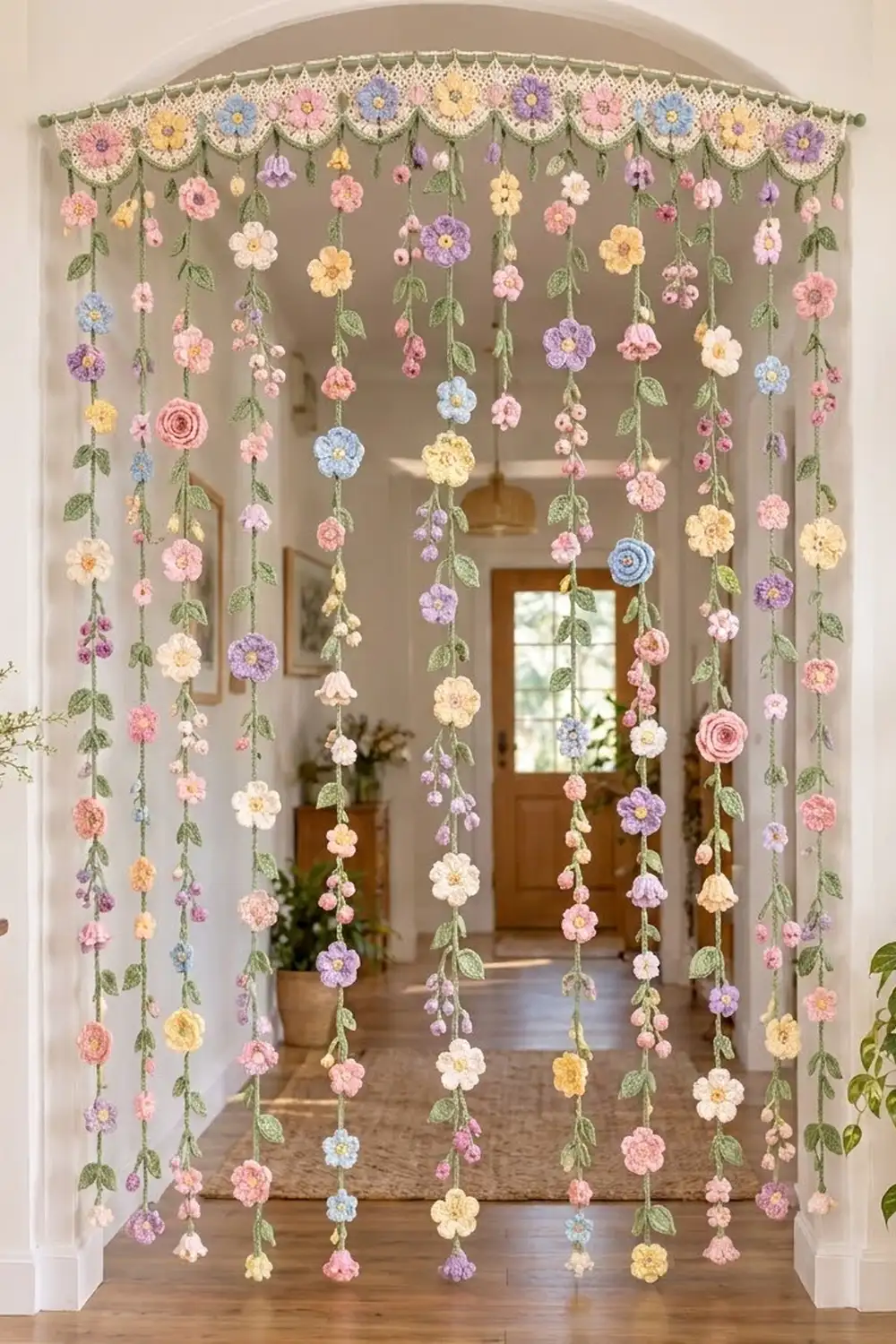
This doorway curtain has a scalloped header across the top and long flowering vines hanging below it. The header is a row of cream half-circle panels under a lace mesh band. Each panel holds one pastel flower and has a sage-green edge around its curve.
There are 17 vines. Each one carries veined leaves, five-petal flowers, bell flowers and berry clusters, and four of the vines also have a rolled rose. The colors are cream, sage green, pastel pink, butter yellow, powder blue, lilac and white, which give it a soft cottage-garden look.
The pattern uses US crochet terms. The finished curtain is 36 in (91.4 cm) wide. It measures 69.5 in (176.5 cm) from the top of the header to the end of the longest vines, not counting the hanging tabs.
You’ll make nine half-circle panels, join them by working the lace band across all of them, and add the hanging tabs. Then you crochet the vines with leaves worked in as you go, sew on the flowers and buds, and attach the vines under the header.
Finished Size and Construction
- Finished size: 36 in (91.4 cm) wide × 69.5 in (176.5 cm) long
- Skill level: Intermediate
- Terminology: US
- Yarn weight: DK (3) cotton
- Hook: 4 mm (G-6)
- Header pieces: 9 half-circle panels, 9 header flowers, 10 tabs
- Layout: 9 panels in a single row; 17 vines (9 at the scallop tips, 8 at the joins)
- Panel size: 4 in (10.2 cm) wide × 2 in (5.1 cm) deep
- Panel size before the green edge: about 3.5 in (8.9 cm) × 1.75 in (4.4 cm)
- Lace band depth: 1.5 in (3.8 cm)
- Vine length: 66 in (167.6 cm)
Materials
Use a smooth, mercerized DK cotton, about 125 m per 50 g (136.7 yd per 50 g). Cotton holds the flower shapes well and doesn’t stretch much while it hangs.
- Cream: 75 g (188 m)
- Sage Green: 200 g (500 m)
- Pastel Pink: 125 g (313 m)
- Butter Yellow: 50 g (125 m)
- Powder Blue: 50 g (125 m)
- Lilac: 50 g (125 m)
- White: 50 g (125 m)
These amounts include a margin of about 25% or more.
Tools: 4 mm (G-6) hook, tapestry needle, about 20 locking stitch markers, rust-proof pins, a blocking board, a spray bottle, and a curtain rod 3/4 in (1.9 cm) in diameter and about 40 in (101.6 cm) long.
Abbreviations (US Terms)
- ch – chain
- sl st – slip stitch
- sc – single crochet
- hdc – half double crochet
- dc – double crochet
- sc2tog – single crochet 2 together
- sk – skip
- sp – space
- st(s) – stitch(es)
- RS – right side
- V-st – (dc, ch 1, dc) worked in the same stitch. Special stitch: this is the only special stitch in the pattern, and it creates the lacy eyelets in Row 4 of each panel.
Gauge and Checkpoints
Gauge: 18 sts and 20 rows of sc = 4 in (10.2 cm). Nine rows of dc = 4 in (10.2 cm).
Stem gauge: 5 ch = 1 in (2.5 cm), measured after the slip-stitch return pass.
Test one panel first. Check its width after each row:
- Row 1: 0.9 in (2.3 cm)
- Row 2: 1.8 in (4.6 cm)
- Row 3: 2.7 in (6.9 cm)
- Row 4: 3.5 in (8.9 cm)
- Row 5 (green edge): 4 in (10.2 cm) wide × 2 in (5.1 cm) deep
Flower check: one finished flower should measure 2 in (5.1 cm) across.
If your panel is more than 1/4 in (0.6 cm) too big, go down half a hook size. If it’s too small, go up half a size. If the curve ruffles, your stitches are too loose for the increases, so use a smaller hook. If it cups, use a larger hook.
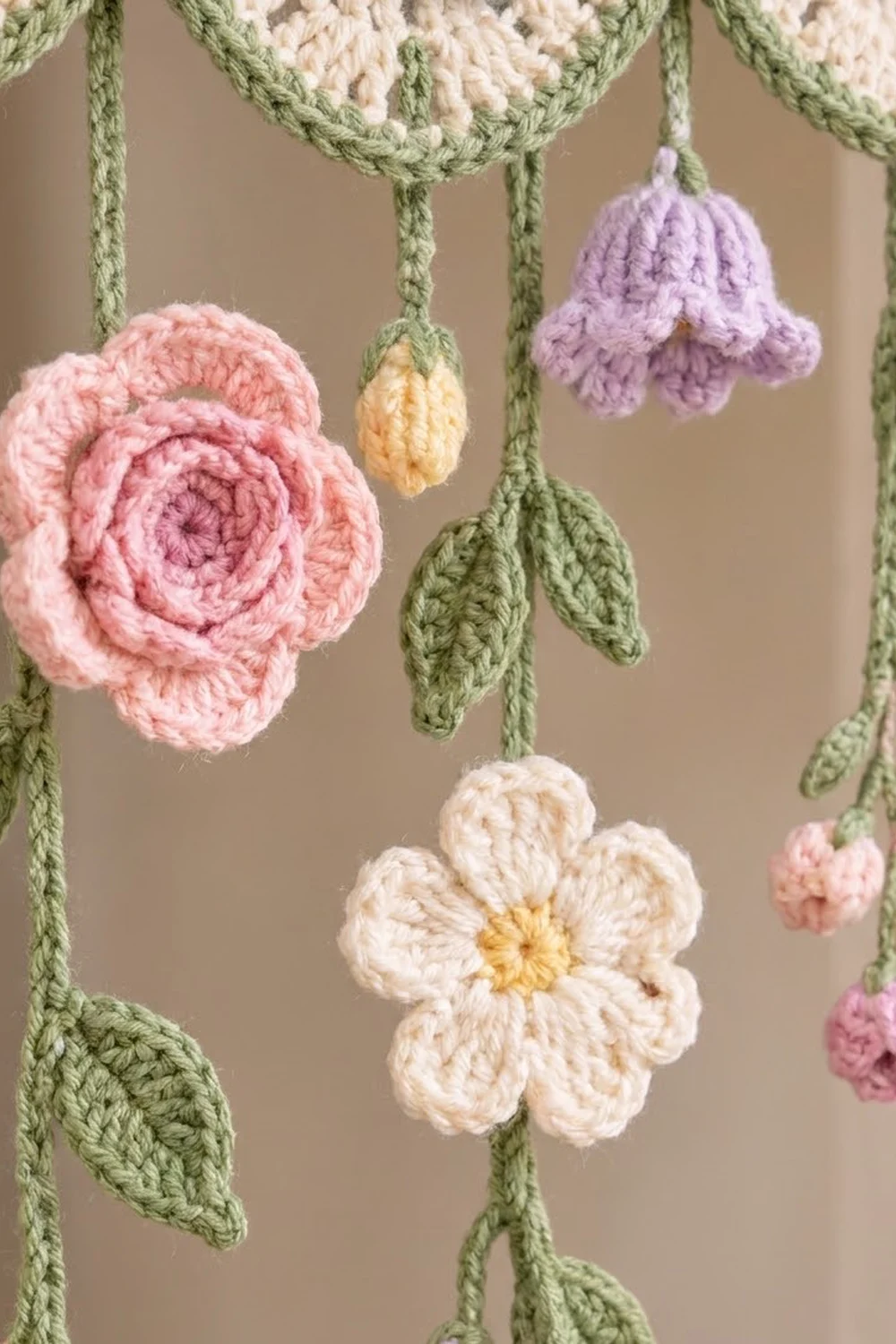
Header Panel (make 9, Cream with a Sage Green edge)
Work in turned rows to form a half circle.
Row 1: Make a magic ring. Ch 3 (counts as dc), work 5 dc in the ring, then pull the ring closed. Turn. (6 sts)
Row 2: Ch 3 (counts as dc), dc in the same st, then 2 dc in each st across. Turn. (12 sts)
Row 3: Ch 3 (counts as dc), dc in the same st, dc in the next st. 2 dc in the next st, dc in the next st; repeat from * 4 more times. Turn. (18 sts)
Row 4 (eyelet row): Ch 4 (counts as dc and ch 1), dc in the same st, which makes the first V-st. Dc in each of the next 2 sts. V-st in the next st, dc in each of the next 2 sts; repeat from * 4 more times. Fasten off Cream. (6 V-sts, 30 sts: 24 dc + 6 ch-1 sps)
Row 5 (edge): With Sage Green, join at the first st of the curve. Ch 1, then sc in each dc and each ch-1 sp across. Fasten off. (30 sc)
Top edge count: The straight edge has 8 dc row-ends (4 on each side of the ring) and 2 green sc row-ends. In the lace band you’ll work 2 sc into each dc row-end and 1 sc into each green row-end, so each panel gives 18 sts on its top edge.
Flowers
Five-Petal Flower (make 73)
Round 1 (center color): Make a magic ring. Ch 1, work 10 sc in the ring, then sl st to the first sc. Fasten off. (10 sc)
Round 2 (petal color): Join in any st. Ch 1, sc in the same st, ch 3, sk 1. Sc in the next st, ch 3, sk 1; repeat from * 3 more times. Sl st to the first sc. (5 sc, 5 ch-3 sps)
Round 3: In each ch-3 sp, work (sc, hdc, 3 dc, hdc, sc). Sl st to join, then fasten off and leave a 10 in (25.4 cm) tail. (35 sts, 5 petals) The flower should measure 2 in (5.1 cm) across.
Center colors:
– Pink flowers get Lilac centers.
– Yellow flowers get Pink centers.
– Blue, White and Lilac flowers get Yellow centers.
Rolled Rose (make 4, Pink)
Row 1: Ch 27. Dc in the 4th ch from the hook and in each ch across. (25 sts; the skipped ch counts as a dc)
Row 2: Ch 1, turn. Sc in the first st. 5 dc in the next st, sc in the next st; repeat from * 11 more times. (73 sts: 13 sc + 60 dc, 12 petals)
Roll the strip up from the starting end, keeping the base edge level, and stitch through all the layers. The rose is about 2 in (5.1 cm) across.
Bell Flower (make 34: 17 Lilac, 17 Pink)
Round 1: Make a magic ring and work 6 sc in it. (6)
Round 2: 2 sc in each st. (12)
Rounds 3–4: Sc in each st around. (12)
Round 5: Sl st in the next st, (hdc, dc, hdc) in the next st; repeat from * 5 more times. (24 sts, 6 points)
Fasten off and leave a tail. The bell is about 1 in (2.5 cm) long.
Berry Bud (make 102, Pink)
Round 1: Make a magic ring and work 6 sc in it. (6)
Round 2: 2 sc in each st. (12)
Round 3: Sc2tog 6 times. (6)
Push the starting tail inside, close the top and leave a tail for sewing. Each bud is about 0.5 in (1.3 cm) across.
Make All Pieces
Header flower order (left to right):
Panel:   1  2  3  4  5  6  7  8  9
Flower:  P  Y  B  L  P  Y  B  L  P
Vine flowers: Every vine has 4 flower spots, A to D. Fill them with the color sequence P, Y, B, W, starting one color later on each new vine:
- Vine 1: P, Y, B, W
- Vine 2: Y, B, W, P
- and so on
On vines S3, S7, S11 and S15, use a rose in place of the pink flower.
Totals per color:
| Piece | Pink | Yellow | Blue | White | Lilac |
|---|---|---|---|---|---|
| Five-petal flowers | 16 | 19 | 19 | 17 | 2 |
| Roses | 4 | – | – | – | – |
| Bell flowers | 17 | – | – | – | 17 |
| Berry buds | 102 | – | – | – | – |
That makes 73 five-petal flowers plus 4 roses, for 77 flowers in all: 68 on the vines and 9 on the header.
Vine order (left to right):
S1  S2  S3  S4  S5  S6  S7  S8  S9  S10 S11 S12 S13 S14 S15 S16 S17
tip join tip join tip join tip join tip join tip join tip join tip join tip
The odd-numbered vines (S1, S3 … S17) hang from the scallop tips. The even-numbered vines hang from the joins between panels.
Joining
- Lay the 9 panels in a row with the straight edges at the top and the RS facing up. The ends of the green edges of neighboring panels should just touch.
- Tack each touching pair together with one whipstitch through the end green sc of both panels. This closes the gap but adds no stitches to the top edge.
- Row 1 of the lace band, below, is the real join: it works 18 sts into each panel’s top edge without stopping between panels.
Use an even, medium tension when working into the row-ends. If you pull too tight, the header will pucker. If it’s too loose, gaps will open at the joins.
Checkpoint: after Row 1 of the band, the header should measure 36 in (91.4 cm) wide.
Lace Band and Tabs
Band gauge: 4.5 sts per inch (18 sts = 4 in / 10.2 cm).
Row 1 (RS): With Cream, join at the top right corner of panel 1. Ch 1. On each panel, work 1 sc in the green row-end, 2 sc in each of the 8 dc row-ends, and 1 sc in the other green row-end, for 18 sc per panel. Continue across all 9 panels. (9 × 18 = 162 sc)
Row 2 (mesh): Ch 3 (counts as dc), turn, dc in the next st. Ch 1, sk 1, dc in the next st; repeat from * 79 more times. (82 dc + 80 ch-1 sps = 162 sts)
Row 3: Ch 1, turn. Sc in each dc and each ch-1 sp across, including the top of the turning ch. (162 sc)
Row 4: Repeat Row 2. (82 dc + 80 ch-1 sps = 162 sts)
Row 5: Repeat Row 3 and fasten off. (162 sc)
Why the math works: The band starts with 162 sts, which equals 9 panels × 18 sts per panel, with nothing added at the joins. At 4.5 sts per inch, 162 sts measure 36 in (91.4 cm).
The mesh rows use 2 sts to start, then 2 sts for each repeat: 2 + (80 × 2) = 162. So every row keeps the same count and the band stays straight.
The band’s 3 sc rows and 2 dc rows add up to 1.5 in (3.8 cm). Together with the 2 in (5.1 cm) panels, the header is 3.5 in (8.9 cm) deep.
Tabs (make 10, Cream):
1. Ch 5. Row 1: sc in the 2nd ch from the hook and in each ch across. (4 sc)
2. Rows 2–20: ch 1, turn, sc in each st across. (4 sc)
Each tab measures about 0.9 in (2.3 cm) × 4 in (10.2 cm).
Sew the tabs over these Row 5 stitches:
– one tab on sts 1–4
– one tab centered over each panel seam, on sts 17–20, 35–38, 53–56, 71–74, 89–92, 107–110, 125–128 and 143–146
– one tab on sts 159–162
Fold each tab in half. Sew 0.5 in (1.3 cm) of one end to the front of the band and 0.5 in (1.3 cm) of the other end to the back, so each tab forms a loop.
Header flowers: Center one flower on each panel, with its center 1 in (2.5 cm) below the band seam. The top petal should touch the seam and the bottom petal should touch the green edge. Sew around the center and tack each petal tip.
Vines (make 17, Sage Green)
Foundation:
1. Leave a 12 in (30.5 cm) tail for attaching the vine later.
2. Ch 331.
3. To find each spot on the vine, multiply its distance from the top (in inches) by 5. Counting from the first ch, put a marker on that ch. For example, the spot at 3 in is ch 15.
Return pass: Sl st in the back bump of the 2nd ch from the hook, then continue up the chain with 1 sl st in each ch, working the elements below at the marked chains. (330 sl sts = 66 in / 167.6 cm)
Leaf (worked onto the stem):
1. Ch 8. Starting in the 2nd ch from the hook, work sc, hdc, dc in each of the next 3 ch, hdc, then sc in the last ch, which brings you back to the stem. (7 sts)
2. Turn the leaf and work along the other side of the same chain: sc, hdc, 3 dc, hdc, sc. (7 sts)
3. Sl st in the tip ch.
4. For the vein, work 7 surface sl sts down the middle of the leaf, then sl st into the stem.
Each leaf is about 1.5 in (3.8 cm) long. For a pair, make a second leaf in the same stem st, angled to the opposite side.
Bell stalk: Ch 6, sl st in the 2nd ch from the hook and in each of the next 4 ch, then sl st in the stem. The stalk is 1 in (2.5 cm) long.
Berry sprig: Work (ch 5, sl st in the 2nd ch from the hook and in each of the next 3 ch) 3 times, all from the same stem st. Each stalk is about 0.75 in (1.9 cm) long.
Where everything goes (distance from the top):
| in (cm) | Element |
|---|---|
| 3 (7.6) | Leaf pair |
| 7 (17.8) | Flower A |
| 11 (27.9) | Leaf |
| 15 (38.1) | Bell stalk (Lilac bell) |
| 19 (48.3) | Leaf pair |
| 23 (58.4) | Flower B |
| 27 (68.6) | Leaf |
| 31 (78.7) | Berry sprig |
| 35 (88.9) | Leaf pair |
| 39 (99.1) | Flower C |
| 43 (109.2) | Leaf |
| 47 (119.4) | Berry sprig |
| 51 (129.5) | Leaf pair |
| 55 (139.7) | Flower D |
| 61 (154.9) | Leaf |
| 66 (167.6) | Pink bell at the bottom tip |
Per vine: 12 leaves, 4 flowers, 2 bells, 2 sprigs and 6 buds.
Sew the flowers flat against the stem at their markers. Sew a bud to the end of each sprig stalk, the Lilac bell to the end of its stalk, and the Pink bell to the bottom tip.
Attaching the vines: Use the top tail of each vine.
– Tip vines (S1, S3 … S17): Sew each one between sc 15 and sc 16 of the green edge, which is the lowest point of the scallop.
– Join vines (S2, S4 … S16): Sew each one at a tacked join between two panels.
The join vines start 2 in (5.1 cm) higher, which gives the bottom edge a slight, deliberate stagger.
Final Blocking
- Pin the header face down at 36 in (91.4 cm) × 3.5 in (8.9 cm). Pin each scallop into a smooth curve.
- Spray the header until it’s damp and let it dry completely.
- Pin each flower flat to 2 in (5.1 cm) and spray it, pulling the petals open.
- Hang the curtain from its rod. Spray the vines lightly and let gravity straighten them.
- Once everything is dry, re-check the length and fix any vine that has twisted.
Final Quality-Control Checklist
- The header measures 36 in (91.4 cm) wide, and the band rows each have 162 sts.
- Each panel’s green edge has 30 sc, with no ruffling.
- All 10 tabs line up and turn freely on the rod.
- Each vine is 66 in (167.6 cm) long, with 12 leaves, 4 flowers, 2 bells and 6 buds.
- The roses are on S3, S7, S11 and S15.
- All tails are woven in and every petal tip is tacked down.
Troubleshooting
- Scallops ruffle: Go down half a hook size, or check that Row 4 has exactly 6 V-sts.
- Scallops cup: Go up half a hook size, then block firmly.
- Band is narrower than 36 in: Check that you worked 18 sts per panel in Row 1.
- Vines twist: Keep working the return pass into the back bump only, then spray and hang the vine.
- Vines are longer than 66 in: Your chains are too loose. Count 5 ch per inch, or remove chains before you start the return pass.
- Flowers flop forward: Tack the top two petals to the stem as well as the center.
Care
Hand wash in cool water, roll in a towel and hang to dry on the rod. Dust it now and then with a cool hairdryer.
Final Notes
All the measurements in this curtain build on each other:
- A gauge of 18 sts per 4 in (10.2 cm) gives a panel 4 in (10.2 cm) wide with 18 sts along its top edge.
- Nine panels make 162 sts, which is 36 in (91.4 cm) across.
- The 1.5 in (3.8 cm) band plus the 2 in (5.1 cm) scallops make a 3.5 in (8.9 cm) header.
- 330 ch at 5 ch per inch make 66 in (167.6 cm) vines.
- The full curtain hangs 69.5 in (176.5 cm) long.
Check each number at its own stage and the whole curtain will come out to size. Happy crocheting!