

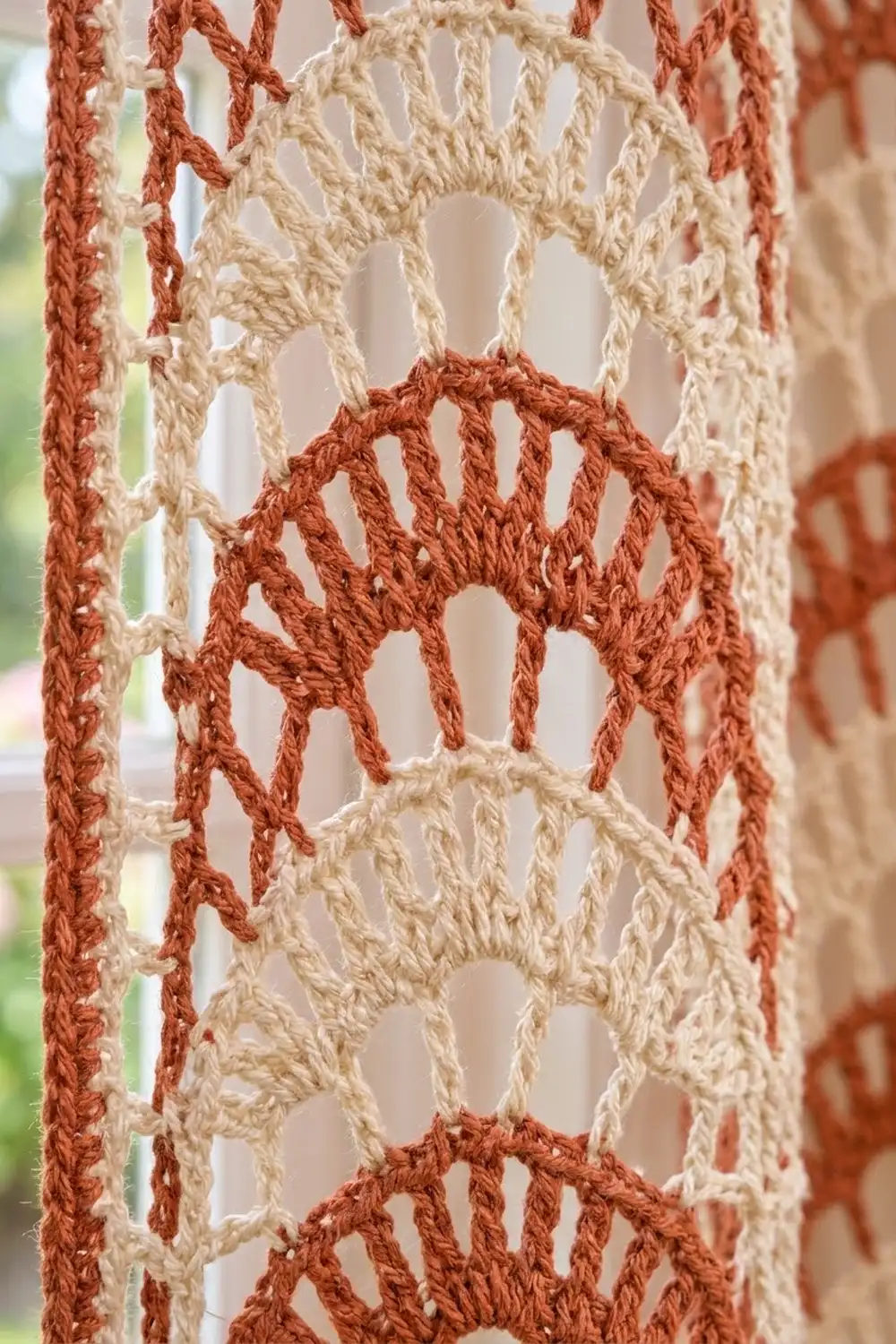
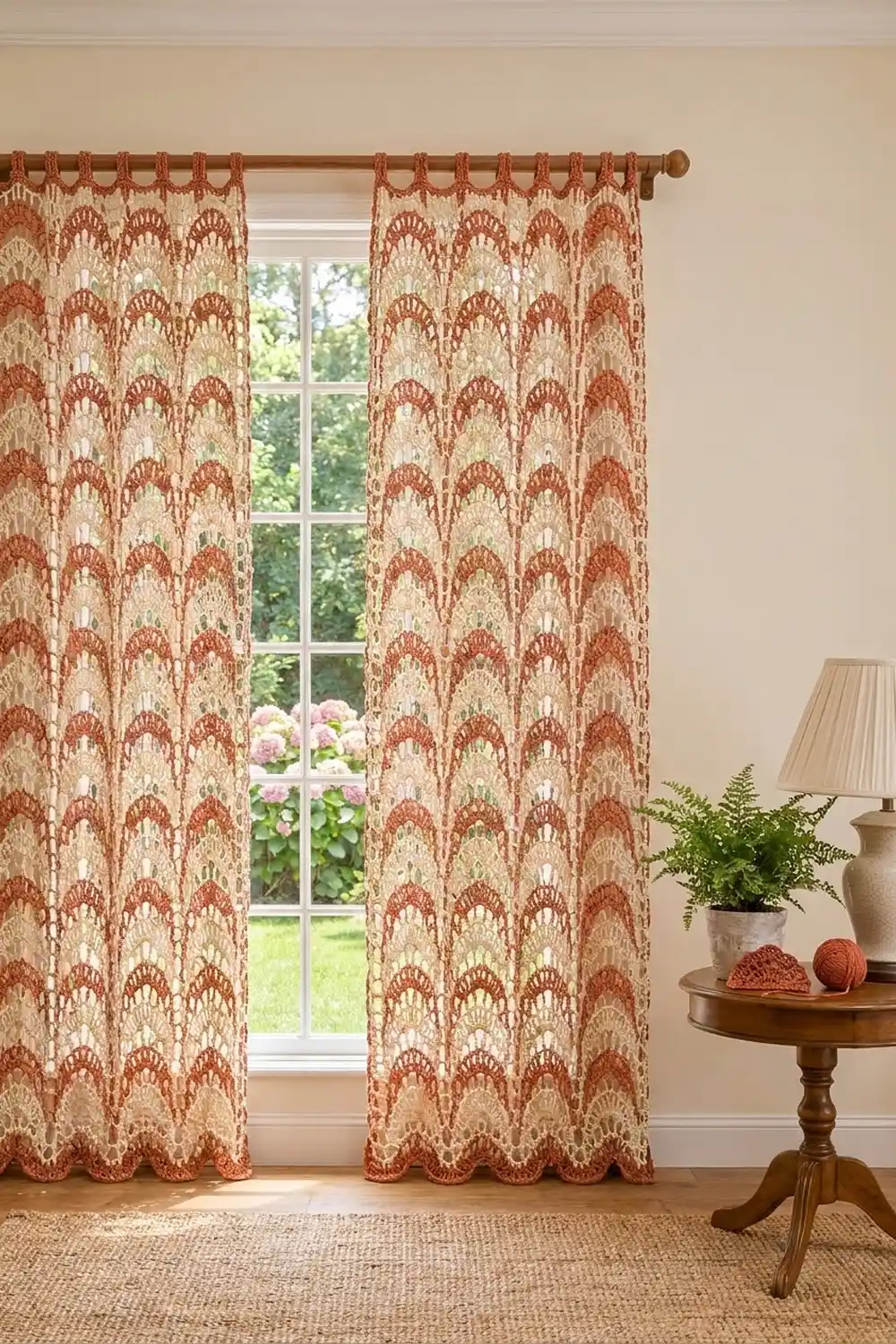
These curtain panels are made of rows of staggered half-circle fans, like old fanlight windows. Each fan has a small inner shell, a ring of paired spokes and a wide outer ring. Light comes through the open spaces, and the solid rust tabs hang neatly on a wooden rod.
The colors are warm terracotta rust and soft cream. The bands swap colors every four rows, and each new band moves over by half a fan, so the rust fans sit between the cream ones in a brick layout. Rust also frames each panel along the sides, across the scalloped hem and on the tab top.
This pattern uses US crochet terms. Each finished panel measures about 37 in (94.0 cm) wide by 83.5 in (212.1 cm) long, not counting the tabs. With the tabs it hangs about 86.5 in (219.7 cm) from the top of the rod. You make two identical panels.
You work each panel from the bottom up in rows. You start with a base row of single crochet, then crochet 32 fan bands that alternate between rust and cream. Next you work two edging rounds that add the scalloped hem, then four solid rows across the top, and finally ten tabs that fold to the back.
Finished Size and Construction
- Finished size (per panel): 37 in (94.0 cm) wide x 83.5 in (212.1 cm) long; 86.5 in (219.7 cm) including the tab loops
- Skill level: Intermediate
- Terminology: US
- Yarn weight: Worsted (#4) cotton or cotton blend
- Hook: 5.0 mm (H-8)
- Number of pieces: 2 separate panels, each worked in one piece
- Layout: 2 panels hung side by side, not joined
- Panel body size: 36 in (91.4 cm) wide x 80.5 in (204.5 cm) long
- Size before border: the same as the panel body
- Border depth: 0.5 in (1.3 cm) on the sides; 1 in (2.5 cm) at the hem; 2 in (5.1 cm) at the top before the tabs
Materials
Pick a smooth, mercerized or combed cotton. It shows the stitches clearly, stays crisp in sunlight and doesn’t stretch as much as acrylic when it hangs. These amounts assume about 170 m (186 yd) per 100 g.
- Rust (Color A): 700 g / 1,190 m per panel; 1,400 g / 2,380 m for the pair
- Cream (Color B): 550 g / 935 m per panel; 1,100 g / 1,870 m for the pair
The amounts include a margin of about 10% for gauge differences and a swatch. Buy all your yarn from one dye lot.
Tools:
– 5.0 mm (H-8) crochet hook
– Tapestry needle
– Stitch markers
– Tape measure
– Rust-proof pins and blocking mats, or a clean carpet covered with towels
Abbreviations (US Terms)
- ch – chain
- sc – single crochet
- hdc – half double crochet
- dc – double crochet
- tr – treble crochet
- sk – skip
- sp – space
- st(s) – stitch(es)
- RS / WS – right side / wrong side
Special stitches
– Fan: [dc, (ch 1, dc) 4 times] in the same st. This gives 5 dc and 4 ch-1 sps.
– Half fan: [dc, (ch 1, dc) twice] in the same st. This gives 3 dc and 2 ch-1 sps.
– V-st: (dc, ch 1, dc) in the same sp.
– Wide V: dc in the first dc of the next V-st, ch 2, sk the V-st’s ch-1 sp, dc in the second dc of that V-st.
Gauge and Checkpoints
Gauge: 12 sts (one fan repeat) = 4 in (10.2 cm) wide. One 4-row band = 2.5 in (6.4 cm) tall, measured after blocking. In the top band, 3 hdc = 1 in (2.5 cm) and 8 rows of hdc = 3 in (7.6 cm).
Test a swatch first. Ch 38. Work the base row (37 sc), then one Band A and one Band B. The repeat count changes to 3: Band A has 3 fans, and Band B has 2 full fans between its half fans. After blocking, the swatch should be 12 in (30.5 cm) wide, and the two bands together should measure 5 in (12.7 cm) above the base row.
Checkpoints for each panel:
– Base row: 109 sts = 36 in (91.4 cm)
– After 4 bands: 10 in (25.4 cm) above the base row
– After 16 bands: 40 in (101.6 cm)
– After 32 bands: 80 in (203.2 cm); the body is 80.5 in (204.5 cm) including the base row
– After the border: 37 in (94.0 cm) x 83.5 in (212.1 cm)
If your swatch is too big, go down a hook size, to 4.5 mm (7). If it’s too small, go up to 5.5 mm (I-9). A width that is off by only 1/4 in (0.6 cm) per repeat adds up to 2.25 in (5.7 cm) across the panel, so fix gauge before you start.
Panel (Make 2)
Foundation: With Rust, ch 110.
Base row (RS): Sc in the 2nd ch from the hook and in each ch across, then turn. (109 sc)
109 = 12 x 9 + 1, which gives nine 12-st repeats plus one edge stitch.
Band A: Aligned Fans (4 rows)
Row 1 (RS): Ch 1, sc in the first st. Sk 5 sts, Fan in the next st, sk 5 sts, sc in the next st; repeat from * 8 more times. Turn. (9 fans, 10 sc)*
Row 2 (WS): Ch 4 (counts as tr). Ch 1, (V-st in the next ch-1 sp, ch 1) 4 times, tr in the next sc; repeat from * 8 more times. The last tr goes into the last sc. Turn. (36 V-sts, 10 tr)*
Row 3 (RS): Ch 3 (counts as dc). Sk the ch-1 sp, (Wide V, ch 1, sk the ch-1 sp) 3 times, Wide V, sk the ch-1 sp, dc in the next tr; repeat from * 8 more times. The last dc goes into the top of the turning ch-4. Turn. (36 Wide Vs, 10 dc)*
Row 4 (WS): Ch 1, sc in the first dc. (2 sc in the next ch-2 sp, sc in the next ch-1 sp) 3 times, 2 sc in the next ch-2 sp, sc in the next dc; repeat from * 8 more times. The last sc goes into the top of the turning ch-3. (109 sc)*
Each repeat in Row 4 has 3 x 3 + 2 + 1 = 12 sts, and 9 x 12 + 1 = 109. On the last yarn over of the final sc, change to Cream. Turn.
Band B: Offset Fans (4 rows)
This band moves the fans over by 6 sts. Each fan sits above a valley of the band below, and the sc between fans sits above a fan center.
Row 1 (RS): Ch 4 (counts as dc + ch 1), (dc, ch 1, dc) in the first st, which makes the first half fan. Sk 5 sts, sc in the next st, sk 5 sts, Fan in the next st; repeat from * 7 more times. Sk 5 sts, sc in the next st, sk 5 sts, (dc, ch 1) twice and dc in the last st, which makes the second half fan. Turn. (8 fans, 2 half fans, 9 sc)*
Stitch check: 1 + (8 x 12) + 12 = 109 sts used.
Row 2 (WS): Ch 4 (counts as dc + ch 1), V-st in the next ch-1 sp, ch 1, V-st in the next ch-1 sp, ch 1, tr in the next sc. Ch 1, (V-st in the next ch-1 sp, ch 1) 4 times, tr in the next sc; repeat from * 7 more times. Ch 1, (V-st in the next ch-1 sp, ch 1) twice, then dc in the 3rd ch of the beginning ch-4. Turn. (36 V-sts, 9 tr, 2 edge dc)*
Row 3 (RS): Ch 3 (counts as dc), sk the ch-1 sp, Wide V, ch 1, sk the ch-1 sp, Wide V, sk the ch-1 sp, dc in the next tr. Sk the ch-1 sp, (Wide V, ch 1, sk the ch-1 sp) 3 times, Wide V, sk the ch-1 sp, dc in the next tr; repeat from * 7 more times. Sk the ch-1 sp, Wide V, ch 1, sk the ch-1 sp, Wide V, sk the ch-1 sp, then dc in the 3rd ch of the turning ch-4. Turn. (36 Wide Vs, 11 dc)*
Row 4 (WS): Ch 1, sc in the first dc, 2 sc in the ch-2 sp, sc in the ch-1 sp, 2 sc in the ch-2 sp, sc in the next dc. (2 sc in the next ch-2 sp, sc in the next ch-1 sp) 3 times, 2 sc in the next ch-2 sp, sc in the next dc; repeat from * 7 more times. 2 sc in the ch-2 sp, sc in the ch-1 sp, 2 sc in the ch-2 sp, then sc in the top of the turning ch-3. (109 sc)*
Stitch check: 1 + 6 + (8 x 12) + 6 = 109. On the last yarn over, change to Rust. Turn.
Body Sequence
Work the bands in this order:
- Bands 1, 3, 5 … 31: Band A in Rust (16 bands)
- Bands 2, 4, 6 … 32: Band B in Cream (16 bands)
Each band has an even number of rows, so both colors finish on the same side. Carry the unused color loosely up the edge rather than cutting it. The side edging will cover the strands. Band 32 is Cream. Fasten off Cream at the end of it, but keep the Rust attached.
Checkpoint: 32 bands = 80 in (203.2 cm), and the body is 80.5 in (204.5 cm) including the base row. Every row should end with 109 sc.
Make Both Panels
Make two identical panels, each with 16 Rust bands, 16 Cream bands, and all the border and tab steps below. The panels hang separately and are not joined.
[ Panel 1 ]   [ Panel 2 ]
 37 in wide    37 in wide
 Tabs: 10      Tabs: 10
Per panel: about 700 g of Rust and 550 g of Cream. For the pair: 1,400 g of Rust and 1,100 g of Cream.
Border
Border gauge: Along the top and bottom, 3 sc = 1 in (2.5 cm), which matches the body (one sc per st). Along the sides, work 7 sc per 2.5 in (6.4 cm) band, which keeps the side edges flat and stops them from waving.
Round 1 (Rust, RS facing)
Turn so the RS faces you. Starting at the top right:
- Top: 3 sc in the first st (corner), sc in the next 107 sts, 3 sc in the last st (corner).
- Left side: Work 7 sc evenly along each band (32 x 7 = 224), plus 1 sc in the end of the base row. (225 sc)
- Bottom: Work into the free loops of the foundation chain: 3 sc in the first ch (corner), sc in the next 107 ch, 3 sc in the last ch (corner).
- Right side: 225 sc, the same as the left side.
- Join with a sl st to the first sc. (676 sts)
The math: (107 x 2) + (225 x 2) + (4 corners x 3) = 214 + 450 + 12 = 676. Between the center sts of two corners, the top has 109 sts and each side has 227 sts (the 225 side sc plus the outer sc of each corner).
Round 2 (Rust)
Ch 1. Work 1 sc in each st and 3 sc in each corner center st, except along the bottom edge:
- Bottom: Between the two bottom corner centers there are 109 sts. Sc in the first st, sk 2 sts, 5 dc in the next st, sk 2 sts, sc in the next st; repeat from * 17 more times. (18 scallops: 19 sc + 90 dc = 109 sts)*
- Join with a sl st to the first sc. (684 sts)
The math: 109 (top) + 227 x 2 (sides) + 109 (bottom) + 12 (corners) = 684. The scallops work because 109 = 6 x 18 + 1. Each scallop is 2 in (5.1 cm) wide, so two scallops sit under each 4 in (10.2 cm) fan repeat. Don’t fasten off.
Top Band (Rust, rows)
Sl st to the top right corner center st. Counting from one corner center to the other and including both of them, the top edge now has 113 sts: 1 corner center + 1 corner sc + 109 + 1 corner sc + 1 corner center.
Row 1 (RS): Ch 2 (does not count as a stitch), hdc in the same st and in each st across, ending in the other corner center st. Turn. (113 hdc)
Rows 2–4: Ch 2, hdc in each st across. Turn. (113 hdc)
Checkpoint: The top band is 1.5 in (3.8 cm) deep. Fasten off.
Tabs (make 10)
Use stitch markers to mark tab positions on Row 4. Each tab is 5 sts wide, with 7-st gaps between tabs: 10 x 5 + 9 x 7 = 50 + 63 = 113. Tab number k covers sts 12(k − 1) + 1 through 12(k − 1) + 5. Tab 1 sits on sts 1–5 and Tab 10 on sts 109–113.
For each tab, join Rust in the first marked st and work 5 hdc. Then work 15 more rows of 5 hdc. (16 rows = 6 in / 15.2 cm)
Fasten off and leave a 12 in (30.5 cm) tail. Fold the tab to the WS and whipstitch its last row to the back of Top Band Row 1. Each finished loop is 3 in (7.6 cm) tall, 1 2/3 in (4.2 cm) wide, and spaced 2 1/3 in (5.9 cm) from the next one.
Final Blocking
- Weave in all the ends along the solid sc rows or the side edging. Don’t weave through the open fan spaces.
- Soak the panel in cool water with a little wool wash for 20 minutes.
- Press out the water. Don’t wring it. Roll the panel in towels to remove more moisture.
- Lay it flat and pin it to 37 in (94.0 cm) x 83.5 in (212.1 cm).
- Pin each scallop point along the hem, and pin the top of each fan into a smooth half-circle.
- Check that the sides are straight with a long ruler or a taut string.
- Let it dry completely. Block the second panel to exactly the same measurements.
Final Quality-Control Checklist
- Every Row 4 has 109 sc.
- The bands alternate Rust and Cream, starting and ending as written (Band 1 Rust, Band 32 Cream).
- The Cream fans sit centered above the Rust valleys, and the reverse.
- Border Round 1 has 676 sts and Round 2 has 684 sts.
- There are 18 scallops on the hem.
- The top band has 113 hdc, and the 10 tabs are evenly spaced.
- Both panels are the same size to within 1/2 in (1.3 cm).
Troubleshooting
The fans lean or drift sideways: You probably skipped 4 or 6 sts instead of 5. Recount Row 1 of that band.
Row 4 doesn’t come out to 109: Check that you worked 2 sc in every ch-2 sp and only 1 sc in each ch-1 sp.
The panel narrows going up: The turning chains are too tight, or you’re missing the last st of the row. Mark the turning chains for a band or two.
The side edges wave: Use fewer side sc, for example 6 per band. If the edges pull in instead, use 8. Keep the total the same on both sides.
The hem curls: Block the scallops firmly. If they still curl, work the dc in the scallops more loosely.
The panel grows too long once hung: Cotton lace drops 1–2 in (2.5–5.1 cm) when it hangs. If yours stretches more than that, remove a band before the border.
Care
Hand wash cool or machine wash on a gentle cycle in a mesh bag, then reshape and dry flat. Don’t hang wet panels on the rod, because the weight will stretch them.
Final Notes
All the measurements follow from the gauge. One 12-st repeat is 4 in (10.2 cm), so nine repeats make the 36 in (91.4 cm) body. One band is 2.5 in (6.4 cm), so 32 bands make 80 in (203.2 cm). The two border rounds and the top band bring each panel to 37 in (94.0 cm) x 83.5 in (212.1 cm), and the tabs add a loop of 3 in (7.6 cm). If you match the gauge at the swatch and at each checkpoint, the panel will come out to the planned size.
Happy crocheting!