

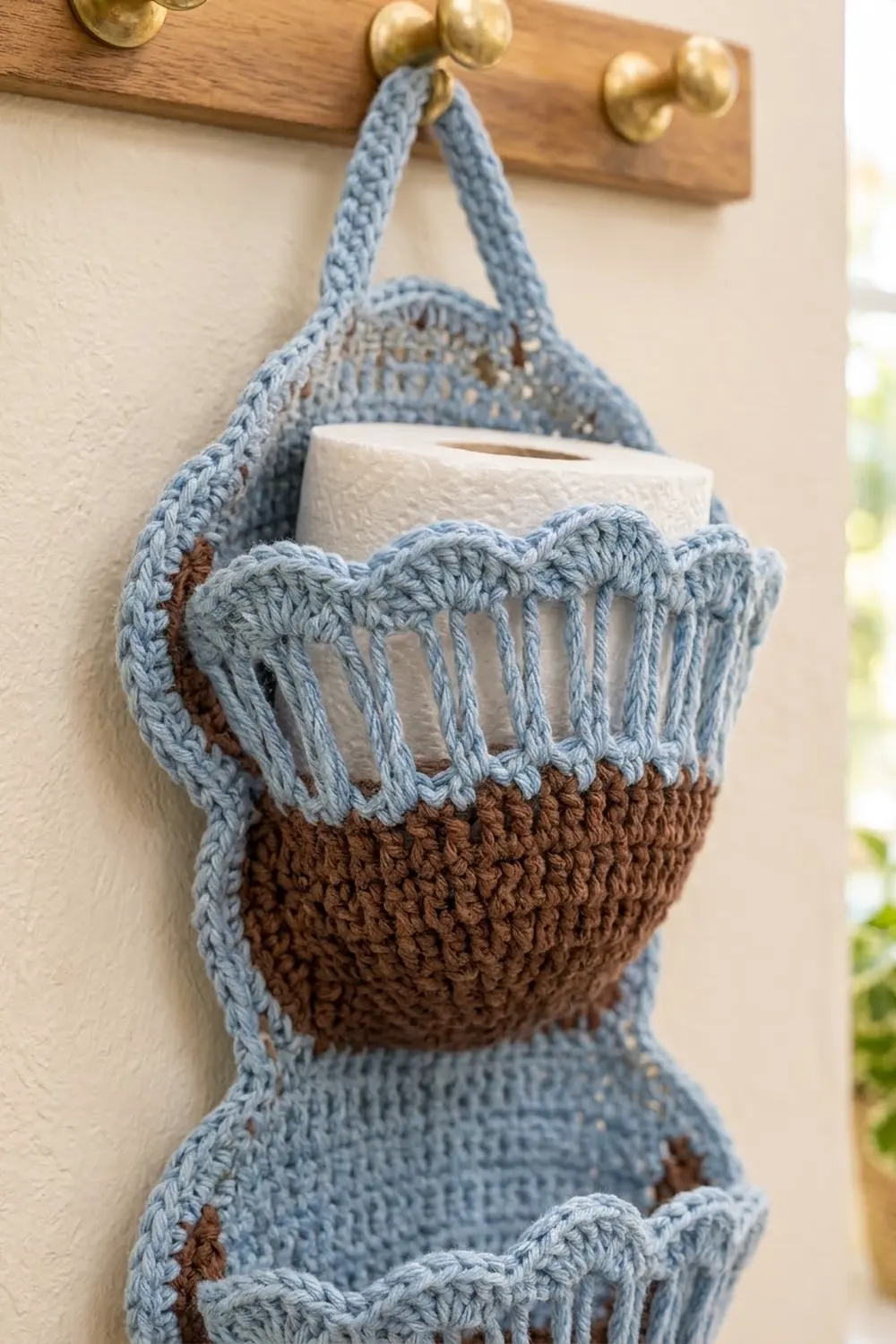
This hanging holder stores three toilet rolls in one narrow column on the wall. A soft blue backing panel with three rounded lobes carries three brown pockets. Each pocket has a bowl-shaped base and an airy blue crown of tall stitches with a scalloped rim.
The colors are a light sky blue and a warm chocolate brown. Together they look cottage-style and calm, and they suit a bathroom with plants, wood and brass. The panel edge is finished with reverse single crochet, which gives a neat corded outline.
The pattern uses US crochet terms. The finished holder is 6.8 in (17.3 cm) wide and 16.8 in (42.7 cm) tall, not counting the strap loop. The loop adds about 3 in (7.6 cm) above the panel.
How it is built: you crochet the backing panel in shaped single crochet rows. Then you make three pockets in the round, starting at the base, and one strap. You sew the pockets to the panel, add a two-round border around the panel, and sew on the strap.
Finished Size and Construction
- Finished size: 6.8 in x 16.8 in (17.3 cm x 42.7 cm), plus a strap loop of about 3 in (7.6 cm)
- Skill level: Intermediate
- Terminology: US
- Yarn weight: Worsted (#4), cotton or cotton blend
- Hook: 5 mm (H-8)
- Number of pieces: 5 (1 panel, 3 pockets, 1 strap)
- Layout: 1 column with 3 pockets stacked
- Panel size before border: 6 in (15.2 cm) wide at the lobes, 5 in (12.7 cm) at the waists, 16 in (40.6 cm) tall
- Pocket size: base 4.75 in (12.1 cm) across; about 3.5 in (8.9 cm) tall
- Border depth: about 0.4 in (1.0 cm)
Materials
Use cotton or a cotton blend. Cotton keeps its shape, holds the weight of the rolls and washes well. Acrylic will also work, but the pockets will stretch more.
- Color A, light blue: 140 g / 265 m
- Color B, chocolate brown: 100 g / 190 m
These amounts include a margin of about 20% for your gauge swatch and tails.
Tools:
– 5 mm (H-8) crochet hook
– Tapestry needle
– 6 stitch markers
– Scissors
– Measuring tape
– Blocking mat and rustproof pins
– Spray bottle
Abbreviations (US Terms)
- ch – chain
- sl st – slip stitch
- sc – single crochet
- dc – double crochet
- dtr – double treble crochet
- sc2tog – single crochet 2 together
- inc – 2 sc in the same stitch
- BLO – back loop only
- MR – magic ring
- rev sc – reverse single crochet
- st(s) – stitch(es)
- sp – space
Special stitches
Double treble (dtr): Yarn over 3 times. Insert the hook in the stitch, yarn over and pull up a loop (5 loops on hook). Yarn over and pull through 2 loops. Repeat from * 3 more times.
Reverse single crochet (rev sc): Work from left to right (right-handed). Insert the hook in the next stitch to the right, pull up a loop, then yarn over and pull through both loops.
Gauge and Checkpoints
Gauge: 16 sc x 18 rows = 4 in (10.2 cm), using the 5 mm hook.
Make one pocket first. It is quick to make and checks both your sc gauge and your dtr height.
Checkpoints:
– Pocket Rnd 10: the flat base measures 4.75 in (12.1 cm) across.
– Pocket Rnd 18: the dtr round is about 1.25 in (3.2 cm) tall.
– Panel Row 5: the panel is 6 in (15.2 cm) wide.
– Panel Row 24: the panel is 5.33 in (13.5 cm) tall.
– Panel Row 48: the panel is 10.67 in (27.1 cm) tall.
– Panel Row 72: the panel is 16 in (40.6 cm) tall.
If your work is too big, change to a hook 0.5 mm smaller. If it is too small, change to a hook 0.5 mm larger. A standard toilet roll is about 4.5 in (11.4 cm) across, so the pocket base must not end up smaller than that.
Backing Panel (make 1)
Use color A. You work the panel in rows from the bottom to the top. At the start of each row, ch 1 and turn; this ch 1 does not count as a stitch.
- Inc row: 2 sc in the first st, sc to the last st, 2 sc in the last st.
- Dec row: sc2tog, sc to the last 2 sts, sc2tog.
Lobe 1 (bottom)
Row 1: Ch 17, sc in the 2nd ch from the hook and in each ch across. (16 sts)
Rows 2–5: Work an inc row. (Row 2: 18 sts; Row 3: 20; Row 4: 22; Row 5: 24)
Rows 6–20: Sc in each st across. (24 sts)
Rows 21–22: Work a dec row. (Row 21: 22 sts; Row 22: 20)
Rows 23–24: Sc in each st across. (20 sts)
Checkpoint: 5.33 in (13.5 cm) tall.
Lobe 2 (middle)
Rows 25–26: Work an inc row. (Row 25: 22 sts; Row 26: 24)
Rows 27–44: Sc in each st across. (24 sts)
Rows 45–46: Work a dec row. (Row 45: 22 sts; Row 46: 20)
Rows 47–48: Sc in each st across. (20 sts)
Checkpoint: 10.67 in (27.1 cm) tall.
Lobe 3 (top)
Rows 49–50: Work an inc row. (Row 49: 22 sts; Row 50: 24)
Rows 51–68: Sc in each st across. (24 sts)
Rows 69–72: Work a dec row. (Row 69: 22 sts; Row 70: 20; Row 71: 18; Row 72: 16)
Fasten off. Each lobe is 24 rows, so the panel totals 72 rows, which is 16 in (40.6 cm) at 18 rows per 4 in.
Mark the pocket lines. Place a pair of markers in each row listed below, one at each end of the center 20 sts:
- Bottom pocket: Rows 4 and 18
- Middle pocket: Rows 28 and 42
- Top pocket: Rows 52 and 66
Pocket (make 3)
You work each pocket in continuous rounds. Do not join the rounds, and move a marker up to the first stitch of every round.
Base (color B)
Rnd 1: 6 sc in the MR. (6)
Rnd 2: Inc in each st around. (12)
Rnd 3: Sc 1, inc 6 times. (18)
Rnd 4: Sc 2, inc 6 times. (24)
Rnd 5: Sc 3, inc 6 times. (30)
Rnd 6: Sc 4, inc 6 times. (36)
Rnd 7: Sc 5, inc 6 times. (42)
Rnd 8: Sc 6, inc 6 times. (48)
Rnd 9: Sc 7, inc 6 times. (54)
Rnd 10: Sc 8, inc 6 times. (60)
Checkpoint: the base is flat and 4.75 in (12.1 cm) across.
Sides (color B)
Rnd 11: Sc in the BLO of each st around. (60) This makes a clean fold line, and the unused front loops of Rnd 10 become your sewing line later.
Rnds 12–16: Sc in each st around. (60)
Checkpoint: the brown sides measure about 1.33 in (3.4 cm) tall. Change to color A in the last st of Rnd 16 and fasten off B.
Openwork crown (color A)
Rnd 17: Sc in each st around, then sl st to the first sc. (60)
Rnd 18: Ch 5 (this counts as the first dtr), ch 1, skip the next st. Dtr in the next st, ch 1, skip the next st. Repeat from * 28 more times, then sl st to the 4th ch of the beginning ch-5.
Count: 30 dtr and 30 ch-1 sps, which is 60 positions.
Rnd 19: Ch 1. Sc in the top of the ch-5, sc in the next ch-1 sp. Sc in the next dtr, sc in the next ch-1 sp. Repeat around, then sl st to the first sc.
Count: 30 sc in the dtr plus 30 sc in the ch-1 sps = 60.
Rnd 20: Sl st in the first st. Skip 2 sts, 5 dc in the next st, skip 2 sts, sl st in the next st. Repeat from * 10 times; the last sl st lands in the first sl st.
Count: 10 scallops of 5 dc each. Each repeat uses 6 sts, and 10 x 6 = 60.
Fasten off and leave an 18 in (45.7 cm) tail of color A.
Checkpoint: the pocket is about 3.5 in (8.9 cm) tall from the base to the tips of the scallops.
Hanging Strap (make 1)
Use color A.
Row 1: Ch 41, sc in the 2nd ch from the hook and in each ch across. (40)
Rows 2–3: Ch 1, turn, sc in each st across. (40)
Fasten off and leave a 12 in (30.5 cm) tail. The strap is 10 in (25.4 cm) long and about 0.67 in (1.7 cm) wide.
Make All Pieces
- Color A: 1 backing panel, 1 strap, and the Rnds 17–20 crown on all 3 pockets
- Color B: Rnds 1–16 (base and sides) on all 3 pockets
Layout (front view):
        (  strap loop  )
   +---------------------+
   |  LOBE 3 | Pocket 3  |  Rows 49–72
   +----- waist ---------+
   |  LOBE 2 | Pocket 2  |  Rows 25–48
   +----- waist ---------+
   |  LOBE 1 | Pocket 1  |  Rows 1–24
   +---------------------+
Joining
Method: Whipstitch with color A and a tapestry needle. Each pocket is sewn on with two horizontal seams, one at the bottom and one at the rim.
Stitch-to-stitch logic: The back third of a pocket is 20 of its 60 stitches. That matches the 20 center stitches you marked on the panel, so every pocket stitch is sewn to exactly one panel stitch.
- Bottom seam. Pick 20 consecutive unused front loops of Rnd 10 and center them over the marked 20 sts of the pocket’s lower row (Row 4, 28 or 52). Whipstitch them together 1 to 1. Row 4 has 22 sts, so 1 st stays free on each side; Rows 28 and 52 have 24 sts, so 2 sts stay free on each side.
- Rim seam. Find the 20 Rnd 19 sts directly above the bottom seam. Lay them flat across the marked 20 sts of the upper row (Row 18, 42 or 66). Whipstitch them 1 to 1 through the back loops of Rnd 19, so the scallops on the back stay upright against the panel.
- Tack the sides. Make 2 or 3 small tacking stitches up each side of the flattened back, between the two seams.
Tension: Pull each stitch just snug. If you pull too hard, the panel puckers. If you sew too loosely, the pocket sags when the roll goes in.
Size checkpoint: the bottom and rim seams on each pocket are 14 rows apart, which is about 3.1 in (7.9 cm). That matches the pocket’s height from the fold line to Rnd 19. The panel should still lie flat and measure 6 in (15.2 cm) across each lobe.
Border
Border gauge: 4 sc per 1 in (2.5 cm), the same as the panel stitch gauge. The border goes around the panel only; the pockets are not part of its stitch count.
Rnd 1 (color A): Join color A in the first st of Row 72. Then work:
- Top: Ch 1, 2 sc in the first st, sc in the next 14 sts, 2 sc in the last st. (18)
- First side: Working into the row ends, sc in each of the next 8 row ends, skip 1 row end. Repeat from * 8 times. (64)
- Bottom: Working into the foundation loops, 2 sc in the first loop, sc in the next 14, 2 sc in the last loop. (18)
- Second side: Work the same as the first side. (64)
- Sl st to the first sc.
Count: 160 sts worked 1 per stitch (16 + 64 + 16 + 64) plus 4 extra corner sts = 164.
Rnd 2: Ch 1, rev sc in each st around, then sl st to the first st. (164) Fasten off.
Why the math works: Each side has 72 row ends over 16 in (40.6 cm), which is 4.5 per in. If you put 1 sc in every row end, the edge would ripple. Skipping 1 row end in every 9 gives 64 sts, which is exactly 4 per in, so the edge matches the sc gauge and stays flat. The top and bottom already sit at 4 sts per in, and the 4 extra corner stitches let the curved ends turn smoothly. The two rounds add about 0.4 in (1.0 cm) on every side, so 6 in becomes 6.8 in (17.3 cm) and 16 in becomes 16.8 in (42.7 cm).
Attach the strap: Overlap each strap end 1 in (2.5 cm) onto the back of Rows 66–69, about 0.5 in (1.3 cm) in from each side edge. Whipstitch each end on securely. This leaves an 8 in (20.3 cm) loop that rises about 3 in (7.6 cm) above the panel.
Final Blocking
- Lightly spray the whole holder until it is damp.
- Lay it face up on the blocking mat.
- Pin the panel to 6.8 in x 16.8 in (17.3 cm x 42.7 cm), following the lobe curves.
- Fill each pocket with a toilet roll or a rolled towel so it dries rounded.
- Use your fingers to open up each scallop and straighten the dtr columns so they stand upright.
- Let it dry completely, at least 12 hours, before you hang it.
Final Quality-Control Checklist
- The panel has 72 rows, and the row counts are correct at every lobe and waist.
- Each pocket has 60 sts at Rnds 10, 17 and 19.
- Each pocket has 30 evenly spaced dtr and 10 scallops.
- Every seam is 20 sts sewn to 20 sts, centered on the panel.
- The border has 164 sts in each round.
- The finished size is 6.8 in x 16.8 in (17.3 cm x 42.7 cm).
- The strap is sewn on securely and the holder hangs straight.
- All tails are woven in and hidden.
Troubleshooting
The pocket base curls into a cup too early. Your tension is too tight. Go up a hook size for Rnds 1–10 only.
The dtr columns lean. Keep every wrap evenly loose, and pull through to the same height each time.
A roll does not fit. Your base is smaller than 4.75 in (12.1 cm). Remake the pocket with a larger hook.
The border ruffles. You may have missed some skips. Check that each side has 64 sts.
The border pulls in. Use a looser hand for the rev sc, or go up 0.5 mm for Rnd 2.
The holder tilts. Re-sew the strap ends so they are the same distance from each side edge.
Care
Hand wash in cool water, press out the water in a towel and dry flat in shape. Do not tumble dry, because heat can shrink the pockets.

Final Notes
The measurements build on each other in a chain. Gauge of 16 sc x 18 rows = 4 in (10.2 cm) gives a pocket base 4.75 in (12.1 cm) across and a panel 6 in x 16 in (15.2 cm x 40.6 cm). The 20-to-20 seams keep all three pockets centered. The 164-stitch border brings the holder to 6.8 in x 16.8 in (17.3 cm x 42.7 cm). If you check each step as you go, the finished holder will hang flat and straight.
Happy crocheting!