

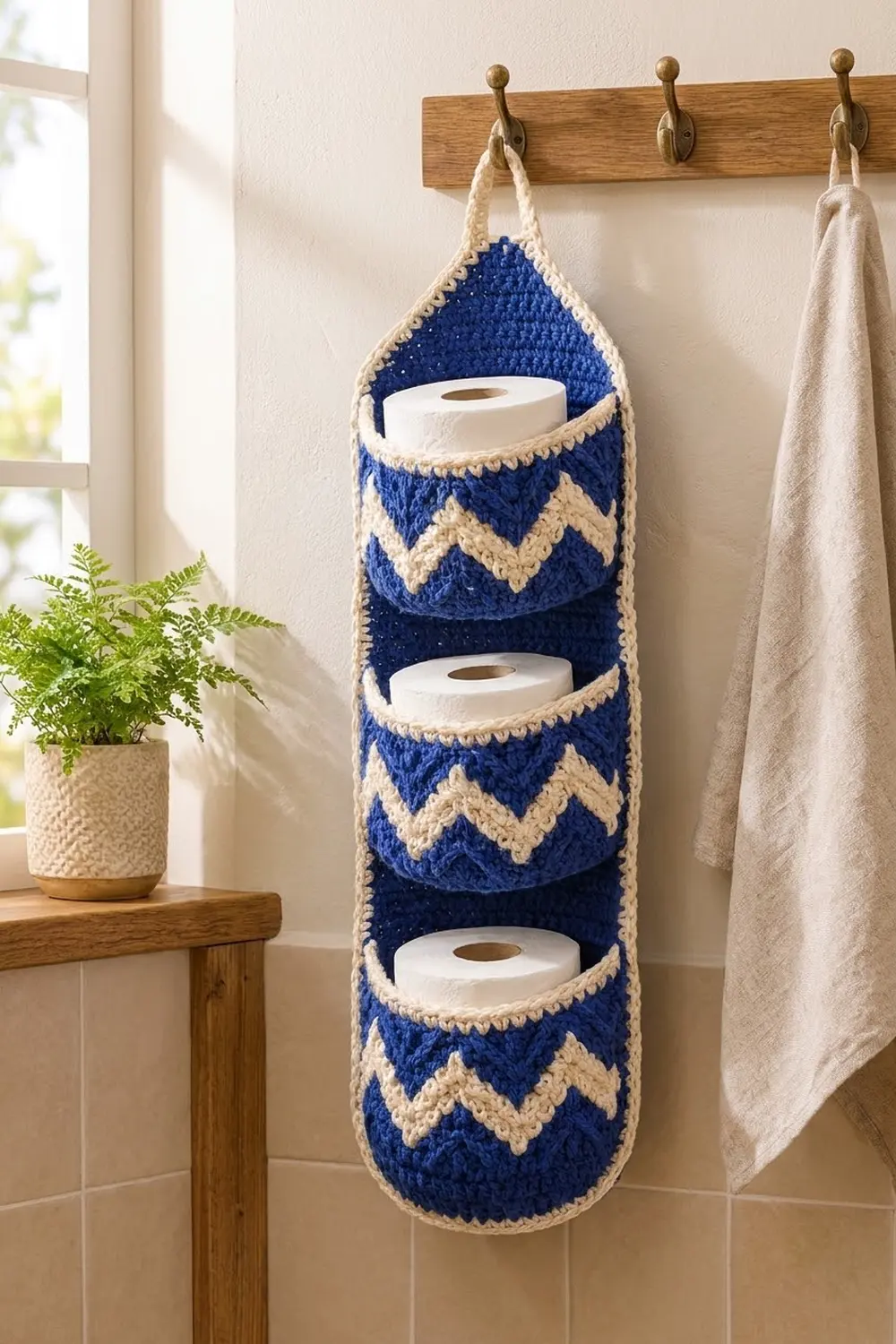
This hanging holder stores three spare toilet rolls in a narrow strip of wall space. A tall cobalt-blue panel hangs from a cream loop. Three round pocket baskets are sewn to its front, one above the other, and each one holds a single roll.
The colors are cobalt blue and cream. Each pocket has two cream zigzag bands and a crunchy cream rim, and the same rope-like cream edge runs around the whole panel. The look is clean and a little nautical, so it suits white or wood bathrooms.
The pattern uses US crochet terms throughout. The finished panel measures 7 in (17.8 cm) wide by 22.8 in (57.9 cm) tall. With the hanging loop, the full drop is 25.8 in (65.5 cm).
You make four pieces: one flat panel worked in rows and three pockets worked in joined rounds. You sew the pockets to the panel, add a two-round border around the panel, and finish with a chain loop.
Finished Size and Construction
- Finished size: 7 in × 22.8 in (17.8 cm × 57.9 cm), plus a 3 in (7.6 cm) loop
- Skill level: Intermediate (tapestry color changes, reverse single crochet)
- Terminology: US
- Yarn weight: Worsted / medium (#4)
- Hook: 5.0 mm (H-8)
- Number of pieces: 4 (1 panel, 3 pockets)
- Layout: 1 column of 3 pockets stacked on the panel
- Pocket size: 5 in × 4.5 in (12.7 cm × 11.4 cm) base, 4 in (10.2 cm) wall height
- Panel size before border: 6 in × 21.8 in (15.2 cm × 55.4 cm)
- Border depth: 0.5 in (1.3 cm) on every edge
Materials
Use a firm worsted cotton or cotton blend so the pockets hold their shape when loaded. Soft acrylic also works, but the pockets will sag a little more.
- Cobalt blue (Color A): 220 g, about 400 m
- Cream (Color B): 100 g, about 180 m
- 5.0 mm (H-8) crochet hook
- Tapestry needle
- 6 locking stitch markers
- Rust-proof pins and a blocking mat
- Scissors and measuring tape
These quantities include a margin of about 20% for swatching and tension differences.
Abbreviations (US Terms)
- ch – chain
- sc – single crochet
- sl st – slip stitch
- st(s) – stitch(es)
- inc – 2 sc in the same stitch
- sc2tog – single crochet 2 together
- BLO – back loop only
- rev sc – reverse single crochet (crab stitch): working left to right, insert the hook in the next stitch to the right, yarn over, pull up a loop, yarn over, and pull through both loops
- Rnd – round
- A / B – Color A / Color B
Tapestry color change: Work the last sc before a color change until 2 loops remain on the hook, then finish it with the new color. Carry the unused color along the top of the previous round and work over it.
Gauge and Checkpoints
Gauge: 16 sc × 18 rows = 4 in (10.2 cm) in plain sc.
Make one pocket first, because it also works as a gauge test for the tapestry rounds. Check it against these measurements:
- Pocket base, after Rnd 4 (36 sts): about 3 in × 2.5 in (7.6 cm × 6.4 cm)
- Pocket base, after Rnd 7 (60 sts): about 5 in × 4.5 in (12.7 cm × 11.4 cm)
- Pocket wall, after Rnd 25: 4 in (10.2 cm) tall
- Panel, after Row 5: 6 in (15.2 cm) wide, 1.1 in (2.8 cm) tall
- Panel, after Row 90: 20 in (50.8 cm) tall
If your pieces come out too big, go down 0.5 mm in hook size. If they come out too small, go up 0.5 mm. Tapestry rounds often tighten, so if only the walls run small, go up 0.5 mm for the walls only.
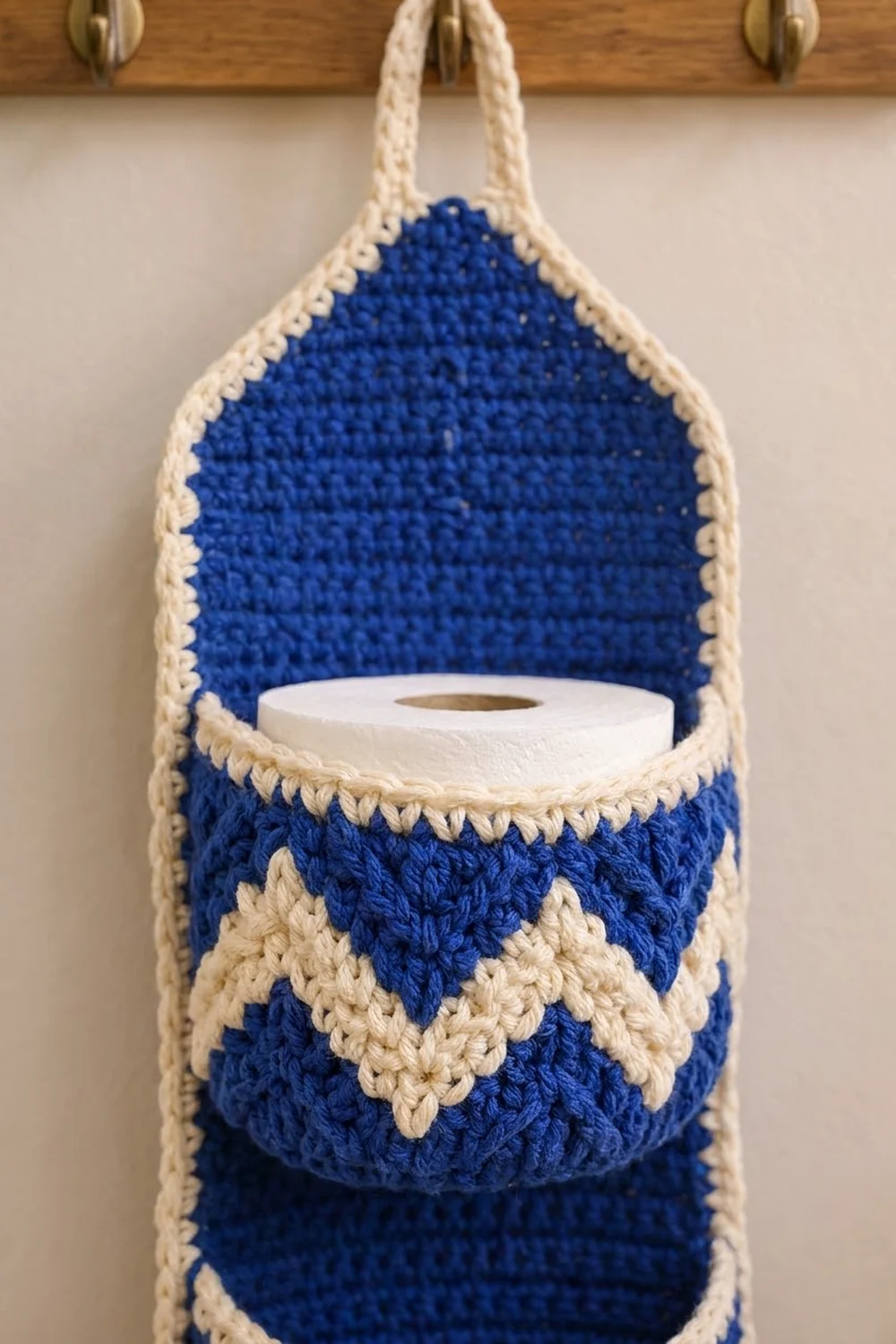
Backing Panel
The panel is worked in rows of sc with Color A. Rows 1–5 round off the bottom corners, and Rows 91–98 shape the top dome.
Ch 17.
Row 1: Sc in 2nd ch from hook and in each ch across. (16 sts)
Row 2: Ch 1, turn, inc in first st, sc across to last st, inc in last st. (18 sts)
Rows 3–5: Repeat Row 2. (20, 22, 24 sts)
Checkpoint: 6 in (15.2 cm) wide.
Rows 6–90: Ch 1, turn, sc in each st across. (24 sts per row, 85 rows)
Checkpoint: 20 in (50.8 cm) tall.
Row 91: Ch 1, turn, sc2tog, sc across to last 2 sts, sc2tog. (22 sts)
Rows 92–98: Repeat Row 91. (20, 18, 16, 14, 12, 10, 8 sts)
Fasten off.
The panel is now 98 rows, 21.8 in (55.4 cm) tall. The top edge is 2 in (5.1 cm) wide, and the dome is 1.8 in (4.6 cm) tall.
Pocket (Make 3)
Base
Use Color A. Work in joined rounds: join each round with a sl st to the first sc, then ch 1 (the ch 1 does not count as a stitch).
Ch 5.
Rnd 1: 2 sc in 2nd ch from hook, sc in next 2 ch, 4 sc in last ch. Working along the other side of the chain, sc in next 2 ch, then 2 sc in the same ch as the first sts. (12 sts)
Rnd 2: [inc] 2 times, sc 2, [inc] 4 times, sc 2, [inc] 2 times. (20 sts)
Rnd 3: [sc 1, inc] 2 times, sc 2, [sc 1, inc] 4 times, sc 2, [sc 1, inc] 2 times. (28 sts)
Rnd 4: [sc 2, inc] 2 times, sc 2, [sc 2, inc] 4 times, sc 2, [sc 2, inc] 2 times. (36 sts)
Rnd 5: [sc 3, inc] 2 times, sc 2, [sc 3, inc] 4 times, sc 2, [sc 3, inc] 2 times. (44 sts)
Rnd 6: [sc 4, inc] 2 times, sc 2, [sc 4, inc] 4 times, sc 2, [sc 4, inc] 2 times. (52 sts)
Rnd 7: [sc 5, inc] 2 times, sc 2, [sc 5, inc] 4 times, sc 2, [sc 5, inc] 2 times. (60 sts)
Each growth round adds exactly 8 sts.
Walls
Rnd 8: Sc in BLO of each st. (60 sts)
This round makes a crisp fold line between the base and the wall.
Rnd 9: Sc in each st. (60 sts)
Rnds 10–15 (zigzag band 1): Join Color B. Work the chart below 6 times around in each round, always reading from right to left. Every round has 60 sts.
| Rnd | 10-st repeat |
|---|---|
| 15 | B1, A8, B1 |
| 14 | B2, A6, B2 |
| 13 | A1, B2, A4, B2, A1 |
| 12 | A2, B2, A2, B2, A2 |
| 11 | A3, B4, A3 |
| 10 | A4, B2, A4 |
Rnd 16: With A, sc in each st. (60 sts)
Rnds 17–22 (zigzag band 2): Repeat Rnds 10–15. (60 sts per round)
Rnd 23: With A, sc in each st. (60 sts) Fasten off A.
Rnd 24: With B, sc in each st. (60 sts)
Rnd 25: With B, rev sc in each st. (60 sts)
Fasten off and leave a 24 in (61 cm) tail for sewing.
Checkpoint: the wall is 18 rounds (Rnds 8–25), which is 4 in (10.2 cm) tall.
Mark the back of the pocket: Place markers in Rnd 25 sts 51 and 10, and in the front loops of Rnd 8 at sts 51 and 10. This marks 20 back sts (sts 51–60 plus sts 1–10), centered on the round joins so the color jog hides against the panel.
Make All Pieces
- Panel: 1, in Color A
- Pockets: 3, each in Color A with Color B bands and rim
Layout, from the top of the panel down (rows are counted from the bottom):
   [ loop ]
   [ dome      Rows 91–98 ]
   [ open      Rows 78–90 ]
   [ POCKET 3  Rows 59–77 ]
   [ open      Rows 51–58 ]
   [ POCKET 2  Rows 32–50 ]
   [ open      Rows 24–31 ]
   [ POCKET 1  Rows 5–23  ]
   [ curve     Rows 1–4   ]
Joining
The pockets are 27 rows, or 6 in (15.2 cm), apart. Each open gap is 8 rows, about 1.8 in (4.6 cm). That leaves room for the top of the roll below and space for your fingers.
- Lay the panel right side up and mark Rows 5, 23, 32, 50, 59, and 77.
- Pocket 1 rim: line up the 20 marked back sts of Rnd 25 with panel sts 3–22 of Row 23. That leaves 2 panel sts free on each side. Whipstitch 1 rim st to 1 panel st, 20 sts total.
- Pocket 1 base: whipstitch the 20 marked Rnd 8 front loops to sts 3–22 of Row 5, again 1 to 1.
- Repeat steps 2–3 for Pocket 2 (Rows 50 and 32) and Pocket 3 (Rows 77 and 59).
Each pocket’s back wall is 18 rounds tall and covers exactly 18 panel rows, so it lies flat without bunching. The other 40 sts of each pocket, 10 in (25.4 cm) of rim, curve forward to hold the roll.
Sew with firm, even tension. Pull each stitch snug but do not pucker the panel. Weave the tail through the back wall to finish.
Checkpoint: the panel still measures 6 in × 21.8 in (15.2 cm × 55.4 cm) when laid flat.
Border
The border uses the same gauge, 16 sc × 18 rows = 4 in (10.2 cm). Work 1 sc into each row end, which is the standard rate for sc fabric, and keep the pockets folded out of the way. They sit within panel sts 3–22, so all edge stitches stay free.
Rnd 1: Join B at the right corner of the top edge (Row 98).
- Top edge: 2 sc in the first st, sc in the next 6 sts, 2 sc in the last st. (10 sts)
- Left side: 1 sc in each row end, 98 row ends. (98 sts)
- Bottom edge, along the foundation chain: 2 sc in the first st, sc in the next 14 sts, 2 sc in the last st. (18 sts)
- Right side: 1 sc in each row end. (98 sts)
Join. (224 sts)
Rnd 2: Ch 1, rev sc in each st around. Join. (224 sts: top 10, sides 98 each, bottom 18)
Why the math works: Each long side has 98 row ends, from Row 1 to Row 98, so each side gets 98 sc. That includes the curved bottom rows and the slanted dome rows. The top edge and bottom edge each get 1 sc per stitch plus 2 increases, one at each point where the edge turns, which gives 8 + 2 = 10 and 16 + 2 = 18. That makes 10 + 98 + 18 + 98 = 224. Rev sc works 1 into 1, so Rnd 2 keeps the same count.
Hanging loop: Join B in the 4th st of the top edge. Ch 24, then sl st in the 7th st of the top edge. Ch 1, turn, sc in each ch (24 sc), then sl st in the 4th st. Fasten off.
The 6 in (15.2 cm) cord folds into a 3 in (7.6 cm) loop.
Checkpoint: the panel measures 7 in × 22.8 in (17.8 cm × 57.9 cm).
Final Blocking
- Weave in all ends inside the pockets or along the back of the panel.
- Lightly mist the whole piece with water.
- Pin the panel to 7 in × 22.8 in (17.8 cm × 57.9 cm). Ease the dome and the bottom corners into smooth curves.
- Stuff each pocket with a toilet roll or rolled towel so the round shape sets.
- Steam the rims gently without touching the yarn with the iron. Skip this step for acrylic, or use very light steam only.
- Let everything dry completely, then unpin.
Final Quality-Control Checklist
- The panel has 98 rows and 24 sts across at its widest.
- Each pocket has 60 sts in every wall round and two full zigzag bands.
- The color jogs face the panel.
- Each pocket is sewn at both its rim and its base, 20 sts each.
- The pockets are centered with 2 panel sts free on each side.
- Border Rnd 1 has 224 sts and Rnd 2 has 224 rev sc.
- The loop is firmly anchored to 4 border sts.
- The finished size is 7 in × 22.8 in (17.8 cm × 57.9 cm).
Troubleshooting
- Zigzag looks slanted: You are working spiral rounds. Join every round with a sl st and restart the chart at stitch 1.
- Cream shows through the blue: Carry the unused color tighter, and twist the strands at each change.
- Pocket too tight for the roll: Go up 0.5 mm in hook size for the base and walls.
- Border ruffles: Your rows are taller than gauge. Skip 1 row end in every 9.
- Border cups: Use a hook 0.5 mm larger for Rnd 1.
- Pocket gapes at the sides: Add 2 extra whipstitches at each end of the rim seam.
Care
Hand wash in cool water, press out the water in a towel, and dry flat with rolls inside the pockets. Do not tumble dry.
Final Notes
The measurement chain is:
- Gauge: 16 sc × 18 rows = 4 in (10.2 cm)
- Pocket: 60-st round, 4 in (10.2 cm) wall
- Panel: 24 sts × 98 rows = 6 in × 21.8 in (15.2 cm × 55.4 cm)
- Pockets stacked every 27 rows, 6 in (15.2 cm) apart
- Border: 224 sts, 0.5 in (1.3 cm) deep
- Finished: 7 in × 22.8 in (17.8 cm × 57.9 cm)
Check gauge first and the rest of the numbers will follow.
Happy crocheting!