

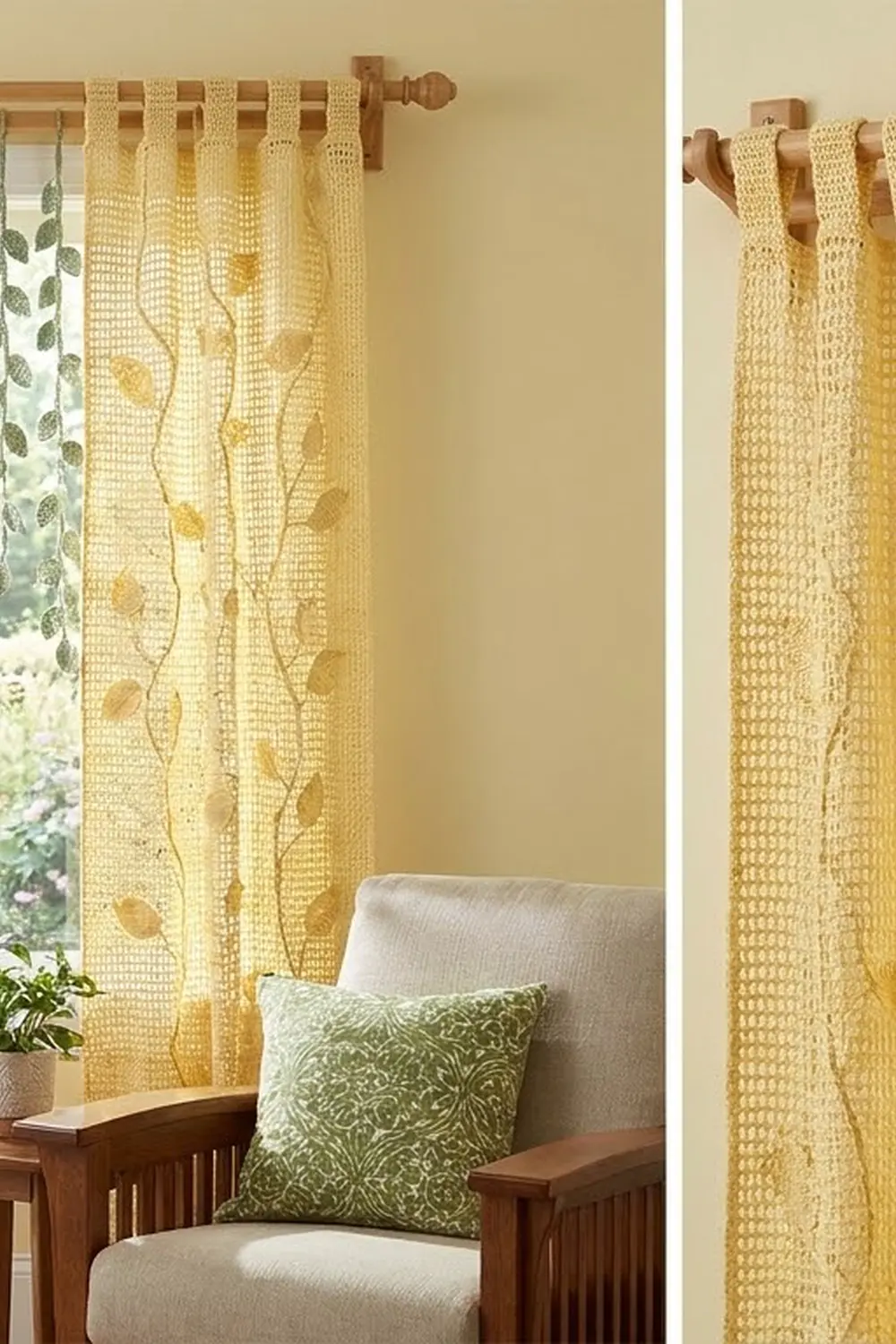
These curtains put a garden in your window. Two butter-yellow filet mesh panels frame the window, and each one carries sculpted leaves along wavy stems. Six sage-green leaf vines hang between the panels and move a little when the window is open.
The look is soft and cottage-style. All of the leaves are tone-on-tone yellow on the panels, and only the hanging vines are green, so the set reads like sunlight with greenery in front of it. Light comes through the mesh and the gaps between the vines.
This pattern uses US crochet terms. Each finished panel is 17 x 77 in (43.2 x 195.6 cm), not counting the tabs. Each vine stem is 76 in (193.0 cm) long, not counting its hanging loop.
Here is the construction in brief. Each panel is a filet mesh rectangle with a 2-round single crochet border and five tab loops. Large leaves and stem cords are crocheted separately and sewn on. The vines are made in one long piece each: a chain stem with leaves worked off it as you go. None of the main pieces are joined to each other. Each one hangs from the rod on its own.
Finished Size and Construction
- Finished panel size: 17 x 77 in (43.2 x 195.6 cm) plus 3 in (7.6 cm) tab loops
- Panel size before border: 16 x 76 in (40.6 x 193.0 cm)
- Border depth: 0.5 in (1.3 cm) on every side
- Vine length: 76 in (193.0 cm) of stem plus a hanging loop
- Skill level: Intermediate
- Terminology: US
- Yarn weight: Worsted (#4 medium) cotton or cotton blend
- Hook: 5.0 mm (H-8)
- Number of pieces: 2 panels and 6 vines (8 hanging pieces), plus 56 leaf appliqués and 4 stem cords sewn onto the panels
- Layout: Panel | 6 vines | Panel, on a double rod (panels in front, vines behind)
Materials
Use a smooth, mercerized or matte cotton worsted yarn. Cotton holds the leaf shapes, blocks flat, and stretches less than acrylic over a long drop. The quantities below assume about 180 m per 100 g.
- Butter yellow: 1,500 g / 2,700 m (panels, tabs, leaves and stems)
- Sage green: 450 g / 810 m (six vines)
All quantities include a margin of about 10% for gauge swatches and tails.
Tools:
– 5.0 mm (H-8) crochet hook
– Tapestry needle
– Locking stitch markers
– Rustproof pins
– Measuring tape
– Blocking mats or a clean carpet and towel
– Spray bottle
Abbreviations (US Terms)
- ch – chain
- sl st – slip stitch
- sc – single crochet
- hdc – half double crochet
- dc – double crochet
- tr – treble crochet
- st(s) – stitch(es)
- sp – space
- RS / WS – right side / wrong side
Mesh square: This is 1 dc post plus ch 2. Each square counts as 3 sts. A row of 20 squares has 21 dc posts and 20 ch-2 spaces, which is 61 sts.
Surface slip stitch: Hold the yarn on the WS. Insert the hook from the RS through the fabric, pull up a loop, and draw it through the loop on your hook. This makes a raised line of chain-like stitches on the RS.
Gauge and Checkpoints
Mesh gauge: 5 mesh squares and 5 rows = 4 in (10.2 cm), so each square and each row is 0.8 in (2.0 cm).
Border gauge: 15 sc = 4 in (10.2 cm), and 4 sc rows = 1 in (2.5 cm).
Chain gauge (vines): 7 ch = 2 in (5.1 cm), measured relaxed.
Make your first large leaf and your first 10 rows of panel before you commit to the full project.
Checkpoints:
– Panel Row 1 (61 sts): 16 in (40.6 cm) wide.
– After 10 rows: 8 in (20.3 cm) tall.
– After 95 rows: 76 in (193.0 cm) tall before the border.
– After Border Round 2: 17 x 77 in (43.2 x 195.6 cm).
– Large leaf: 3.5 x 1.75 in (8.9 x 4.4 cm).
– Small vine leaf: 2.25 x 1 in (5.7 x 2.5 cm).
– Vine after 10 segments: 20 in (50.8 cm) of stem.
If your piece is too big, go down 0.5 mm. If it is too small, go up 0.5 mm. Don’t change the stitch counts, because the border and tab math depends on them.
Panel (Make 2)
Use yellow.
Foundation: Ch 63.
Row 1 (RS, solid): Dc in the 4th ch from hook and in each ch across. The skipped 3 ch count as the first dc. Turn. (61 sts)
Row 2 (mesh): Ch 5 (counts as dc + ch 2). Skip the next 2 sts and dc in the next st. Ch 2, skip 2 sts, dc in the next st. Repeat from * across, working the last dc in the top of the turning ch. Turn. (20 squares = 61 sts)
Rows 3–94: Ch 5 (counts as dc + ch 2). Dc in the next dc, ch 2. Repeat from * across, ending with a dc in the 3rd ch of the turning ch-5. Turn. (20 squares = 61 sts in every row)
Check your progress at Row 10: the panel should be 8 in (20.3 cm) tall. At Row 50 it should be 40 in (101.6 cm) tall.
Row 95 (solid): Ch 3 (counts as dc). Work 2 dc in the next ch-2 sp, dc in the next dc. Repeat from * across, working the last dc in the 3rd ch of the turning ch. Count: (21 dc posts worked 1 per post) + (20 × 2 dc in the spaces) = 61 sts. Don’t fasten off.
The panel now measures 16 x 76 in (40.6 x 193.0 cm) and has 95 rows.
Border (Each Panel)
The border uses the sc gauge of 15 sc = 4 in (10.2 cm), which is 3.75 sc per inch.
Round 1: Ch 1. Work 3 sc in the first st (corner). Sc in each of the next 59 sts, then work 3 sc in the last st (corner). Now work down the long side. The end of Row 95 is already covered by the corner group, so work 3 sc into the end of each row from Row 94 down to Row 2. That’s 93 rows × 3 = 279 sc. Work 3 sc in the first st of Row 1 (corner). Along the foundation ch, sc in each of the next 59 ch, then work 3 sc in the last ch (corner). Work 3 sc into the end of each row from Row 2 up to Row 94 (279 sc). Join with a sl st to the first sc.
Round 1 counts:
– Short sides: 59 sc between the corner groups.
– Long sides: 279 sc between the corner groups.
– Corners: 4 groups of 3 sc.
– Total: (2 × 59) + (2 × 279) + 12 = 688 sc.
Round 2: Ch 1. Sc in each st around, working 3 sc in the center sc of each corner group. Join.
Each side gains 2 sc, because the outer sc of each Round 1 corner group now count as side stitches.
Round 2 counts:
– Short sides: 61 sc between corner centers.
– Long sides: 281 sc between corner centers.
– Corners: 4 groups of 3 sc.
– Total: (2 × 61) + (2 × 281) + 12 = 696 sc. This matches 688 + 8 = 696.
Why the math works: The top edge has 61 sts over 16 in (40.6 cm), which is 3.8 sts per inch. That’s very close to the 3.75 sc border gauge, so the edge lies flat. On the long sides, the 93 middle rows are 74.4 in long, and 74.4 × 3.75 = 279 sc, so 3 sc per row matches the gauge exactly. The two sc rounds add 0.25 in per round, so each edge gains 0.5 in (1.3 cm) of border. That makes the panel 17 x 77 in (43.2 x 195.6 cm).
Tab Loops
Along the top edge, Round 2 has 63 positions: 61 side sts plus 2 corner centers. Number them 1–63 from right to left.
You’ll make 5 tabs of 7 sts each, at sts 1–7, 15–21, 29–35, 43–49 and 57–63. That leaves 4 gaps of 7 sts. Check the math: (5 × 7) + (4 × 7) = 63.
Each tab: Join yellow in the first st of the tab.
– Row 1: Ch 1, sc in the same st and the next 6 sts. Turn. (7 sc)
– Rows 2–24: Ch 1, sc in each st. Turn. (7 sc)
Fasten off and leave a 12 in (30.5 cm) tail. Each tab is 6 in (15.2 cm) long and about 1.9 in (4.8 cm) wide. Fold it to the WS and whipstitch the last row to the base of Round 1. This makes a 3 in (7.6 cm) loop.
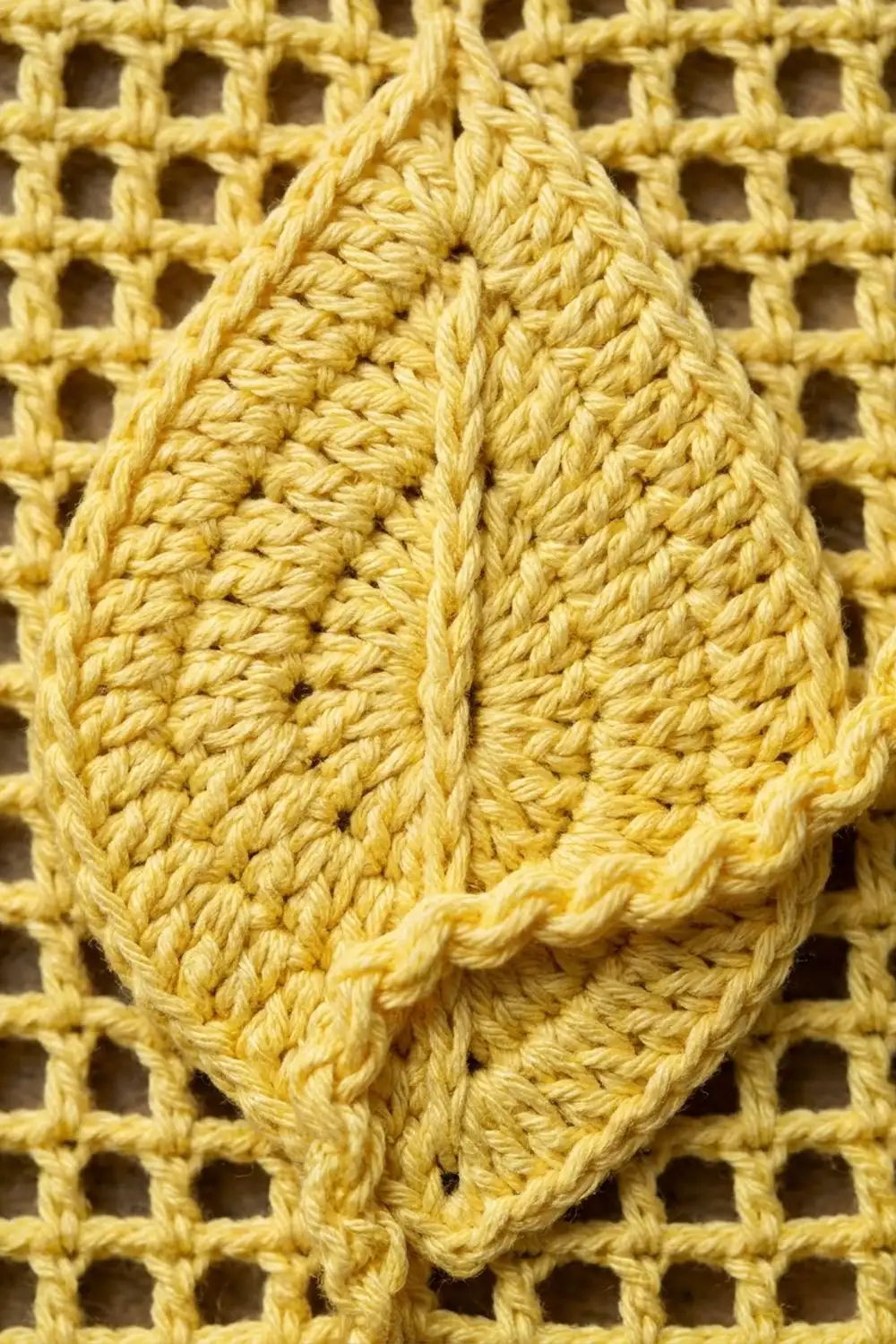
Large Leaf (Make 56: 28 per Panel)
Use yellow.
Foundation: Ch 12.
Round 1: Working into the chain, sc in the 2nd ch from hook, hdc in the next ch, dc in the next 2 ch, tr in the next 3 ch, dc in the next 2 ch, and hdc in the next ch. That’s 10 sts along the first side. Work 3 sc in the last ch (tip).
Rotate the leaf and work along the opposite loops of the chain: hdc in the next ch, dc in the next 2 ch, tr in the next 3 ch, dc in the next 2 ch, hdc in the next ch, and sc in the last ch. That’s 10 sts along the second side. Join with a sl st to the first sc.
Total: 10 + 3 + 10 = 23 sts.
Round 2: Ch 1. Sc in each of the first 11 sts. In the center sc of the tip, work (sc, ch 2, sc). Sc in each of the remaining 11 sts. Join.
Count: (22 sts worked 1 per st) + (2 sc in the tip st) = 24 sc and 1 ch-2 point.
Vein: With the RS facing, surface slip stitch from the base to the tip along the center chain. Fasten off and leave a 10 in (25.4 cm) tail for sewing.
The tr stitches make a raised center and the ch-2 makes a sharp tip. Each leaf measures 3.5 x 1.75 in (8.9 x 4.4 cm).
Stem Cord (Make 4: 2 per Panel)
Use yellow.
Ch 294. Sl st in the back bump of the 2nd ch from hook and of each ch across. (293 sl sts)
The cord is about 84 in (213.4 cm) long. That leaves extra length for the curves.
Green Vine (Make 6)
Use green. Each vine is one continuous piece.
Hanging loop: Ch 20 and sl st in the first ch to form a ring.
Segment (repeat 38 times):
1. Stem: Ch 7.
2. Leaf: Ch 9.
– Sc in the 2nd ch from hook (this is the tip), hdc in the next ch, dc in the next 3 ch, hdc in the next ch, sc in the next ch, and sl st in the last ch (the base). (8 sts)
– Rotate and work into the opposite loops, toward the tip: sc in the next ch, hdc in the next ch, dc in the next 3 ch, hdc in the next ch, and sc in the next ch. (7 sts)
– Ch 2 and sl st in the first sc to make the tip point.
– Surface slip stitch down the center of the leaf to the base to make the vein. (7 sl sts)
3. Turn the vine over so the next leaf falls on the opposite side.
Each leaf has 15 sts plus a ch-2 point.
Checkpoint: After 10 segments, the stem should be 20 in (50.8 cm) long. After 38 segments, it should be 76 in (193.0 cm), with a leaf at the bottom tip.
Fasten off and weave in the ends along the stem.
Make All Pieces
Yellow:
– 2 panels with border and 5 tabs each
– 56 large leaves
– 4 stem cords
Green:
– 6 vines, each with 38 leaves (228 small leaves in total)
Rod layout, seen from the front:
Front rod:  [PANEL 17 in] ................................ [PANEL 17 in]
Back rod:              | V | V | V | V | V | V |
                        (vines about 3 in / 7.6 cm apart)
Joining (Appliqué Assembly)
The panels, vines and rod pieces are never sewn to each other. Joining only means attaching the leaves and stems to each panel.
- Lay the panel flat with the RS up.
- Pin 2 stem cords in gentle S-curves from hem to top. Keep each cord about 4 squares in from its long edge, and let the cords cross near the center now and then.
- Along each cord, place 14 leaves, alternating left and right, about 5.4 in (13.7 cm) apart. Tilt each leaf about 30° up from the stem.
- Layer the pieces in this order: mesh, then leaf, then stem. Tuck each leaf’s base under the cord so the cord covers it.
- Whipstitch each leaf’s Round 2 edge to the mesh posts underneath, catching every second sc. Then stitch the cord down along its center every 0.5 in (1.3 cm).
Tension: Sew loosely enough that the mesh stays flat under each leaf. If you pull too tight, the mesh will pucker and the panel will get shorter.
Size checkpoint: When the panel is fully appliquéd and laid flat, it should still measure 17 x 77 in (43.2 x 195.6 cm).
Final Blocking
- Lay the panel RS up on mats.
- Pin the corners to 17 x 77 in (43.2 x 195.6 cm).
- Pin the long edges every 4 in (10.2 cm) and keep them straight.
- Spray until the panel is damp.
- Shape each leaf tip to a point and press the veins with your fingers.
- Let it dry completely.
- For the vines, wet each one, lay it straight at 76 in (193.0 cm), flatten each leaf, and let it dry flat.
Final Quality-Control Checklist
- Each panel is 61 sts wide, 95 rows tall, and has 696 border sc.
- Each panel is 17 x 77 in (43.2 x 195.6 cm), and the edges are straight.
- 5 tabs per panel, each 3 in (7.6 cm) when folded, with matching gaps.
- 28 leaves per panel, all secure, with no puckering.
- Each vine has 38 leaves on alternating sides.
- All vines are the same length, within 1 in (2.5 cm).
- All ends are woven in.
Troubleshooting
- Panel is narrower at the top than at the hem: Your tension tightened as you went. Check every 10 rows against 8 in (20.3 cm).
- Border ruffles: Work 2 sc per row end on the worst sections and rework, keeping the total even on both sides.
- Border pulls in: Go up a hook size for the border only.
- Leaves curl: Block them again and pin the tips.
- Vines stretch when hanging: Cotton chains relax with weight. Block and hang them for 24 hours, then remove segments from the bottom if needed.
- Mesh puckers under leaves: Snip the stitching and resew it more loosely.
Care
Hand wash cold and lay flat to dry, reshaping the leaves. Don’t hang the pieces wet, or the panels and vines will stretch.
Final Notes
Every measurement in this pattern comes from one gauge: 5 squares = 4 in (10.2 cm). That gives 61 sts across 16 in (40.6 cm) and 95 rows down 76 in (193.0 cm). Two sc rounds add 0.5 in (1.3 cm) per side, for a finished panel of 17 x 77 in (43.2 x 195.6 cm). The vine segments are 2 in (5.1 cm) each, and 38 of them match the 76 in (193.0 cm) panel body. If you check each stage as you go, the whole set will hang evenly.
Happy crocheting!