

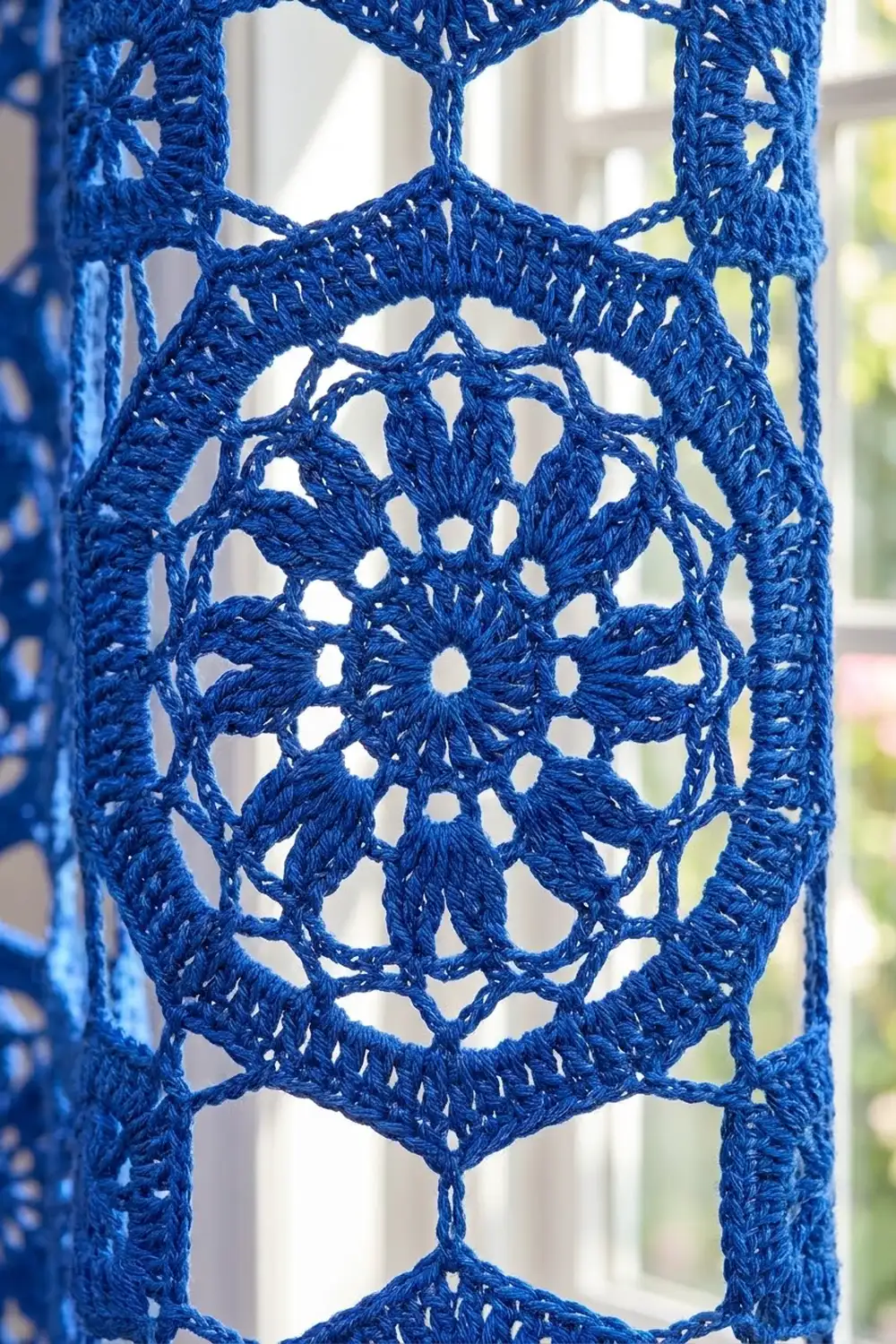
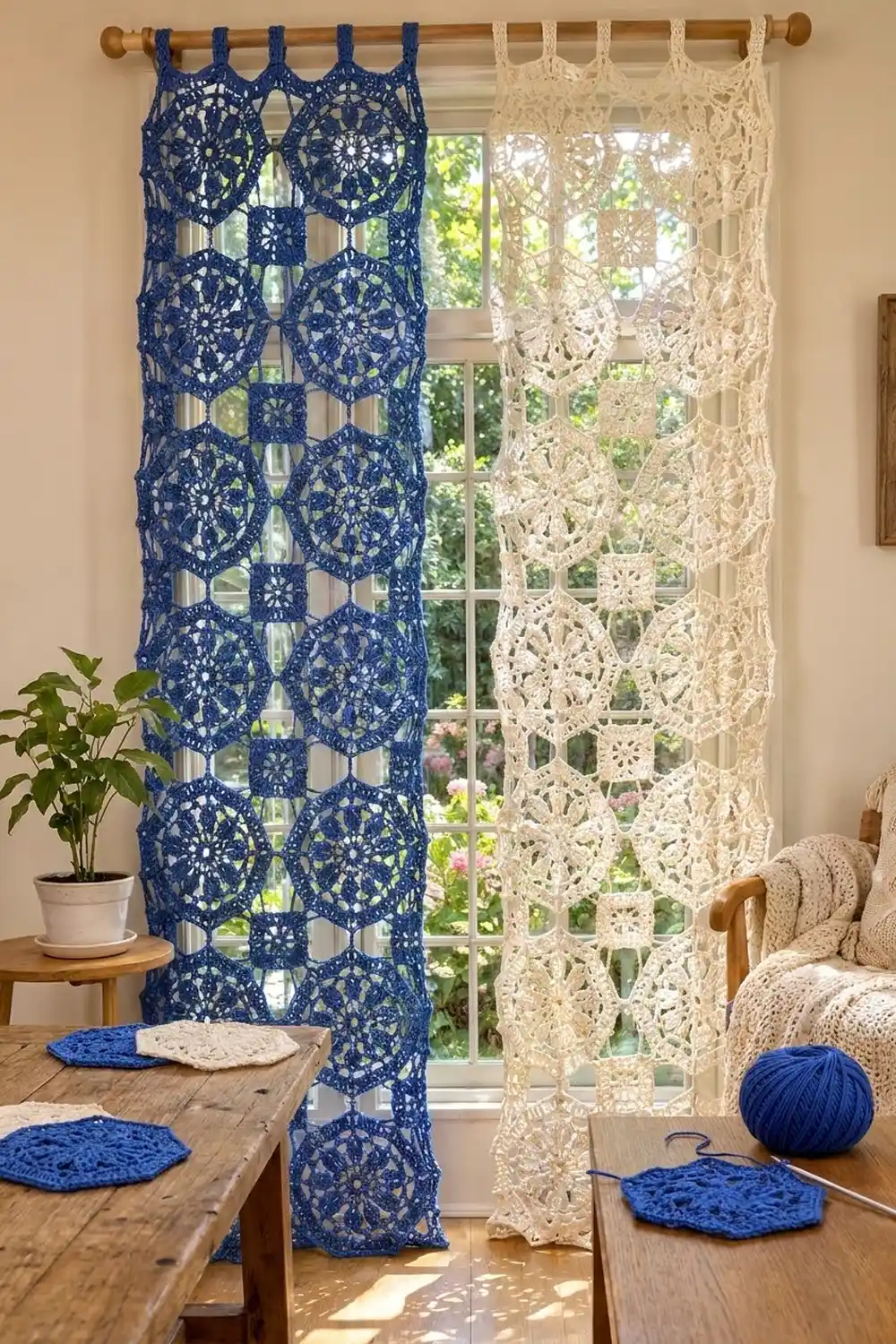
Delft Window is a pair of lace curtain panels made from joined octagon motifs. In each octagon a flower of eight V-shaped petals sits inside a firm double crochet frame. Small solid squares fill the gaps where four octagons meet, so sunlight comes through in a regular pattern of open loops and solid shapes.
The sample pair uses one cobalt blue panel and one cream panel, in the style of Delft tiles with a clean farmhouse look. You can also make both panels in the same color. Every instruction uses US crochet terms.
Each finished panel measures about 19.25 in × 64.25 in (48.9 cm × 163.2 cm), not counting the tabs. Each panel has fourteen octagons set 2 across and 7 down, plus six small squares, a three-round border and five tabs for hanging.
You make the octagons and squares one at a time, join them flat with slip stitch, add the border and then work the tabs straight onto the top edge.
Finished Size and Construction
- Finished panel: 19.25 in × 64.25 in (48.9 cm × 163.2 cm), plus tabs
- Skill level: Intermediate
- Terminology: US
- Yarn weight: Worsted (#4) cotton or cotton blend
- Hook: 5 mm (H-8)
- Pieces per panel: 14 octagons + 6 squares (tabs are worked onto the panel)
- Layout: 2 octagons across × 7 down, with squares in the 6 inside gaps
- Octagon: 9 in (22.9 cm) across the flat sides, each side 3.75 in (9.5 cm)
- Square: 3.75 in × 3.75 in (9.5 cm × 9.5 cm)
- Size before border: 18 in × 63 in (45.7 cm × 160.0 cm)
- Border depth: 5/8 in (1.6 cm) on each side
Materials
Choose a smooth mercerized cotton or a cotton-linen blend. It shows the stitches clearly, keeps its shape when hanging and holds up to sunlight better than acrylic.
Per pair of panels:
– Color A, cobalt blue: 450 g / 765 m
– Color B, cream: 450 g / 765 m
These amounts include a margin of about 15–20% for swatching, gauge differences and joining.
Tools:
– 5 mm (H-8) crochet hook
– Tapestry needle
– Stitch markers
– Rust-proof pins and a blocking mat or large towel
– Tape measure
– Spray bottle
Abbreviations (US Terms)
- ch – chain
- sl st – slip stitch
- sc – single crochet
- dc – double crochet
- sp(s) – space(s)
- st(s) – stitch(es)
- RS / WS – right side / wrong side
- BLO – back loop only
Special stitches:
– Cluster (cl): Yarn over, insert the hook in the stitch or space, pull up a loop, yarn over and pull through 2 loops. Repeat from * to * 2 more times in the same place (4 loops on the hook). Yarn over and pull through all 4 loops.
– Beginning cluster (beg cl): Ch 2, then work the cluster steps 2 times only (3 loops on the hook). Yarn over and pull through all 3 loops.
Gauge and Checkpoints
Gauge: 16 sc and 18 rows = 4 in (10.2 cm) in single crochet.
Make one octagon before you do anything else. It tells you more about gauge than a flat swatch does.
Octagon checkpoints:
– After Round 1: about 2.25 in (5.7 cm) across
– After Round 3: about 5.25 in (13.3 cm) across
– After Round 6: about 8.5 in (21.6 cm) across the flat sides
– After Round 7: 9 in (22.9 cm) across the flat sides, with each side 3.75 in (9.5 cm)
Square checkpoints:
– After Round 1: about 1.5 in (3.8 cm)
– After Round 2: about 2.4 in (6.1 cm)
– After Round 3: about 3.25 in (8.3 cm)
– After Round 4: 3.75 in (9.5 cm) per side
The side of the square must match the side of the octagon. If they differ by more than 1/8 in (0.3 cm), the squares will ripple or pull.
Too big? Go down half a hook size. Too small? Go up half a hook size. Change the hook size for both motifs together.
Octagon Motif (make 14 per panel)
Round 1: Make a magic ring. Ch 4 (counts as dc + ch 1). (Dc, ch 1) in the ring. Repeat from * to * 14 more times. Join with sl st to the 3rd ch of the beginning ch-4. (16 dc, 16 ch-1 sps) Pull the ring closed.
Round 2: Sl st into the first ch-1 sp. Work (beg cl, ch 3, cl) in the same sp, then ch 3 and skip the next ch-1 sp. (Cl, ch 3, cl) in the next ch-1 sp, ch 3, skip the next ch-1 sp. Repeat from * to * 6 more times. Join with sl st to the top of the beg cl. (16 cl in 8 V-shaped petals, 16 ch-3 sps)
Round 3: Sl st into the first ch-3 sp and ch 1. (Sc in the ch-3 sp, ch 4). Repeat from * to * in each ch-3 sp around. Join with sl st to the first sc. (16 sc, 16 ch-4 sps)
Round 4 (shaping round): This round turns the circle into an octagon. Each side uses 2 loops and the sc between them. The sc between sides is skipped under the corner chain.
Sl st into the first ch-4 sp. Ch 3 (counts as dc) and work 3 dc in the same sp. Dc in the next sc, 4 dc in the next ch-4 sp, ch 2, skip the next sc. 4 dc in the next ch-4 sp, dc in the next sc, 4 dc in the next ch-4 sp, ch 2, skip the next sc. Repeat from * to * 6 more times. Join to the top of the ch-3. (72 dc: 9 dc per side, 8 ch-2 corner sps)
Check the count: 8 sides × 2 loops = 16 loops, and 8 worked sc + 8 skipped sc = 16 sc.
Round 5: Ch 3 (counts as dc). Dc in the next 8 dc, then (dc, ch 2, dc) in the corner sp. Dc in the next 9 dc, (dc, ch 2, dc) in the corner sp. Repeat from * to * around. Join. (88 dc: 11 per side)
Each side now has 9 dc worked into the stitches below, plus 1 dc from the corner at each end.
Round 6: Repeat Round 5, working the dc across the 11 dc of each side. (104 dc: 13 per side)
Round 7 (edge round): Ch 1. Sc in each dc, and work (sc, ch 2, sc) in each corner sp. Join to the first sc. (120 sc: 15 per side, 8 ch-2 corner sps) Fasten off and weave in the ends.
The 15 stitches per side include the 2 corner sc on that side.
Square Motif (make 6 per panel)
Round 1: Make a magic ring. Ch 3 (counts as dc), 4 dc in the ring, ch 2. 5 dc in the ring, ch 2. Repeat from * to * 2 more times. Join to the top of the ch-3. (20 dc: 5 per side, 4 ch-2 corner sps)
Round 2: Ch 3 (counts as dc). Dc in the next 4 dc, then (2 dc, ch 2, 2 dc) in the corner sp. Dc in the next 5 dc, (2 dc, ch 2, 2 dc) in the corner sp. Repeat from * to * around. Join. (36 dc: 9 per side)
Round 3: Repeat Round 2, working across the 9 dc of each side. (52 dc: 13 per side)
Round 4: Ch 1. Sc in each dc, and work (sc, ch 2, sc) in each corner sp. Join. (60 sc: 15 per side) Fasten off, leaving a 24 in (61.0 cm) tail for joining.
Make All Pieces
For each panel, make:
– 14 octagons
– 6 squares
For the pair, make:
– Color A: 14 octagons + 6 squares
– Color B: 14 octagons + 6 squares
Lightly steam or wet-block each motif to its checkpoint size before joining.
Layout for one panel (O = octagon, s = square):
O   O
  s
O   O
  s
O   O
  s
O   O
  s
O   O
  s
O   O
  s
O   O
Joining
Method: Slip stitch join through the back loops, worked from the RS. Lay the two pieces RS up, edge to edge. Insert the hook through the BLO of a stitch on one piece and the matching stitch on the other piece, then sl st. This makes a flat seam with a slight ridge on the WS, and the RS stays smooth.
Stitch-to-stitch logic: Each octagon side and each square side has 15 sc, including its corner sc. Start each seam in the matching corner ch-2 sps. Join the 15 sc to the 15 sc, then finish in the next pair of corner ch-2 sps. Never skip a stitch and never work two stitches into one.
Order:
1. Join the octagons in pairs along one flat side to make 7 rows of 2.
2. Join the rows together, flat side to flat side, working down the panel. Where the corners of four octagons meet, a square-shaped gap is left, edged by four of the slanted octagon sides.
3. Set a square into each of the 6 gaps. Join each square side to one slanted octagon side, 15 sc to 15 sc, and go around all four sides (60 sc in total).
Tension: The seam should be the same length as the edges next to it. If it puckers, go up one hook size for joining only.
Size checkpoint: The joined panel lies flat at 18 in × 63 in (45.7 cm × 160.0 cm).
Border
Border gauge: 16 sc = 4 in (10.2 cm), the same as the motifs.
The outer edge is not straight. Between each pair of octagons there is a triangle-shaped notch, and there is a cut-off corner at each corner of the panel. Round 1 crosses these notches with chains to make a straight edge.
- Each triangle notch measures about 5.3 in (13.5 cm) across, so it gets ch 21.
- Each panel corner gets ch 23: 11 ch along each side plus 1 ch at the corner point.
Round 1: With the RS facing, join the yarn with sc in the first corner sc of the top flat side of the top-left octagon. Then work as follows:
- Top: Sc in the next 14 sc (15 sc on that flat side), ch 21, 15 sc across the flat side of the next octagon, ch 23 (corner bridge).
- Right side: 15 sc across the flat side, ch 21. Repeat from * to * 5 more times. Then 15 sc across the last flat side and ch 23.
- Bottom: Work as for the top, ending with ch 23.
- Left side: Work as for the right side, ending with ch 23. Join to the first sc.
Counts per section:
– Top and bottom: 15 + 21 + 15 = 51
– Each long side: (7 × 15) + (6 × 21) = 105 + 126 = 231
– Each corner bridge: 23
– Total: 656 sts
Round 2: Ch 1. Sc in each sc and in each ch. At each corner bridge: sc in the first 11 ch, (sc, ch 2, sc) in the 12th ch, sc in the last 11 ch. Join. Each corner adds 1 extra sc, so 656 + 4 = 660 sc.
- Each short side: 11 + 51 + 11 + 2 corner sc = 75
- Each long side: 11 + 231 + 11 + 2 corner sc = 255
- Check: (2 × 75) + (2 × 255) = 660 ✓
Round 3: Ch 1. Sc in each sc, and work (sc, ch 2, sc) in each corner sp. Join. 660 + 8 = 668 sc.
- Each short side: 77
- Each long side: 257
Fasten off.
Why the math works: Between the corner stitches, the top edge of Round 2 has 73 sts. At 4 sts per inch, that is 18.25 in (46.4 cm), which matches the 18 in (45.7 cm) edge plus the small step outward from Round 1. The long side has 253 sts between corners, which is 63.25 in (160.7 cm) against 63 in (160.0 cm). The chain bridges fit the notches, so the border lies flat without ruffling or pulling.
Tabs (make 5 per panel)
Number the 77 sts of the top edge from left to right. Stitch 1 is the top-left corner sc. Work the tabs over these stitches:
| Tab | Stitches |
|---|---|
| Tab 1 | 5–13 |
| Tab 2 | 20–28 |
| Tab 3 | 35–43 |
| Tab 4 | 50–58 |
| Tab 5 | 65–73 |
That leaves 4 sts at each end and 6 sts between tabs: 8 + (5 × 9) + (4 × 6) = 77 ✓.
Row 1: With the RS facing, join the yarn with sc in the first stitch of the tab, then sc in the next 8 sts. (9 sc)
Rows 2–24: Ch 1, turn, sc in each sc across. (9 sc)
Fasten off, leaving a 12 in (30.5 cm) tail. Fold the tab to the WS and whipstitch Row 24 to the back of Round 2, behind the base of the same tab.
Each tab is 2.25 in (5.7 cm) wide and 5.25 in (13.3 cm) long before folding. Folded, it makes a loop about 2.6 in (6.6 cm) tall that fits rods up to 1.5 in (3.8 cm) across.
Final Blocking
- Weave in all ends along the seams so they don’t show against the light.
- Soak the panel in cool water for 10 minutes, then squeeze out the water gently. Do not wring it.
- Roll the panel in towels to remove more water.
- Lay it flat and pin it to 19.25 in × 64.25 in (48.9 cm × 163.2 cm).
- Pin each corner bridge into a sharp right angle.
- Pin the centers of the octagons and squares so the lace opens evenly.
- Leave it to dry completely. Turn on a fan if the room is humid.
- Repeat for the second panel. Measure both panels against each other before unpinning.
Final Quality-Control Checklist
- [ ] 14 octagons and 6 squares in each panel
- [ ] Every octagon is 9 in (22.9 cm) across the flat sides
- [ ] Every seam joins 15 sc to 15 sc
- [ ] Border Round 3 has 77 sts on each short side and 257 sts on each long side
- [ ] Corners are square and the long edges are straight
- [ ] 5 tabs evenly spaced, each 9 sts wide
- [ ] The two panels match in length within 0.5 in (1.3 cm)
- [ ] No ends showing when you hold the panel up to the light
Troubleshooting
The octagon cups. Your Round 4 is probably tight. Loosen the dc, or use 5 dc in each ch-4 sp on that round only, then skip the extra stitches in Round 5.
The octagon ruffles. Your ch-4 loops in Round 3 are too long. Change them to ch 3.
Squares bulge in the gaps. The square is larger than the octagon sides. Work Round 4 of the square with a hook half a size smaller.
Border corners droop. Pull the ch-23 bridge slightly tighter in Round 2, and pin the corners firmly when blocking.
The tabs twist. Make sure you turn at the end of every row and that each row has exactly 9 sc.
Care
Hand wash in cool water with a mild detergent, and dry flat. Do not tumble dry. Re-block after washing to keep the panels square.
Final Notes
The measurement chain is simple. A 9 in (22.9 cm) octagon has 3.75 in (9.5 cm) sides. Each side matches a 3.75 in (9.5 cm) square, and the joined grid of 2 × 7 octagons measures 18 in × 63 in (45.7 cm × 160.0 cm). The border adds 5/8 in (1.6 cm) on each side, for a finished panel of 19.25 in × 64.25 in (48.9 cm × 163.2 cm). Check your gauge at each step, and the pair will hang straight and even in the window.
Happy crocheting!