

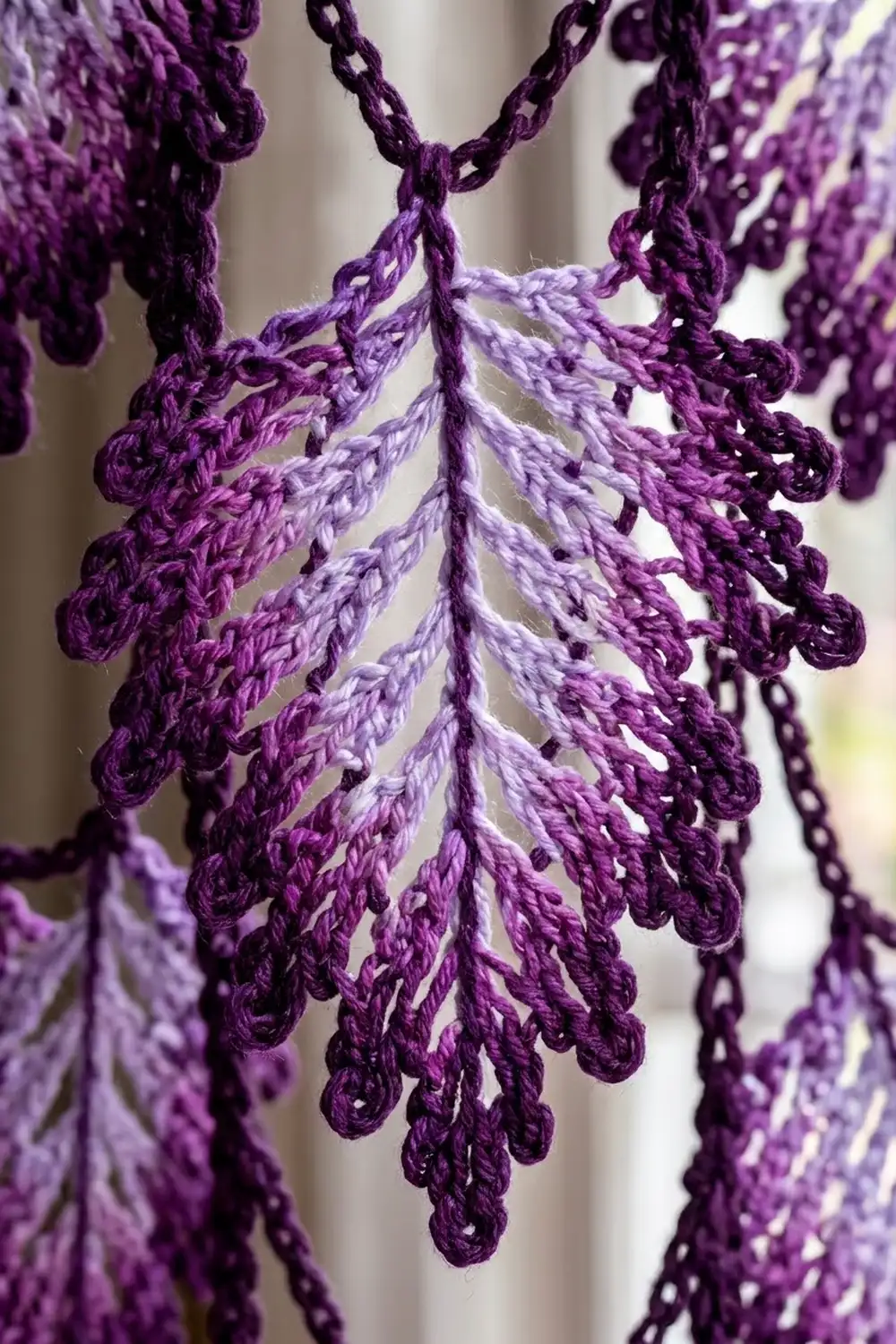
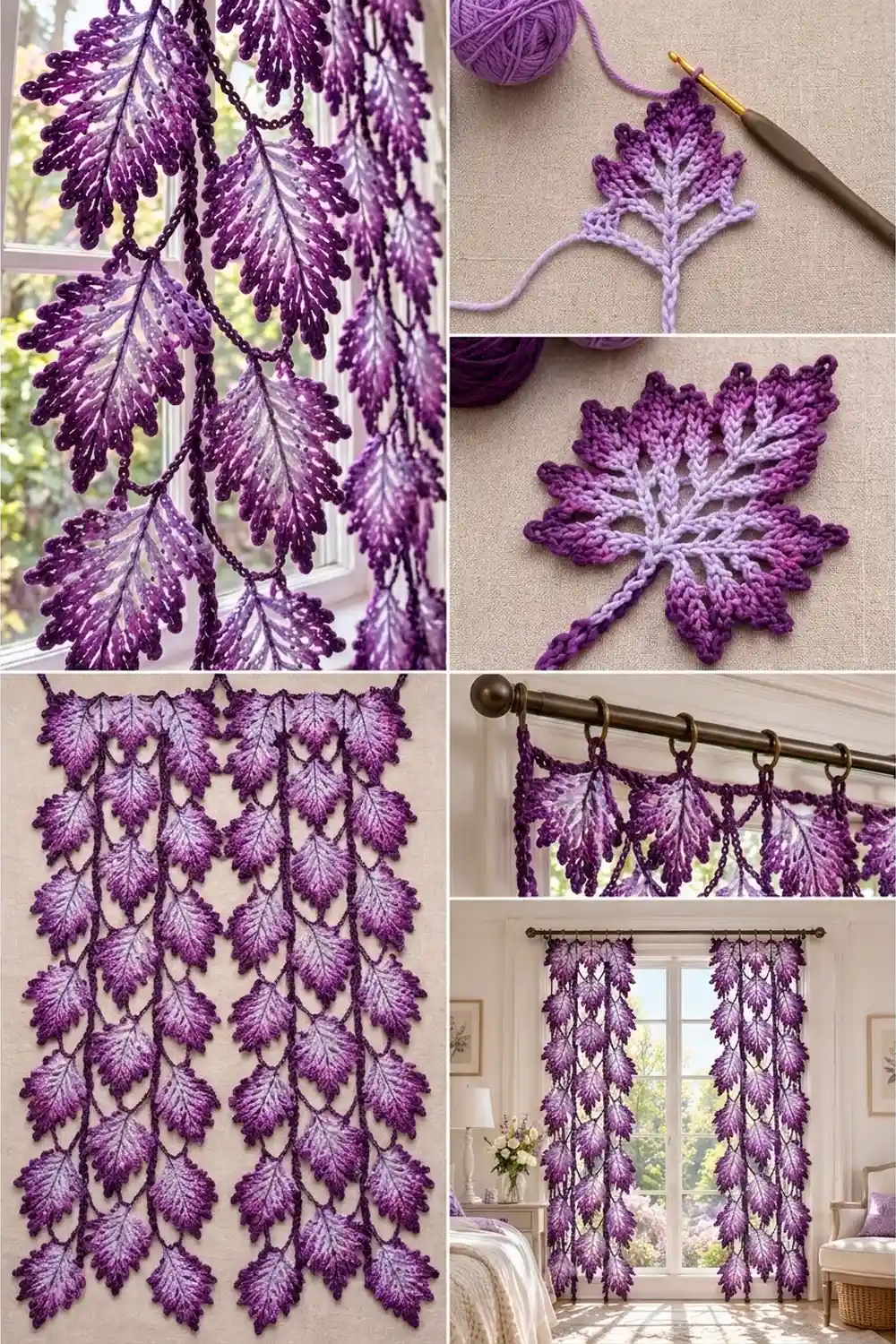
This curtain is made of strands of ombré leaves. Each leaf has a soft lavender center, a violet middle and a deep plum picot edge. Dark plum chain links hold the leaves in hanging strands, and light shows through the gaps between them.
The look is airy and a little romantic, the kind of panel that softens a bedroom window without blocking the view. The three-color fade does the work, so every leaf uses the same short pattern.
This pattern uses US crochet terms. One finished panel measures 18.75 in (47.6 cm) wide and 72.5 in (184.2 cm) long from the top of the heading band to the lowest leaf tip, not counting the hanging loops. The pair shown is two identical panels.
You’ll make 27 leaves per panel, each worked in 3 rounds around a foundation chain. You then link them stem-to-tip into 3 strands of 9 leaves, connect neighboring strands with chain swags, and finish with a 2-row heading band that has 7 hanging loops.
Finished Size and Construction
- Finished panel size: 18.75 in × 72.5 in (47.6 cm × 184.2 cm)
- Skill level: Intermediate
- Terminology: US
- Yarn weight: Worsted (#4)
- Hook: 5.0 mm (H-8)
- Number of pieces: 27 leaf motifs per panel (54 for the pair)
- Layout: 3 strands across × 9 leaves down
- Piece size: 6 in × 4 in (15.2 cm × 10.2 cm) per leaf
- Size before border: 16.5 in × 72 in (41.9 cm × 182.9 cm)
- Border (heading band) depth: 0.5 in (1.3 cm), plus hanging loops of about 1.25 in (3.2 cm)
Materials
Use a smooth worsted-weight cotton or cotton blend so the picots stay crisp and the curtain hangs straight. Acrylic also works, but it drapes a little less. The amounts below assume about 180 m per 100 g.
Per panel:
– Color A, light lavender: 100 g (180 m)
– Color B, medium violet: 150 g (270 m)
– Color C, deep plum: 200 g (360 m)
For the pair: double each amount: A 200 g (360 m), B 300 g (540 m), C 400 g (720 m).
These quantities include a margin of about 15% for gauge swatches and tails.
Tools:
– 5.0 mm (H-8) crochet hook
– Tapestry needle
– Scissors
– Stitch markers
– Blocking mats and rustproof pins
– Spray bottle
– 7 curtain rings per panel (optional; the loops can also slide straight onto a rod)
Abbreviations (US Terms)
- ch – chain
- sl st – slip stitch
- sc – single crochet
- hdc – half double crochet
- dc – double crochet
- tr – treble crochet
- sp – space
- st(s) – stitch(es)
- rnd – round
Special stitch – picot: Ch 3, sl st in the 3rd ch from hook. A picot is not counted as a stitch.
Surface slip stitch: Hold the yarn behind the work, insert the hook from front to back through the fabric, pull up a loop and draw it through the loop on your hook.
Gauge and Checkpoints
Gauge: 16 sc × 18 rows = 4 in (10.2 cm) in Color C with a 5.0 mm hook. A chain of 8 measures about 2 in (5.1 cm).
Make and block one complete leaf before you start production. Then check it at each stage:
- After Rnd 1: 4.5 in (11.4 cm) long × 0.75 in (1.9 cm) wide
- After Rnd 2: 5.25 in (13.3 cm) long × 3.25 in (8.3 cm) wide
- After Rnd 3: 6 in (15.2 cm) long × 4 in (10.2 cm) wide, measured picot tip to picot tip
If your leaf is too big, go down to a 4.5 mm hook. If it is too small, go up to a 5.5 mm hook. Change the hook, not the stitch counts, because the heading band and swags are sized to a 4 in (10.2 cm) leaf.
Leaf Motif
Make 27 per panel. The base is the end where you join each round, and the tip is the end with the chain space.
Rnd 1 (Color A): Ch 19. Sc in 2nd ch from hook and in each ch across (18 sc). Ch 2 for the tip. Rotate and work along the opposite side of the foundation chain: sc in each of the next 18 ch. Join with sl st to the first sc. Fasten off A.
Count: 36 sc (18 per side) + 1 ch-2 tip sp.
Rnd 2 (Color B, growth round): Join B with sl st in the first sc at the base.
- Side 1 (base to tip): Ch 1, sc in the same st, hdc in next 2, dc in next 2, tr in next 5, dc in next 3, hdc in next 3, sc in next 2 (18 sts).
- Tip: (2 hdc, ch 2, 2 hdc) in the ch-2 sp.
- Side 2 (tip to base): Sc in next 2, hdc in next 3, dc in next 3, tr in next 5, dc in next 2, hdc in next 2, sc in next 1 (18 sts).
Join with sl st to the first sc. Fasten off B.
Count: 40 sts (18 + 2 + 2 + 18) + 1 ch-2 tip sp.
The 5 treble crochets on each side line up across from each other. They make the widest part of the leaf, a little toward the base, and their posts fan out like side veins.
Rnd 3 (Color C, trim round): Join C with sl st in the first sc of Rnd 2.
- Ch 1. Sc in next 2 sts, picot 10 times. This covers Side 1 and the first 2 tip hdc.
- (Sc, ch 4, sc) in the tip ch-2 sp.
- Sc in next 2 sts, picot 10 times. This covers the last 2 tip hdc and Side 2.
- Join with sl st to the first sc. Fasten off C, leaving an 8 in (20.3 cm) tail.
Count: 40 sc (1 in each existing st) + 2 sc (extra, in the tip) = 42 sc, 20 picots (10 per side), 1 ch-4 tip loop.
Center vein (Color A): Starting at the base, work 18 surface slip stitches straight up the line of the foundation chain, between the two rows of Rnd 1 sc, ending at the tip. Fasten off and weave in all ends except the C tail at the base.
Checkpoint: The leaf measures 6 in × 4 in (15.2 cm × 10.2 cm). Counting from the base, the 4th picot on each side sits beside the treble crochets. These are the swag points.
Make All Pieces
Per panel, make 27 leaves, each using A for Rnd 1 and the vein, B for Rnd 2, and C for Rnd 3. For the pair, make 54.
Lay the panel out face up, with stems up and tips down:
Strand 1   Strand 2   Strand 3
 Leaf 1     Leaf 1     Leaf 1    <- top, linked to heading
 Leaf 2     Leaf 2     Leaf 2
 Leaf 3     Leaf 3     Leaf 3
 Leaf 4     Leaf 4     Leaf 4
 Leaf 5     Leaf 5     Leaf 5
 Leaf 6     Leaf 6     Leaf 6
 Leaf 7     Leaf 7     Leaf 7
 Leaf 8     Leaf 8     Leaf 8
 Leaf 9     Leaf 9     Leaf 9    <- bottom
Block all the leaves to 6 in × 4 in (15.2 cm × 10.2 cm) before joining. Leaves of the same size give strands of the same length.
Joining
Method: Work chain links in Color C. Each leaf hangs from the leaf above it by its own stem chain.
Vertical links:
- Take Leaf 2. Join C with sl st in the base sc (the join point of Rnd 3).
- Ch 8.
- Sl st into the ch-4 tip loop of Leaf 1. Fasten off.
- Repeat down the strand until Leaf 9 hangs from Leaf 8.
That is 8 links per strand. Leaf 1 stays unlinked for now; it gets its stem when you attach it to the heading.
Stitch logic: Each link is one sl st into a fixed stitch (the base sc) and one sl st into a fixed loop (the tip ch-4). Every leaf therefore hangs on its own center line, and the link length stays exactly ch 8.
Strand checkpoint: 9 leaves × 6 in (15.2 cm) + 8 links × 2 in (5.1 cm) = 70 in (177.8 cm). All 3 strands should match to within 0.5 in (1.3 cm).
Swags: Lay the 3 strands side by side with 2.25 in (5.7 cm) between leaf edges. At each leaf level:
- Join C in the 4th picot from the base on the right edge of the Strand 1 leaf.
- Ch 10.
- Sl st into the 4th picot from the base on the left edge of the matching Strand 2 leaf. Fasten off.
- Repeat between Strands 2 and 3.
That is 9 levels × 2 gaps = 18 swags. A ch 10 is about 2.5 in (6.4 cm), so each swag dips gently across its 2.25 in (5.7 cm) gap.
Tension: Chain at your normal gauge. Tight links pull the strands short and make the swags flatten into straight bars.
Size checkpoint: 3 leaves × 4 in (10.2 cm) + 2 gaps × 2.25 in (5.7 cm) = 16.5 in (41.9 cm) wide. The strands are 70 in (177.8 cm) long, or 72 in (182.9 cm) once the top links are added.
Border: Top Heading Band
Border gauge: 16 sc = 4 in (10.2 cm), so each sc is 0.25 in (0.6 cm).
The heading only runs along the top edge. Each strand gets a 25-stitch section: 3 strands × 25 sts = 75 sts. No seam stitches are added between sections.
Row 1 (Color C): Ch 76. Sc in 2nd ch from hook and in each ch across. Turn.
Count: 75 sc (3 sections × 25).
Row 2 (hanging-loop row):
- Ch 1, sc in the first st.
- Sc in next st, ch 10, sl st in the top of the sc just made, sc in next 11 sts 6 times.
- Sc in next st, ch 10, sl st in the top of the sc just made, sc in the last st.
- Fasten off.
Count: 75 sc (1 in each existing st) + 0 extra = 75 sc, 7 ch-10 loops.
The loops sit on stitches 2, 14, 26, 38, 50, 62 and 74. They are spaced 12 sts (3 in / 7.6 cm) apart and sit 1 st in from each edge, so they are symmetric around the center stitch, st 38.
Attaching the strands: Work along the free loops of the foundation chain on the bottom of Row 1. For each strand:
- Join C in the base sc of Leaf 1.
- Ch 8.
- Sl st into the free loop below st 13 (Strand 1), st 38 (Strand 2) or st 63 (Strand 3).
- Fasten off.
Why the math works: Sts 13, 38 and 63 are the centers of the three 25-stitch sections, so the strands sit exactly 6.25 in (15.9 cm) apart. Each 4 in (10.2 cm) leaf, centered in its 6.25 in (15.9 cm) section, leaves 1.125 in (2.9 cm) on each side. The panel width is 16.5 in + 2 × 1.125 in = 18.75 in (47.6 cm), which matches 75 sts ÷ 4.
Final Blocking
- Lay the panel face up on blocking mats, heading at the top. Work in sections if you don’t have room for the full length.
- Pin the heading straight to 18.75 in (47.6 cm).
- Pin each strand straight down from its attachment point, keeping the leaves centered.
- Pin each leaf at its tip loop and at its 4th picots, holding 6 in × 4 in (15.2 cm × 10.2 cm).
- Open the edge picots with a pin tip.
- Mist evenly until damp, not soaked.
- Let it dry completely, then unpin. Hang the panel for 24 hours so the chains settle.
Final Quality-Control Checklist
- Every leaf has 42 sc, 20 picots and 1 ch-4 tip loop.
- Each leaf measures 6 in × 4 in (15.2 cm × 10.2 cm).
- The center veins run straight from base to tip.
- Each strand has 9 leaves and 9 links, 8 between leaves and 1 to the heading, each a ch 8.
- There are 18 swags, all ch 10, at matching heights.
- The heading has 75 sc and 7 loops on sts 2, 14, 26, 38, 50, 62 and 74.
- The panel measures 18.75 in × 72.5 in (47.6 cm × 184.2 cm).
- All ends are woven in securely.
Troubleshooting
- The leaf cups or ruffles: Your trebles are too loose. Go down a hook size for Rnd 2 only.
- The tip is blunt: Check that you worked (2 hdc, ch 2, 2 hdc) in the tip space and (sc, ch 4, sc) in Rnd 3.
- Strands are different lengths: Recount the link chains. A single extra chain per link adds up to about 2 in (5.1 cm) over a strand.
- Swags hang crooked: Make sure every swag uses the 4th picot from the base on both leaves.
- The heading curls: Your Row 1 is tight. Rework the foundation chain with a hook one size larger.
- The vein puckers: Loosen your surface slip stitches, or go up a hook size for the vein.
Care
Hand wash in cool water with mild soap. Press out the water in a towel, then lay flat and pin to shape to dry. Shake out gently between washes to release dust.
Final Notes
The measurements build on each other. A 6 in × 4 in (15.2 cm × 10.2 cm) leaf plus a 2 in (5.1 cm) link gives an 8 in (20.3 cm) repeat. Nine of those give a 72 in (182.9 cm) strand, and three strands with 2.25 in (5.7 cm) gaps give 16.5 in (41.9 cm). The 75-stitch heading brings the panel to 18.75 in × 72.5 in (47.6 cm × 184.2 cm).
If your first leaf matches its checkpoints, the rest of the panel will match too. Make a second panel to complete the pair.
Happy crocheting!