

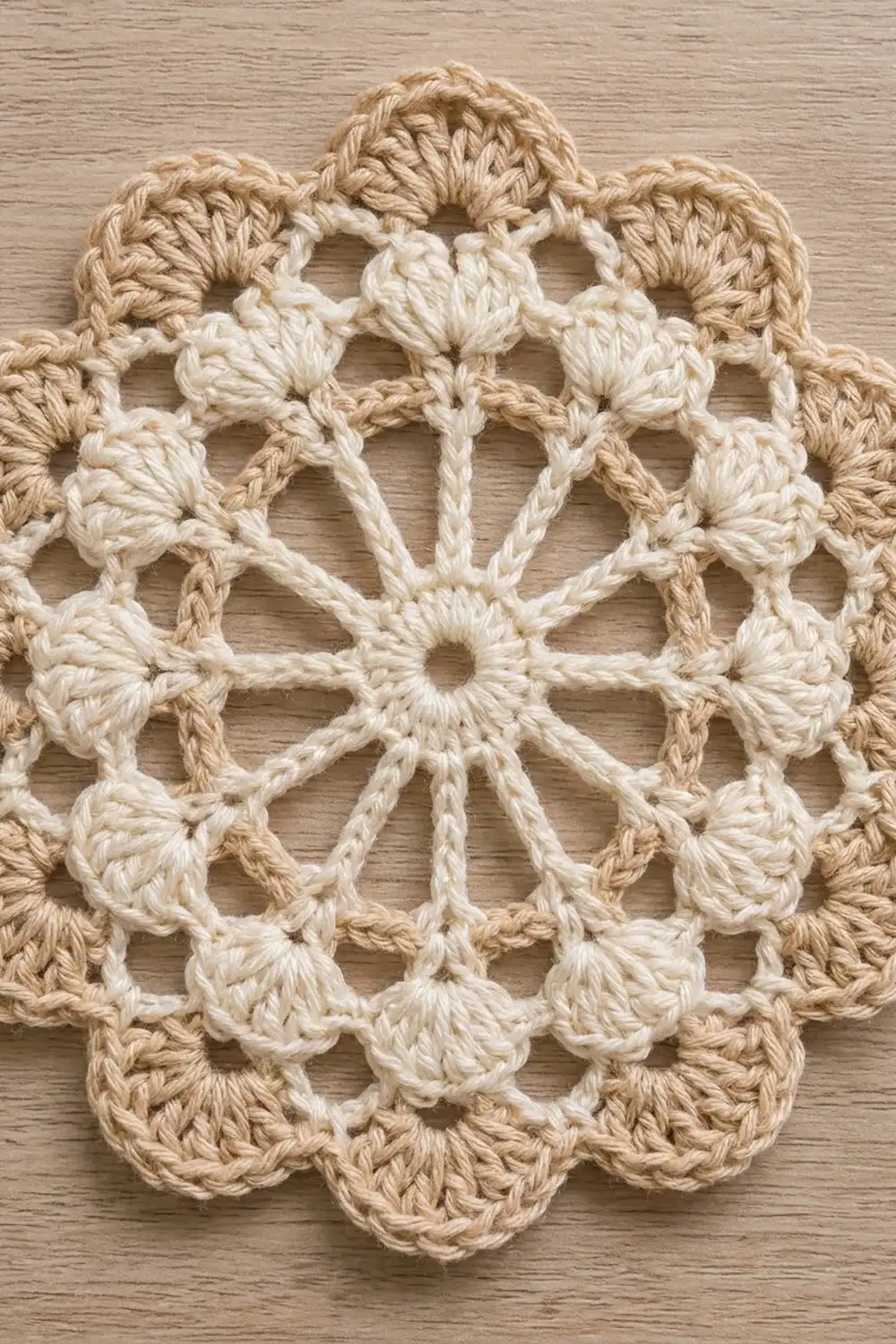
The Ivory Wheel is a round, lacy motif with a soft vintage feel. Twelve slim spokes run out from a small open center. A ring of twelve plump puff stitches circles the wheel, and a two-tone scalloped edge with small picot points finishes it.
The motif uses two neutral colors. Ivory (cream) is used for the center, spokes and puffs, and a warm sand beige for the chain ring and scalloped edge. The contrast is gentle, so the piece looks like a classic farmhouse or cottage-style doily rather than a bold block of color.
This pattern is written in US crochet terms. After blocking, the motif measures 6 in (15.2 cm) across from scallop tip to scallop tip. It is worked in DK-weight cotton with a 3.5 mm hook.
Construction is simple. It is one piece worked in joined rounds from a magic ring. Rounds 1–3 build the wheel and the puff ring in ivory. Round 4 adds a beige chain ring, and Rounds 5–6 form the scalloped border with picots. There is no sewing or joining.
Finished Size and Construction
- Finished size: 6 in (15.2 cm) diameter, scallop tip to scallop tip
- Skill level: Easy-intermediate (puff stitches, working into chain spaces)
- Terminology: US crochet terms
- Yarn weight: DK (light worsted, #3) cotton or cotton blend
- Hook: 3.5 mm (E-4)
- Number of pieces: 1 single motif
- Layout: One round motif worked in the round, no assembly
- Piece size: 6 in (15.2 cm) diameter
- Size before border (after Round 4): 4.75 in (12.1 cm) diameter
- Border depth (Rounds 5–6): about 0.625 in (1.6 cm) on each side
Materials
Choose a smooth mercerized or combed DK cotton. Cotton gives crisp stitch definition, holds the puffs firmly and blocks flat. Avoid fuzzy or very loosely plied yarns, because the spokes and picots lose their shape in them.
- Color A – Ivory / Cream: 8 g (about 19 m)
- Color B – Sand Beige: 8 g (about 19 m)
These amounts include a margin of about 30% for swatching, tails and the occasional round you have to undo. One 50 g ball of each color will make several motifs.
Tools:
- 3.5 mm (E-4) crochet hook
- Tapestry needle
- Scissors
- Measuring tape or ruler
- Blocking mat and rust-proof pins
- Spray bottle with clean water
Abbreviations (US Terms)
- ch – chain
- sl st – slip stitch
- sc – single crochet
- hdc – half double crochet
- dc – double crochet
- tr – treble crochet
- sp – space
- lp – loop
- st(s) – stitch(es)
- yo – yarn over
- beg – beginning
- rep – repeat
Puff stitch (puff): (Yo, insert hook in the indicated space, yo and pull up a loop about 0.5 in / 1.3 cm tall) 3 times. Yo and pull through all 7 loops on the hook, then ch 1 to lock. The ch-1 closure is the top of the puff.
Beginning puff (beg puff): Ch 2. (Yo, insert hook in same space, yo and pull up a loop to the height of the ch-2) 2 times. Yo and pull through all 5 loops on the hook, then ch 1 to lock.
Standing sc: With a slip knot on the hook, insert hook in the indicated stitch, yo and pull up a loop, yo and pull through both loops.
Picot: Ch 3, worked between two sc in the same stitch so the chain stands up as a small point.
Gauge and Checkpoints
You measure gauge on the motif itself. Work Rounds 1 and 2, lay the piece flat without stretching it, and measure across.
- After Round 1: 1.25 in (3.2 cm) diameter
- After Round 2: 2.75 in (7.0 cm) diameter
- After Round 3: 3.75 in (9.5 cm) diameter
- After Round 4: 4.75 in (12.1 cm) diameter
- After Round 5: 5.75 in (14.6 cm) diameter
- After Round 6 and blocking: 6 in (15.2 cm) diameter
At Round 2, being off by up to 0.125 in (0.3 cm) is fine. If Round 2 is more than 0.25 in (0.6 cm) too big, go down to a 3.25 mm hook. If it is more than 0.25 in (0.6 cm) too small, go up to a 3.75 mm hook. Check again at Round 4. That is the most important checkpoint, because the border is built on it.
Check that the piece lies flat, not just its size. If the center cups like a bowl, your chains are too tight. If it ripples, your chains are too loose or your tall stitches are too short.
Pattern
Round 1 – Center Ring (Color A)
With Color A, make a magic ring.
Ch 5 (counts as dc + ch 2), *dc in ring, ch 2; rep from * 10 more times. Sl st to the 3rd ch of the beg ch-5. Pull the ring closed, leaving a small open center about 0.25 in (0.6 cm) wide.
Count: 12 dc and 12 ch-2 sps (36 sts total).
Checkpoint: 1.25 in (3.2 cm) across.
Round 2 – Spokes (Color A)
Ch 4 (counts as tr), ch 3. *Tr in next dc, ch 3; rep from * 10 more times. Sl st to the top of the beg ch-4.
Each tr sits directly on top of a Round 1 dc, so the two stitches line up into one long, straight spoke. This creates the 12-spoke wheel.
Count: 12 tr and 12 ch-3 sps (48 sts total).
Checkpoint: 2.75 in (7.0 cm) across. The spokes should lie straight, not curved.
Round 3 – Puff Ring (Color A)
Sl st into the next ch-3 sp. Beg puff in the same sp, ch 3. *Puff in next ch-3 sp, ch 3; rep from * 10 more times. Sl st to the top of the beg puff (its ch-1 closure). Fasten off Color A.
Each puff sits centered between two spokes, which forms the ring of 12 rounded puffs.
Count: 12 puffs and 12 ch-3 sps (12 puffs + 36 ch).
Checkpoint: 3.75 in (9.5 cm) across.
Round 4 – Chain Ring (Color B)
Join Color B with a standing sc in the ch-1 top of any puff. Ch 5. *Sc in top of next puff, ch 5; rep from * 10 more times. Sl st to the first sc.
The ch-5 loops arch over the spaces above each spoke. They give the border 12 even foundations.
Count: 12 sc and 12 ch-5 lps (72 sts total).
Checkpoint: 4.75 in (12.1 cm) across. This is the size before the border.
Border
The border is Rounds 5 and 6, both in Color B. It adds about 0.625 in (1.6 cm) on each side, taking the diameter from 4.75 in (12.1 cm) to 6 in (15.2 cm) after blocking.
Border gauge: Each finished scallop is about 1.5 in (3.8 cm) wide along the outer edge and 0.625 in (1.6 cm) deep. A 6 in (15.2 cm) circle has an outer edge of about 18.85 in (47.9 cm). Twelve scallops of about 1.5 in (3.8 cm) each cover about 18 in (45.7 cm). The small difference is taken up where neighboring scallops meet.
Round 5 – Scallops
Sl st into the first ch-5 lp. Ch 1. *(Sc, hdc, 5 dc, hdc, sc) in the same ch-5 lp, then move to the next ch-5 lp; rep from * 11 more times, working the last set into the final lp. Sl st to the first sc.
Do not work into the Round 4 sc between loops. The last sc of one scallop and the first sc of the next sit side by side over that sc, which makes a neat dip between scallops.
Per repeat: 1 sc + 1 hdc + 5 dc + 1 hdc + 1 sc = 9 sts.
Count: 12 scallops x 9 sts = 108 sts.
Checkpoint: 5.75 in (14.6 cm) across.
Round 6 – Picot Edging
Ch 1. *Sc in the first sc of the scallop, sc in the hdc, sc in the next 2 dc, (sc, picot, sc) in the center dc, sc in the next 2 dc, sc in the hdc, sc in the last sc of the scallop; rep from * 11 more times. Sl st to the first sc. Fasten off and weave in all ends.
Per repeat: 9 sts worked 1 per stitch, plus 1 extra sc in the center dc = 10 sc, plus 1 picot.
Count: 108 sts worked 1 per stitch + 12 extra sc = 120 sc, plus 12 ch-3 picots.
Why the math works: Every round keeps the same 12 repeats:
- Round 1 sets 12 dc.
- Round 2 stacks 12 tr on top of them as spokes.
- Round 3 places 12 puffs between the spokes.
- Round 4 anchors 12 sc on the puffs and makes 12 loops over the spokes.
- Round 5 fills each loop with one 9-stitch scallop.
- Round 6 trims each scallop with 10 sc and 1 picot.
Because the number of repeats never changes, each scallop sits directly over one spoke and each dip sits over one puff. Nothing drifts, and the circle stays flat.
Final Blocking
- Weave in all ends securely before blocking, following the direction of the stitches. Hide Color A tails in Color A stitches and Color B tails in Color B stitches.
- Spray the motif lightly with clean water until damp. You can also soak it briefly and press the extra water out in a towel. Do not wring it.
- Lay the motif face up on a blocking mat.
- Pin the center first. Then pin the tip of each of the 12 picots outward in opposite pairs: 12 and 6 o’clock, then 3 and 9 o’clock, and so on.
- Measure from picot tip to the opposite picot tip. Adjust until every diameter is 6 in (15.2 cm).
- Straighten each spoke with your fingers and gently round the puffs.
- Let it dry completely, at least several hours, before you unpin it.
Final Quality-Control Checklist
- 12 straight spokes spread evenly from a small open center.
- 12 puffs sit between the spokes, all the same height.
- Round 4 has exactly 12 ch-5 loops.
- Round 5 has 12 scallops of 9 sts each (108 sts).
- Round 6 has 120 sc and 12 picots.
- Each scallop is centered over a spoke.
- The motif lies flat, without cupping or ruffling.
- The diameter is 6 in (15.2 cm), within 0.125 in (0.3 cm).
- All ends are woven in and can’t be seen from the front.
Troubleshooting
The center hole is too large. Pull the magic ring tail tighter before joining Round 1. Then secure the tail with a few stitches on the back.
The spokes look twisted or slanted. Make sure each tr goes into the top of a Round 1 dc, not into the chain space beside it.
The puffs are uneven. Pull each loop to the same height before the final yo. Counting “one, two, three” at a steady pace helps.
The motif cups. Loosen your chains in Rounds 2 and 4, or use a hook one size larger for those rounds only.
The scallops ruffle. Your ch-5 loops may be too short. Check that each loop has 5 chains and that they aren’t pulled tight. If you need to, work Round 5 with a 3.25 mm hook.
The Round 6 count is off. Recount Round 5 first. Each scallop must be exactly 9 sts, and most errors come from a missing hdc.
The finished motif is too small. Block it again with more stretch, or rework it with a 3.75 mm hook.
Care
Hand wash in cool water with a mild detergent. Press the water out in a towel and dry flat, reshaping and pinning if needed. A cool iron through a pressing cloth will freshen up the scallops.
Final Notes
The Ivory Wheel motif follows one clear measurement chain:
- 1.25 in (3.2 cm) after Round 1
- 2.75 in (7.0 cm) after Round 2
- 3.75 in (9.5 cm) after Round 3
- 4.75 in (12.1 cm) after Round 4
- 5.75 in (14.6 cm) after Round 5
- 6 in (15.2 cm) after Round 6 and blocking
Check your size at Rounds 2 and 4 and keep the 12 repeats lined up, and the motif will come out flat and even.
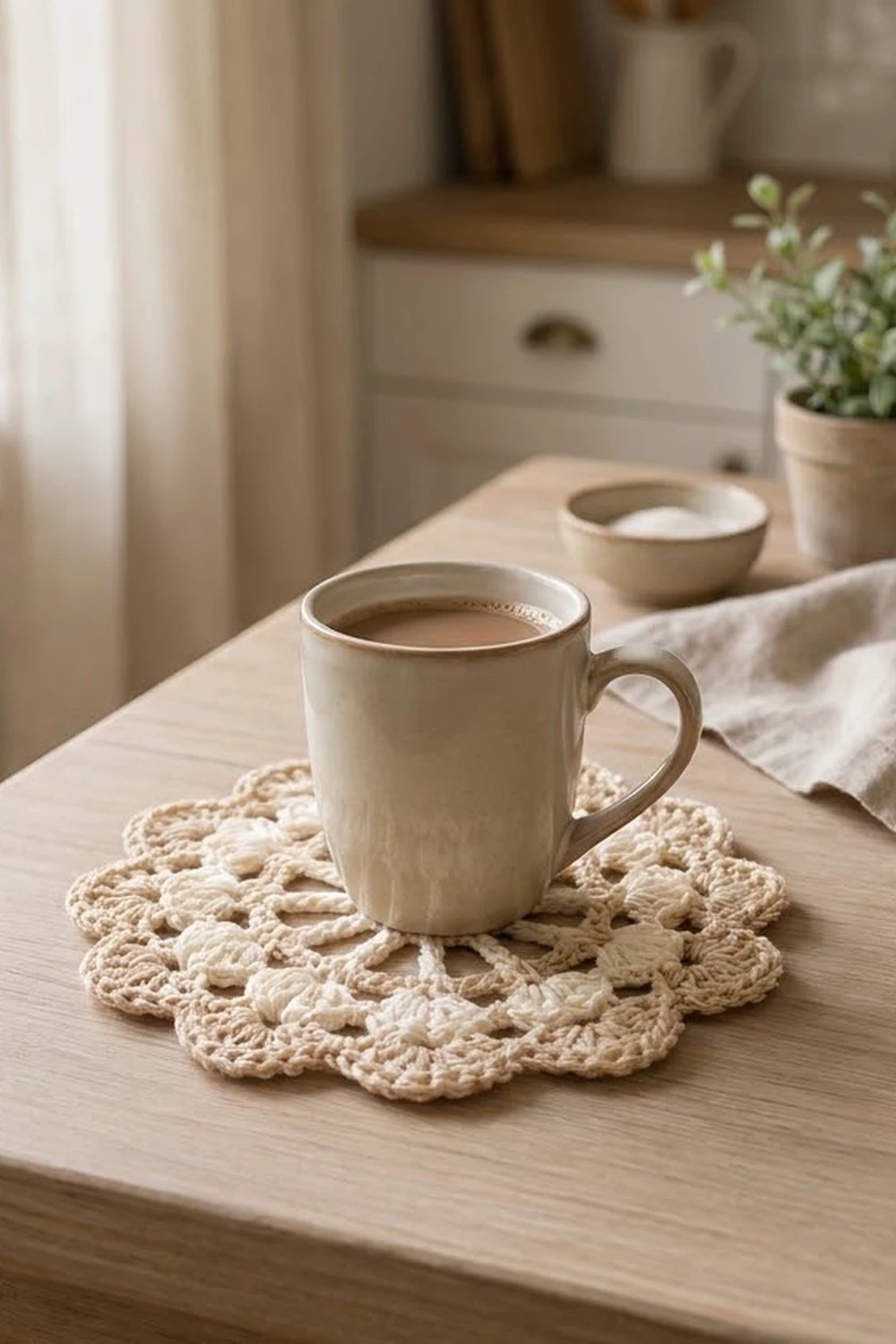
Use it as a coaster, as a small doily under a vase or candle, or as a delicate decoration on a shelf. Make one, enjoy the rhythm of the puffs, and let the warm ivory and sand tones do the rest.
Happy crocheting!