

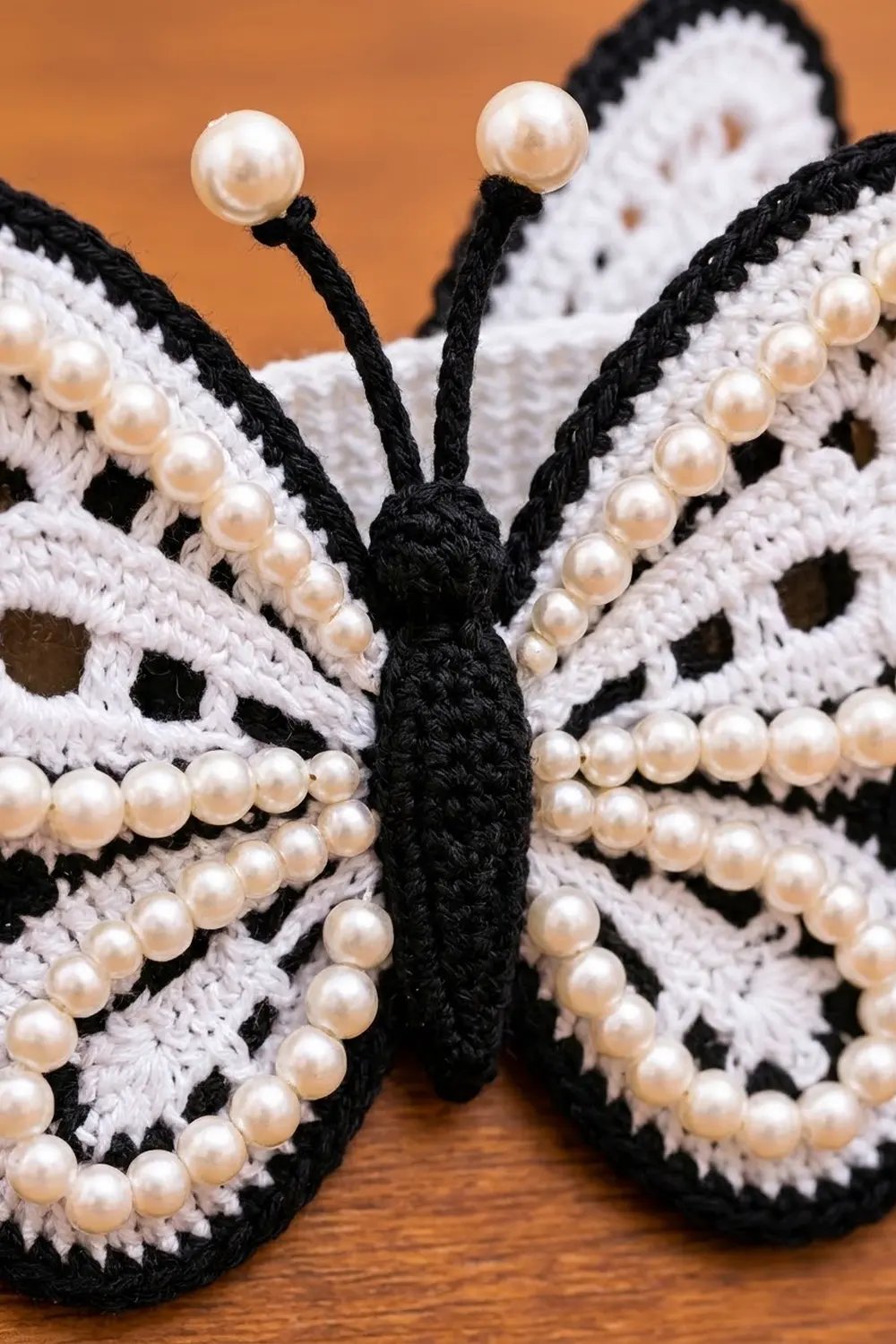
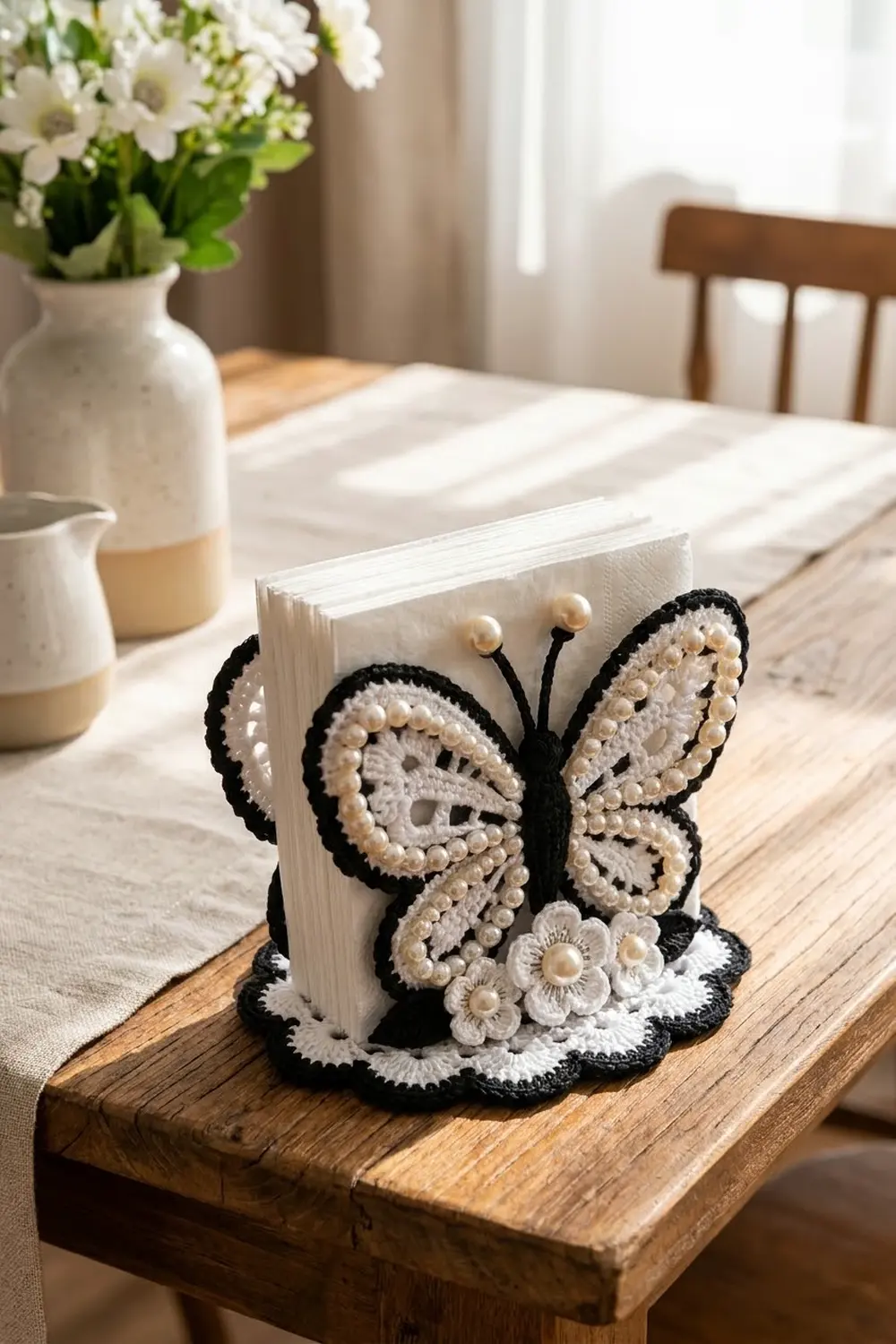
This napkin holder pairs crisp white lace with a bold black outline. Two lacy butterflies stand back to back on a scalloped oval doily base. A firm white wall between them holds the napkins. The front butterfly gets pearls around each wing, pearl-tipped antennae, and a small cluster of flowers and leaves.
The holder is worked in white and black sport-weight cotton. It looks graphic and slightly vintage, so it suits a farmhouse table, a wedding buffet or a monochrome kitchen. All instructions use US terms.
The finished base measures 9.75 x 6.25 in (24.8 x 15.9 cm). Each butterfly is about 9 x 6.5 in (22.9 x 16.5 cm), and the holder stands about 6.5 in (16.5 cm) tall at the wing tips.
Every part is crocheted flat: an oval base, a folded wall strip with a stiffener inside, two butterflies, loose antennae, flowers and leaves. Black outline rounds act as the borders. You then sew everything together.
Finished Size and Construction
- Finished size: base 9.75 x 6.25 in (24.8 x 15.9 cm). Height is 6.5 in (16.5 cm) at the wings and 8 in (20.3 cm) at the antenna tips.
- Skill level: Intermediate
- Terminology: US
- Yarn weight: #2 fine (sport) mercerized cotton
- Hook: 3.25 mm (US D/3)
- Number of pieces: 23 in total: 1 base, 1 wall, 8 wings, 2 bodies, 2 loose antennae, 3 flowers and 6 leaves
- Layout: the oval wall is centered on the base, with one butterfly on its front face and one on its back face
- Piece sizes:
- Upper wing: 4.75 x 3.5 in (12.1 x 8.9 cm)
- Lower wing: 3.25 x 2.75 in (8.3 x 7.0 cm)
- Wall, folded: 18 x 4.5 in (45.7 x 11.4 cm)
- Base size before border: 9.25 x 5.75 in (23.5 x 14.6 cm)
- Border depth: 0.25 in (0.6 cm) of black sc
Materials
Choose a smooth mercerized cotton. It shows the lace clearly, holds a crisp edge and washes well. Fuzzy yarns will blur the black outline.
- White: 100 g (280 m)
- Black: 25 g (70 m)
- 3.25 mm (US D/3) hook
- Two 7-count plastic canvas strips, each 8.75 x 4.25 in (22.2 x 10.8 cm)
- 45 in (114.3 cm) of strung 6 mm pearl beads
- Flat-back pearls: one 10 mm and two 8 mm
- Two 10 mm round pearl beads
- A small handful of fiberfill
- Tapestry needle, sewing needle and white thread
- Clear-drying craft glue, pins and stitch markers
- Fabric stiffener (optional)
The yarn quantities include a margin of about 25 percent for swatching and joining.
Abbreviations (US Terms)
- ch: chain
- sl st: slip stitch
- sc: single crochet
- hdc: half double crochet
- dc: double crochet
- sp(s): space(s)
- st(s): stitch(es)
- rnd: round
- beg: beginning
4-dc cluster: [Yarn over, insert hook in st, pull up a loop, yarn over, pull through 2 loops] 4 times in the same st. Yarn over and pull through all 5 loops.
Shell: (3 dc, ch 2, 3 dc) in the same st.
Gauge and Checkpoints
- Single crochet: 20 sts x 22 rows = 4 in (10.2 cm)
- Double crochet: 18 sts x 10 rnds = 4 in (10.2 cm)
Make one lower wing first as your test piece. Before the black edge, it should measure 2.75 x 2.25 in (7.0 x 5.7 cm).
- If the wing is too big, go down half a hook size.
- If it is too small, go up half a hook size.
Also swatch the wall in sc, because firm sc often works up tighter than lace.
Base (make 1)
Use white throughout the base.
Rnd 1: Ch 21. Work 2 dc in the 4th ch from hook (the skipped chains count as the first dc), dc in the next 16 ch, then 6 dc in the last ch. Working along the other side of the chain, dc in the next 16 ch, then 3 dc in the first ch you worked into. Join with a sl st to the top of the beg ch. (44 dc)
Checkpoint: 4.25 x 0.75 in (10.8 x 1.9 cm).
Rnd 2: Ch 3 (counts as dc throughout), dc in same st, 2 dc in each of next 2, dc in next 16, 2 dc in each of next 6, dc in next 16, 2 dc in each of last 3. Join. (56 dc)
Rnd 3: Ch 3, 2 dc in next, [dc in next, 2 dc in next] 2 times, dc in next 16, [dc in next, 2 dc in next] 6 times, dc in next 16, [dc in next, 2 dc in next] 3 times. Join. (68 dc)
Rnd 4: Ch 3, dc in next, 2 dc in next, [dc in next 2, 2 dc in next] 2 times, dc in next 16, [dc in next 2, 2 dc in next] 6 times, dc in next 16, [dc in next 2, 2 dc in next] 3 times. Join. (80 dc)
Checkpoint: 6.75 x 3.25 in (17.1 x 8.3 cm).
Rnd 5 (eyelet ring): Ch 5 (counts as dc + ch 2), skip next st, [dc in next, ch 2, skip next] 39 times. Join to the 3rd ch of the beg ch. (40 dc, 40 ch-2 sps)
Rnd 6: Sl st into the first sp. Ch 3, dc in same sp, 3 dc in next sp, [2 dc in next sp, 3 dc in next sp] 19 times. Join. (100 dc, in 20 groups of 5)
Checkpoint: 8.25 x 4.75 in (21.0 x 12.1 cm).
Rnd 7 (scallops): Ch 1, sc in the first st. Skip 2 sts, work a shell in the next st (the center of a 3-dc group), skip 1 st, sc in the next st. Repeat from * to * around, leaving out the final sc on the last repeat. Join. (20 shells, 20 sc) Fasten off.
Checkpoint: 9.25 x 5.75 in (23.5 x 14.6 cm).
Wall (make 1)
Use white.
Row 1: Ch 91. Sc in the 2nd ch from hook and in each ch across. (90 sc)
Rows 2–50: Ch 1, turn, sc in each st across. (90 sc)
Fasten off, leaving a 36 in (91.4 cm) tail.
Checkpoint: 18 x 9 in (45.7 x 22.9 cm).
Butterflies (make 2)
Upper Wing (make 4)
Rnd 1: With white, ch 10. Work 2 dc in the 4th ch from hook, dc in the next 5 ch, then 6 dc in the last ch. Working along the other side, dc in the next 5 ch, then 3 dc in the first ch you worked into. Join. (22 dc)
Rnd 2: Ch 3, dc in same st, 2 dc in each of next 2, dc in next 5, 2 dc in each of next 6, dc in next 5, 2 dc in each of last 3. Join. (34 dc)
Rnd 3: Ch 5, skip next st, [dc in next, ch 2, skip next] 16 times. Join. (17 dc, 17 ch-2 sps)
Rnd 4: Sl st into the first sp. Ch 3, 2 dc in same sp, then 3 dc in each remaining sp. Join. (51 dc) Fasten off.
Checkpoint: 4.25 x 3.25 in (10.8 x 8.3 cm).
Lower Wing (make 4)
Rnd 1: With white, ch 7. Work 2 dc in the 4th ch from hook, dc in the next 2 ch, then 6 dc in the last ch. Working along the other side, dc in the next 2 ch, then 3 dc in the first ch you worked into. Join. (16 dc)
Rnd 2: Ch 5 (counts as dc + ch 2), [dc in next, ch 2] 15 times. Join. (16 dc, 16 ch-2 sps)
Rnd 3: Sl st into the first sp. Ch 3, dc in same sp, 3 dc in next sp, [2 dc in next sp, 3 dc in next sp] 7 times. Join. (40 dc) Fasten off.
Checkpoint: 2.75 x 2.25 in (7.0 x 5.7 cm).
On both wings, the eyelet rounds form the radiating openwork veins and the dc fans give the rippled outer edge.
Body (make 2)
Rnd 1: With black, ch 20. Work 2 sc in the 2nd ch from hook, sc in the next 17 ch, then 4 sc in the last ch (this end is the head). Working along the other side, sc in the next 17 ch, then 2 sc in the first ch you worked into. Join. (42 sc)
Rnd 2: Ch 1, sc in each st around, working 2 sc in each of the 4 head sts. Join. (46 sc)
Fasten off, leaving a 20 in (50.8 cm) tail. The body measures 4.5 x 0.75 in (11.4 x 1.9 cm).
Antennae
Back butterfly: Join black at the head, 2 sts to one side of center. Ch 12, work a 4-dc cluster in the 4th ch from hook, sl st in the remaining 8 ch, then sl st into the head. Repeat 2 sts to the other side of center. Each antenna is 1.75 in (4.4 cm) long.
Front butterfly (make 2 separate): With black, ch 11. Sl st in the 2nd ch from hook and in each ch across. (10 sl st) Glue a 10 mm pearl bead to one end. Each antenna is about 2 in (5.1 cm) long.
Flowers and Leaves
Large flower (make 1, white):
- Work 10 sc in a magic ring and join. (10 sc)
- Next rnd: [sc in next, ch 3, skip next] 5 times. Join. (5 sc, 5 ch-3 sps)
- Next rnd: (sc, hdc, 3 dc, hdc, sc) in each ch-3 sp. Join. (5 petals, 35 sts)
The large flower measures 2 in (5.1 cm) across.
Small flower (make 2, white):
- Work 10 sc in a magic ring and join. (10 sc)
- Next rnd: [(hdc, 2 dc, hdc) in next st, sl st in next st] 5 times. (5 petals, 25 sts)
Each small flower measures 1.5 in (3.8 cm) across.
Leaf (make 6, black): Ch 9. Starting in the 2nd ch from hook, work sc, hdc, 3 dc, hdc and sc, one st in each ch. Work 3 sc in the last ch. Working along the other side, work sc, hdc, 3 dc, hdc and sc. Sl st to the first sc. (17 sts) Each leaf measures 1.5 x 0.75 in (3.8 x 1.9 cm).
Make All Pieces
- White: 1 base (Rnds 1–7), 1 wall, 4 upper wings, 4 lower wings, 1 large flower and 2 small flowers
- Black: the base border, 8 wing borders, 2 bodies, the back antennae, 2 loose antennae and 6 leaves
Top-view layout, with the front at the bottom:
            BACK BUTTERFLY
   +--------------------------------+
   |     ( WALL  +  napkins )       |  <- oval base
   +--------------------------------+
            FRONT BUTTERFLY
   leaves  flower FLOWER flower  leaves
Joining
Wall:
- Fold the strip in half lengthwise so Row 1 meets Row 50. The fold becomes the top edge.
- Slide both canvas strips inside, end to end.
- With the white tail, whipstitch the foundation chain to Row 50, matching st 1 to st 1 all the way through st 90.
- Bring the short ends together and whipstitch them row-end to row-end (25 pairs).
- Shape the ring into an oval 8 x 2.75 in (20.3 x 7.0 cm).
Wall to base: Center the oval on the base. Leave 0.875 in (2.2 cm) clear at each end and 1.75 in (4.4 cm) clear at the front and back. Whipstitch each of the 90 bottom sts to the base st directly below it. Keep your tension snug but even, because over-tight stitches pucker the base.
Butterflies:
- For each side, overlap the inner tip of an upper wing 0.5 in (1.3 cm) over the inner tip of a lower wing, then tack them together.
- Whipstitch the body over the center seam. Add a little fiberfill before closing the last 1 in (2.5 cm).
- Sew one butterfly to each long face of the wall. Stitch along the full length of the body, then tack each wing at two points.
- The lower wings should just touch the base, and the upper wings should rise about 2 in (5.1 cm) above the wall.
Front embellishment:
- Sew the pearl strand just inside each black wing outline, tacking between the pearls every 0.5 in (1.3 cm).
- Sew the loose antennae to the head.
- Glue the flat-back pearls to the flower centers: the 10 mm pearl on the large flower and the 8 mm pearls on the small ones.
- Sew three leaves on each side of the flower cluster.
- Sew the flowers at the base of the butterfly, with the large flower in the center.
Size checkpoint: 9.75 x 6.25 in (24.8 x 15.9 cm) at the base and 6.5 in (16.5 cm) tall.
Border
Border gauge: The black sc should lie flat at about 5 sc per 1 in (2.5 cm) of curved edge.
Base, Rnd 8: Join black in any sc of Rnd 7, ch 1. Work 1 sc in each sc, 1 sc in each dc and 3 sc in each ch-2 sp. Join.
- Count: (20 sc + 120 dc = 140 sts worked 1 per st) + (20 sps x 3 = 60 extra) = 200 sc.
- That is 10 sc per scallop, or 100 sc along each long half.
Upper wing, Rnd 5: Join black, ch 1. Sc in each dc around, working 2 sc in the center dc of the fan at each tip. Join.
- Count: 51 + 2 = 53 sc.
Lower wing, Rnd 4: Join black, ch 1. Sc in each dc around, working 2 sc in the center dc at each tip. Join.
- Count: 40 + 2 = 42 sc.
Why the math works:
- Each base scallop curves along about 2 in (5.1 cm) of edge, so 10 sc per scallop matches the border gauge.
- The 3 sc in each ch-2 sp round off the shell point without cupping it.
- On the wings, one sc per dc follows the fans exactly, and the 2 extra sc keep the tips from being pulled into sharp points.
Final Blocking
- Wet-block the base and all 8 wings before you assemble anything.
- Pin the base to 9.75 x 6.25 in (24.8 x 15.9 cm), pinning out all 20 scallops.
- Pin the upper wings to 4.75 x 3.5 in (12.1 x 8.9 cm).
- Pin the lower wings to 3.25 x 2.75 in (8.3 x 7.0 cm).
- Brush on stiffener if you want a crisper finish.
- Let everything dry completely, then assemble.
- Steam the wall fold lightly from a distance.
Final Quality-Control Checklist
- The base has 20 even shells and a 200-sc border.
- The wings are within 0.25 in (0.6 cm) of their target sizes.
- The wing borders have 53 and 42 sc and no puckers.
- The wall stands upright with no gaps along the seams.
- The butterflies are centered and their bodies are vertical.
- The pearls lie flat inside the outlines.
- All ends are woven in on the back.
Troubleshooting
- The base ruffles: Go down a hook size, or block it flat with stiffener.
- The base cups: Loosen your tension in Rnds 5–6.
- The black border waves: Use a hook half a size smaller for the border.
- The wall leans: Make sure both canvas strips reach the bottom seam.
- The wings droop: Add a third tack point near each upper wing tip.
- The pearls twist: Tack between every bead.
Care
Spot clean with mild soap and cool water, then reshape and air dry. Never machine wash it, because the canvas and glued pearls will not survive.
Final Notes
Each measurement in this pattern depends on the one before it:
- Your gauge sets the wing sizes: 4.75 x 3.5 in (12.1 x 8.9 cm) for the upper wings and 3.25 x 2.75 in (8.3 x 7.0 cm) for the lower wings.
- Those wings give you butterflies about 9 in (22.9 cm) wide.
- The base grows to 9.25 x 5.75 in (23.5 x 14.6 cm) before the border. The 200-sc border brings it to 9.75 x 6.25 in (24.8 x 15.9 cm).
- The 18 in (45.7 cm) wall forms an 8 x 2.75 in (20.3 x 7.0 cm) oval that sits neatly inside the base.
Check each stage as you go, and the holder will come together cleanly.
Happy crocheting!