

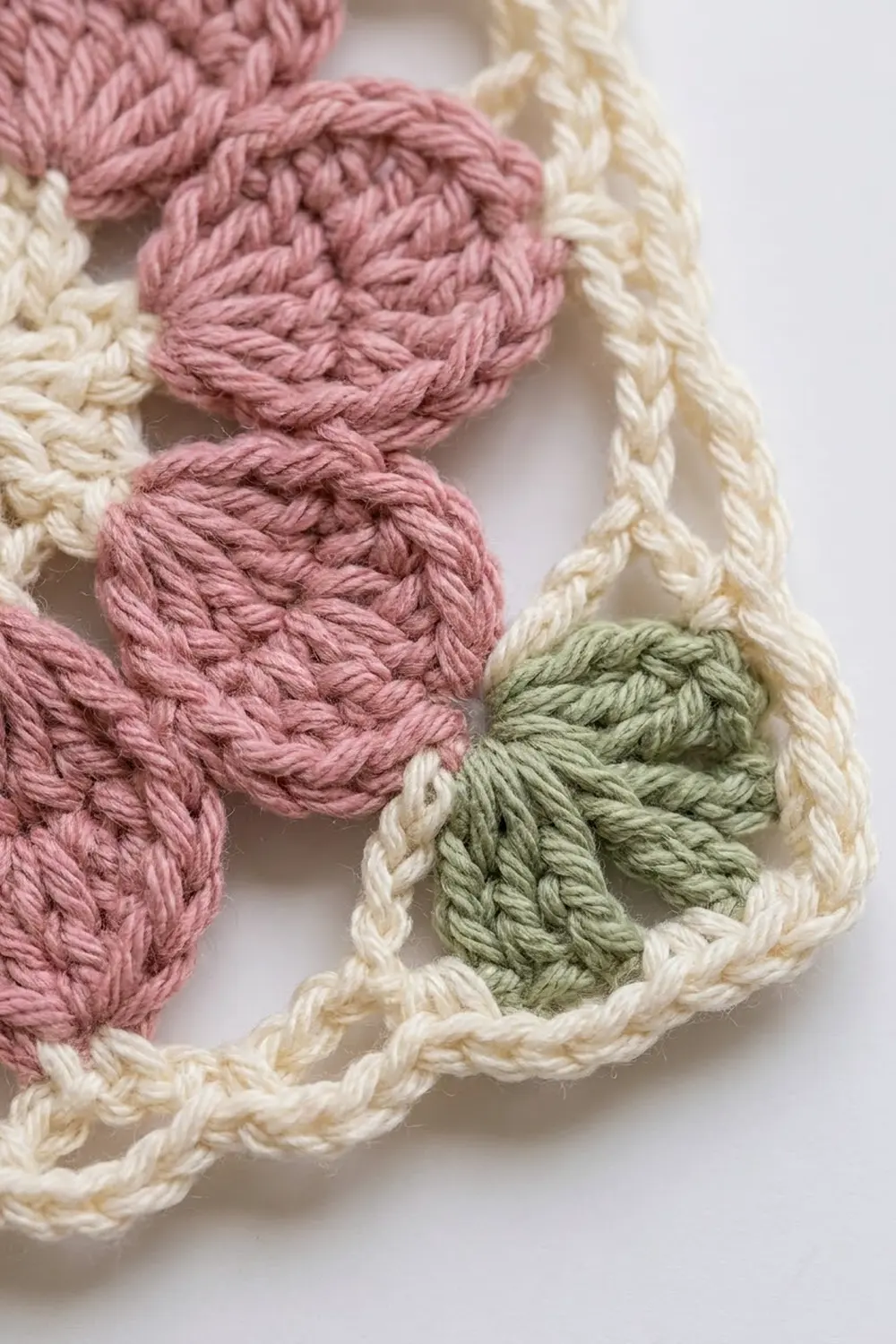
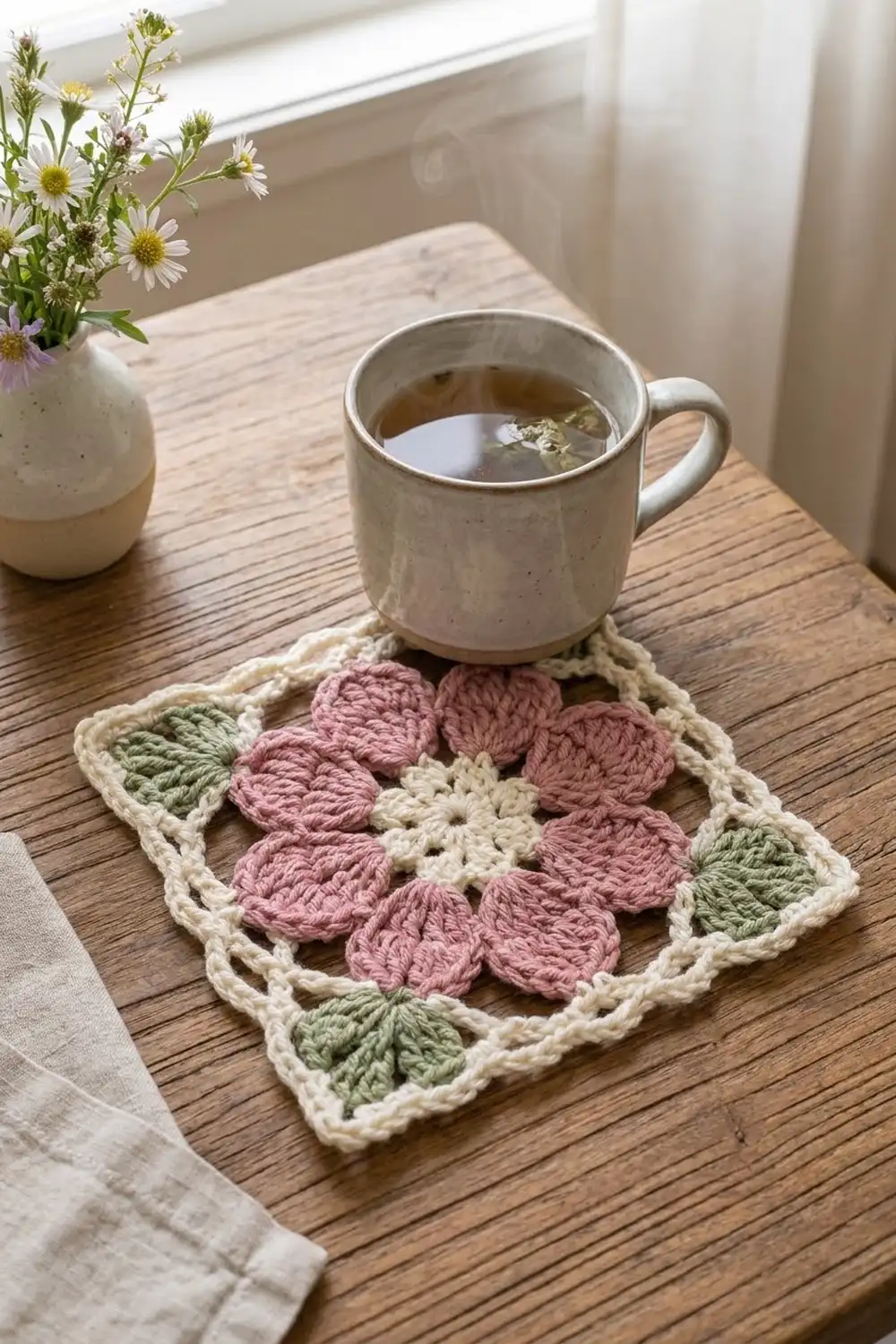
The Rosewood Lace Bloom is a single granny square built around one large, soft flower. A small cream center sits inside eight rounded dusty rose petals, and three-leaf sage green sprigs fill the four corners. An open cream chain-lace window frames the flower, and a twisted rope edge finishes the square.
The palette is quiet and vintage: cream, dusty rose, and sage green. The petals are worked in dense, ridged double and treble crochet, so they look plump and textured. The frame stays light and airy. Together the two textures give the square a cottage-garden feel.
This pattern uses US crochet terms. The finished square measures 6 in (15.2 cm) per side after blocking. You make one square, worked in the round from the center out.
Construction is simple. You crochet a cream ring, then a pink chain round and the eight petals. Next comes a cream round of chain loops that sits behind the petals. Green leaves go into the four corner loops. Two cream rounds square the motif off with chain lace and single crochet. A two-round border adds a neat sc edge and a crab-stitch rope trim.
Finished Size and Construction
- Finished size: 6 in x 6 in (15.2 cm x 15.2 cm) after blocking
- Skill level: Intermediate (clusters, working behind petals, crab stitch)
- Terminology: US crochet terms
- Yarn weight: DK / light worsted (#3)
- Hook: 4.0 mm (US G-6)
- Number of pieces: 1 single square motif
- Layout: Not applicable; this is one standalone square
- Piece size: 6 in (15.2 cm) per side, bordered
- Size before border: 5.5 in (14.0 cm) per side after Round 7
- Border depth: 0.25 in (0.6 cm) on each side, two rounds
Materials
Choose a smooth DK cotton or cotton blend with good stitch definition. Cotton keeps the petal ridges crisp and helps the lace frame hold its square shape. A soft acrylic DK also works, but it needs steam blocking to open up the lace.
- Cream (center, lace frame, border): 9 g, about 21 m
- Dusty rose (Rounds 2–3, petals): 5 g, about 12 m
- Sage green (corner leaves): 2 g, about 5 m
These amounts assume a DK yarn of about 230 m per 100 g. They include a margin of about 20% for color joins, weaving in ends, and re-working a round if a checkpoint misses.
Tools:
- 4.0 mm (US G-6) crochet hook
- Tapestry needle
- Scissors
- Stitch markers (4)
- Ruler or tape measure
- Blocking mat and rust-proof pins
- Spray bottle or steamer
Abbreviations (US Terms)
- ch – chain
- sl st – slip stitch
- sc – single crochet
- hdc – half double crochet
- dc – double crochet
- tr – treble crochet
- sp(s) – space(s)
- st(s) – stitch(es)
- MR – magic ring
- rev sc – reverse single crochet (crab stitch)
- tr3tog-cl – treble 3-together cluster (see below)
Special stitch – tr3tog-cl: *Yarn over twice, insert the hook in the indicated loop, yarn over and pull up a loop, then (yarn over and pull through 2 loops) twice. Repeat from * 2 more times in the same loop (4 loops on hook). Yarn over and pull through all 4 loops.
Rev sc (crab stitch): Work from left to right if you are right-handed. Insert the hook in the next stitch to the right, pull up a loop, yarn over, and pull through both loops. This makes the twisted rope edge.
Gauge and Checkpoints
Gauge matters less for one square than for a joined project, but it still decides whether your square comes out at 6 in (15.2 cm). Treat your first square as the test piece. Measure at each checkpoint and adjust before you weave in ends.
Frame gauge: 9 sc = 2 in (5.1 cm) in Rounds 7 and 8.
Checkpoints (measured flat, unblocked):
- After Round 1: the center ring is 1.25 in (3.2 cm) across.
- After Round 3: the flower is 4.25 in (10.8 cm) from petal tip to petal tip.
- After Round 6: the lace frame is about 5 in (12.7 cm) per side.
- After Round 7: the square is 5.5 in (14.0 cm) per side.
- After Round 9: the square is 6 in (15.2 cm) per side; blocking settles it exactly.
If your square is too big: Go down to a 3.75 mm (US F-5) hook, or work the ch-5 loops in Round 6 a little more firmly.
If your square is too small: Go up to a 4.5 mm (US 7) hook. If only the flower is small, loosen the petal trebles instead of changing every round.
Pattern
Round 1 (Cream): Center
Make a MR. Ch 3 (counts as dc), work 15 dc in the ring, pull the ring closed, and sl st in the top of the beginning ch-3. (16 dc) Fasten off.
Checkpoint: 1.25 in (3.2 cm) across.
Round 2 (Dusty Rose): Petal Base
Join dusty rose with a sl st in any dc. Ch 1, sc in the same st, ch 3, skip next dc. Sc in next dc, ch 3, skip next dc; repeat from * 6 more times. Sl st in the first sc. (8 sc, 8 ch-3 sps)*
Do not fasten off.
Round 3 (Dusty Rose): Petals
Sl st in the next ch-3 sp. In the same sp, work (hdc, 2 dc, 2 tr, 2 dc, hdc). In the next ch-3 sp, work (hdc, 2 dc, 2 tr, 2 dc, hdc); repeat from * 6 more times. Sl st in the first hdc. (8 petals of 8 sts each = 64 sts)*
Fasten off. Each petal is a rounded fan with the trebles at its tip. The sc stitches of Round 2 stay visible as small dips between the petals.
Checkpoint: 4.25 in (10.8 cm) from tip to tip. Gently push each petal into a rounded shape.
Round 4 (Cream): Back Loops
This round sits behind the petals and gives the frame something to grow from.
Fold the petals toward you. Join cream with a sl st in any sc of Round 2, working behind Round 3. Ch 1, sc in the same sc. Ch 5, passing the chain behind the next petal, then sc in the next Round 2 sc; repeat from * 6 more times. Ch 5, sl st in the first sc. (8 sc, 8 ch-5 loops)*
Fasten off. Lay the square down. Pick four alternating loops that sit on the diagonals as corner loops, and place a marker in each. The four loops between them are side loops.
Round 5 (Sage Green): Corner Leaves, Worked 4 Times
Each corner gets its own small three-leaf sprig, so the green appears only in the corners.
Join green with a sl st in a marked corner loop. Ch 4, tr3tog-cl in the same loop, ch 4, sl st in the same loop; repeat from * 2 more times. (3 leaves per corner)* Fasten off.
Repeat in the other three corner loops. (12 leaves total, 12 cluster tops)
Fan out the three leaves. The middle leaf points straight into the corner, and the outer two angle toward the sides. Leave the side loops empty.
Round 6 (Cream): Chain-Lace Frame
In each corner, name the leaves first, middle, and last in the direction you are working. Join cream with a sl st in the top of the middle leaf of any corner.
Ch 1, then work (sc, ch 3, sc) in the same cluster top (corner). *Ch 5, sc in the top of the last leaf of this corner. Ch 5, sc in the next side loop of Round 4. Ch 5, sc in the top of the first leaf of the next corner. Ch 5, work (sc, ch 3, sc) in the top of the middle leaf (corner). Repeat from * 2 more times. Then ch 5, sc in the top of the last leaf, ch 5, sc in the side loop, ch 5, sc in the top of the first leaf, ch 5, and sl st in the first sc.
Count: 4 corner ch-3 sps, 16 ch-5 loops (4 per side), and 20 sc (2 per corner + 3 per side).
This round squares off the flower and makes the open window of chain loops around it.
Checkpoint: about 5 in (12.7 cm) per side.
Round 7 (Cream): Solid Frame Round
Sl st in the next ch-3 corner sp. Ch 1, then work (2 sc, ch 2, 2 sc) in the same sp. *Work 5 sc in each of the next 4 ch-5 loops, then (2 sc, ch 2, 2 sc) in the next corner sp; repeat from * 2 more times. Work 5 sc in each of the next 4 ch-5 loops, then sl st in the first sc.
Count per side: 2 + (4 x 5) + 2 = 24 sc between the corner ch-2 sps. Total: 96 sc + 4 corner ch-2 sps.
Checkpoint: 5.5 in (14.0 cm) per side. This is your size before the border. Do not fasten off.
Border
The border is two cream rounds. A single crochet round sets clean corners, and a crab-stitch round adds the rope texture.
Border gauge: 9 sc = 2 in (5.1 cm). The two rounds add 0.25 in (0.6 cm) on each side, so the square grows from 5.5 in (14.0 cm) to 6 in (15.2 cm).
Round 8: Single Crochet
Ch 1, then sc in the same st and in each sc around, working 3 sc in each corner ch-2 sp. Sl st in the first sc.
Count: 96 (1 sc in each existing sc) + 12 (3 sc in each of the 4 corner sps) = 108 sc.
Per side: 28 sts. This count includes the center sc of the 3-sc group at each end as that side’s corner stitch. Check: 4 x (28 – 1) = 108, because two sides share each corner stitch.
Round 9: Crab Stitch Rope Edge
Ch 1 and do not turn. Working left to right, rev sc in each st around, with 2 rev sc in each corner center sc. Sl st in the first st. Fasten off.
Count: 108 (1 rev sc in each existing st) + 4 (1 extra at each corner) = 112 rev sc.
Why the math works: Round 6 gives 4 ch-5 loops per side. Five sc in each loop makes 20, and the two corner groups add 2 sc each, so each side has 24 sc. Round 8 keeps those 24 and adds 3 sc in each corner for a flat 90-degree turn. That gives 28 sts per side, counting the shared corners. Round 9 matches Round 8 stitch for stitch and adds one extra stitch at each corner, so the rope edge lies flat instead of cupping.
Final Blocking
- Weave in all ends on the back, through the same color where possible. Hide green tails behind the leaves and pink tails behind the petals.
- Pin the square face up on a blocking mat to 6 in x 6 in (15.2 cm x 15.2 cm). Pin the four corners first, then the middle of each side.
- Add pins at each quarter point of every side so the edges stay straight.
- Shape each petal into a round fan and spread out the three leaves in each corner.
- Use your fingers to open each ch-5 loop of Round 6 so the lace window looks even.
- Spray cotton until damp. For acrylic, hold the steamer just above the square without touching it.
- Let the square dry completely, at least 4 to 6 hours, before unpinning.
Final Quality-Control Checklist
- Round 1 has 16 dc and lies flat.
- There are 8 petals, each with 8 sts, and all are the same size.
- All Round 4 loops sit behind the petals, not in front.
- Each corner has 3 green leaves, and no green shows along the sides.
- Round 6 has 4 ch-5 loops on every side.
- Round 7 has 24 sc per side.
- Round 8 totals 108 sc, and Round 9 totals 112 rev sc.
- The square measures 6 in (15.2 cm) on all four sides.
- All ends are woven in and can’t be seen from the front.
Troubleshooting
The flower ruffles. Your trebles are too loose or too tall. Work them more tightly, or use hdc in place of the first and last dc of each petal.
The flower cups. Check that Round 2 has ch 3, not ch 2, between the sc stitches.
Round 4 loops pull the petals backward. Lengthen the loops to ch 6 if needed, but keep 8 loops.
The leaves look floppy. Pull each ch-4 snug before the cluster and close each cluster firmly.
The sides bow inward after Round 7. Your ch-5 loops are too tight. Rework Round 6 with slightly looser chains.
The corners curl after the border. Make sure Round 8 has 3 sc in each corner sp and Round 9 has 2 rev sc in each corner st.
The crab stitch twists the edge. Keep your loops relaxed. Reverse sc should be worked slightly loose.
Care
Hand wash in cool water with mild soap, roll the square in a towel to remove water, and dry it flat, reshaping it to 6 in (15.2 cm). Steam lightly to refresh the lace.
Final Notes
Here is the measurement chain: a 1.25 in (3.2 cm) center, a 4.25 in (10.8 cm) flower, a 5 in (12.7 cm) lace frame, a 5.5 in (14.0 cm) solid frame, and a 6 in (15.2 cm) bordered square. If you hit each checkpoint, the finished square will come out the right size.
This is one finished square. It works as a coaster, a mug rug, or a small display piece on its own. Take your time with the petals and the lace window, because that is where this design really shows.
Happy crocheting!