

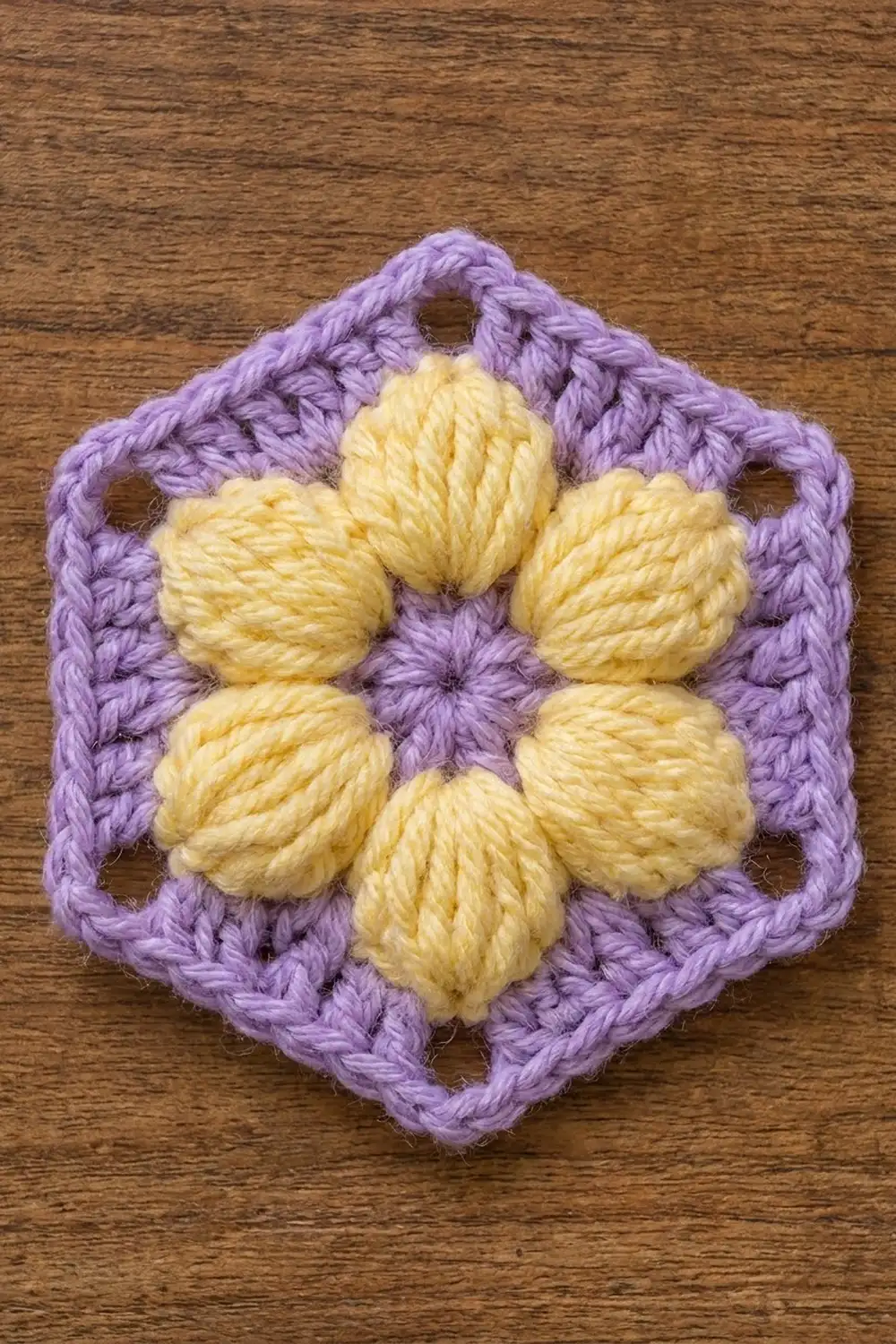
The Lavender Puff Bloom Hexagon is one six-sided motif with a soft, chunky flower in the middle. Six plump yellow puff-stitch petals surround a small lavender center. Two solid lavender rounds and a neat single crochet edge turn the flower into a crisp hexagon.
The palette is simple: soft lavender for the center, body and edge, and butter yellow for the petals. Each petal points straight at one of the six corners, and a small open chain space sits at every corner. These corner holes give the motif its classic hexagon look and make the points easy to find and pin.
This pattern uses US crochet terms. The finished motif measures 5.25 in (13.3 cm) from flat side to flat side and 6 in (15.2 cm) from point to point. Each side is about 3 in (7.6 cm) long.
The construction is quick. You work a lavender ring and then add the yellow puff petals. Two lavender double crochet rounds build the hexagon and place a corner above each petal. A final single crochet round finishes the edge. It is one piece, worked in the round from the center out, with nothing to sew together.
Finished Size and Construction
- Finished size: 5.25 in (13.3 cm) flat to flat; 6 in (15.2 cm) point to point
- Side length: about 3 in (7.6 cm)
- Skill level: Easy to Intermediate (puff stitches and corner shaping)
- Terminology: US crochet terms
- Yarn weight: Worsted (#4), cotton or cotton blend
- Hook: 5 mm (H-8)
- Number of pieces: 1
- Layout: one hexagon, worked in the round from the center out
- Piece size: 5.25 in (13.3 cm) flat to flat
- Size before border: 4.75 in (12.1 cm) flat to flat; 5.5 in (14.0 cm) point to point
- Border depth: 0.25 in (0.6 cm) per side
Materials
Choose a smooth worsted-weight cotton or cotton blend. Cotton gives the puffs clear definition and keeps the hexagon’s edges sharp. A fuzzy acrylic also works, but the petals will look softer and the corner holes less defined.
- Color A, lavender: 10 g, about 20 m (center, body rounds and border)
- Color B, butter yellow: 5 g, about 10 m (puff petals)
These amounts include a margin of about 25% for swatching, a possible restart and weaving in ends.
Tools:
- 5 mm (H-8) crochet hook
- Tapestry needle
- Scissors
- Stitch marker (optional, for the first stitch of each round)
- Ruler or tape measure
- Blocking mat and rust-proof pins
- Spray bottle with water
Abbreviations (US Terms)
- ch: chain
- sl st: slip stitch
- sc: single crochet
- dc: double crochet
- sk: skip
- st(s): stitch(es)
- sp: space
- MR: magic ring
- puff: puff stitch (see below)
Puff stitch (puff): Yarn over, insert the hook in the stitch, yarn over and draw up a loop about 0.5 in (1.3 cm) tall. Repeat this 5 more times in the same stitch, giving 13 loops on the hook. Yarn over, draw through all 13 loops, then ch 1 to close. The closing ch 1 is the “top” of the puff. It is not counted as a separate stitch.
Keep every loop the same height. Even loops make a round, smooth petal; uneven loops make a lopsided one. If drawing through 13 loops is hard, rotate the hook slightly downward as you pull through.
Gauge and Checkpoints
The motif itself is your gauge swatch. Make one hexagon and check each stage before you move on. Measure the piece lying flat, without stretching it.
- After Round 1: 1.25 in (3.2 cm) across
- After Round 2: 2.75 in (7.0 cm) across the petals
- After Round 3: 3.75 in (9.5 cm) flat to flat
- After Round 4: 4.75 in (12.1 cm) flat to flat
- After Round 5 (border): 5.25 in (13.3 cm) flat to flat; 11 sc along one side = 3 in (7.6 cm)
If your motif is too big by more than 0.25 in (0.6 cm) at any checkpoint, go down to a 4.5 mm (7) hook or pull your puff loops up a little shorter.
If your motif is too small by more than 0.25 in (0.6 cm), go up to a 5.5 mm (I-9) hook or pull your puff loops up a little taller.
Small differences don’t matter much for a single motif. They matter more if you later join several hexagons, because all of them need to match.
Pattern
Round 1: Center (Color A, lavender)
Make a MR.
Ch 3 (counts as the first dc), then work 11 dc into the ring. Pull the ring tightly closed. Join with a sl st to the top of the beginning ch-3.
Stitch count: 12 dc.
Fasten off Color A, leaving a 6 in (15.2 cm) tail.
Round 2: Puff Petals (Color B, butter yellow)
Join Color B with a sl st in any dc of Round 1.
Ch 2 (does not count as a st), puff in the same st, ch 3, sk next dc. Puff in next dc, ch 3, sk next dc. Repeat from * 4 more times. Join with a sl st to the top of the first puff.
Stitch count: 6 puffs and 6 ch-3 sps. This uses all 12 dc of Round 1: 6 hold puffs and 6 are skipped.
Each puff is one petal. Gently push each puff outward with a fingertip so it sits round and full. The ch-3 spaces let the petals spread without cupping.
Fasten off Color B, leaving a 6 in (15.2 cm) tail.
Round 3: First Hexagon Round (Color A, lavender)
This round sets the six corners, one directly above each petal.
Join Color A with a sl st in the top (the closing ch 1) of any puff.
Ch 5 (counts as dc and ch 2), then dc in the same puff top. This is the first corner. Work 3 dc in the next ch-3 sp. (Dc, ch 2, dc) in the top of the next puff, 3 dc in the next ch-3 sp. Repeat from * 4 more times. Join with a sl st to the 3rd ch of the beginning ch-5.
Stitch count: 30 dc and 6 ch-2 corner sps.
Between the corner spaces, each side has 5 dc: 1 dc from one corner, 3 dc in the ch-3 sp and 1 dc from the next corner. 6 sides x 5 dc = 30 dc.
Tip: The puff top is small. Work the corner stitches under both loops of the closing ch 1 so the corner sits centered over the petal. When you work 3 dc into each ch-3 sp, push them firmly together so the lavender covers the gap between petals.
Checkpoint: 3.75 in (9.5 cm) flat to flat. The piece should already look like a hexagon, with each petal pointing into a corner.
Do not fasten off.
Round 4: Second Hexagon Round (Color A, lavender)
Sl st into the first ch-2 corner sp.
Ch 3 (counts as dc), then (dc, ch 2, 2 dc) in the same sp. Dc in each of the next 5 dc. (2 dc, ch 2, 2 dc) in the next ch-2 sp, dc in each of the next 5 dc. Repeat from * 4 more times. Join with a sl st to the top of the beginning ch-3.
Stitch count: 54 dc and 6 ch-2 corner sps.
Between the corner spaces, each side now has 9 dc: 2 dc from one corner, 5 dc across and 2 dc from the next corner. 6 sides x 9 dc = 54 dc.
Checkpoint: 4.75 in (12.1 cm) flat to flat and 5.5 in (14.0 cm) point to point. This is your size before the border.
Do not fasten off.
Border
Border Gauge
The border is one round of sc in Color A. Its gauge is 11 sc along one side = 3 in (7.6 cm), or about 3.7 sc per inch (1.5 sc per cm). This round adds 0.25 in (0.6 cm) to each side. That makes the motif 0.5 in (1.3 cm) larger overall, both flat to flat and point to point.
Round 5: Single Crochet Edge (Color A, lavender)
Sl st into the first ch-2 corner sp.
Ch 1 (does not count as a st), then (sc, ch 2, sc) in the same sp. Sc in each of the next 9 dc. (Sc, ch 2, sc) in the next ch-2 sp, sc in each of the next 9 dc. Repeat from * 4 more times. Join with a sl st to the first sc.
Stitch count: 54 sc (1 in each existing dc) + 12 corner sc = 66 sc, plus 6 ch-2 corner sps.
Per side: 11 sc. This includes the 2 corner sc (1 at each end of the side, worked into the corner spaces) and the 9 sc worked across. 6 sides x 11 sc = 66 sc. The ch-2 at each corner is not counted as a stitch. It keeps the small corner hole open and lets the point lie flat.
Fasten off, leaving a 10 in (25.4 cm) tail. Weave in all ends on the wrong side, keeping each tail hidden behind stitches of its own color.
Why the Math Works
A flat hexagon needs 6 corners, and every side must gain the same number of stitches each round.
- Round 3 sets the 6 corners and gives 5 dc per side.
- Round 4 works (2 dc, ch 2, 2 dc) in each corner, which adds 2 dc at each end of every side: 5 + 4 = 9 dc.
- Round 5 works 1 sc in each of the 9 dc, plus 1 sc at each end from the corner spaces: 9 + 2 = 11 sc.
Every side grows by the same amount and every corner turns on a ch-2, so the motif stays flat with sharp, even points. If one side has a different count, the hexagon will lean toward that side.
Final Blocking
- Weave in all ends before blocking.
- Lay the motif right side up on a blocking mat.
- Pin one corner, then the corner directly opposite it. The point-to-point measurement should be 6 in (15.2 cm).
- Pin the other four corners so all six points are evenly spaced. Check all three flat-to-flat measurements: each should be 5.25 in (13.3 cm).
- Add a pin at the middle of each side to keep the edges straight, not scalloped.
- Spray lightly with water until the motif is damp but not soaked.
- Use your fingertips to round out each puff petal. Do not press them flat.
- Let the motif dry completely, for at least 4 hours, before you unpin it.
Final Quality-Control Checklist
- Round 1 has 12 dc, and the center ring is pulled closed.
- Round 2 has 6 full, even puffs and 6 ch-3 sps.
- Each petal points directly into a corner.
- Round 3 has 30 dc, Round 4 has 54 dc and Round 5 has 66 sc.
- Each side of the border has 11 sc.
- All 6 corners have an open ch-2 space.
- The motif measures 5.25 in (13.3 cm) flat to flat and 6 in (15.2 cm) point to point.
- The motif lies flat, with no ruffling or cupping.
- All ends are woven in securely and can’t be seen from the right side.
Troubleshooting
The petals look thin or flat. Pull the puff loops up taller and keep all 6 loops the same height. Close each puff with ch 1 so its top stays tight.
There is a hole in the center. Pull the magic ring tighter before you join Round 1, and secure the tail with a few extra stitches as you weave it in.
The motif cups like a bowl. Your stitches may be too tight. Go up a hook size, or check that every corner has the full (2 dc, ch 2, 2 dc) or (sc, ch 2, sc).
The motif ruffles. You probably have extra stitches. Recount each side: 5 dc in Round 3, 9 dc in Round 4 and 11 sc in Round 5.
The corners are rounded. Check that no corner ch-2 was skipped, and pin the points firmly when blocking.
One side is longer than the others. Recount that side. One extra or missing stitch shows clearly on a hexagon.
Yellow shows through the lavender. In Round 3, work the corner stitches only into the puff tops, and weave the yellow tails behind yellow stitches.
Care
Hand wash in cool water with mild soap, roll the motif in a towel to press out the water and dry it flat. While it is damp, reshape the corners and gently plump the petals.
Final Notes
This pattern makes one Lavender Puff Bloom Hexagon. The measurement chain is 1.25 in (3.2 cm) after Round 1, 2.75 in (7.0 cm) after the petals, 3.75 in (9.5 cm) after Round 3 and 4.75 in (12.1 cm) after Round 4. After the border, the motif is 5.25 in (13.3 cm) flat to flat and 6 in (15.2 cm) point to point. The stitch counts are just as simple: 12 dc, 6 puffs, 30 dc, 54 dc and 66 sc, with 11 sc on every finished side.
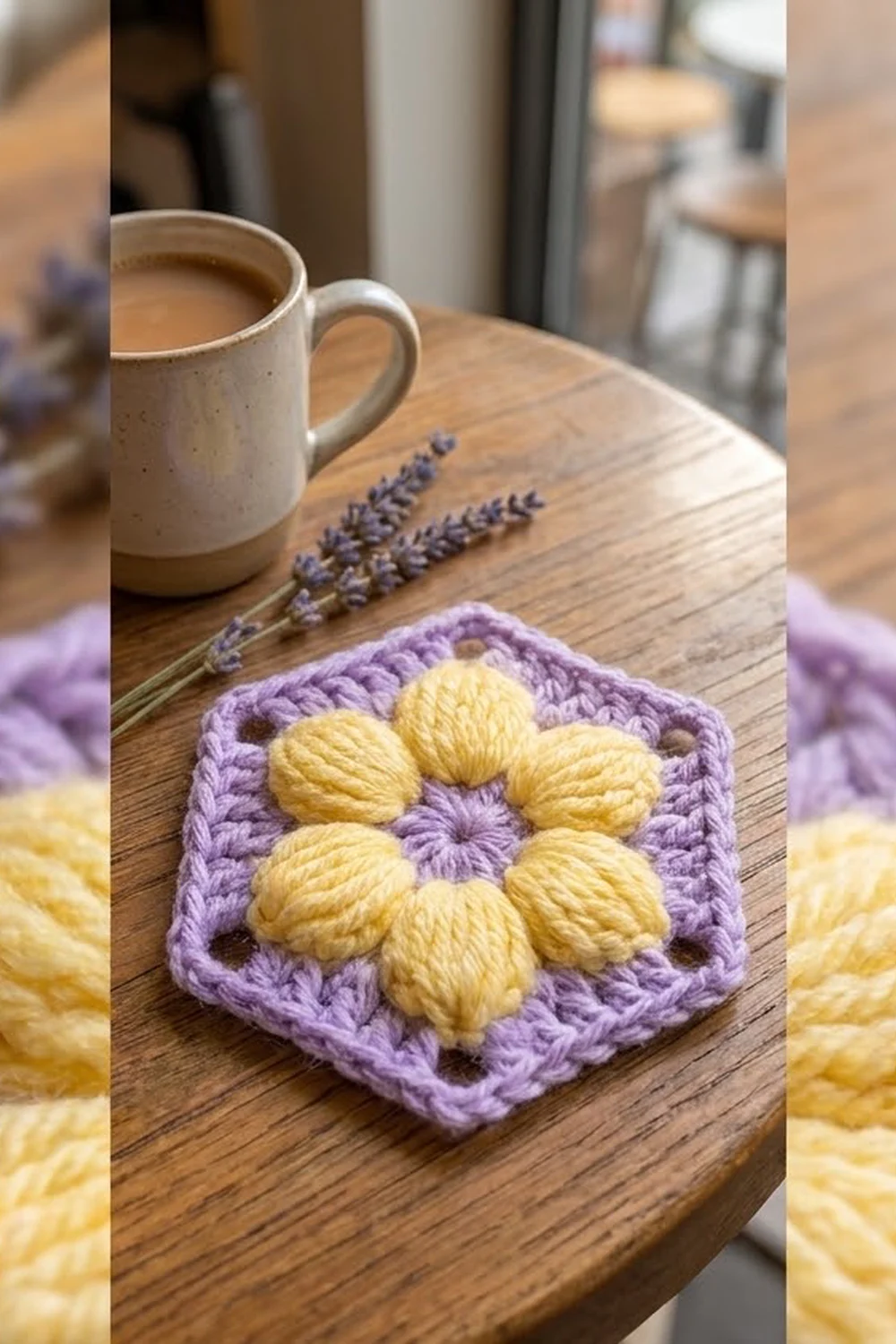
If you hit all of these checkpoints, your motif will lie flat with even points and full petals. It works well on its own as a coaster, a bag patch or a decorative appliqué. If you make more later, block each one to the same measurements so they all match.
Happy crocheting!