

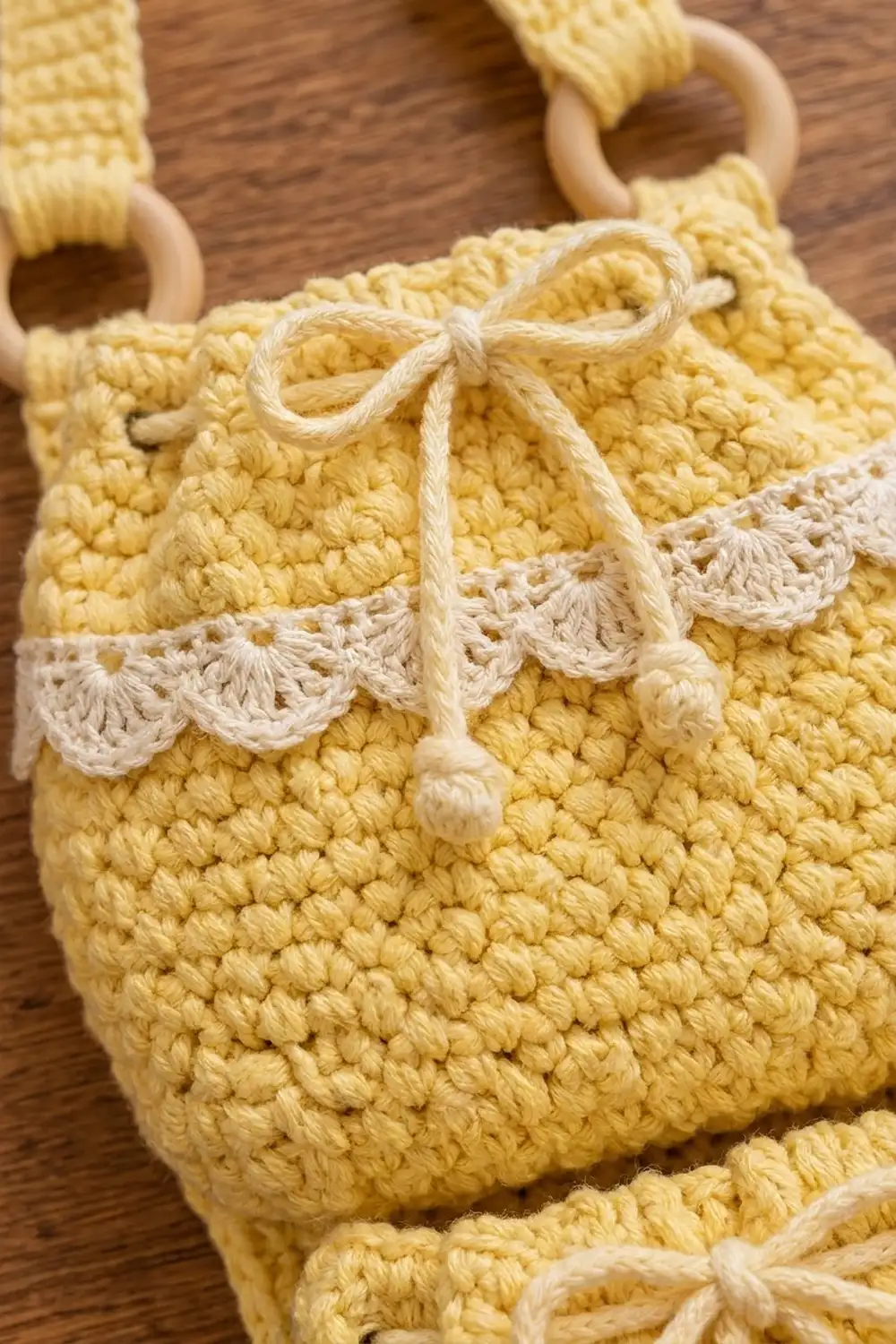
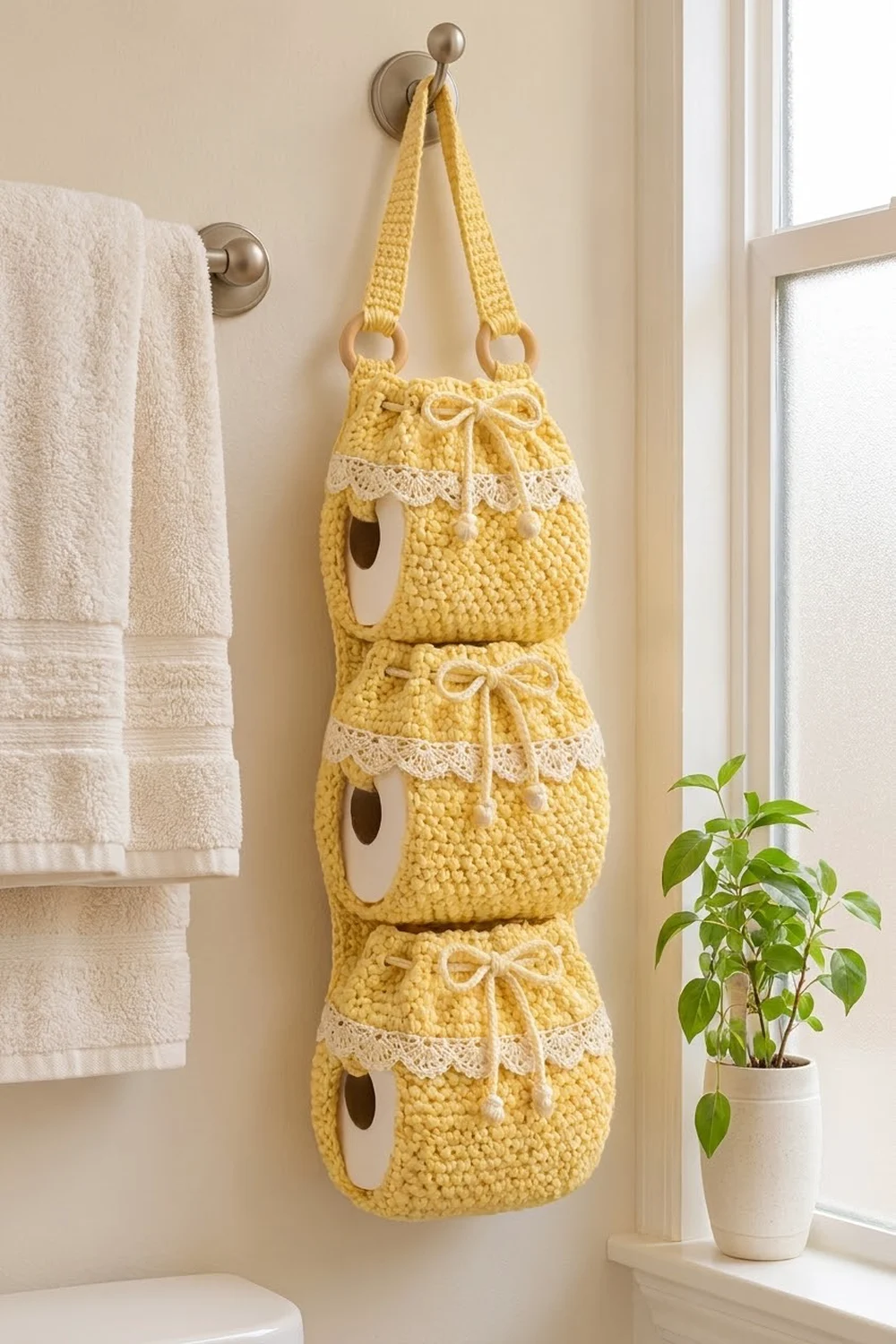
This hanging toilet roll holder is soft, pebbly and a little vintage. Three gathered pockets are stacked on a long back panel, and each one holds a spare roll. A cream scalloped lace strip runs across every pocket, and a cream drawstring bow with tiny bobble ends finishes each top.
The main fabric is butter-yellow worsted yarn in a sc/dc seed stitch, which gives the nubby, pebble-like texture. The lace, drawstrings and bobbles are cream. A yellow strap and two natural wooden rings let the holder hang from a towel hook or a door hook.
This pattern uses US crochet terms. The back panel is 6.5 in (16.5 cm) wide and 17.5 in (44.5 cm) tall when finished. With the strap, the holder hangs about 23 in (58.4 cm) from the top of the strap to the bottom edge.
Everything is worked flat. You’ll make one back panel, three pockets, three lace strips, three drawstrings with bobble ends and one strap. You sew each pocket bottom across the panel, then work one border round that joins the pocket sides and finishes the edge at the same time.
Finished Size and Construction
- Finished size: 6.5 in x 17.5 in (16.5 cm x 44.5 cm) for the panel; about 23 in (58.4 cm) total hanging length
- Skill level: Easy-intermediate
- Terminology: US crochet terms
- Yarn weight: Worsted (#4)
- Hook: 4.5 mm (US 7)
- Number of pieces: 11 crocheted pieces (1 back panel, 3 pockets, 3 lace strips, 3 drawstrings, 1 strap), plus 6 bobbles and 2 wooden rings
- Layout: 3 pockets stacked in 1 column
- Pocket size: 10 in x 5.5 in (25.4 cm x 14.0 cm) flat; the bottom edge is 6 in (15.2 cm) after the trim row
- Back panel size before border: 6 in x 17 in (15.2 cm x 43.2 cm)
- Border depth: 0.25 in (0.6 cm) on each side, 1 round
Materials
Pick a smooth, soft worsted yarn with clear stitch definition. Acrylic and cotton blends both work, and both handle bathroom humidity. For crisper lace, you can use a worsted cotton for the cream.
- Yellow (main color): 130 g, about 260 m (284 yd)
- Cream (lace, drawstrings, bobbles): 40 g, about 80 m (87 yd)
These amounts include about 25% extra for swatching and differences in tension.
Tools:
- 4.5 mm (US 7) crochet hook
- 2 wooden rings, 2 in (5.1 cm) outer diameter
- Tapestry needle
- Locking stitch markers (at least 8)
- Scissors
- Blocking mat and rust-proof pins
- Spray bottle
- Measuring tape
Abbreviations (US Terms)
- ch = chain
- sl st = slip stitch
- sc = single crochet
- dc = double crochet
- sc2tog = single crochet 2 together
- sk = skip
- sp = space
- st(s) = stitch(es)
- RS = right side
Special stitch: Seed stitch (sc/dc). Work over an even number of sts. On the first row, work (sc, dc) across and end with a dc. On every later row, ch 1 (this doesn’t count as a st), turn, then work a sc in each dc and a dc in each sc. Every row starts with a sc and ends with a dc. The short and tall stitches nest into each other, which creates the pebble texture.
Gauge and Checkpoints
Gauge: 16 sts and 16 rows = 4 in (10.2 cm) in seed stitch, after light blocking. That’s 4 sts and 4 rows per 1 in (2.5 cm).
Make one pocket first as your test piece. It’s small, it uses every main stitch, and it shows whether the rest of the project will match.
Checkpoints:
- Pocket after Row 8: 10 in (25.4 cm) wide and 2 in (5.1 cm) tall.
- Pocket after Row 22: 10 in x 5.5 in (25.4 cm x 14.0 cm).
- Back panel after Row 16: 6 in (15.2 cm) wide and 4 in (10.2 cm) tall.
- Back panel after Row 68: 6 in x 17 in (15.2 cm x 43.2 cm).
- After the border: 6.5 in x 17.5 in (16.5 cm x 44.5 cm).
If your piece is too big, go down 0.5 mm in hook size. If it’s too small, go up 0.5 mm. Row gauge matters as much as stitch gauge here, because each pocket side has to match 22 panel rows exactly. Make all pieces with the same hook and the same relaxed tension.
Back Panel
Make 1 in yellow.
Row 1: Ch 25, sc in 2nd ch from hook, dc in next ch, *sc in next ch, dc in next ch; repeat from * across. (24 sts: 12 sc, 12 dc)
Rows 2–68: Ch 1, turn, seed stitch across. (24 sts in each row)
Fasten off. The panel should measure 6 in x 17 in (15.2 cm x 43.2 cm). Put markers in the right-edge row ends of Rows 22 and 44. These mark the seam lines for the middle and top pockets.
Pockets
Make 3 in yellow. Each pocket is worked from the bottom up.
Row 1: Ch 41, sc in 2nd ch from hook, dc in next ch, *sc in next ch, dc in next ch; repeat from * across. (40 sts)
Rows 2–17: Ch 1, turn, seed stitch across. (40 sts)
Row 18 (eyelet row): Ch 1, turn, sc in first 2 sts, [ch 1, sk next st, sc in next 3 sts] 9 times, ch 1, sk next st, sc in last st. (40 sts: 30 sc + 10 ch-1 sps, which makes 10 eyelets)
Row 19: Ch 1, turn, sc in each sc and in each ch-1 sp across. (40 sc)
Rows 20–22: Ch 1, turn, seed stitch across. (40 sts)
Fasten off. The pocket should measure 10 in x 5.5 in (25.4 cm x 14.0 cm). Rows 20–22 are 0.75 in (1.9 cm) tall and form the ruffle above the drawstring.
Bottom trim (conversion row): With RS facing, join yellow in the first foundation ch. Ch 1, [sc in next st, sc2tog twice] 8 times. (24 sts = 8 sc worked 1 per st + 16 sc2tog; all 40 foundation sts used)
Fasten off and leave a 24 in (61.0 cm) tail. The bottom edge now measures 6 in (15.2 cm), the same width as the panel, and the top is still 10 in (25.4 cm). The extra 4 in (10.2 cm) wraps around the roll and makes the pocket puffy.
Lace Strips
Make 3 in cream.
Row 1: Ch 42, sc in 2nd ch from hook and in each ch across. (41 sc)
Row 2 (shells): Ch 1, turn, sc in first sc, *sk next sc, ([dc, ch 1] 3 times, dc) in next sc, sk next sc, sc in next sc; repeat from * 9 more times. (10 shells and 11 sc; all 41 sts used)
Row 3 (picots): Ch 1, turn, sl st in first sc, *(sc, ch 2, sc) in each of the 3 ch-1 sps of the next shell, sl st in next sc; repeat from * 9 more times. (10 scallops, 30 picots)
Fasten off. Each strip should be about 10.25 in x 1 in (26.0 cm x 2.5 cm).
Drawstrings and Bobbles
Drawstrings: Make 3 in cream. Ch 105, which is about 30 in (76.2 cm). Sl st in the back bump of the 2nd ch from hook and in each back bump across. (104 sl sts) Fasten off.
Bobbles: Make 6 in cream.
Rnd 1: Magic ring, 6 sc in ring. (6 sc)
Rnd 2: Sc in each sc around. (6 sc) Tuck the tails inside as stuffing.
Rnd 3: Sc2tog 3 times. (3 sts)
Fasten off and close the hole. Sew one bobble, about 0.5 in (1.3 cm) across, to each drawstring end.
Strap
Make 1 in yellow.
Row 1: Ch 7, sc in 2nd ch from hook, dc in next ch, [sc in next ch, dc in next ch] 2 times. (6 sts)
Rows 2–56: Ch 1, turn, seed stitch across. (6 sts)
Fasten off. The strap should measure 1.5 in x 14 in (3.8 cm x 35.6 cm).
Make All Pieces
Before you start assembly, check that you have:
- Yellow: 1 back panel, 3 pockets with the bottom trim done, and 1 strap
- Cream: 3 lace strips, 3 drawstrings and 6 bobbles
- Hardware: 2 wooden rings
Layout (front view, top to bottom):
   O------- strap -------O      rings at top corners
 [ Panel Rows 67-68: top band ]
 [ Pocket 3: panel Rows 45-66 ]
 [ Pocket 2: panel Rows 23-44 ]
 [ Pocket 1: panel Rows 1-22  ]
Block all flat pieces lightly to their checkpoint sizes before joining.
Joining
Step 1: Attach the lace. Lay a lace strip across a pocket with the scallops pointing down. Line up the lace’s Row 1 with pocket Row 15, which is 3.75 in (9.5 cm) above the bottom edge. Sew it on with small running stitches in cream, and fold 1 st at each end to the back. Repeat for all three pockets.
Step 2: Sew the pocket bottoms. Each bottom seam is 24 sts to 24 sts, one to one.
- Pocket 1: Whipstitch the 24 trim sts to the 24 foundation chs of the panel.
- Pocket 2: Whipstitch the 24 trim sts across the front of the panel, along the tops of the 24 sts of Row 22.
- Pocket 3: Do the same along Row 44.
Keep the tension firm but not tight. Each seam should lie flat and measure 6 in (15.2 cm).
Step 3: Pin the sides. Pin each pocket’s 22 row ends to 22 panel row ends: Pocket 1 to Rows 1–22, Pocket 2 to Rows 23–44 and Pocket 3 to Rows 45–66. Place a pin every 4 rows. The pockets should bulge outward.
Size checkpoint: The panel edges should still measure 6 in x 17 in (15.2 cm x 43.2 cm). If a pocket side is longer than its 22 panel rows, check your row gauge before you continue.
Border
Border gauge: 1 sc per st across the top and bottom, and 1 sc per row end on the sides. That matches the gauge of 4 sts and 4 rows per 1 in (2.5 cm).
Rnd 1: With RS facing, join yellow in the first st of Row 68 at the top right corner. Ch 1.
- Top: Sc in each of the 24 sts of Row 68. (24 sc) Ch 2 for the corner.
- Left side: Work 1 sc in each of the 68 row ends. Where there’s a pocket, put the hook through both the pocket row end and the panel row end. (68 sc) Ch 2 for the corner.
- Bottom: Sc in each of the 24 foundation chs, catching the Pocket 1 trim sts as you go. (24 sc) Ch 2 for the corner.
- Right side: Work 1 sc in each of the 68 row ends, going through both layers at the pockets. (68 sc) Ch 2, then sl st to the first sc.
Total: 184 sc + 4 ch-2 corner sps. The corners are separate ch-2 spaces and are not included in the per-side counts. Fasten off and weave in the ends.
Why the math works: At 4 sts and 4 rows per inch, 1 sc per st or per row end keeps every edge the same length as the fabric. The three pockets take 3 x 22 = 66 rows, which leaves Rows 67–68 free as the top band. The border adds 0.25 in (0.6 cm) on each side, so 6 in x 17 in (15.2 cm x 43.2 cm) becomes 6.5 in x 17.5 in (16.5 cm x 44.5 cm).
Drawstrings, Rings and Strap
Drawstrings: Start at center front, between eyelets 5 and 6. Weave a drawstring in and out through the eyelets toward one side. Carry it across the back by weaving through the matching panel row: Row 18 for Pocket 1, Row 40 for Pocket 2 and Row 62 for Pocket 3. Then bring it back through the remaining eyelets so both ends come out at center front. Gather the top gently and tie a bow.
Rings: Center a ring over each top corner so that half of it sits above the panel. Whipstitch the ring to the corner ch-2 sp and the 3 nearest border sc.
Strap: Wrap 1 in (2.5 cm) of each strap end around a ring toward the back and sew it down. The finished strap loop is 12 in (30.5 cm) long.
Final Blocking
- Mist the whole holder lightly with water.
- Lay it face up on the blocking mat.
- Pin the panel to 6.5 in x 17.5 in (16.5 cm x 44.5 cm).
- Put a toilet roll or a rolled towel in each pocket so it dries rounded.
- Pin each lace picot flat.
- Let it dry completely, then take out the pins and re-tie the bows.
Final Quality-Control Checklist
- The panel measures 6.5 in x 17.5 in (16.5 cm x 44.5 cm).
- Each bottom seam is 24 sts to 24 sts, with no gaps.
- Each pocket side covers exactly 22 panel rows.
- The border has 24 sc on the top and bottom, 68 sc on each side and 4 ch-2 corners.
- All 10 eyelets on each pocket are threaded.
- Each lace strip has 10 scallops and sits level.
- The bobbles, rings and strap are all secure.
Troubleshooting
- The pocket is too shallow for a roll: It’s narrower than 10 in (25.4 cm). Go up a hook size and remake it.
- The pocket sides are longer than the panel rows: Your row gauge is off. Make all pieces with the same hook.
- The bottom seam puckers: The trim row is too tight. Rework it more loosely.
- The border ripples or pulls in: Count exactly 68 sc on each side.
- The lace curls: Block it flat before you sew it on.
- The top band sags: Sew the rings through more border stitches.
Care
Hand wash in cool water. Untie the bows first, then reshape the pockets and lay the holder flat to dry.
Final Notes
Everything in this pattern follows from one gauge: 4 sts and 4 rows per 1 in (2.5 cm). The back panel is 24 sts x 68 rows, or 6 in x 17 in (15.2 cm x 43.2 cm). Each pocket is 40 sts x 22 rows, or 10 in x 5.5 in (25.4 cm x 14.0 cm), and its bottom is trimmed to 24 sts to match the panel. The three pockets fill 66 of the 68 panel rows. One border round of 184 sc brings the holder to 6.5 in x 17.5 in (16.5 cm x 44.5 cm). Check your measurements at each checkpoint and the pieces will line up.
Happy crocheting!