

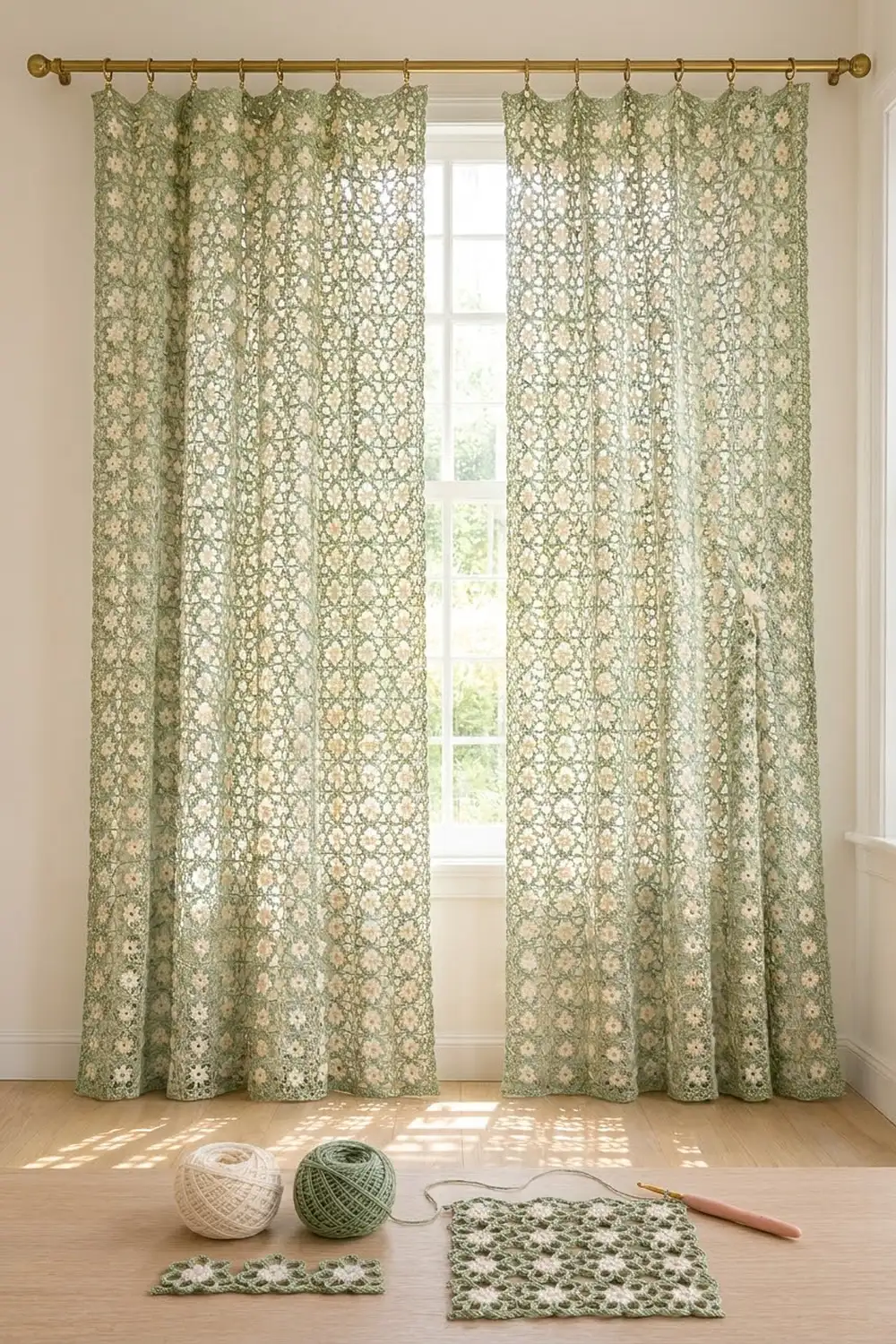
The Sage Daisy Lace Curtain is a light, airy pair of panels made from small flower motifs. Each motif has a solid cream daisy in the center and a ring of open sage-green chain-loop petals around it. Once the motifs are joined, the loops form round windows of light between the flowers, so the curtain filters daylight instead of blocking it.
The palette is calm and natural: soft cream daisies on a muted sage background. The style is cottage-romantic and still simple. It suits a bedroom, a kitchen window, or any room where you want privacy without darkness.
This pattern uses US crochet terms. Each finished panel measures 40 in wide x 82 in long (101.6 cm x 208.3 cm) after the border and blocking. You make two identical panels.
Construction is join-as-you-go. You crochet each motif in three rounds: two cream rounds for the daisy and one green round of chain loops. As you work the green round, you connect the loops to the motifs that are already finished. A three-round green border then straightens the edges and gives the clip rings a firm place to grip.
Finished Size and Construction
- Finished size (per panel): 40 in x 82 in (101.6 cm x 208.3 cm)
- Skill level: Intermediate
- Terminology: US crochet terms
- Yarn weight: DK (#3) cotton or cotton blend
- Hook: 4.0 mm (US G-6)
- Number of pieces: 253 motifs per panel, 506 motifs in total for 2 panels
- Layout: 11 motifs wide x 23 motifs long per panel
- Motif size: 3.5 in (8.9 cm) side to side, blocked
- Size before border: 38.5 in x 80.5 in (97.8 cm x 204.5 cm)
- Border depth: 0.75 in (1.9 cm) on each side
Materials
Choose a smooth, mercerized or matte DK cotton, about 110 m per 50 g (roughly 2.2 m per gram). Cotton keeps the loops crisp, blocks well, and holds up in sunlight. Avoid fuzzy yarns, because they blur the open loops.
Yarn (for two panels):
– Sage green (Color A): 1,550 g / about 3,410 m
– Cream (Color B): 650 g / about 1,430 m
These quantities include a margin of about 10% for gauge differences, swatching, and joins.
Tools:
– 4.0 mm (US G-6) crochet hook
– Tapestry needle
– Stitch markers
– Rust-proof pins and blocking mats
– Measuring tape
– 24 curtain clip rings (12 per panel)
Abbreviations (US Terms)
- ch – chain
- sl st – slip stitch
- sc – single crochet
- hdc – half double crochet
- dc – double crochet
- sp – space
- rep – repeat
- st(s) – stitch(es)
Special stitch – standing sc: Start with a slip knot on the hook. Insert the hook into the stitch, yarn over, pull up a loop, yarn over, and pull through both loops.
Special technique – loop join: Work the first half of the chain loop. Remove the hook from the loop, insert it from front to back through the center chain of the neighbor’s matching loop, pick up the dropped loop, and pull it through. Then work the second half of the chain loop. The join counts as the loop’s center chain.
Gauge and Checkpoints
Make one motif, then a 2 x 2 test block of four joined motifs, before you start a panel. Wet-block the test block and pin it flat.
- Checkpoint 1 (after cream Rnd 2): The daisy measures 1.25 in (3.2 cm) across.
- Checkpoint 2 (one motif, blocked): 3.5 in (8.9 cm) side to side, measured from the tip of one side loop to the tip of the opposite side loop.
- Checkpoint 3 (2 x 2 block, blocked): 7 in x 7 in (17.8 cm x 17.8 cm).
- Border gauge: 16 sc = 3.5 in (8.9 cm), and 4 rounds of sc = 1 in (2.5 cm).
If your motif is too big: Go down to a 3.75 mm hook, or chain more tightly.
If your motif is too small: Go up to a 4.5 mm hook.
Matching the motif size matters more than matching the daisy size, because the motif size sets the panel size.

Motif Pattern
Each motif has 4 corner petals and 4 side petals, alternating around the daisy. The longer ch-17 loops point to the corners and the shorter ch-13 loops point straight out to the sides. This turns a round flower into a square unit that tiles neatly in a grid.
Round 1 (Color B, cream)
Make a magic ring, ch 1, and work 8 sc in the ring. Pull the ring closed, leaving a small center hole. Sl st to the first sc. (8 sc)
Round 2 (Color B, cream)
*In the next sc work (sl st, hdc, dc, hdc). Rep from * 7 more times. Sl st to the first sl st. Fasten off and weave in the end.
(8 petals; 32 sts: 8 sl st, 16 hdc, 8 dc)
Check: there are 8 petals, and each one has a dc at its tip. Mark any 4 alternating petals as corner petals. The other 4 are side petals.
Round 3 (Color A, sage green), first motif with no joins
Join Color A with a standing sc in the dc of a corner petal.
*Ch 17, sc in the same dc (corner loop made). Ch 3, sc in the dc of the next (side) petal. Ch 13, sc in the same dc (side loop made). Ch 3, sc in the dc of the next (corner) petal. Rep from * 3 more times, leaving out the last sc on the final repeat. Sl st to the first sc. Fasten off.
Round 3 count: 4 corner loops (ch-17), 4 side loops (ch-13), 8 ch-3 sps, 16 sc.
Total: 16 sc + 68 ch + 52 ch + 24 ch = 160 sts.
The ch-3 spaces lie flat along the daisy edge between petals. The long loops stand out as open, teardrop-shaped green petals.
Make All Pieces
Each panel needs 253 motifs arranged 11 wide x 23 long. Every motif uses both colors.
- Cream centers (Rnds 1–2): 253 per panel, 506 total
- Green rounds (Rnd 3): 253 per panel, 506 total
To save time, make all the cream centers in batches first. Then add the green round to each one as you join.
Layout grid (one panel, M = motif):
Row 1:  M M M M M M M M M M M   (11)
Row 2:  M M M M M M M M M M M   (11)
Row 3:  M M M M M M M M M M M   (11)
  ...   repeat to
Row 23: M M M M M M M M M M M   (11)
11 columns x 23 rows = 253 motifs
Joining (Join-As-You-Go)
Work Row 1 from left to right, then each new row from left to right above the last one. Only Rnd 3 changes when you join. The cream center is always made the same way.
Side loop join: Instead of ch 13, work ch 6, a loop join into the center (7th) chain of the neighbor’s side loop, then ch 6, and sc in the same dc.
Corner loop join: Instead of ch 17, work ch 8, a loop join into the center (9th) chain of the neighbor’s corner loop, then ch 8, and sc in the same dc.
Joining logic, stitch to stitch:
– Motifs in Row 1 after the first: Join 1 side loop, plus the corner loop on each side of it, to the motif on the left.
– First motif of each new row: Join 1 side loop and its 2 flanking corner loops to the motif below.
– All other motifs: Join to the left motif (1 side + 2 corners) and to the motif below (1 side + 2 corners). One corner loop is shared by both joins, so you join 2 side loops and 3 corner loops in total.
– Four-motif junctions: Always join into the center chain of the first motif’s corner loop, so all four corners meet at one point.
The stitch count of every motif stays at 160, because each loop join takes the place of one center chain.
Tension advice: Keep your chains even and slightly relaxed. Tight chains make the panel pucker. Loose chains make the loops sag when the curtain hangs.
Size checkpoint: After Row 1, the strip should measure 38.5 in (97.8 cm) long when relaxed flat. After 4 rows, the piece should be 14 in (35.6 cm) deep. The finished grid should measure 38.5 in x 80.5 in (97.8 cm x 204.5 cm) before the border.
Border
Border gauge: 16 sc = 3.5 in (8.9 cm), the same as the width of one motif.
Each motif presents 3 loops along an edge: the outer half of one corner loop, one side loop, and the outer half of the next corner loop. Along any edge, every motif gets exactly 16 sc: 5 sc in the corner loop, 6 sc in the side loop, and 5 sc in the next corner loop. This per-side count does not include the panel’s corners. The panel’s corners are separate ch-2 spaces.
Round 1 (Color A)
Join with a standing sc in the first corner loop of the top-right motif, just after the panel corner. For each motif along the top, work 5 sc in the corner loop, 6 sc in the side loop, and 5 sc in the next corner loop.
At each panel corner, the corner motif’s corner loop holds both sides: 5 sc, ch 2, 5 sc. Continue the same way around all four sides and sl st to the first sc.
- Top and bottom: 11 x 16 = 176 sc each
- Long sides: 23 x 16 = 368 sc each
- Total: 1,088 sc + 4 corner ch-2 sps
Round 2
Ch 1, sc in each sc, and work (sc, ch 2, sc) in each corner sp. Sl st to the first sc.
– Top/bottom: 176 + 2 = 178 sc; long sides: 368 + 2 = 370 sc; total: 1,096 sc
Round 3
Repeat Round 2. Fasten off.
– Top/bottom: 178 + 2 = 180 sc; long sides: 370 + 2 = 372 sc; total: 1,104 sc
Why the math works: 16 sc per 3.5 in (8.9 cm) motif matches the border gauge, so Round 1 lies flat without ruffling or drawing in. The only additions are 2 sc per side per round at the corners, which turn the corner neatly. Three rounds at 4 rounds per inch give a 0.75 in (1.9 cm) border. That brings each panel to 40 in x 82 in (101.6 cm x 208.3 cm).
Final Blocking
- Weave in all remaining ends along the chain loops, not through the cream centers.
- Soak the panel in cool water with a little wool wash for 15 minutes.
- Press out the water gently. Roll the panel in towels. Don’t wring it.
- Lay the panel flat on mats or a clean sheet over carpet, working in sections if you need to.
- Pin the border straight to 40 in x 82 in (101.6 cm x 208.3 cm), pinning every 4 in (10.2 cm).
- Open the loops so each daisy sits centered and each four-motif junction forms a neat point.
- Let the panel dry completely, then unpin.
- Clip 12 rings along the top edge: one at each end and one at each of the 10 motif seams.
Final Quality-Control Checklist
- Every daisy has 8 petals and a closed center hole.
- Every motif has 4 corner loops and 4 side loops.
- Every four-motif junction meets at a single point.
- No unjoined loops are left inside the panel.
- Border Round 3 has 180 sc on the top and bottom edges and 372 sc on each long side.
- The panel measures 40 in x 82 in (101.6 cm x 208.3 cm).
- Both panels match each other within 0.5 in (1.3 cm).
- All ends are hidden and secure.
Troubleshooting
- The panel is narrowing: Your chains are too tight. Relax your tension or go up half a hook size for Rnd 3 only.
- The loops droop when hung: Your chains are too loose. Go down half a hook size for Rnd 3.
- The border ruffles: Check that you have 16 sc per motif, not more.
- The border pulls in: You skipped sc in the corner loops. Recount to 5 + 6 + 5.
- The daisy cups: Work Rnd 2 more loosely, or block the daisy flat with steam.
- A loop is joined to the wrong spot: Undo the green round back to that loop and redo the join through the center chain.
Care
Hand wash cool or machine wash on a gentle cycle in a mesh bag, then reshape and dry flat. Avoid hanging the panels wet, because the weight will stretch the loops.
Final Notes
The measurement chain is simple. A 1.25 in (3.2 cm) daisy grows into a 3.5 in (8.9 cm) motif. Eleven motifs make 38.5 in (97.8 cm) of width, and 23 motifs make 80.5 in (204.5 cm) of length. A 0.75 in (1.9 cm) border on each side completes a 40 in x 82 in (101.6 cm x 208.3 cm) panel. Check each stage before you move on, and your two panels will hang straight and match.
Happy crocheting!