

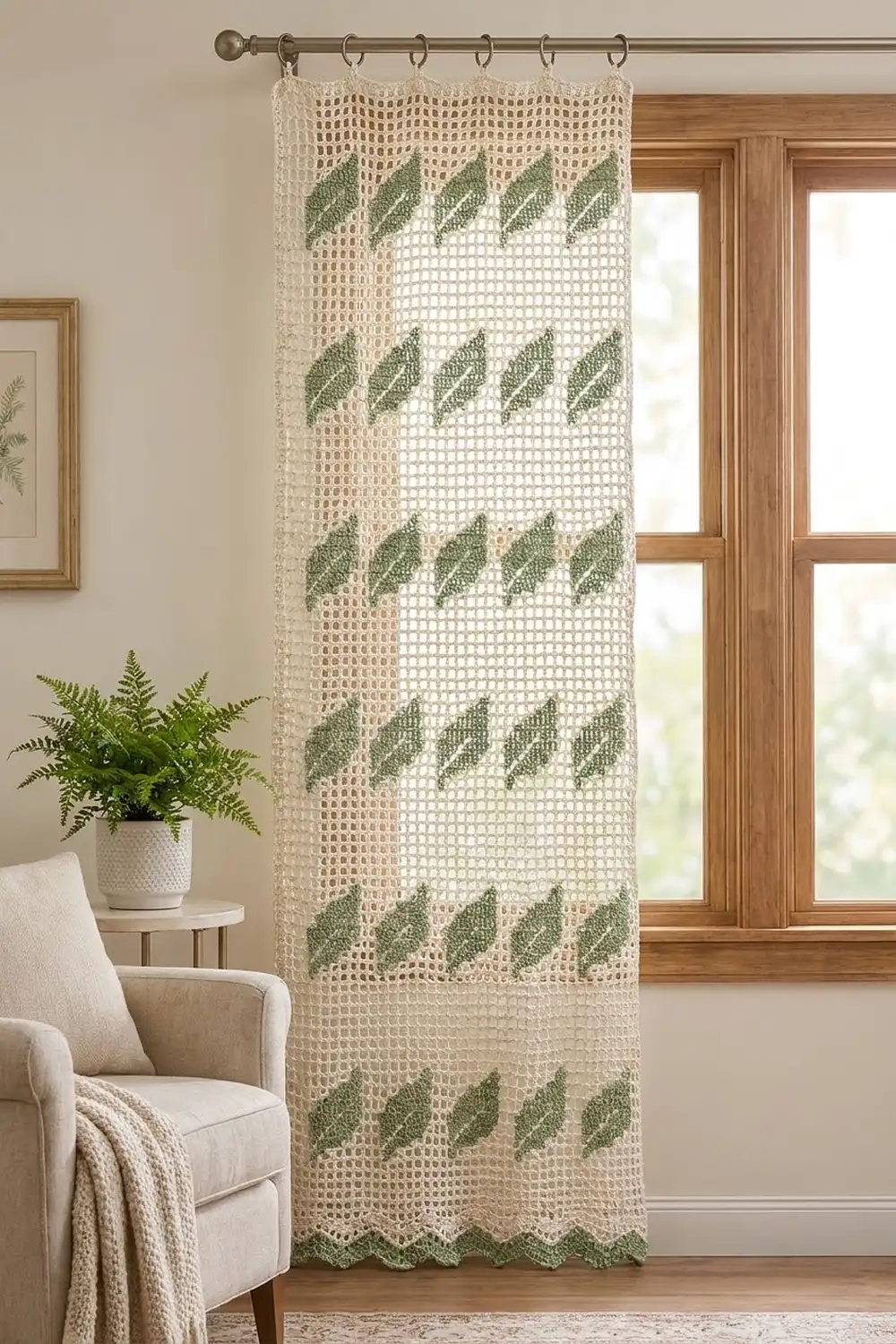
This curtain panel has a light, airy filet mesh in soft cream with bands of slanted sage-green leaves. When it hangs at a window, light comes through the open squares and the leaves stand out as solid shapes, like a row of leaves blowing past the glass.
The palette has just two colors: cream for the mesh, border and hanging loops, and sage green for the leaves and the pointed scallops at the hem. The style is cottage-garden and fresh. The design comes from simple filet blocks and spaces, so you don’t need any advanced stitches.
The pattern uses US crochet terms. The finished panel measures 28.5 in wide × 78 in long (72.4 × 198.1 cm), or 78.75 in (200.0 cm) to the top of the hanging loops.
You work the panel flat in rows from the bottom up, as one piece. Seven leaf bands are worked into the mesh as you go. After that, a single-crochet round frames the panel, hanging loops are added across the top, and a two-row shell-and-scallop edging finishes the hem.
Finished Size and Construction
- Finished size: 28.5 × 78 in (72.4 × 198.1 cm), plus 0.75 in (1.9 cm) loops
- Skill level: Intermediate (filet colorwork)
- Terminology: US
- Yarn weight: Sport (#2 fine) cotton
- Hook: 3.5 mm (E-4)
- Number of pieces: 1 panel
- Layout: 56 squares wide × 152 rows tall
- Piece size before border: 28 × 76 in (71.1 × 193.0 cm)
- Border depth: 0.25 in (0.6 cm) on the sides and top, 1.75 in (4.4 cm) at the hem (sc round plus edging)
Materials
Use a smooth, mercerized or combed sport-weight cotton. Cotton holds the square shape of the mesh, hangs straight and washes well. Avoid fuzzy yarns, because they blur the open squares.
- Cream (main color): 250 g, about 750 m (820 yd), which is 5 balls of 50 g / 150 m (164 yd)
- Sage green (contrast): 100 g, about 300 m (328 yd), which is 2 balls of 50 g / 150 m (164 yd)
These quantities include a margin of about 15% for swatching and color changes.
Tools:
– 3.5 mm (E-4) crochet hook
– 5 small yarn bobbins (or wound butterflies) for green
– Tapestry needle
– Stitch markers
– Tape measure
– Blocking mats and rust-proof pins
Abbreviations (US Terms)
- ch – chain
- sl st – slip stitch
- sc – single crochet
- dc – double crochet
- sk – skip
- sp – space
- RS / WS – right side / wrong side
Filet squares: Every row begins with ch 3, which counts as the first dc. After that, each square is 3 stitches:
- Space (S): ch 2, sk 2 sts, dc in next dc.
- Block (B): 2 dc (into the ch-2 sp, or into the next 2 dc), dc in next dc.
- Vein (V): a Space worked in green inside a leaf.
A full row is 1 starting dc + 56 squares × 3 sts = 169 sts.
Color change: Change color on the last yarn over of the stitch before the new color starts.
Gauge and Checkpoints
Gauge: 8 squares and 8 rows = 4 in (10.2 cm) in filet mesh. One square is 0.5 in (1.3 cm) wide, and one row is 0.5 in (1.3 cm) tall.
Test first: ch 39 and work Row 1 below over those chains (37 dc = 12 squares). Then work 9 rows of Spaces, for 10 rows in total. The swatch should measure 6 × 5 in (15.2 × 12.7 cm).
- Too big: go down 0.5 mm.
- Too small: go up 0.5 mm.
Even a small gauge error adds up fast over 152 rows. A difference of just 1 row per 4 in changes the length by more than 9 in (22.9 cm).
Checkpoints:
– After Row 1: 28 in (71.1 cm) wide
– After Row 12 (first band): 6 in (15.2 cm) tall
– After Row 34: 17 in (43.2 cm)
– After Row 78: 39 in (99.1 cm)
– After Row 152: 76 in (193.0 cm)
Panel Layout
The 56 squares are numbered 1 to 56 from the right edge as seen on the RS. Odd rows are RS rows and run 1→56. Even rows are WS rows and run 56→1.
- Squares 1–3 and 54–56 are always plain Spaces. This gives a margin of 1.5 in (3.8 cm) on each side.
- Squares 4–53 hold 5 leaf repeats of 10 squares each, so each repeat is 5 in (12.7 cm) wide.
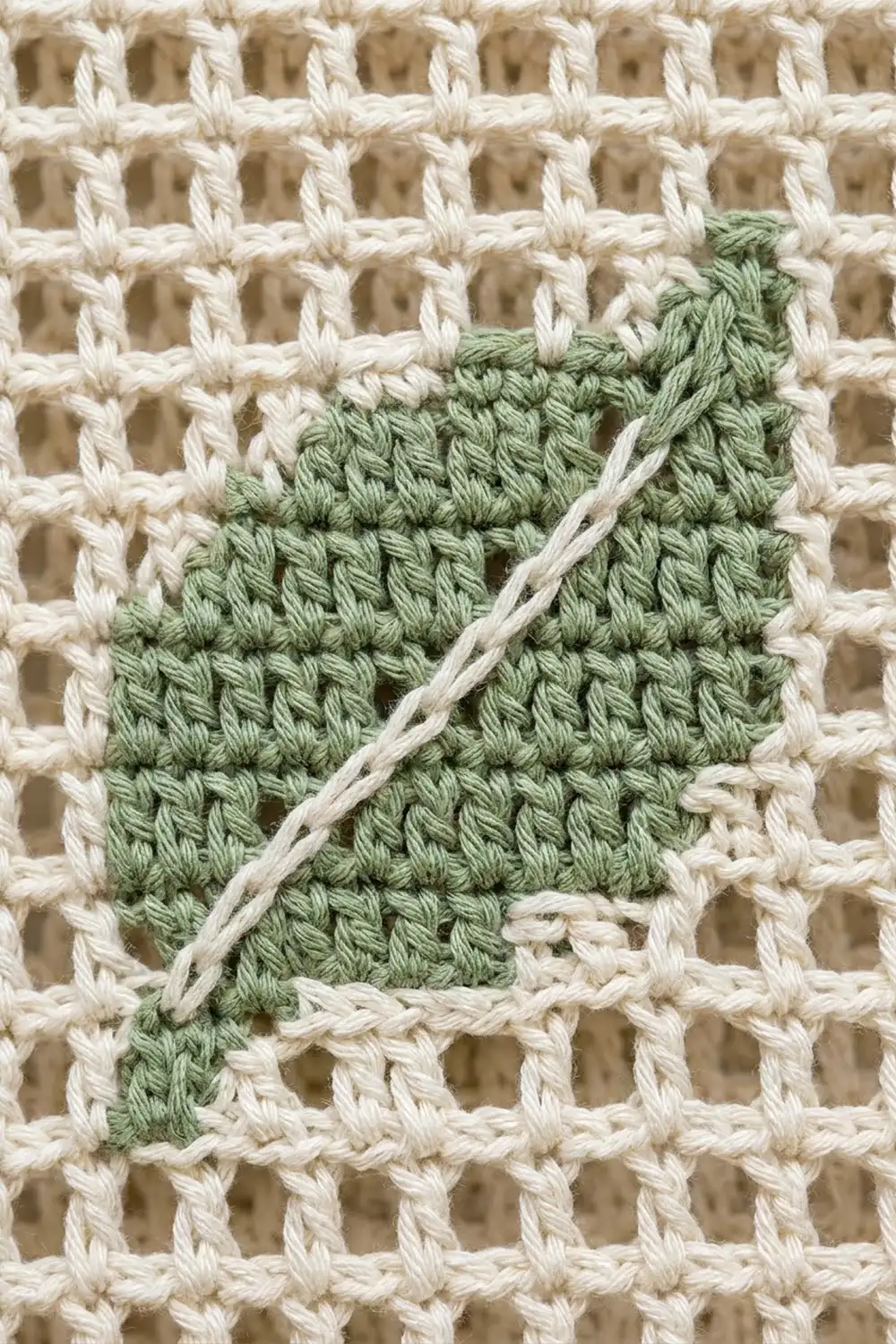
- Each leaf is 8 rows tall and 8 squares wide, which is 4 × 4 in (10.2 × 10.2 cm).
Row plan:
– Rows 1–4: bottom margin
– Leaf bands: Rows 5–12, 27–34, 49–56, 71–78, 93–100, 115–122, 137–144
– Plain spacers: 14 rows (7 in / 17.8 cm) between bands
– Rows 145–152: top margin
Panel
With cream, ch 171.
Row 1 (RS): dc in 4th ch from hook. The skipped 3 ch count as a dc. Dc in each remaining ch across. (169 dc, or 56 Blocks) Turn. This row gives the hem a firm base.
Rows 2–4: ch 3, then work 56 Spaces. (169 sts: 57 dc + 56 ch-2 sps) Turn.
Leaf Band (worked 7 times)
Before Row 5, wind 5 green bobbins with about 4 m (4.4 yd) each, one for each leaf.
Each row: ch 3, 3 S (margin), then the repeat sequence below 5 times, then 3 S. Turn. Every row is 169 sts.
Work green Blocks and Veins with that leaf’s bobbin. Carry the cream strand inside the green dc so it stays tucked away. Across a Vein’s ch-2, let the cream strand lie behind the chains on the WS. It shows as a fine pale midrib through the leaf.
If a green bobbin ends 1–2 squares away from where it’s needed next, carry it inside the cream dc to reach its new start.
The repeat sequences are listed in working order:
- L1 (RS): 8 S, 1 B, 1 S (stem; 1 green square per leaf)
- L2 (WS): 2 S, 2 B, 6 S (2 green)
- L3 (RS): 4 S, 2 B, 1 V, 1 B, 2 S (4 green)
- L4 (WS): 2 S, 2 B, 1 V, 2 B, 3 S (5 green)
- L5 (RS): 2 S, 2 B, 1 V, 2 B, 3 S (5 green)
- L6 (WS): 4 S, 2 B, 1 V, 1 B, 2 S (4 green)
- L7 (RS): 2 S, 3 B, 5 S (3 green)
- L8 (WS): 7 S, 2 B, 1 S (tip; 2 green)
Each sequence adds up to 10 squares. Seen from the RS, the stem sits at repeat position 9, the vein climbs diagonally through positions 7, 6, 5 and 4, and the tip ends at positions 2–3. This gives the lower-left to upper-right slant. Cut the green bobbins after L8, leaving 6 in (15.2 cm) tails.
Rows 5–152
- Rows 5–12: Leaf Band.
- Rows 13–26: 14 rows of 56 Spaces.
- Repeat these 22 rows 5 more times (through Row 144). The bands fall on Rows 27–34, 49–56, 71–78, 93–100, 115–122 and 137–144.
- Rows 145–152: 56 Spaces each.
Don’t fasten off. The panel should now measure 28 × 76 in (71.1 × 193.0 cm).
Border
Border gauge:
– Sides: 2 sc per dc row-end, which is 4 sc per inch (2.5 cm). Two sc stacked sideways match the height of one dc, so the edges stay flat.
– Top and bottom: 1 sc per stitch, which is 169 sc over 28 in (71.1 cm).
Round 1 (cream, RS)
- Top: Turn so the RS faces you. Ch 1, then sc in each st across the top. (169 sc)
- Ch 1 for the corner.
- Side: Work 2 sc in each row-end. (152 rows × 2 = 304 sc)
- Ch 1 for the corner.
- Bottom: sc in the base of each Row 1 dc. (169 sc)
- Ch 1 for the corner.
- Side: 304 sc.
- Ch 1, then sl st to the first sc.
The total is 946 sc plus 4 corner ch-1 sps. The side counts above do not include the corner chains. Fasten off.
Hanging Loops (cream, top edge, RS)
Join at the first sc of the top edge.
- Ch 1. In the first sc, work [sc, ch 10, sl st in same sc]. Then work 14 sc around the ch-10 loop and sl st to the same base sc.
- sc in next 23 sc. In the next sc, work [sc, ch 10, sl st], then 14 sc into the loop and sl st to the base sc. Repeat 7 times.
That gives 1 + 7 × 24 = 169 base sc and 8 loops, spaced 24 sc apart, or about 4 in (10.2 cm). Fasten off.
Hem Edging (bottom edge, RS facing for every row)
The edging repeat is 6 sts. Since 169 = 6 × 28 + 1, the bottom edge fits 28 full repeats plus 1 closing sc.
E1 (cream): Join at the first sc of the bottom edge. Ch 1, sc in the same sc. Then work sk 2 sc, 5 dc in next sc, sk 2 sc, sc in next sc 28 times. (28 shells, 29 sc, 169 sts) Fasten off.
E2 (green): Join at the first sc of E1. Ch 1, sc in the same sc. Then work sk 1 dc, 2 dc in next dc, [dc, ch 2, dc] in center dc, 2 dc in next dc, sk 1 dc, sc in next sc 28 times. (168 dc, 28 ch-2 points, 29 sc) Fasten off.
The edging is 1.5 in (3.8 cm) deep, and each scallop is 1 in (2.5 cm) wide.
Why the math works: Every border step uses the panel’s own stitch counts. The top and bottom take exactly 169 sc, the same as each row. The sides take exactly 2 sc per row. The loop and edging repeats divide evenly into 169 with one stitch left over, so nothing is added or skipped at a seam.
Final size:
– Width: 28 + 0.25 + 0.25 = 28.5 in (72.4 cm)
– Length: 76 + 0.25 + 0.25 + 1.5 = 78 in (198.1 cm)
– To the top of the loops: 78.75 in (200.0 cm)
Final Blocking
- Weave in all the green and cream tails along the dc posts, never across open spaces.
- Soak the panel in cool water with a little wool or cotton wash for 15 minutes.
- Press out the water in a towel. Don’t wring it.
- Lay the panel flat on mats and pin it to 28.5 × 78 in (72.4 × 198.1 cm).
- Pin along a straight line every 4 in (10.2 cm) so the sides don’t wave.
- Pin out each green scallop point and open each hanging loop.
- Leave it to dry fully, about 24–36 hours.
Final Quality-Control Checklist
- Every row has 169 sts and 56 squares.
- Each band has 5 leaves with matching shapes and all 4 vein squares.
- There are 7 bands with 14 spacer rows between them.
- The sides have 304 sc each. The top and bottom have 169 sc each.
- There are 8 loops evenly spaced, about 4 in (10.2 cm) apart.
- There are 28 shells and 28 green points.
- The panel is 28.5 × 78 in (72.4 × 198.1 cm) after blocking.
Troubleshooting
- Squares look like tall rectangles: Your dc are too tall. Pull up a shorter loop, or go down a hook size.
- Panel gets narrower toward the top: You’re dropping the last dc into the turning chain. Always finish with a dc in the 3rd ch of the ch-3.
- Leaves look jagged: Change color on the last yarn over, not after the stitch is finished.
- Green shows through the cream mesh: Carry green only inside the dc, never across more than 2 squares.
- Sides ripple: You worked too many sc per row-end. Use exactly 2.
- Hem flares: Your shells are too loose. Go down 0.5 mm for E1–E2.
Care
Hand wash or machine wash on a cool delicate cycle in a mesh bag. Lay flat or hang damp on the rod to dry, and smooth the mesh square while it’s still wet.
Final Notes
The measurements follow a simple chain:
- 8 squares and 8 rows = 4 in (10.2 cm).
- 56 squares make 28 in (71.1 cm), and 152 rows make 76 in (193.0 cm).
- A 0.25 in (0.6 cm) sc frame and a 1.5 in (3.8 cm) scalloped hem bring the panel to 28.5 × 78 in (72.4 × 198.1 cm).
- The hanging loops add 0.75 in (1.9 cm).
If your gauge matches, every band, loop and scallop will line up. If your window needs a pair, crochet a second panel the same way.
Happy crocheting!