

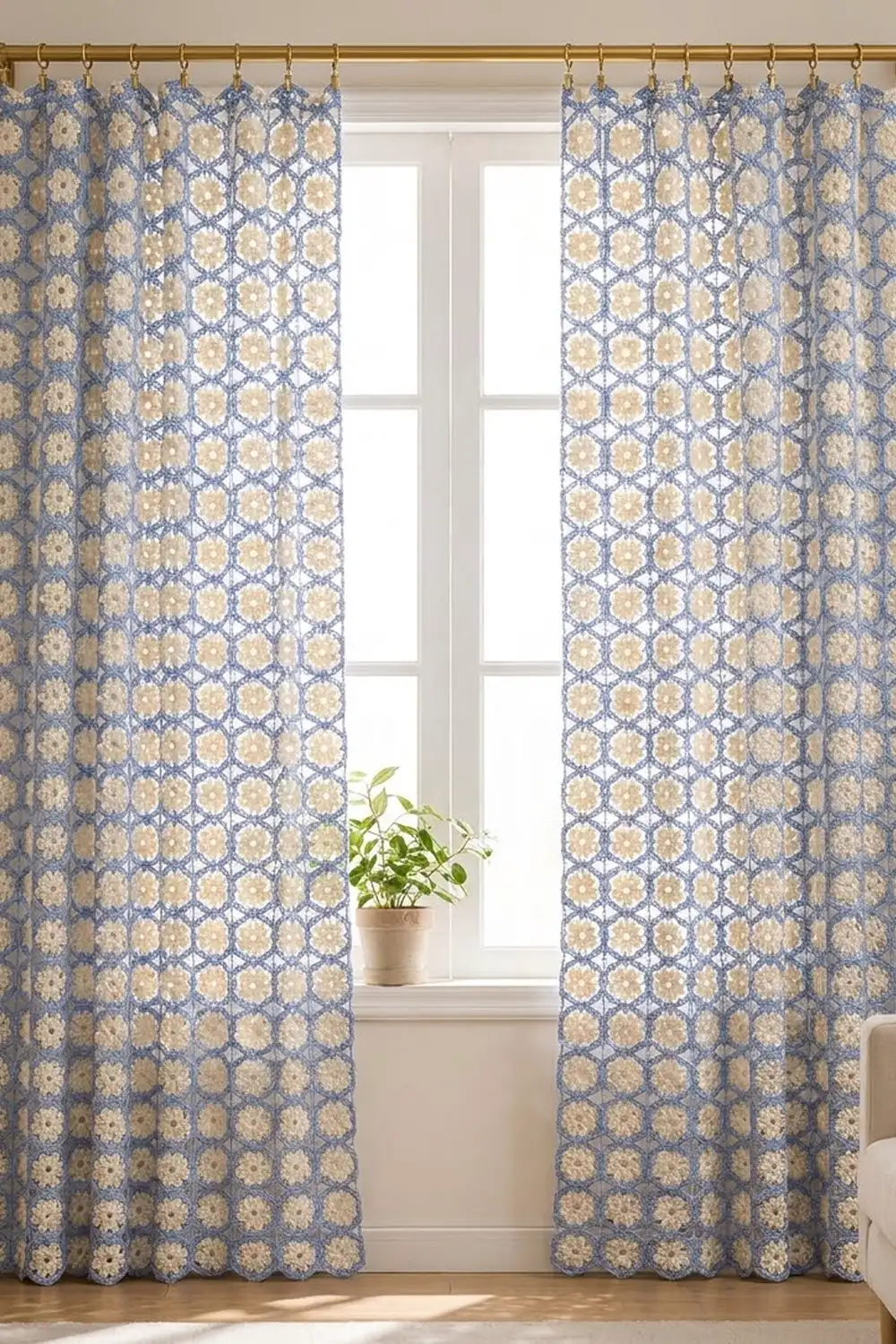
This curtain panel is an airy honeycomb of cornflower-blue lines with a small cream flower in every hexagon. Against a window, the lattice reads like a tiled screen and the flowers seem to float in the openings.
The palette is two colors: a medium blue for the lattice and a warm cream for the flowers. The style is cottage-classic, open enough to let light through but structured enough to hang straight. All instructions use US crochet terms.
Each finished panel measures 44.2 in (112.3 cm) wide by 80.0 in (203.2 cm) long, from the top peaks to the bottom points. The photo shows a matching pair, so the materials list covers two panels.
To make each motif, you crochet a cream flower and add two blue rounds that turn it into a hexagon. Each new hexagon joins to its neighbors on its last round. Half-hexagons straighten the side edges, and a two-round blue border finishes the panel.
Finished Size and Construction
- Finished size (one panel): 44.2 in x 80.0 in (112.3 cm x 203.2 cm)
- Skill level: Intermediate
- Terminology: US crochet terms
- Yarn weight: DK (#3) cotton
- Hook: 3.5 mm (US E/4)
- Pieces per panel: 392 full hexagons and 28 half-hexagons, joined as you go
- Layout: 29 rows. Odd rows have 14 full hexagons. Even rows have 13 full hexagons plus a half-hexagon at each end.
- Hexagon size: 3.1 in (7.9 cm) flat to flat, 3.6 in (9.1 cm) point to point, 1.8 in (4.6 cm) per side
- Size before border: 43.4 in x 79.2 in (110.2 cm x 201.2 cm)
- Border depth: 0.4 in (1.0 cm) on every edge
Materials
Use a smooth mercerized or combed DK cotton. Cotton gives clean, rope-like lattice lines and hangs without stretching. Avoid fluffy blends, which blur the honeycomb and sag over a long drop.
These amounts are based on 50 g balls of about 110 m (120 yd):
- Blue (lattice and border): 1,250 g / 2,750 m per panel; 2,500 g / 5,500 m for the pair
- Cream (flowers): 800 g / 1,760 m per panel; 1,600 g / 3,520 m for the pair
These quantities include a margin of about 12–14 percent for gauge differences and swatching. Buy each color from a single dye lot.
Tools:
- 3.5 mm (US E/4) crochet hook
- Tapestry needle and scissors
- Stitch markers
- Measuring tape
- Blocking mats and rust-proof pins
- Spray bottle or steamer
- 14 clip rings per panel (28 for the pair)
Abbreviations (US Terms)
- ch – chain
- sl st – slip stitch
- sc – single crochet
- hdc – half double crochet
- dc – double crochet
- tr – treble crochet
- sc2tog / sc3tog – single crochet 2 / 3 together
- sp(s) – space(s)
- st(s) – stitch(es)
- beg – beginning
- rep – repeat
Join-sl st: Insert the hook into the given stitch or space of the finished neighbor, yarn over, and pull through both the neighbor and the loop on your hook. A join-sl st never counts as a stitch.
Gauge and Checkpoints
Gauge: 5 sc = 1 in (2.5 cm) in the blue frame round.
Make one complete hexagon first and check it at each stage:
- After flower Rnd 2: 1.6 in (4.1 cm) from petal tip to opposite petal tip
- After Rnd 3: 3.2 in (8.1 cm) from tr to opposite tr
- After Rnd 4: 1.8 in (4.6 cm) per side, 3.1 in (7.9 cm) flat to flat, 3.6 in (9.1 cm) point to point
If your hexagon is larger than 3.1 in (7.9 cm) flat to flat, go down a half hook size. If it is smaller, go up a half size. An error of 0.1 in (0.3 cm) per hexagon adds up to 1.4 in (3.6 cm) across a 14-hexagon row.
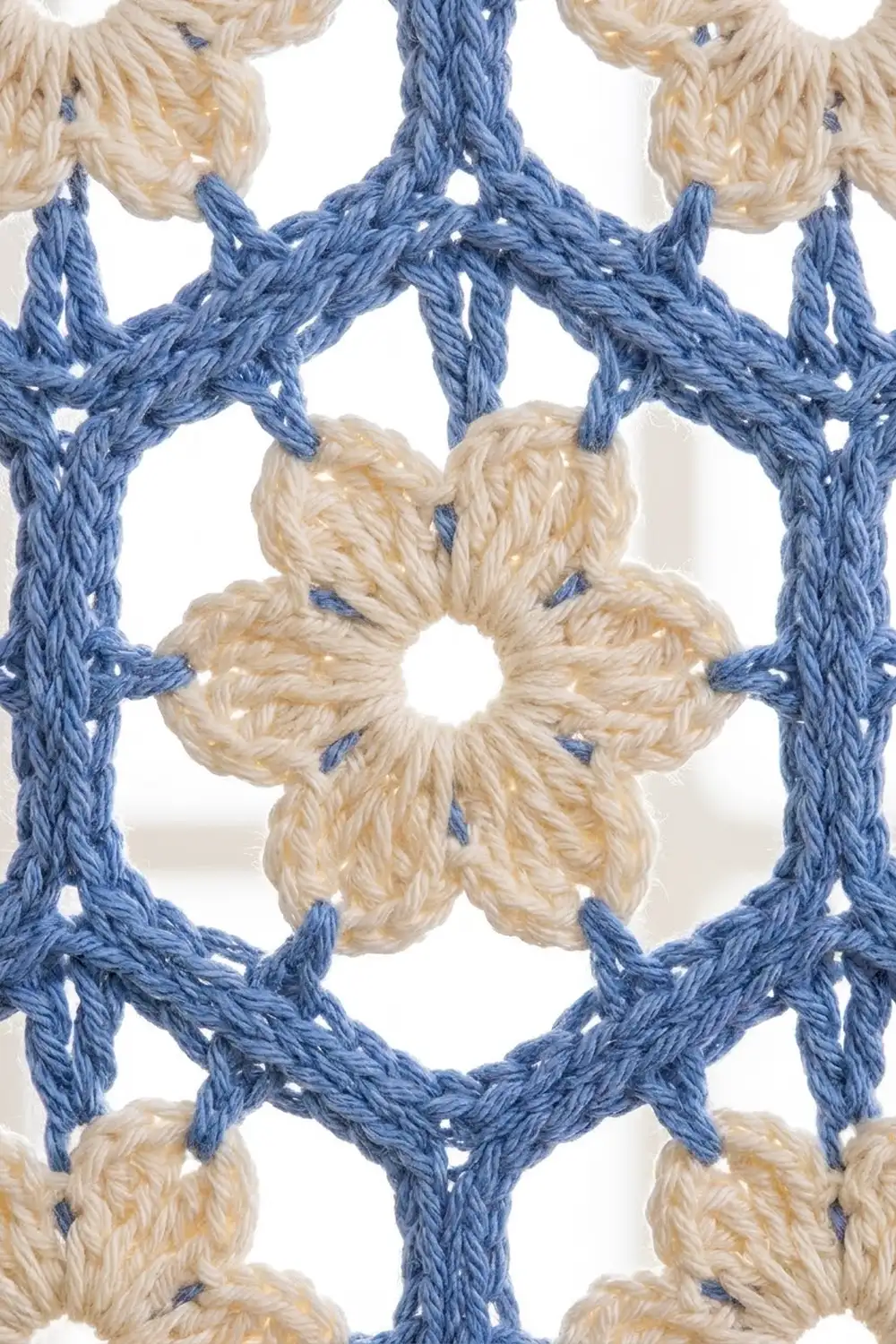
Full Hexagon
Flower (cream)
Rnd 1: Ch 6, sl st in first ch to form a ring. Ch 1, 12 sc in ring, sl st in first sc. (12 sc)
The ring leaves the small open center seen in the photo.
Rnd 2: *Sl st in next sc, (hdc, 3 dc, hdc) in next sc; rep from * 5 more times. Work the last sl st into the joining sl st of Rnd 1. (6 petals; 36 sts: 6 sl sts + 30 petal sts)
The center dc of each petal is its tip. Fasten off cream.
Frame (blue)
Rnd 3: Join blue with sl st in center dc of any petal. Ch 4 (counts as tr), *ch 7, tr in center dc of next petal; rep from * 4 more times, ch 7, sl st in 4th ch of beg ch-4. (6 tr, 6 ch-7 sps)
The tr posts are the spokes that hold the flower in the center of its opening.
Rnd 4: Ch 1, (sc, ch 2, sc) in same st as joining sl st, 7 sc in next ch-7 sp, *(sc, ch 2, sc) in next tr, 7 sc in next ch-7 sp; rep from * 4 more times, sl st in first sc. (54 sc, 6 corner ch-2 sps)
Each side has 9 sc: 1 sc after a corner ch-2, 7 sc in the space, and 1 sc before the next corner ch-2. Fasten off, unless you are joining this round (see Joining as You Go).
Half-Hexagon
The half-hexagon is a full hexagon split through its top and bottom points. Its straight cut edge becomes part of the panel’s side edge.
Row 1 (cream): Ch 6, sl st in first ch to form a ring. Ch 1, 7 sc in ring, covering half of the ring only. (7 sc)
Row 2: Ch 3 (counts as dc), turn, hdc in first sc [half petal], sl st in next sc, (hdc, 3 dc, hdc) in next sc, sl st in next sc, (hdc, 3 dc, hdc) in next sc, sl st in next sc, (hdc, dc) in last sc [half petal]. (17 sts: 2 half petals, 2 full petals, 3 sl sts) Fasten off.
Row 3 (blue): Join blue with sl st in top of beg ch-3. Ch 4 (counts as tr), ch 7, tr in center dc of next petal, ch 7, tr in center dc of next petal, ch 7, tr in last dc. (4 tr, 3 ch-7 sps)
Row 4: Ch 1, turn. Sc in first tr, 7 sc in next ch-7 sp, (sc, ch 2, sc) in next tr, 7 sc in next ch-7 sp, (sc, ch 2, sc) in next tr, 7 sc in next ch-7 sp, sc in 4th ch of beg ch-4. (27 sc, 2 corner ch-2 sps)
Each of the three outer sides has 9 sc, the same as a full hexagon. The first and last sc are the cut-edge corners.
Make All Pieces
For one panel:
- Full hexagons: 392 (15 odd rows x 14, plus 14 even rows x 13)
- Half-hexagons: 28 (2 per even row)
For the pair, make 784 full hexagons and 56 half-hexagons. You can make all the flowers ahead of time, then add the blue rounds row by row as you join.
Layout grid for one panel (H = full hexagon, ½ = half-hexagon with its cut edge facing out):
Row 1:   H H H H H H H H H H H H H H
Row 2:  ½ H H H H H H H H H H H H H ½
Row 3:   H H H H H H H H H H H H H H
...  repeat Rows 2-3 ...
Row 28: ½ H H H H H H H H H H H H H ½
Row 29:  H H H H H H H H H H H H H H
Each row sits in the dips of the row above it.
Joining as You Go
Make the first hexagon completely. Join every later piece on its last round or row.
Joining a side: Any side of the new piece that touches a finished neighbor is a joining side. On that side:
- At each shared corner, replace “ch 2” with “ch 1, join-sl st in neighbor’s corner ch-2 sp, ch 1.”
- After the 3rd sc of the side, join-sl st in the neighbor’s 7th sc of that side. The neighbor’s side runs in the opposite direction, so its 7th sc lines up with your 3rd.
- After the 7th sc of the side, join-sl st in the neighbor’s 3rd sc.
This places joins at both corners and after sc 3 and sc 7, so the gaps along a side are 3, 4, and 3 sts. The shared edge reads as one thick blue line.
Which sides join: A full hexagon after the first in its row joins its left vertical side and its two upper slanted sides. In Row 1, only the left vertical side is joined. Half-hexagons join wherever they touch a finished neighbor.
Three-way corners: Where three pieces meet, work the join-sl st into the existing join-sl st.
Cut corners: When a half-hexagon’s first or last sc lands at a full hexagon’s corner, work a join-sl st into that corner sp right after the sc.
Tension: Draw each join-sl st up to sc height. If the joins are tight, the panel narrows. If they are loose, the lattice looks gappy.
Checkpoint: Row 1 should measure 43.4 in (110.2 cm) wide. Rows 1 and 2 together should measure 6.3 in (16.0 cm) from the Row 1 peaks to the Row 2 bottom points. Each additional row adds 2.7 in (6.9 cm).
Before the border, the panel measures 43.4 in x 79.2 in (110.2 cm x 201.2 cm). The length is 3.6 in (9.1 cm) for Row 1 plus 28 x 2.7 in (6.9 cm).
Border
Border gauge: 5 sc = 1 in (2.5 cm), the same as the frames.
The side edges are straight. The top and bottom edges each have 14 points with 13 valleys between them, and each point rises 0.9 in (2.3 cm) above the valleys. The panel corners are the corner ch-2 sps where an end hexagon’s vertical side meets its slanted side.
Each panel corner gets a (sc, ch 2, sc) group. The first sc of the group belongs to the edge before the corner and the second to the edge after it. The edge counts below include those corner sc.
Rnd 1: With RS facing, join blue in the top-left panel corner sp.
- Top edge: (Sc, ch 2, sc) in corner sp. Then for each hexagon: 1 sc in each of the 9 sc on the upper-left side, (sc, ch 2, sc) in the peak ch-2 sp, and 1 sc in each of the 9 sc on the upper-right side. At each valley, work the last sc of one hexagon and the first sc of the next together as sc2tog, skipping the joined sp. Count: 14 x 20 = 280, minus 13 at the valleys, plus 2 corner sc = 269 sts, plus 14 peak ch-2 sps.
- Each side edge: Work 1 sc in each of the 9 sc on every full-hexagon vertical side. Along every half-hexagon cut edge, work 18 sc in this order: 1 in the end sc, 2 around the tr, 3 around the half petal, 6 in the bare half of the ring, 3 around the next half petal, 2 around the tr, and 1 in the end sc. Skip the joined sps between segments. Count: 15 x 9 + 14 x 18 = 387, plus 2 corner sc = 389 sts.
- Bottom edge: Work as for the top edge. 269 sts, plus 14 ch-2 sps.
Sl st in first sc. (1,316 sts, 32 ch-2 sps)
Rnd 2: Ch 1. Sc in each st, and work (sc, ch 2, sc) in every ch-2 sp, both peaks and panel corners. At each valley, sc3tog over the sc2tog and the st on each side of it. Sl st in first sc.
- Top and bottom edges: 269 sts worked 1 per st, minus 26 at the valleys, plus 28 at the peaks, plus 2 corner sc = 273 sts each
- Side edges: 389 sts worked 1 per st, plus 2 corner sc = 391 sts each
Fasten off.
Why the math works: Each side edge is 77.4 in (196.6 cm) long: 15 vertical hexagon sides of 1.8 in (4.6 cm) plus 14 cut edges of 3.6 in (9.1 cm). At 5 sc per inch, that length needs exactly 387 sc. Decreasing at the valleys stops them from rippling, and increasing at the peaks keeps the points sharp. The two rounds add 0.4 in (1.0 cm) on every edge, for a finished size of 44.2 in x 80.0 in (112.3 cm x 203.2 cm).
Final Blocking
- Weave in all tails along the blue lines, where the rope texture hides them.
- Lay the panel flat on blocking mats, one section at a time if space is limited.
- Pin the side edges straight, 44.2 in (112.3 cm) apart.
- Pin every top and bottom point so the points line up.
- Center each flower in its opening, with the petal tips pointing at the spokes.
- Mist with water, or hover steam over the panel without pressing.
- Let it dry completely before unpinning, then move to the next section.
Final Quality-Control Checklist
- Each hexagon measures 3.1 in (7.9 cm) flat to flat
- Each hexagon side has 9 sc
- Each shared side is joined at both corners and after sc 3 and sc 7
- The flowers lie flat, with 6 petals and an open center
- The side edges are straight: 389 sts in Rnd 1, 391 in Rnd 2
- The top and bottom edges each have 14 crisp points
- The panel measures 44.2 in x 80.0 in (112.3 cm x 203.2 cm)
Troubleshooting
- Flower ruffles: Your petals are too loose. Go down a hook size for the cream rounds only.
- Frame cups around the flower: Your Rnd 3 chains are too tight. Loosen them, or work ch 8 and keep 7 sc per sp.
- Panel narrower than 43.4 in (110.2 cm): Your join-sl sts are too tight. Draw them up to sc height.
- Wavy side edges: Recount 18 sc per cut edge and 9 sc per vertical side.
- Lumpy valleys: Check that every valley has an sc2tog in Rnd 1 and an sc3tog in Rnd 2.
- Drooping after hanging: Re-block, and place the clip rings exactly at the top points.
Care
Hand wash in cool water with a mild detergent and dry flat. Never hang the panel wet, because the weight of the water will stretch the lattice.
Final Notes
Here is the measurement chain. A 1.6 in (4.1 cm) flower becomes a 3.1 in (7.9 cm) hexagon with 1.8 in (4.6 cm) sides. Fourteen hexagons make a 43.4 in (110.2 cm) row, and 29 rows make 79.2 in (201.2 cm) of length. A 0.4 in (1.0 cm) border brings the panel to 44.2 in x 80.0 in (112.3 cm x 203.2 cm). If your first hexagon is right, everything after it follows. Clip a ring at each of the 14 top points and hang.
Happy crocheting!