
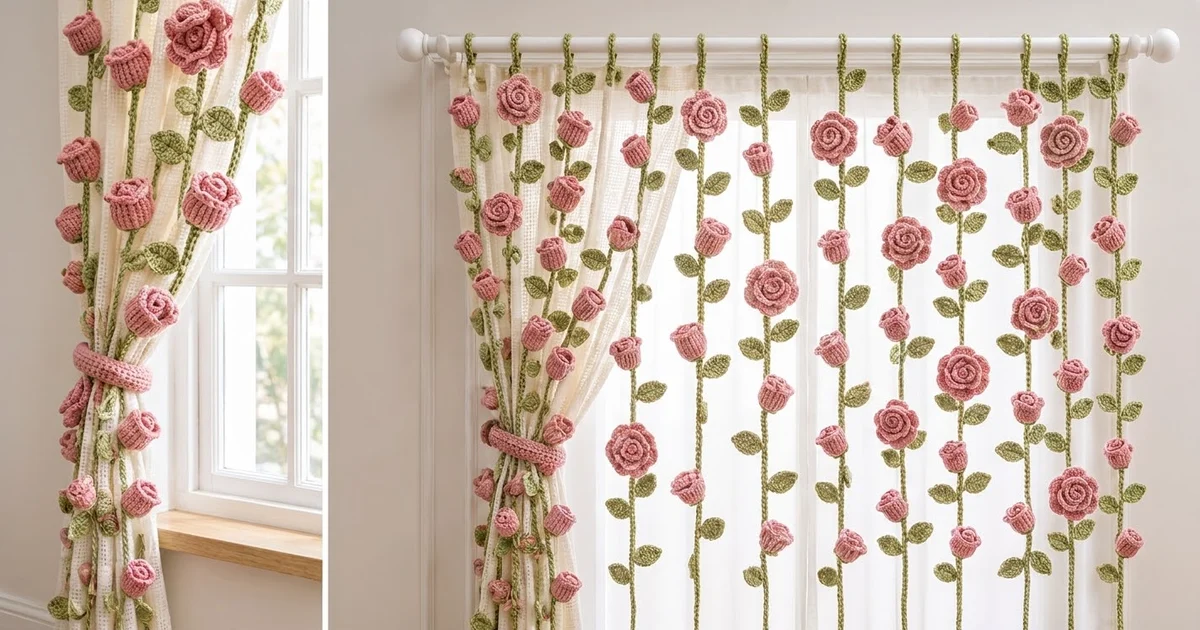
This curtain is made of hanging rose vines. Each vine is one long green slip-stitch cord carrying spiral roses, tight rosebuds and pairs of almond-shaped leaves, with a loop at the top that slips over a curtain rod. Nine vines hung side by side make a soft, see-through floral curtain.
The palette has two colors: dusty rose pink for the flowers and sage green for the stems and leaves. In front of a bright window the look is cottage-style and romantic without being busy.
All instructions use US crochet terms. One finished panel is about 35 in (88.9 cm) wide and hangs 60 in (152.4 cm) below the rod. Each vine is about 3 in (7.6 cm) wide at its widest rose.
Construction is simple. You crochet a cord and three kinds of small pieces: open roses (a ruffled strip rolled into a spiral), rosebuds (a short double crochet strip rolled into a cup) and leaves (worked around a foundation chain). Then you sew the pieces onto the cord at set stitch positions and finish the top with a hanging loop.
Finished Size and Construction
- Finished size (one panel): 35 in (88.9 cm) wide x 60 in (152.4 cm) drop
- Skill level: Easy to intermediate
- Terminology: US crochet terms
- Yarn weight: Worsted (#4) cotton or cotton blend
- Hook: 4.0 mm (US G-6)
- Number of pieces per vine: 23 (1 cord, 4 roses, 4 buds, 14 leaves)
- Layout: 9 vines hung 4 in (10.2 cm) apart, center to center
- Piece sizes: rose 3 in (7.6 cm) across; bud 1.25 in (3.2 cm) wide x 1.25 in (3.2 cm) tall; leaf 2 in (5.1 cm) long x 1 in (2.5 cm) wide
- Size before border (hanging loop): cord 64 in (162.6 cm) straight
- Border depth: the folded loop rises 2 in (5.1 cm) above its seam
Materials
Choose a smooth worsted-weight cotton with about 170 m per 100 g. Cotton keeps the rolled petals crisp and stretches less than acrylic under the weight of the flowers.
Per vine:
– Color A, dusty rose pink: 35 g (60 m)
– Color B, sage green: 30 g (51 m)
Per panel of 9 vines:
– Color A, dusty rose pink: 300 g (510 m)
– Color B, sage green: 250 g (425 m)
These amounts include about 15 percent extra for swatching and sewing tails.
Tools:
– 4.0 mm (US G-6) crochet hook
– Tapestry needle
– 9 locking stitch markers
– Scissors and tape measure
– Rust-proof pins and a blocking mat
– Spray bottle or steam iron
Abbreviations (US Terms)
- ch: chain
- sl st: slip stitch
- sc: single crochet
- hdc: half double crochet
- dc: double crochet
- BLO: back loop only
- st(s): stitch(es)
Special stitch: back-bump slip stitch. Turn the chain over so the bumps on the back face you. Insert the hook under the back bump only, yarn over, and pull through both the bump and the loop on your hook. This makes the round, braided-looking cord.
Gauge and Checkpoints
- Cord: 18 back-bump sl st = 4 in (10.2 cm)
- Strips: 16 sc = 4 in (10.2 cm); 16 dc = 4 in (10.2 cm); 2 rows of dc = 1.25 in (3.2 cm)
Make one rose, one bud and one leaf first, and check them against these measurements:
- Rose Row 1 strip: 11.25 in (28.6 cm) long.
- Rolled rose: 3 in (7.6 cm) across.
- Bud strip before rolling: 4 in (10.2 cm) x 1.25 in (3.2 cm).
- Leaf: 2 in (5.1 cm) x 1 in (2.5 cm).
- First 36 cord sts: 8 in (20.3 cm).
If your pieces come out too big, switch to a 3.75 mm hook. If they’re too small, use a 4.5 mm hook. Cord gauge matters most, because every flower position is counted in cord stitches.
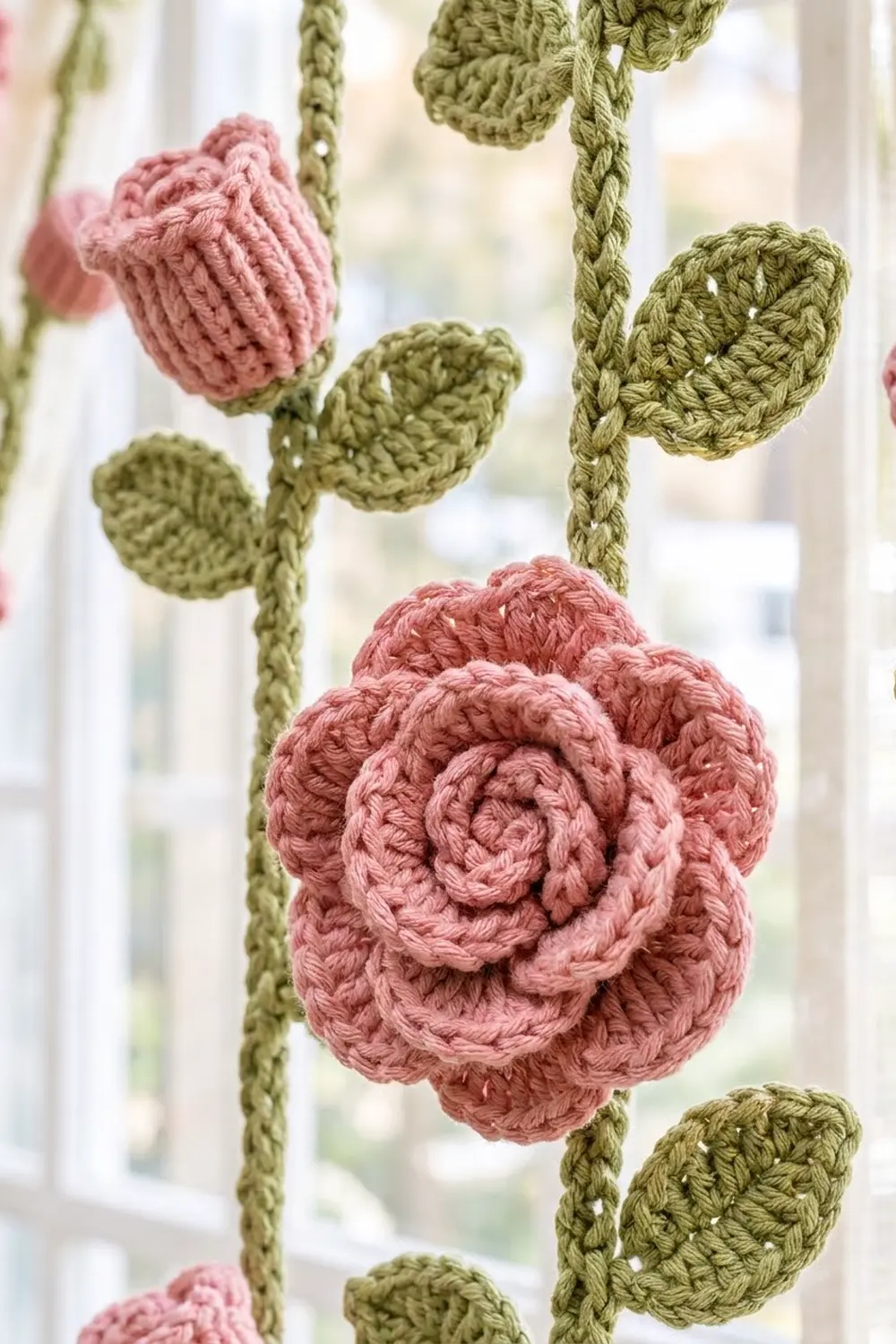
Stem Cord (Make 1 per vine)
With Color B, leave a 12 in (30.5 cm) tail.
Foundation: Ch 289.
Row 1: Sl st in back bump of 2nd ch from hook and in back bump of each ch across. (288 sl st)
Fasten off, leaving a 12 in (30.5 cm) tail.
Number the stitches from the starting-tail end. Stitch 1 is the top of the vine and stitch 288 is the bottom tip.
Checkpoint: Lay the cord flat without stretching it. It should measure 64 in (162.6 cm), because 288 sts ÷ 4.5 sts per inch = 64 in.
Place markers at sts 18, 36, 72, 108, 144, 180, 216, 252 and 288. Leaf positions are 18 sts below each flower marker.
Open Rose (Make 4 per vine)
With Color A.
Foundation: Ch 46.
Row 1: Sc in 2nd ch from hook and in each ch across. (45 sc)
Row 2 (petal row): Ch 1, turn. Sl st in first sc.
- Petals 1–4 (center): *Skip 1 sc, 5 hdc in next sc, skip 1 sc, sl st in next sc; repeat from * 3 more times.
- Petals 5–8 (middle): *Skip 1 sc, 5 dc in next sc, skip 1 sc, sl st in next sc; repeat from * 3 more times.
- Petals 9–11 (outer): *Skip 1 sc, 7 dc in next sc, skip 1 sc, sl st in next sc; repeat from * 2 more times.
Row 2 has 73 sts: 20 hdc + 20 dc + 21 dc + 12 sl st, making 11 petals. Each petal uses 4 sc of Row 1, plus the opening sl st, so 1 + (11 x 4) = 45 sc. The row ends exactly on the last sc.
Fasten off, leaving an 18 in (45.7 cm) tail.
Rolling: Start at the small hdc petals, at the opposite end from the tail. Roll petals 1 and 2 tightly to form the spiral center. Wrap petals 3–8 around it a little more loosely, keeping the sc edge level as the base. Wrap the three large petals loosely so they flare out. Sew through every layer at the base with 5 passes in a star pattern. Keep the tail to attach the rose later.
Checkpoint: 3 in (7.6 cm) across, with a tight spiral center.
Rosebud (Make 4 per vine)
With Color A.
Foundation: Ch 18.
Row 1: Dc in 4th ch from hook and in each ch across. (16 dc; the skipped 3 ch count as the first dc)
Row 2: Ch 3 (counts as first dc), turn. Dc in BLO of next 15 sts. (16 dc)
Fasten off, leaving a 12 in (30.5 cm) tail.
Checkpoint: 4 in (10.2 cm) x 1.25 in (3.2 cm).
Rolling: Hold the foundation edge as the base. Start at the end without the tail and roll the strip tightly along its length. The upright dc posts make the ribbed sides. Keep the base tight and let the Row 2 edge spread slightly so it forms a rolled lip. Sew through all layers at the base with 4 passes, and keep the tail.
Checkpoint: 1.25 in (3.2 cm) wide x 1.25 in (3.2 cm) tall.
Leaf (Make 14 per vine)
With Color B.
Foundation: Ch 9.
Rnd 1: Sc in 2nd ch from hook, hdc in next ch, dc in next 3 ch, hdc in next ch, sc in next ch, 3 sc in last ch (tip). Now work along the free loops on the other side of the chain: sc in next ch, hdc in next ch, dc in next 3 ch, hdc in next ch, sc in next ch. Sl st to first sc. (17 sts: 7 + 3 at the tip + 7)
Stalk: Ch 4, sl st in 2nd ch from hook and in next 2 ch, then sl st into the base of the leaf. (3 sl st)
Fasten off, leaving an 8 in (20.3 cm) tail.
Checkpoint: 2 in (5.1 cm) x 1 in (2.5 cm), with a pointed tip.
Make All Pieces
Per vine: 1 cord and 14 leaves in Color B; 4 roses and 4 buds in Color A.
Per panel: 9 cords and 126 leaves in Color B; 36 roses and 36 buds in Color A.
There are two vine versions so the flowers are staggered across the curtain. Vine A starts with a rose and Vine B starts with a bud. Both have 4 roses and 4 buds.
Cord st | Below seam       | Vine A    | Vine B
--------+------------------+-----------+-----------
  1-18  | loop             | loop      | loop
   36   | 4 in (10.2 cm)   | Rose      | Bud
   54   | 8 in (20.3 cm)   | 2 leaves  | 2 leaves
   72   | 12 in (30.5 cm)  | Bud       | Rose
   90   | 16 in (40.6 cm)  | 2 leaves  | 2 leaves
  108   | 20 in (50.8 cm)  | Rose      | Bud
  126   | 24 in (61.0 cm)  | 2 leaves  | 2 leaves
  144   | 28 in (71.1 cm)  | Bud       | Rose
  162   | 32 in (81.3 cm)  | 2 leaves  | 2 leaves
  180   | 36 in (91.4 cm)  | Rose      | Bud
  198   | 40 in (101.6 cm) | 2 leaves  | 2 leaves
  216   | 44 in (111.8 cm) | Bud       | Rose
  234   | 48 in (121.9 cm) | 2 leaves  | 2 leaves
  252   | 52 in (132.1 cm) | Rose      | Bud
  270   | 56 in (142.2 cm) | 2 leaves  | 2 leaves
  288   | 60 in (152.4 cm) | Bud (tip) | Rose (tip)
Hang the vines from left to right in this order: A, B, A, B, A, B, A, B, A. That’s 5 of Vine A and 4 of Vine B.
Joining
Every piece is sewn onto the cord.
Stitch-to-stitch logic: Center each flower on one marked cord stitch. Flowers are 36 sts apart, which is 8 in (20.3 cm). Each leaf pair sits 18 sts below a flower, at the midpoint before the next flower. That gives 8 flowers and 7 leaf pairs.
Roses and buds: Place the flower facing forward with its base over the marked stitch. Using the flower’s own tail, whipstitch the base to 3 cord sts (the marked st and one on each side), wrapping around the cord 6 times. Weave the tail into the base.
Bottom tip: On Vine A, push the cord end (st 288) up into the base of the bud and sew around it. On Vine B, tuck the cord end behind the rose center and sew it in place.
Leaves: Sew one leaf on each side of the cord with the stalks touching it and the tips angled upward at about 45 degrees. Use 3 stitches through each stalk.
Tension: Sew snugly, but don’t pull. If the cord bunches or twists at a seam, the stitches are too tight. After each flower, check that the spacing still measures 8 in (20.3 cm).
Size checkpoint: Measure from st 19 to the tip. It should be 60 in (152.4 cm), because 270 sts ÷ 4.5 = 60 in.
Border: Hanging Loop
A vine curtain has no edging, so its “border” is the hanging loop at the top of each cord.
Border gauge: 4.5 sts per inch, the same as the cord.
Loop: Fold sts 1–18 back to make a loop. Using the starting tail, sew st 1 to st 19 with 4 passes through both layers. That puts 9 sts on each side of the fold: 9 + 9 = 18 sts.
Why the math works: 18 sts ÷ 4.5 = 4 in (10.2 cm) around the loop. A rod 1.25 in (3.2 cm) across measures about 3.9 in (9.9 cm) around, so the loop slides easily without hanging loose. Folded flat, the loop rises 2 in (5.1 cm) above the seam. The other 270 sts give the 60 in (152.4 cm) drop, and 18 + 270 = 288 sts. For a thicker rod, add 4 or 5 foundation chains for every extra inch around the rod.
Hang the loops 4 in (10.2 cm) apart. The nine vines span 8 x 4 in = 32 in (81.3 cm) from the first to the last. Half a rose width on each side, 1.5 in (3.8 cm), brings the panel to 35 in (88.9 cm).
Final Blocking
- Lightly spray each rose and bud with water, then shape the outer petals so they curl evenly.
- Pin each leaf flat with its tip pointed, and let it dry completely.
- Hold a steam iron above the roses without touching them to set the spiral.
- Hang each vine for 24 hours so the cord settles under the flowers’ weight.
- Measure the drop again. If it’s longer than 61 in (154.9 cm), steam the bare cord sections and let them dry hanging free.
Final Quality-Control Checklist
- Cord has 288 sts, with the loop seam at st 19.
- Each vine has 4 roses, 4 buds and 14 leaves.
- Flowers are 8 in (20.3 cm) apart, with leaf pairs centered between them.
- Each rose has a tight spiral center and flared outer petals.
- Buds are closed cups with upright ribs.
- Leaves point upward in mirrored pairs.
- No tails or cord ends show.
- Each vine hangs 60 in (152.4 cm) below the rod.
Troubleshooting
Rose center looks open. Roll the first two petals tighter and add another sewing pass at the base.
Roses are too big. Your sc is loose. Use a smaller hook for Row 1.
Cord twists. This is normal for back-bump slip stitch. Steam it and hang it with a light weight overnight.
Vine is too long. Remove the bottom flower, pull out the extra sts, and sew the flower back on.
Flowers droop forward. Add a sewing pass through the back of the flower base, higher up the cord.
Care
Hand wash in cool water with mild soap. Press out the water in a towel and dry flat before rehanging; don’t wring, or the roses can lose their shape.
Final Notes
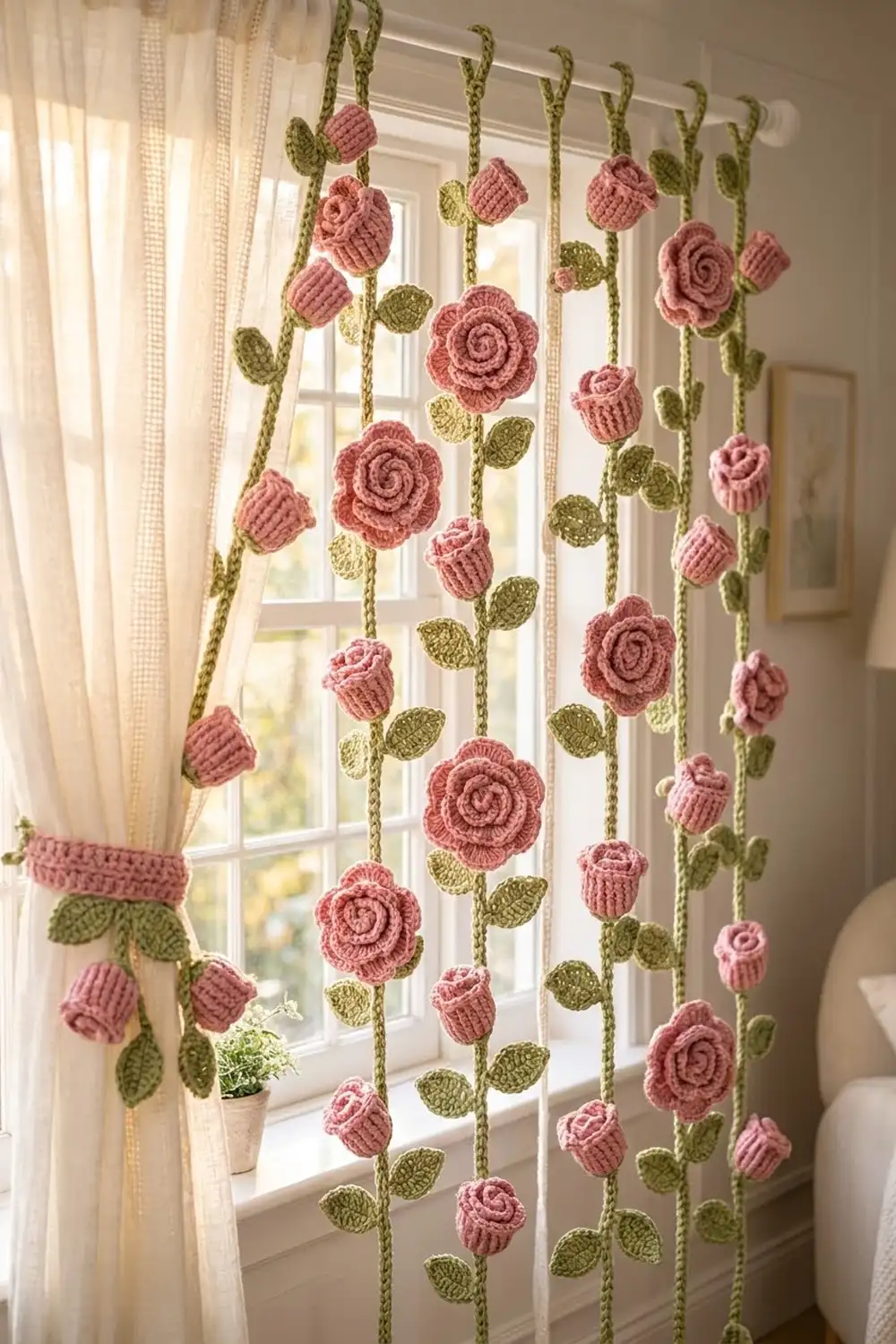
Every measurement follows from the cord gauge. At 4.5 sts per inch, 288 sts make a 64 in (162.6 cm) cord. Folding 18 sts makes a 4 in (10.2 cm) loop and leaves a 60 in (152.4 cm) drop. Flowers every 36 sts land 8 in (20.3 cm) apart, and nine vines hung 4 in (10.2 cm) apart make a 35 in (88.9 cm) panel. Check your gauge first and count your cord stitches, and every rose will land where it should.
Happy crocheting!