

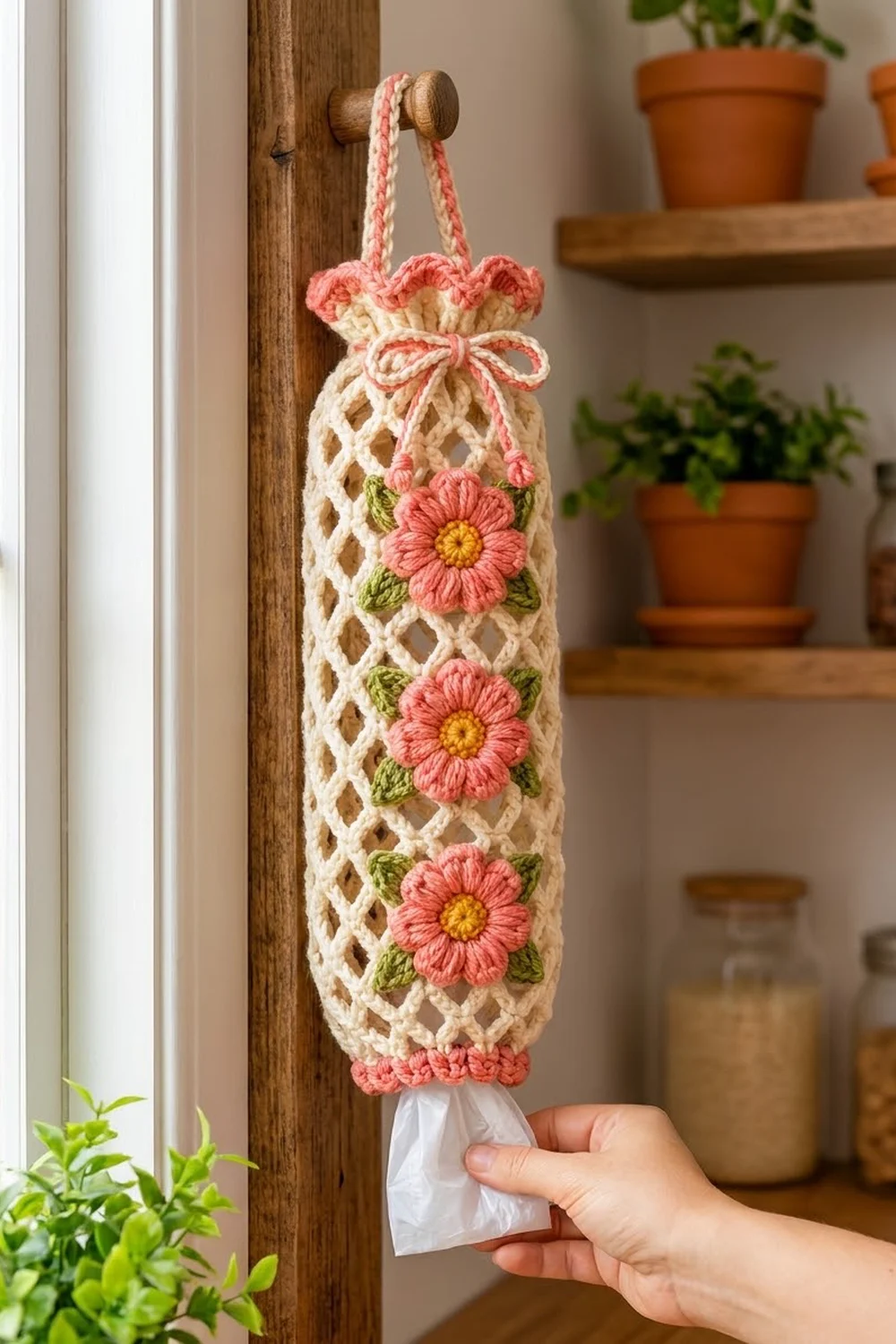
This bag holder looks good enough to leave out in the kitchen. The body is a cream diamond mesh that stretches around a bundle of plastic bags. Three coral flowers with golden centers and green leaves run down the front, and a coral-edged ruffle with a drawstring bow finishes the top.
The colors are cream, coral pink, golden yellow and olive green. Together they give a soft cottage look that suits wood shelves, plants and pantry jars. The pattern uses US crochet terms throughout.
The finished holder is about 6.25 in (15.9 cm) wide when flat and about 21 in (53.3 cm) long, not counting the hanging loop. The loop adds about 4.5 in (11.4 cm).
You crochet the mesh body flat in rows, then seam it into a tube. Next you add the top cuff, the ruffle and the bottom band in rounds. Last, you make the flowers, leaves and cords and sew them on.
Finished Size and Construction
- Finished size: 6.25 in (15.9 cm) wide flat × 21 in (53.3 cm) long
- Skill level: Easy-Intermediate
- Terminology: US
- Yarn weight: Medium (#4) worsted cotton or cotton blend
- Hook: 5.0 mm (US H-8)
- Number of pieces: 1 mesh body, 3 flowers, 12 leaves, 4 cords, 4 mini beads
- Layout: 3 flowers stacked in one column on the front center
- Mesh panel size: 12.5 in (31.8 cm) wide × 17.75 in (45.1 cm) tall
- Body before edgings: tube 12.5 in (31.8 cm) around, 6.25 in (15.9 cm) wide flat
- Edging depth: top cuff and ruffle about 2 in (5.1 cm); bottom band about 1.25 in (3.2 cm)
Materials
Cotton is the best choice here. It holds the mesh shape, doesn’t stretch out much under the weight of bags, and washes well. Any smooth worsted cotton with about 190 m per 100 g works.
- Cream: 120 g / 228 m (body, cuff, ruffle, 1 hanger cord, 1 drawstring cord)
- Coral pink: 50 g / 95 m (petals, ruffle edge, bottom band, 2 cords, beads)
- Olive green: 15 g / 29 m (leaves)
- Golden yellow: 10 g / 19 m (flower centers)
All of these amounts include a margin of about 15%.
Tools: 5.0 mm (H-8) hook, yarn needle, 8 stitch markers, scissors, measuring tape, rust-proof pins, spray bottle, blocking mat.
Abbreviations (US Terms)
- ch – chain
- sl st – slip stitch
- sc – single crochet
- hdc – half double crochet
- dc – double crochet
- tr – treble crochet
- sc2tog – single crochet 2 together
- sp – space
- st(s) – stitch(es)
- MR – magic ring
- rev sc – reverse single crochet (crab stitch)
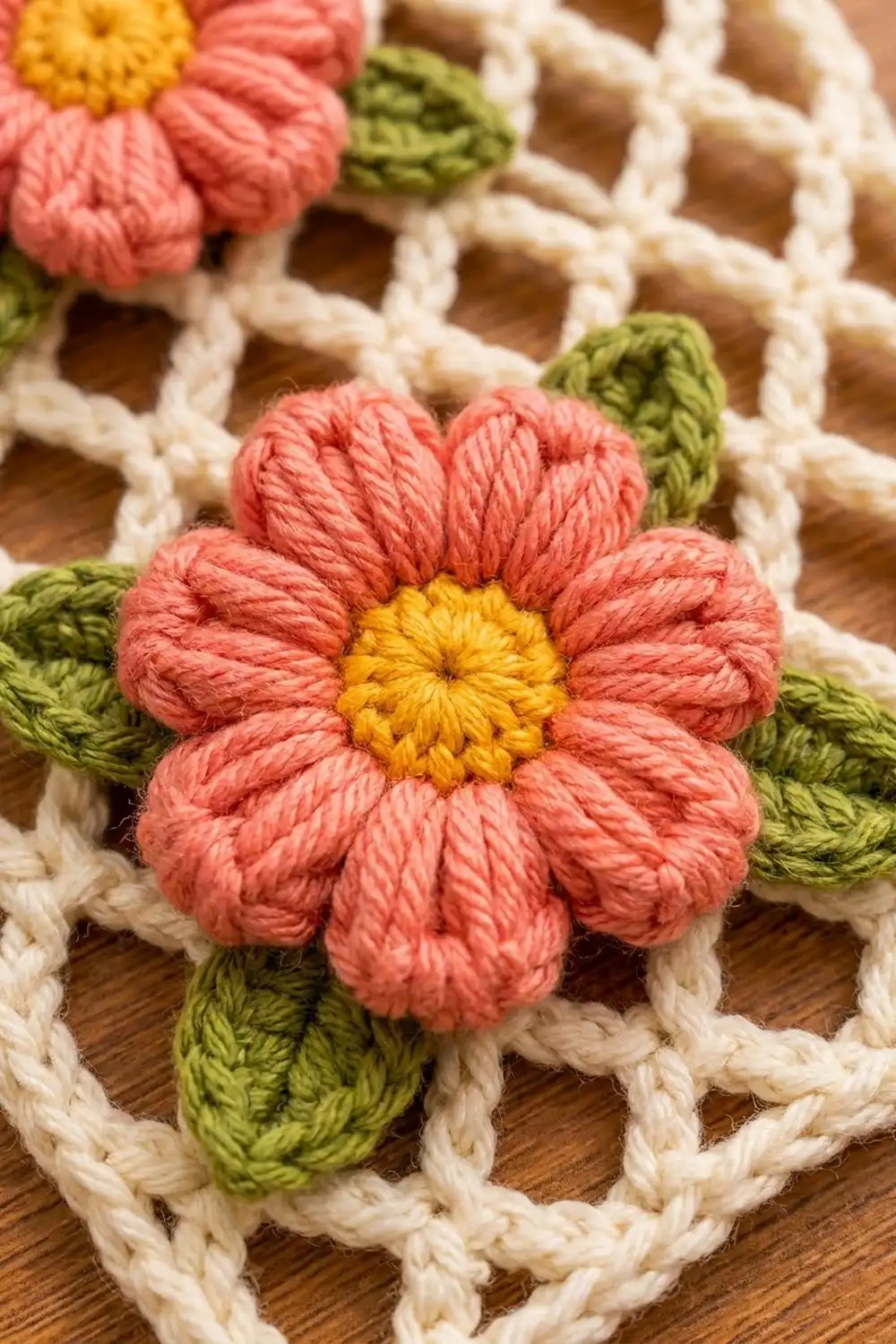
Puff stitch: (yo, insert hook in st, pull up a loop to 0.5 in [1.3 cm]) 3 times, yo, pull through all 7 loops on hook.
Petal: (hdc, dc, 2 tr, dc, hdc) all in the same st.
Gauge and Checkpoints
Single crochet gauge: 13 sc = 4 in (10.2 cm).
Mesh gauge: 4 ch-5 spaces = 5 in (12.7 cm) wide, and 4 mesh rows = 3 in (7.6 cm) tall. That works out to 1.25 in (3.2 cm) per space and 0.75 in (1.9 cm) per row.
Test first. Make 1 flower and a small mesh swatch before you start the body. For the swatch, ch 22, then sc in the 2nd ch from the hook and in each ch across (21 sc). Next, work Rows 2–9 of the body pattern with 5 spaces in each repeat. The swatch should measure 6.25 in (15.9 cm) wide and about 6 in (15.2 cm) tall without the sc row.
Checkpoints:
– Flower center after Rnd 2: 1.25 in (3.2 cm) across
– Finished flower: 3.25 in (8.3 cm) across
– Flower with leaves, measured corner to corner: 4.5 in (11.4 cm)
– Mesh panel after Row 25: 12.5 × 17.75 in (31.8 × 45.1 cm)
If your pieces come out too big, go down one hook size (4.5 mm). If they come out too small, go up one size (5.5 mm). Hook size matters most for the mesh. If your chains are tight, the loops get short and the tube ends up narrow.
Mesh Body
You work the body flat. With cream, ch 42.
Row 1 (RS): Sc in the 2nd ch from the hook and in each ch across. Turn. (41 sc)
Row 2: Ch 1, sc in the first sc, (ch 5, skip 3 sc, sc in next sc) 10 times. Turn. (10 ch-5 sps, 11 sc)
Row 3: Ch 5 (counts as dc + ch 2), sc in the first ch-5 sp, (ch 5, sc in next ch-5 sp) 9 times, ch 2, dc in the last sc. Turn. (9 ch-5 sps + 2 ch-2 half spaces, 10 sc)
Row 4: Ch 1, sc in the first dc, (ch 5, sc in next ch-5 sp) 9 times, ch 5, sc in the 3rd ch of the turning ch. Turn. (10 ch-5 sps, 11 sc)
Rows 5–24: Repeat Rows 3–4 ten more times. This gives you 23 mesh rows in total (Rows 2–24), ending on a full-space row.
Row 25: Ch 1, sc in the first sc, (3 sc in next ch-5 sp, sc in next sc) 10 times. (1 + 40 = 41 sc)
Fasten off and leave a 30 in (76.2 cm) tail for seaming.
Checkpoint: The panel should measure 12.5 in (31.8 cm) wide and 17.75 in (45.1 cm) tall. The ch-5 loops form clear diamonds when you stretch the panel lightly.
Flowers (make 3)
Rnd 1: With yellow, make a MR, ch 1, 8 sc in the ring, then sl st to the first sc. (8 sc)
Rnd 2: Ch 1, 2 sc in each st around, then sl st to the first sc. (16 sc)
Fasten off yellow. Checkpoint: the center measures 1.25 in (3.2 cm).
Rnd 3: Join coral in any sc. Work (sl st in next st, Petal in next st) 8 times, then sl st to the joining st. (8 petals + 8 sl st = 56 sts)
Fasten off and leave a 12 in (30.5 cm) tail. Checkpoint: the flower measures 3.25 in (8.3 cm). The petals should be rounded and puffy, and each one should sit flat beside its neighbors.
Leaves (make 12)
With green, ch 6.
Leaf: Sc in the 2nd ch from the hook, then hdc, dc and hdc in the next 3 ch, and sc in the last ch. Ch 2 for the tip. Working along the other side of the foundation ch, sc, hdc, dc and hdc in the next 4 ch, sc in the last ch, then sl st to the first sc. (10 sts + ch-2 tip)
Fasten off and leave an 8 in (20.3 cm) tail. Each leaf is about 1.5 in (3.8 cm) long, including the base you will hide behind the petals.
Cords and Beads
Hanger cords (make 1 cream, 1 coral): Ch 41. Sl st in the back bump of the 2nd ch from the hook and of each ch across. (40 sl st, about 10 in [25.4 cm])
Drawstring cords (make 1 cream, 1 coral): Ch 101. Sl st in the back bump of the 2nd ch from the hook and of each ch across. (100 sl st, about 25 in [63.5 cm])
Mini beads (make 4, coral): Make a MR, ch 1, 6 sc in the ring, then sl st to the first sc. Pull the ring tight to make a small ball about 0.4 in (1.0 cm) across. Leave a 6 in (15.2 cm) tail.
Twisting: Lay the cream and coral hanger cords side by side. Twist them around each other 6 times and stitch both ends together. The twisted hanger will be about 9.5 in (24.1 cm) long.
Twist the drawstring cords the same way, but leave the last 1.5 in (3.8 cm) at each end untwisted. Sew a bead onto each of the 4 loose strand ends.
Make All Pieces
| Piece | Qty | Colors |
|---|---|---|
| Mesh body | 1 | Cream |
| Flower | 3 | Yellow + coral |
| Leaf | 12 | Green |
| Hanger cord | 2 | 1 cream, 1 coral |
| Drawstring cord | 2 | 1 cream, 1 coral |
| Mini bead | 4 | Coral |
Front layout (tube laid flat, seam at center back):
   [ ruffle  ~~~~~~~~~~~ ]
   [ cuff + bow          ]
   [ L   FLOWER 3     L  ]  center 13.75 in (34.9 cm)
   [ L                L  ]
   [ L   FLOWER 2     L  ]  center 9 in (22.9 cm)
   [ L                L  ]
   [ L   FLOWER 1     L  ]  center 4.25 in (10.8 cm)
   [ L                L  ]
   [ bottom band ooooo   ]
Measure flower heights from the bottom edge of the mesh panel (Row 1). Each “L” is a leaf sitting at a diagonal behind its flower.
Joining
Seam the tube. Fold the panel with the RS facing out, so the two long side edges meet. Thread the yarn needle with the 30 in (76.2 cm) tail and whipstitch through the row ends:
- 1 stitch through each sc row end (Rows 1 and 25)
- 2 stitches around each mesh row end (Rows 2–24), one through the post or turning ch and one through the loop above it
That makes 2 + (23 × 2) = 48 whipstitches.
Keep the tension matched to the mesh. The seam should stretch just as much as the diamonds around it. A tight seam pulls the tube into a twist.
Checkpoint: The tube is 12.5 in (31.8 cm) around and 6.25 in (15.9 cm) wide flat. Lay it flat with the seam at the center back.
Sew on the flowers. Pin the 3 flowers on the front center, half way around from the seam, at the heights shown on the layout grid. Use the coral tail to sew around Rnd 3 at the base of each petal, catching the mesh strands that lie underneath.
Sew on the leaves. Tuck 4 leaves behind each flower at the diagonals, tips pointing out. Leave about 0.75 in (1.9 cm) of each leaf showing past the petals. Sew the leaf bases to the mesh and to the back of the flower.
Border: Top Cuff, Ruffle and Bottom Band
The edging gauge is 13 sc = 4 in (10.2 cm). Each “side” below means one half of the tube when it lies flat.
Top Cuff and Ruffle
Rnd 1: With the RS facing you, join cream in the first sc of Row 25 at the seam. Ch 1, sc in the same st and in the next 38 sts, then sc2tog over the last 2 sts. Sl st to the first sc. (39 worked 1 per st + 1 decrease = 40 sc; 20 per side)
Rnd 2 (eyelets): Ch 4 (counts as dc + ch 1), skip the next st, then (dc in next st, ch 1, skip next st) 19 times. Sl st in the 3rd ch of the beginning ch-4. (20 dc + 20 ch-1 sps; 10 eyelets per side)
Rnd 3: Ch 1, sc in each dc and in each ch-1 sp around, then sl st to the first sc. (40 sc; 20 per side)
Rnd 4 (shells): Ch 1, sc in the same st, then skip 1, 5 dc in next st, skip 1, sc in next st. Repeat from * around, but end the last repeat with skip 1 and a sl st to the first sc. Fasten off cream. (10 shells: 50 dc + 10 sc = 60 sts; 5 shells per side)
Rnd 5 (coral edge): Join coral in any sc. Ch 1, then sc in each st around, working 2 sc in the center dc of each shell. Sl st to the first sc and fasten off. (60 worked 1 per st + 10 extra = 70 sc; 35 per side)
Bottom Band
Rnd 1: Turn the tube upside down. Join coral in the first foundation ch at the seam, working into the free loops on the underside of Row 1. Ch 1, sc in the same loop and in the next 38 loops, then sc2tog over the last 2. Sl st to the first sc. (39 worked 1 per st + 1 decrease = 40 sc; 20 per side)
Rnd 2: Ch 1, (sc in next 3 sts, sc2tog) 8 times, then sl st to the first sc. (32 sc; 16 per side)
Rnd 3: Ch 1, (sc in next st, puff stitch in next st) 16 times, then sl st to the first sc. (16 sc + 16 puffs = 32 sts)
Rnd 4: Ch 1, sc in each st around, then sl st to the first sc. (32 sc)
Rnd 5: Ch 1, rev sc in each st around, then sl st to the first st. Fasten off. (32 rev sc)
Why the Math Works
The mesh has 10 spaces of 4 sts each, plus 1 closing sc, so each sc row holds 41 sts. One sc2tog at the seam brings that to 40. Forty divides evenly by 2 (eyelets), 4 (shells) and 5 (decrease repeats), so every round ends without a partial repeat.
At 13 sc per 4 in, 40 sts measure about 12.5 in (31.8 cm), which matches the mesh. The bottom band has 32 sts, so the opening is about 10 in (25.4 cm) around. That is snug enough to hold bags in but still lets you pull one out easily.
Hanger and Drawstring
Drawstring: Starting at the front center, weave the twisted drawstring in and out through the Rnd 2 eyelets all the way around. Both ends should come out of neighboring eyelets at the front, between dc 10 and dc 11 counted from the seam. Tie the ends in a bow.
Hanger: Sew one end of the hanger to the inside of the cuff (Rnds 1–3) at each side fold. The side folds sit 10 sts either side of the seam. Use several firm stitches at each end.
Final Blocking
- Lightly mist the whole holder with water.
- Slide a rolled towel inside the tube so it holds its shape at 6.25 in (15.9 cm) wide flat.
- Pin the mesh so the diamonds are even and the length measures 17.75 in (45.1 cm) from Row 1 to Row 25.
- Pat the flowers flat and shape each petal into a round curve with your fingertips.
- Pin each leaf tip so it points out at its diagonal.
- Spread out the ruffle shells and pin each one open.
- Let everything dry completely before you take out the pins and the towel.
Final Quality-Control Checklist
- Mesh panel has 10 spaces across and 23 mesh rows
- Seam is flat, even and as stretchy as the mesh
- The 3 flowers are centered on the front, opposite the seam, at 4.25 in, 9 in and 13.75 in (10.8, 22.9 and 34.9 cm)
- Each flower has 8 petals and 4 leaves
- Top Rnd 5 has 70 sc and 10 shells
- Bottom band ends with 32 sts and has 16 puffs
- Hanger ends are secure at both side folds
- Drawstring runs freely and the bow sits at the front
- All 4 beads are secure and all yarn ends are woven in
Troubleshooting
Mesh is narrower than 12.5 in (31.8 cm): Your chains are too tight. Go up a hook size, or make each ch slightly looser.
Panel slants: You missed a sc at the start or end of a row. Count 11 sc on every full-space row.
Petals ruffle or overlap: Check that Rnd 2 has exactly 16 sts. Too many sts there makes the petals crowd each other.
Petals cup forward: Steam the flower lightly and press the petals flat while they cool.
Ruffle lies flat with no wave: Make sure you worked 5 dc in each shell and the extra 2 sc at each shell center in Rnd 5.
Bags won’t come out: Leave out the Rnd 2 decreases in the bottom band and work 40 sts in each round instead.
Drawstring sticks: Untwist the cord slightly, or thread it with a large-eye needle.
Care
Hand wash in cool water with mild soap, press out the water in a towel, and dry flat with the holder reshaped. Don’t tumble dry, because the mesh can stretch out of shape.
Final Notes
Each stage in this holder sets up the next. The 41-stitch mesh panel makes a 12.5 in (31.8 cm) tube. One sc2tog brings the top and bottom edges to an even 40 stitches. Ten shells form the ruffle, and the bottom gathers to 32 stitches so bags stay in until you pull one out.
Check your gauge on the swatch and the first flower, then confirm the panel measures 12.5 × 17.75 in (31.8 × 45.1 cm) before you seam. If those two checks are right, the edgings, flowers and cords will all fit as written.
Happy crocheting!