
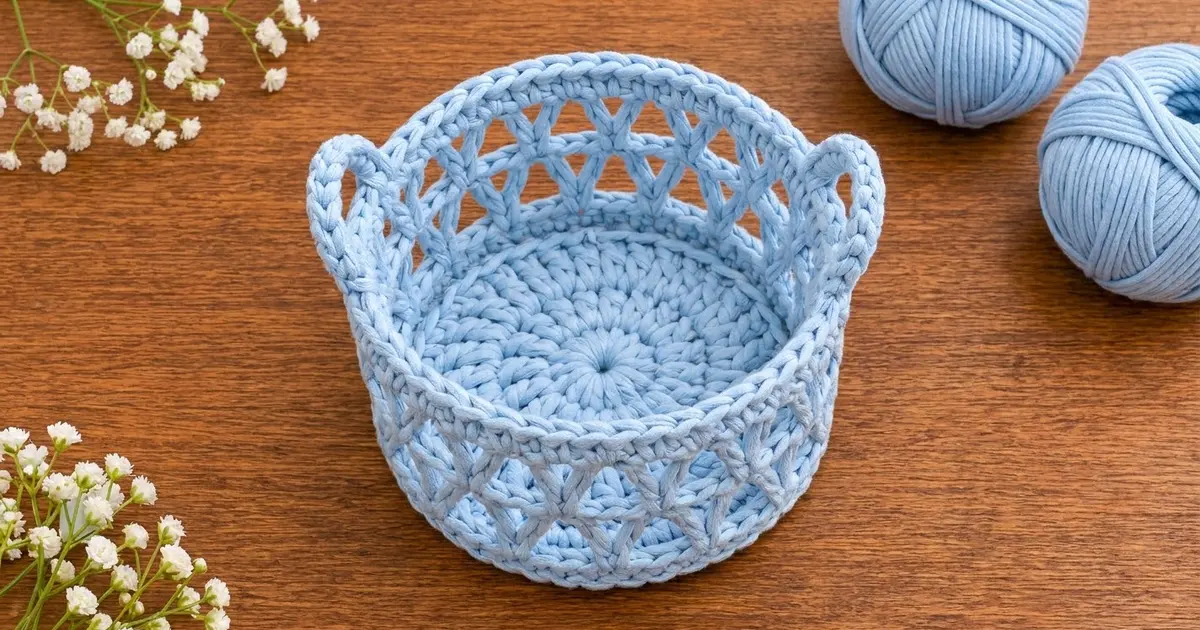
This little round basket is sturdy, simple and a bit airy. A solid base and solid single crochet bands keep the shape firm. Two rounds of tall V-stitches open up the sides into a row of light triangles. Two loop handles on opposite sides make it easy to lift off a shelf or out of a cabinet.
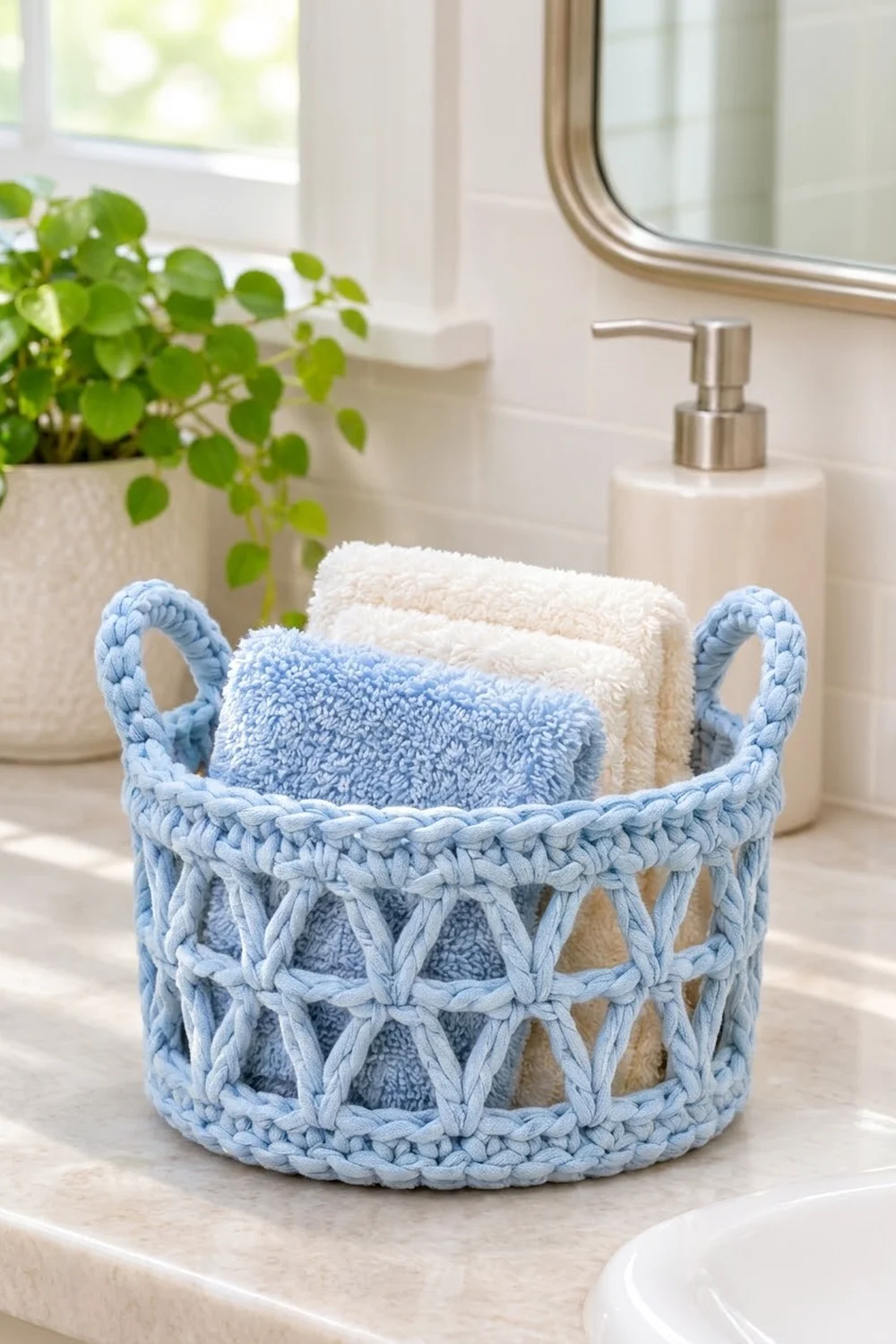
The sample is worked in one soft powder-blue cotton cord, which gives the stitches a smooth, rounded, rope-like texture. It suits a bathroom, nursery or craft table and holds washcloths, cotton pads, hair ties or small yarn balls. Since it uses only one color, you never have to carry or join a second yarn.
The pattern uses US crochet terms. The finished basket measures 7 in (17.8 cm) across the base and 4.5 in (11.4 cm) tall at the rim. The handles rise about 1.5 in (3.8 cm) above that, so the total height is 6 in (15.2 cm).
Construction is seamless. You work a flat double crochet circle, turn the wall up with a back-loop round, then work joined rounds straight up without increases. The handles are made in the rim rounds, and a reverse single crochet edge finishes the top.
Finished Size and Construction
- Finished size: 7 in (17.8 cm) diameter × 4.5 in (11.4 cm) tall; 6 in (15.2 cm) to the top of the handles
- Skill level: Easy / advanced beginner
- Terminology: US crochet terms
- Yarn weight: Bulky (#5) cotton cord or chunky cotton
- Hook: 6.0 mm (US J-10)
- Number of pieces: 1, worked in one piece
- Layout: Round base, straight cylindrical wall, 2 opposite handles
- Base size: 7 in (17.8 cm) across after Round 5
- Wall height before rim: 3.5 in (8.9 cm) after Round 12
- Rim (border) depth: 1 in (2.5 cm), Rounds 13–15
Materials
Yarn: Use a smooth bulky cotton or cotton-blend cord. Cotton holds its shape better than acrylic and doesn’t stretch under the weight of the contents. Avoid fuzzy or brushed yarns, because they hide the V-stitches.
- Light powder blue: about 180 g / 200 m (219 yd)
Tools:
- 6.0 mm (US J-10) crochet hook
- 1 locking stitch marker
- Tapestry needle
- Scissors
- Tape measure
- Spray bottle and a straight-sided container about 7 in (17.8 cm) across for blocking
The yarn amount includes a margin of about 15 percent for your gauge test and small differences in tension.
Abbreviations (US Terms)
- ch – chain
- sl st – slip stitch
- sc – single crochet
- dc – double crochet
- tr – treble crochet
- BLO – back loop only
- rev sc – reverse single crochet (crab stitch)
- sp – space
- st(s) – stitch(es)
- rep – repeat
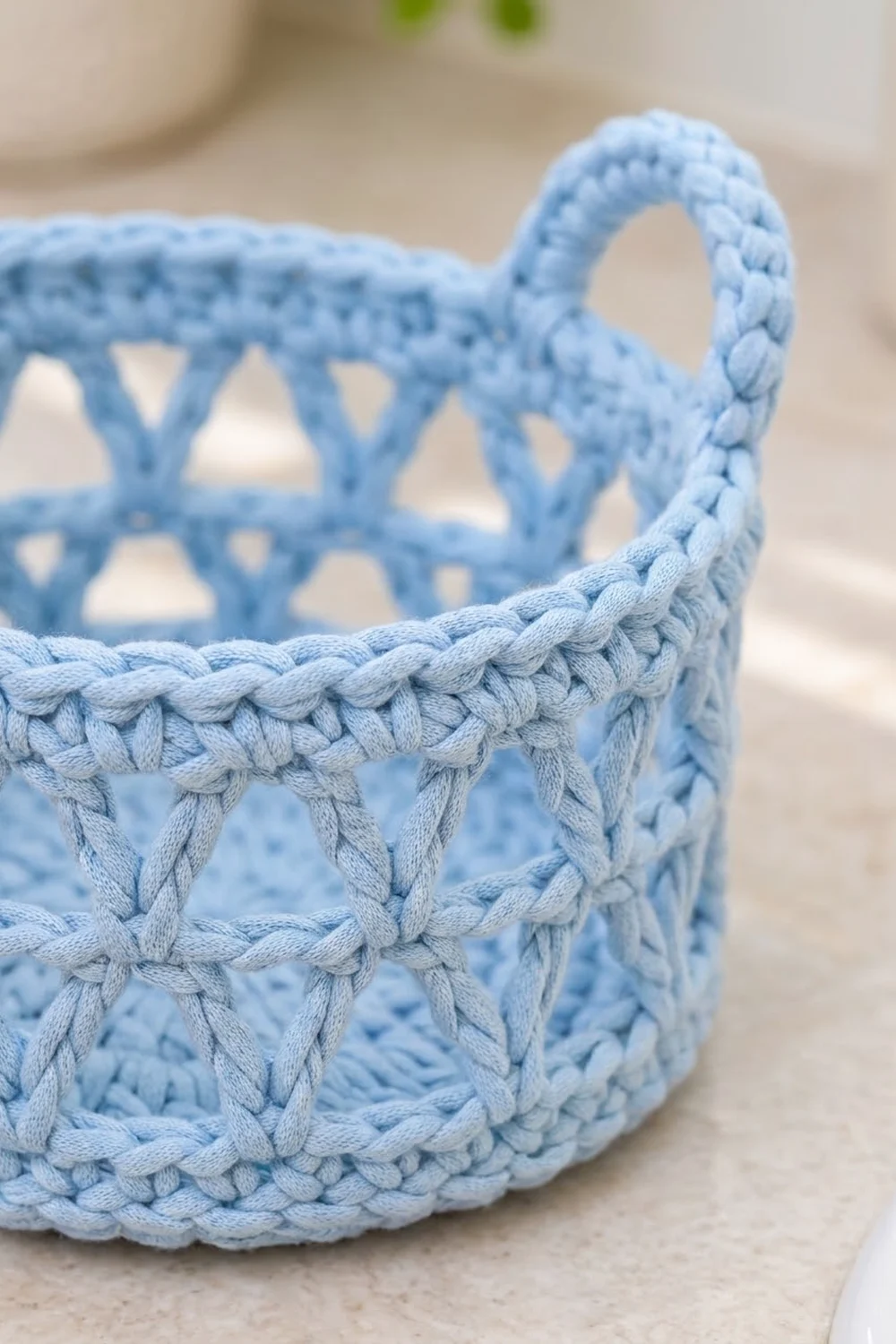
Special stitch – V-stitch (V): Work (tr, ch 1, tr) all in the same stitch. The two trebles share one base and spread apart at the top, which forms the point-down V.
Reverse single crochet: Work single crochet from left to right (right to left if you crochet left-handed). Insert the hook into the next stitch to the right, yarn over, pull up a loop, yarn over and pull through both loops.
Gauge and Checkpoints
Gauge: 11 sts = 4 in (10.2 cm) in both dc and sc. 13 sc rounds = 4 in (10.2 cm). One V-stitch round = 1 in (2.5 cm) tall.
Make the base first and use it as your gauge test. If the base is right, the wall will fit, because the wall keeps the same 60 stitches all the way up.
Checkpoints:
- After Round 2: 2.75 in (7.0 cm) across
- After Round 3: 4.2 in (10.7 cm) across
- After Round 4: 5.5 in (14.0 cm) across
- After Round 5: 7 in (17.8 cm) across, lying flat
- After Round 12: wall is 3.5 in (8.9 cm) tall
- After Round 15: wall is 4.5 in (11.4 cm) tall
Too big? If the base is wider than 7.25 in (18.4 cm), go down a hook size to 5.5 mm (US I-9).
Too small? If the base is under 6.75 in (17.1 cm), go up to 6.5 mm (US K-10.5).
A loose base also ruffles and a tight one cups. Fix the hook size before you start the wall. It is much faster to rip back five rounds now than a whole basket later.
Base
Work in joined rounds with the right side facing. The beginning ch 3 counts as a dc. The beginning ch 1 does not count as a stitch.
Round 1: Make a magic ring. Ch 3, work 11 dc into the ring. Pull the ring closed and join with sl st to the top of the ch 3. (12 dc)
Round 2: Ch 3, dc in the same st, 2 dc in each st around. Join. (24 dc)
Round 3: Ch 3, dc in the same st, dc in next st, 2 dc in next st, dc in next st; rep from * around. Join. (36 dc)*
Round 4: Ch 3, dc in the same st, dc in next 2 sts, 2 dc in next st, dc in next 2 sts; rep from * around. Join. (48 dc)*
Round 5: Ch 3, dc in the same st, dc in next 3 sts, 2 dc in next st, dc in next 3 sts; rep from * around. Join. (60 dc)*
Lay the base flat and measure it. It should be 7 in (17.8 cm) across with no ruffling or cupping. The circumference is about 21.8 in (55.4 cm), which matches 60 stitches at 11 sts per 4 in (10.2 cm).
Wall
From here on there are no increases. Every solid round has 60 stitches.
Round 6 (turning round): Ch 1, sc in BLO of each st around. Join to the first sc. (60 sc)
This is a conversion round: 60 dc worked 1-per-existing-stitch + 0 added = 60 sc. The unworked front loops form a ridge on the outside, and the work starts to stand up into a wall.
Round 7: Ch 1, sc in each st around. Join. (60 sc)
Round 8 (V round): Ch 4 (counts as tr), ch 1, tr in the same st (first V made), ch 2, skip next 3 sts. V in next st, ch 2, skip next 3 sts; rep from * 13 more times. Join with sl st to the 3rd ch of the beginning ch 4. (15 V-stitches, 15 ch-2 sps)*
Each repeat sits on 4 stitches of the round below: 1 stitch holds the V and 3 are skipped. 15 repeats × 4 sts = 60 sts, so the round lines up exactly. The skipped stitches under each ch 2 leave the open triangles between the Vs.
Round 9: Sl st into the first ch-1 sp. Ch 1, sc in the same ch-1 sp, sc in next tr, sc in next ch-2 sp, sc in next tr, sc in next ch-1 sp, sc in next tr, sc in next ch-2 sp; rep from * 13 more times, sc in the beginning ch-4 (the first tr). Join to the first sc. (60 sc)*
This is a conversion round: 4 sc per V repeat (tr, ch-1 sp, tr, ch-2 sp) × 15 repeats = 60 sc. That brings the count back to 60 and caps the triangles with a solid band.
Round 10: Ch 1, sc in each st around. Join. (60 sc)
Round 11 (V round): Rep Round 8. (15 V-stitches, 15 ch-2 sps)
To stack the Vs neatly, start this round in the stitch above the first V of Round 8. Each V point should line up over a V below.
Round 12: Rep Round 9. (60 sc)
Checkpoint: The wall should be about 3.5 in (8.9 cm) tall. That’s 5 sc rounds at about 0.3 in (0.8 cm) each plus 2 V rounds at 1 in (2.5 cm) each. The wall should stand straight and not flare out.
Rim and Handles (Border)
The rim works as this basket’s border. It firms up the top edge and holds the handles.
Border gauge: Same as the wall, 11 sc = 4 in (10.2 cm) and 13 sc rounds = 4 in (10.2 cm). The handle wrapping is packed tighter than gauge, with 14 sc over each ch 10.
Round 13 (handle round): Ch 1, sc in next 5 sts, ch 10, skip next 6 sts, sc in next 24 sts, ch 10, skip next 6 sts, sc in next 19 sts. Join to the first sc. (48 sc + 2 ch-10 handle loops)
Why the math works: 5 + 6 + 24 + 6 + 19 = 60, so the round uses every stitch of Round 12 exactly once. Each skip of 6 sts spans about 2.2 in (5.6 cm). The two skipped sections start 30 stitches apart, so the handles sit directly opposite each other. Ch 10 is longer than the 6 skipped stitches, so the chain arches up instead of lying flat.
Round 14: Ch 1, sc in each sc to the first handle, 14 sc into the ch-10 sp, sc in each sc to the second handle, 14 sc into the ch-10 sp, sc in each remaining sc. Join. (76 sc)
This is a trim round: 48 sc worked 1-per-existing-stitch + 28 sc wrapped into the 2 handle loops (14 + 14) = 76 sc. Push the stitches tightly together along each chain so the handle feels like a firm, padded loop.
Round 15: Ch 1, rev sc in each st around. Join and fasten off. (76 rev sc)
The reverse single crochet gives the rope-like edge on the rim and the outside of the handles. Work it slightly loosely so it doesn’t pull the rim in.
Final rim checkpoint: The wall should now be 4.5 in (11.4 cm) tall, since the three rim rounds add about 1 in (2.5 cm). Each handle should rise about 1.5 in (3.8 cm) above the rim, with an opening about 2 in (5.1 cm) wide. That’s enough for two or three fingers.
Weave in all ends on the inside of the wall. Cotton cord is slippery, so weave each tail in at least three directions.
Final Blocking
- Lightly mist the whole basket with water until it is damp but not soaked.
- Slide a straight-sided container about 7 in (17.8 cm) across inside the basket, or pack it firmly with a rolled towel.
- Press the base flat against the table and smooth the wall straight up.
- Gently open each V-stitch with your fingers so the triangles are even and the V points line up vertically.
- Shape each handle into a smooth upright arch. A rolled strip of paper towel tucked inside the loop holds the curve.
- Let it dry completely, usually 12–24 hours, before you remove the form.
Final Quality-Control Checklist
- Base lies flat and measures 7 in (17.8 cm) across
- Every solid round has 60 sc (Rounds 14 and 15 have 76 sts)
- Each V round has 15 V-stitches with even gaps
- Round 11 Vs sit directly above the Round 8 Vs
- Wall stands straight at 4.5 in (11.4 cm)
- Handles are directly opposite each other and the same height
- Rev sc edge is even, with no ruffling or pulling in
- All ends are woven in on the inside
Troubleshooting
Base is ruffling: Your dc is too loose, or you added extra increases. Count each round, and go down a hook size if needed.
Base cups up before Round 6: Your tension is too tight. Go up a hook size or loosen your dc slightly.
Wall flares outward: You probably have more than 60 sts. Recount Rounds 9 and 12, where it’s easy to put 2 sc into a ch-2 sp by mistake.
Wall leans inward: Round 6 was worked too tightly. Redo the BLO round with a slightly looser hand.
V-stitches look short or crooked: Pull each tr loop up to full height before finishing it, and make sure both trebles of each V go into the same stitch.
Handles are floppy: Pack the stitches more firmly, or work 16 sc instead of 14 into each loop in Round 14. Round 15 will then have 80 rev sc.
Handles are uneven: Recount Round 13. The two skipped groups must start 30 stitches apart.
Care
Hand wash in cool water with a mild soap, press the water out gently, and dry the basket on its form. Don’t tumble dry, because heat can shrink cotton and soften the shape.
Final Notes
The measurement chain is short and reliable. A base of 60 dc at 11 sts per 4 in (10.2 cm) gives a 7 in (17.8 cm) circle. Keeping 60 stitches on every solid round keeps the wall straight. Fifteen 4-stitch V repeats fit the round exactly, and each sc round after a V round brings the count back to 60. The rim adds 28 handle stitches for a total of 76 at the top. The finished basket stands 4.5 in (11.4 cm) tall, with handles reaching 6 in (15.2 cm).
Check your base first and keep counting your 60s. The rest of the basket follows from there. Happy crocheting!