

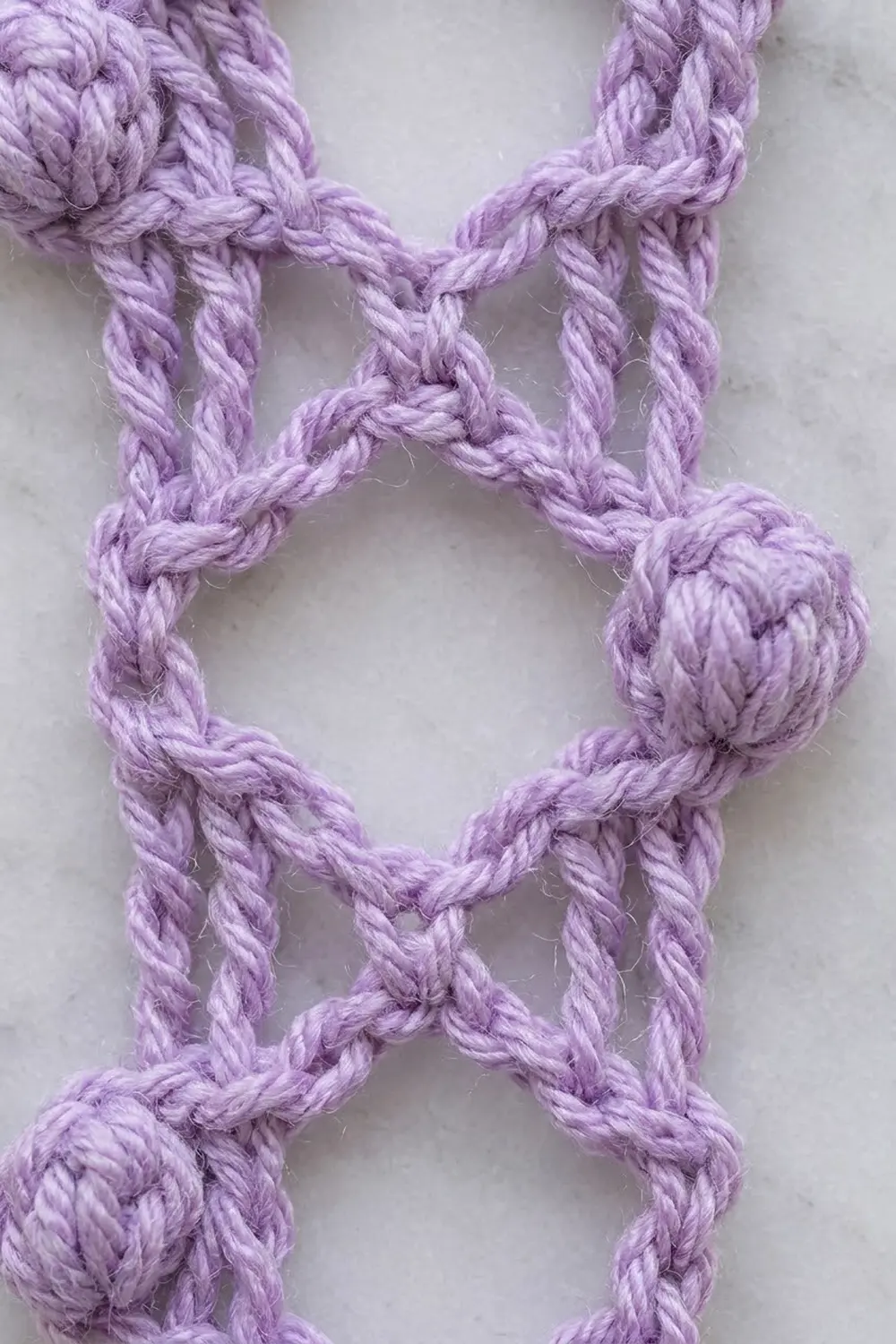
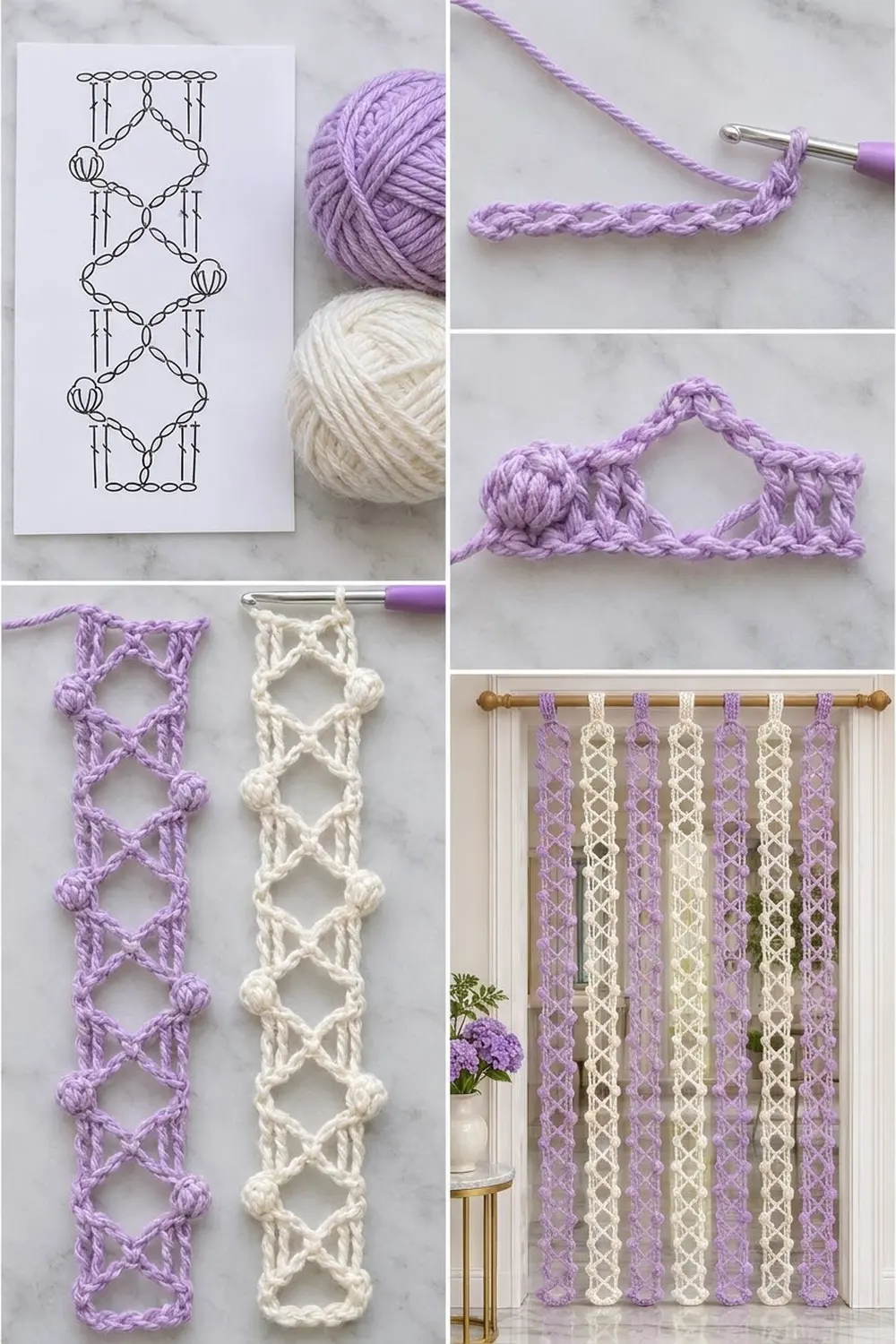
This doorway curtain is made of seven narrow lace strips hung side by side from a wooden rod. Each strip has two solid columns along its edges and a row of open diamonds down the middle, divided by little chain crosses. A round bobble sits beside every cross, and the bobbles switch sides as the strip goes up, so the outline zigzags gently.
The strips alternate soft lavender and creamy white: four lavender and three cream, starting and ending with lavender. The look is airy and a little romantic. Light comes through, the bobbles add some texture, and the strips sway apart when you walk through them.
All instructions use US crochet terms. Each finished strip measures 3.5 in (8.9 cm) wide and 76.5 in (194.3 cm) long, plus a 3 in (7.6 cm) hanging loop. Hung from the rod, the curtain drops about 79.5 in (201.9 cm). With the strips spaced 2 in (5.1 cm) apart, it covers about 36.5 in (92.7 cm) across.
Construction is simple. Each strip is worked flat in rows from the bottom up, gets one round of single crochet border, and then a short tab is worked off the top edge and folded back into a loop. The strips are not sewn to each other. Each one slides onto the rod on its own.
Finished Size and Construction
- Finished curtain: about 36.5 in (92.7 cm) wide x 79.5 in (201.9 cm) drop
- Skill level: Easy-intermediate
- Terminology: US
- Yarn weight: Worsted (#4)
- Hook: US H-8 (5 mm)
- Number of pieces: 7 separate strips (4 lavender, 3 cream)
- Layout: 1 row of 7 strips, colors alternating, spaced 2 in (5.1 cm) apart
- Strip size: 3.5 in (8.9 cm) x 76.5 in (194.3 cm), not counting the loop
- Size before border: 3 in (7.6 cm) x 76 in (193.0 cm)
- Border depth: 0.25 in (0.6 cm) on every side
- Hanging loop: 2.25 in (5.7 cm) wide, 3 in (7.6 cm) deep when folded
Materials
Pick a smooth worsted-weight cotton or cotton blend. Cotton keeps the lace crisp and stops the strips from stretching under their own weight. Acrylic works too, but the strips will grow more in length after hanging. The amounts below assume skeins of about 180 m per 100 g.
- Lavender: 250 g / 450 m (4 strips)
- Cream: 200 g / 360 m (3 strips)
One strip uses about 50 g / 90 m. These quantities include a margin of roughly 25% for your gauge swatch, slightly heavier tension, and weaving in ends.
Tools:
- US H-8 (5 mm) crochet hook
- Tapestry needle
- Scissors
- Stitch markers
- Tape measure
- Rust-proof pins and a long blocking surface (a clean floor with towels works)
- Spray bottle
- Curtain rod, up to 1.5 in (3.8 cm) in diameter
Abbreviations (US Terms)
- ch = chain
- sc = single crochet
- dc = double crochet
- sk = skip
- sp = space
- st(s) = stitch(es)
- RS / WS = right side / wrong side
Special stitches:
- Bobble (bob): [Yarn over, insert hook in st, yarn over and pull up a loop, yarn over and pull through 2 loops] 5 times in the same st (6 loops on hook). Yarn over and pull through all 6 loops. Counts as 1 st.
- Beginning bobble (beg-bob): Ch 2, then [yarn over, insert hook in first st, yarn over and pull up a loop, yarn over and pull through 2 loops] 4 times in the same st (5 loops on hook). Yarn over and pull through all 5 loops. Counts as 1 st and replaces the turning chain.
The ch-3 at the start of a dc row counts as a dc throughout.
Gauge and Checkpoints
Gauge:
- Pattern width: 11 sts = 3 in (7.6 cm)
- Pattern height: 2 pattern rows = 1 in (2.5 cm), so each dc-height row is 0.5 in (1.3 cm)
- Single crochet: 16 sc and 16 rows = 4 in (10.2 cm)
Test strip first. Before you start the full curtain, make a short strip: Rows 1-3, Rows 4-7 once, Rows 8-11 once (as written below), then Rows 152-153. That is 9 pattern rows plus the bands. Unblocked, it should measure 3 in (7.6 cm) wide and 6 in (15.2 cm) long.
Checkpoints on the full strip:
- After Row 2: 3 in (7.6 cm) wide, 0.75 in (1.9 cm) tall
- After Row 77: 38.25 in (97.2 cm) long
- After Row 153: 3 in (7.6 cm) x 76 in (193.0 cm)
- After the border: 3.5 in (8.9 cm) x 76.5 in (194.3 cm)
If the strip is too big: switch to a hook one size smaller (4.5 mm), and keep your chains snug. Loose ch-7 bars are the most common reason the lace gets too wide.
If the strip is too small: switch to a hook one size larger (5.5 mm). If only the length is short, add pattern rows in blocks of 4 (Rows 8-11) so the bobble sequence stays correct.
Strip Pattern (Make 7)
Each strip is 11 sts wide. Every row keeps that count of 11: 2 edge sts on each side and 7 sts across the center (or a ch-7 bar on diamond rows).
Foundation: Ch 12.
Row 1 (WS): Sc in 2nd ch from hook and in each ch across, turn. (11 sc)
Row 2: Ch 3, dc in each st across, turn. (11 dc)
Rows 1 and 2 form the solid bottom band.
Row 3 (V row, end bobble): Ch 3, dc in next st, ch 3, sk 3 sts, sc in next st (the center st), ch 3, sk 3 sts, dc in next st, bob in top of turning ch, turn. (2 dc + 3 ch + 1 sc + 3 ch + 1 dc + 1 bob = 11 sts)
The two ch-3 lengths slope down from the tall edge columns to the short center sc, which makes the first V of the lattice. The bobble puffs out toward the back of the row you are working. Because all V rows are worked in the same direction, every bobble ends up on the same face. That face is the RS.
Row 4 (diamond row): Ch 3, dc in next st, ch 7, sk (ch-3, sc, ch-3), dc in next st, dc in top of turning ch, turn. (2 dc + 7 ch + 2 dc = 11 sts)
Row 5 (V row, beginning bobble): Beg-bob in first st, dc in next st, ch 3, sc around the ch-7 bar, enclosing it at its 4th ch, ch 3, dc in next st, dc in top of turning ch, turn. (1 beg-bob + 1 dc + 3 ch + 1 sc + 3 ch + 2 dc = 11 sts)
This sc does the real work. It pulls the middle of the ch-7 bar upward into an inverted V while the new ch-3 lengths come down to meet it, so the two lines cross into an X. The open spaces between the crosses become the diamonds.
Row 6 (diamond row): Ch 3, dc in next st, ch 7, sk (ch-3, sc, ch-3), dc in next st, dc in top of beg-bob, turn. (11 sts)
Row 7 (V row, end bobble): Ch 3, dc in next st, ch 3, sc around the ch-7 bar at its 4th ch, ch 3, dc in next st, bob in top of turning ch, turn. (11 sts)
Rows 4-7 form the 4-row repeat. Each repeat has 2 crosses, with one bobble on each edge.
Rows 8-151: Repeat Rows 4-7 another 36 times. (11 sts in every row)
Row 151 is an end-bobble V row. You now have 149 pattern rows (Rows 3-151): 75 V rows and 74 diamond rows. That gives 75 crosses and 75 bobbles, with 38 bobbles on one edge and 37 on the other.
Row 152: Ch 3, dc in next st, dc in each of next 3 ch, dc in sc, dc in each of next 3 ch, dc in last 2 sts, turn. (2 + 3 + 1 + 3 + 2 = 11 dc)
Row 153: Ch 1, sc in each st across. (11 sc) Do not fasten off.
Length check: Rows 1-2 measure 0.75 in (1.9 cm). Rows 3-151 add 149 x 0.5 in = 74.5 in (189.2 cm). Rows 152-153 add 0.75 in (1.9 cm). The total is 76 in (193.0 cm).
Make All Pieces
- Lavender: 4 strips
- Cream: 3 strips
Layout from left to right as you face the doorway:
| L | C | L | C | L | C | L |
  1   2   3   4   5   6   7
L = lavender, C = cream
Keep strips 1 and 7 lavender so the curtain is symmetrical. Check each strip against the 76 in (193.0 cm) checkpoint before you add its border.
Joining: Hanging Loops (No Seaming Between Strips)
The strips are never stitched to each other. Each one gets its own loop and hangs from the rod on its own, so the curtain parts easily.
Loop tab (after the border, worked on each strip): With RS facing, look at the top edge. It has 15 border sc: a 3-sc corner group, 9 sc, and another 3-sc corner group. Sk the first 3 sc and join yarn in the next sc.
Tab Row 1: Ch 1, sc in same st and in next 8 sc, turn. (9 sc) Leave the last 3 sc unworked.
Tab Rows 2-24: Ch 1, sc in each st across, turn. (9 sc)
At 4 sc rows per inch, the tab is 6 in (15.2 cm) long and 2.25 in (5.7 cm) wide. Fasten off and leave a 12 in (30.5 cm) tail.
Stitch-to-stitch closing: Fold the tab to the WS. Line up the 9 sts of Tab Row 24 with the 9 sts at the base of Tab Row 1, one to one. Whipstitch each pair together, working through the back of the border sc. The folded loop is 3 in (7.6 cm) deep and fits a rod up to 1.5 in (3.8 cm) in diameter.
Tension: Sew firmly but leave the sts flat. If the seam puckers, the loop will twist on the rod.
Size checkpoint: Lay all 7 strips side by side. Loops included, each should measure 79.5 in (201.9 cm), and all lengths should match within 0.5 in (1.3 cm).
Border
Border gauge: 4 sc per inch (2.5 cm), matching the sc gauge.
Rnd 1 (RS): Continue from Row 153 with the same yarn. Ch 1, then work:
- Top edge: 3 sc in first st, sc in next 9 sts, 3 sc in last st. (15 sc, including both corner groups)
- First long side: Working in row ends, sc in end of Row 153, 2 sc in end of each of Rows 152-2, sc in end of Row 1. (1 + 302 + 1 = 304 sc)
- Bottom edge: Working in the free loops of the foundation chain, 3 sc in first ch, sc in next 9 ch, 3 sc in last ch. (15 sc, including both corner groups)
- Second long side: Work as the first long side. (304 sc)
Sl st to first sc to join. (638 sc total: 15 + 304 + 15 + 304) Fasten off and weave in ends.
The corner groups are counted only on the short edges, so no corner stitch is counted twice.
Why the math works: Rows 2-152 are 151 dc-height rows of 0.5 in (1.3 cm) each. Two sc per row end gives 4 sc per inch, which exactly matches the sc gauge. Rows 1 and 153 are sc rows of 0.25 in (0.6 cm), and 1 sc each also gives 4 per inch. 304 sc divided by 76 in is 4 sc per inch, so the long edges lie flat without ruffling or pulling in. On the short edges, the 9 straight sc plus the corner groups cover 3 in (7.6 cm) and give the corners room to turn.
After the border, each strip measures 3.5 in (8.9 cm) x 76.5 in (194.3 cm).
Final Blocking
- Weave in all ends along the edge columns, never through the open chain bars.
- Lay one strip on towels with the RS up, bobbles facing you.
- Mist it until it is damp but not dripping.
- Pin the long edges straight to 3.5 in (8.9 cm) wide, working in 12 in (30.5 cm) sections.
- Ease each cross so it sits in the center and each diamond opens evenly.
- Check the length: 76.5 in (194.3 cm), not counting the loop.
- Gently round each bobble with your fingers.
- Let the strip dry completely before unpinning. Repeat for all 7 strips.
Final Quality-Control Checklist
- [ ] Every row has 11 sts
- [ ] 75 crosses and 75 bobbles per strip, alternating sides
- [ ] All bobbles puff toward the RS
- [ ] The border has 638 sc, with 304 on each long side
- [ ] The strip measures 3.5 in (8.9 cm) x 76.5 in (194.3 cm) after blocking
- [ ] The loop is 3 in (7.6 cm) deep and the seam lies flat
- [ ] 4 lavender and 3 cream strips, hung L-C-L-C-L-C-L
- [ ] Gaps are about 2 in (5.1 cm), and the full width is about 36.5 in (92.7 cm)
Troubleshooting
Crosses sit off-center: The sc was not placed at the 4th ch of the ch-7. Count the chains and re-work that row.
Bobbles all on one edge: You repeated the same V row twice. The end-bobble and beginning-bobble rows alternate in every 4-row repeat.
Bobbles on the wrong face: You worked a V row in the wrong direction. Make sure every V row has an odd row number.
Strip curves to one side: The turning chains are tighter than the edge dc. Make your ch-3 a little looser.
Border ruffles: You worked too many sc into the row ends. Use exactly 2 per dc row.
Care
Hand wash in cool water with mild soap, roll each strip in a towel to remove water, and dry flat. Don’t hang the strips wet, because the weight of the water will stretch the lace.
Final Notes
The measurement chain is short and easy to check. Eleven stitches make 3 in (7.6 cm) of width. Two pattern rows make 1 in (2.5 cm) of length, and 153 rows make 76 in (193.0 cm). Two sc per row end match the 4-per-inch border gauge, and one round of border brings the strip to 3.5 in (8.9 cm) x 76.5 in (194.3 cm). The 6 in (15.2 cm) tab folds into a 3 in (7.6 cm) loop, which gives a 79.5 in (201.9 cm) drop. Measure at each checkpoint and all seven strips will hang evenly.
Happy crocheting!