

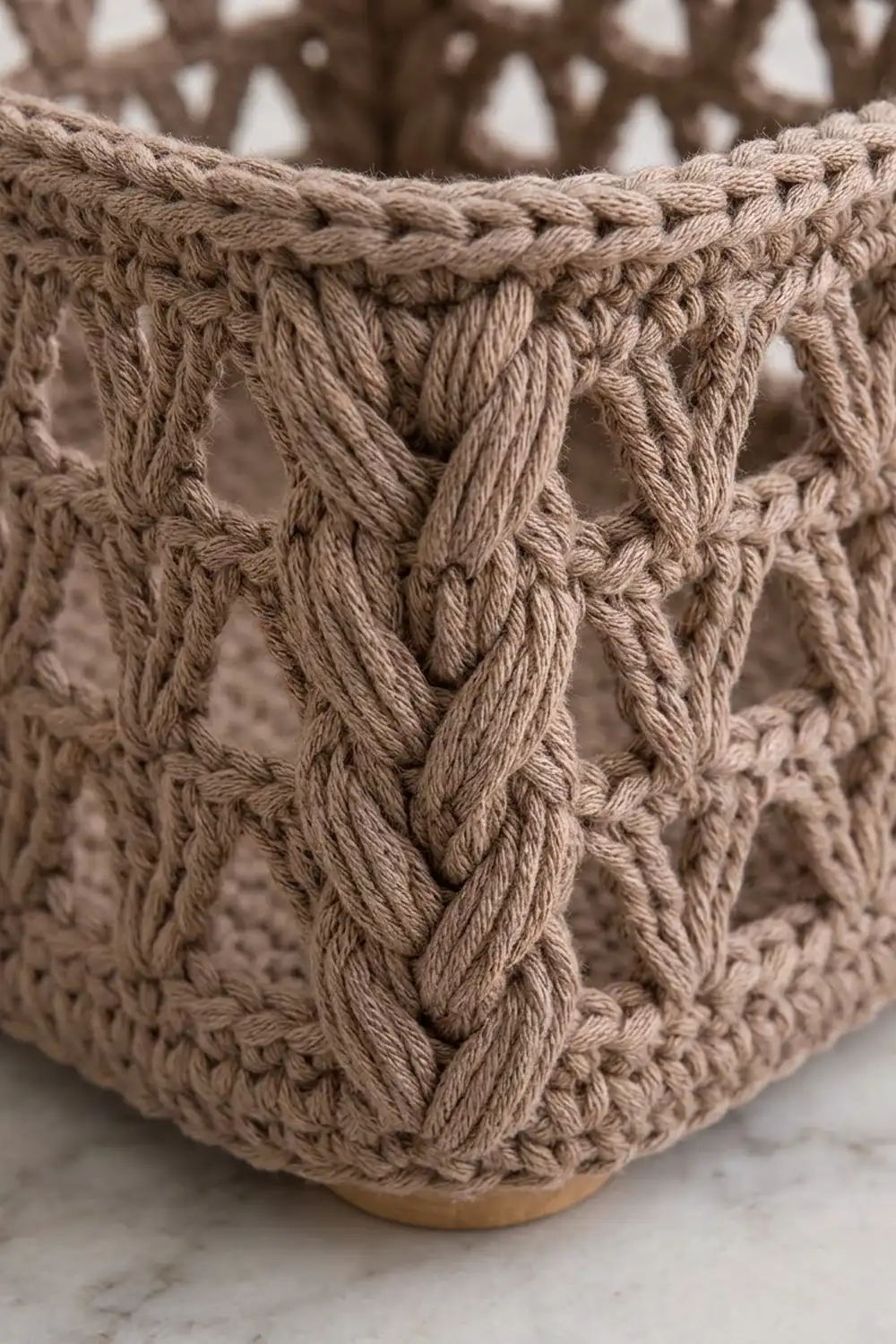
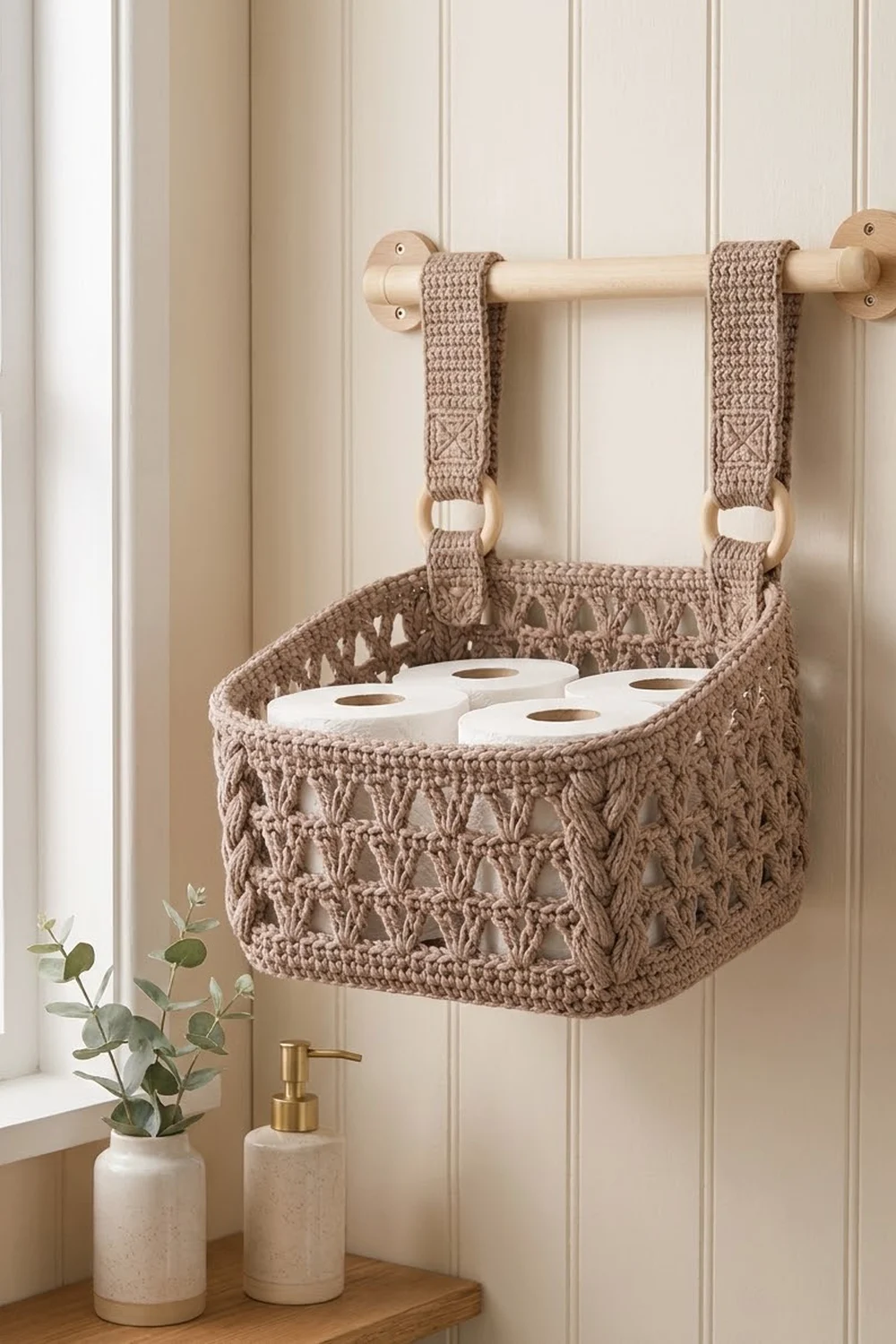
This hanging basket is a soft, structured storage piece in a warm mocha taupe. It has a solid base, open V-stitch walls with neat rows of small triangles, and a plaited cable braid running up each corner. A rolled rim finishes the top edge, and two ring straps hang it from a wooden dowel rail.
The look is calm and natural, made to suit a bathroom, nursery, or entryway. Everything is worked in one color, so the texture does all the work. The finished basket holds about four standard toilet paper rolls.
The pattern uses US crochet terms. The finished basket measures about 8 in (20.3 cm) square and 5.4 in (13.7 cm) tall. The straps are 14 in (35.6 cm) long before folding.
Construction is simple. You work the base in joined rounds from a magic ring, turn up the walls with a back-loop round, and then work the lattice and braid rounds without changing color. A two-round rim finishes the top. Last, you crochet two straps and two tabs as flat strips and sew them to wooden rings.
Finished Size and Construction
- Finished size: 8 in × 8 in (20.3 cm × 20.3 cm) footprint, 5.4 in (13.7 cm) tall
- Skill level: Intermediate
- Terminology: US crochet terms
- Yarn weight: Aran / heavy worsted (#4) cotton or cotton blend
- Hook: 4.5 mm (US 7)
- Number of pieces: 5 (1 basket, 2 straps, 2 tabs)
- Layout: Basket hangs from 2 straps on a rod, linked by 2 tabs and 2 rings
- Base size: 8 in (20.3 cm) between corner stitches
- Size before border (rim): 8 in × 8 in × 4.9 in (20.3 cm × 20.3 cm × 12.4 cm)
- Border (rim) depth: about 0.6 in (1.5 cm)
Materials
Yarn. Choose a smooth, firm cotton or cotton blend in aran weight. Cotton holds the basket’s shape and shows the stitch texture clearly. Avoid fuzzy or very stretchy yarns, because they blur the triangles and let the walls sag.
- Mocha / taupe: 250 g, about 425 m (465 yd)
- Basket: about 180 g
- Straps: about 15 g each
- Tabs: about 5 g each
These quantities include a margin of about 12% for your gauge swatch and tension differences.
Tools and hardware:
– 4.5 mm (US 7) crochet hook
– 4 locking stitch markers
– Tapestry needle
– Scissors and measuring tape
– 2 wooden rings, 2.5 in (6.4 cm) outer diameter, about 2 in (5.1 cm) inner diameter
– 1 wooden dowel, 1 in (2.5 cm) diameter × 12 in (30.5 cm) long
– 2 round wooden end mounts, 2.5 in (6.4 cm), with 2 screws and 2 wall anchors
Abbreviations (US Terms)
- ch: chain
- sl st: slip stitch
- sc: single crochet
- dc: double crochet
- BLO: back loop only
- FPdc: front post double crochet
- rev sc: reverse single crochet (crab stitch)
- st(s): stitch(es)
- sp: space
- rep: repeat
Special stitches
- V-st: (dc, ch 1, dc) all in the same stitch. Each V-st counts as 3 sts: 2 dc plus 1 ch.
- Braid cable (worked over 4 sts): Skip the next 2 sts. FPdc around each of the next 2 sts. Then, working in front of the stitches you just made, FPdc around each of the 2 skipped sts. That’s 4 sts.
- Box-X: A sewn rectangle with an X through it, worked with a tapestry needle through both layers of a fold.
Gauge and Checkpoints
Gauge: 14 sc and 14 sc rounds = 4 in (10.2 cm). In dc pattern rounds, 7 rounds = 4 in (10.2 cm).
Test the base first. It works as your gauge swatch.
- After Rnd 8: The base is 4 in (10.2 cm) between corner stitches, with 56 sts.
- After Rnd 15: The base is 8 in (20.3 cm) between corner stitches, with 112 sts.
- After Rnd 18: The wall is about 7/8 in (2.2 cm) tall.
- After Rnd 24: The wall is about 4.25 in (10.8 cm) tall.
- After Rnd 26: The wall is about 4.9 in (12.4 cm) tall.
If your base is too big, go down a hook size, to 4.0 mm. If it’s too small, go up to 5.0 mm. Don’t add or remove rounds to fix the size. The wall pattern needs exactly 112 sts.
Basket Base
Work in joined rounds with the right side facing. Ch 1 at the start of each round does not count as a stitch. Join each round with a sl st to the first sc.
Rnd 1: Make a magic ring. Ch 1, then work 8 sc in the ring. Join. (8 sts)
Rnd 2: Ch 1, then [3 sc in next st, sc in next st] 4 times. Join. (16 sts)
The middle sc of each 3-sc group is a corner stitch. Mark the corners if it helps.
Rnd 3: Ch 1. Sc in each st up to the corner st, then work 3 sc in the corner st. Rep from * 3 more times, then sc in each remaining st. Join. (24 sts)
Rnds 4–15: Rep Rnd 3. Each round adds 8 sts.
| Rnd | Total sts | Sts per side, corners included |
|---|---|---|
| 4 | 32 | 7 |
| 6 | 48 | 11 |
| 8 | 56 | 15 |
| 10 | 72 | 19 |
| 12 | 88 | 23 |
| 15 | 112 | 29 |
Round n has 8 × (n − 1) sts. On Rnd 15, each side has 29 sts, including its 2 corner sts. Because neighboring sides share their corners, 4 × 29 − 4 = 112.
Move a marker into each of the 4 corner sts of Rnd 15. The edge rounds of sc and the wall turn give the base its slightly rounded corners.
Basket Walls
Rnd 16 (turning ridge): Ch 1, then sc in the BLO of each st around. Join. (112 sts)
This round creates the crisp fold at the base. Move each marker up to the st directly above a corner.
Rnds 17–18: Ch 1, then sc in each st around. Join. (112 sts)
Before Rnd 19, sl st across to the st just before the first marked corner st. Each wall now has 28 sts: a 4-st braid over the corner (the st before the corner, the corner, and the 2 sts after it) followed by a 24-st lattice panel. Since 4 × 28 = 112, every stitch is used once.
Rnd 19 (V round): Ch 2 (doesn’t count). FPdc around each of the next 4 sts for the braid. Then [skip 1 st, V-st in next st, skip 1 st] 8 times for the panel. Rep from * 3 more times. Join to the first FPdc.
Per side that’s 4 + 24 = 28, for a total of 112 sts. The 2 skipped sts between neighboring V-sts open into the triangles.
Rnd 20 (solid round): Ch 2 (doesn’t count). Work a braid cable over the 4 braid sts. Then [dc in dc, dc in ch-1 sp, dc in dc] 8 times. Rep from * 3 more times. Join. (28 per side, 112 sts)
Rnd 21: Ch 2 (doesn’t count). FPdc around each of the 4 braid sts. Then [skip 1 st, V-st in next st, skip 1 st] 8 times. Rep from * 3 more times. Join. (112 sts)
Each V-st lands on the dc that was worked into a ch-1 sp, so the triangles stack in neat columns.
Rnd 22: Rep Rnd 20. (112 sts)
Rnd 23: Rep Rnd 21. (112 sts)
Rnd 24: Rep Rnd 20. (112 sts)
That gives you three bands of triangles and three braid crossings on each corner.
Rnds 25–26: Ch 1, then sc in each st around. Join. (112 sts)
Checkpoint: the wall should be about 4.9 in (12.4 cm) tall, and each side should still measure 8 in (20.3 cm).
Make All Pieces
All pieces use mocha:
- 1 basket: about 180 g, made above
- 2 straps: about 15 g each
- 2 tabs: about 5 g each
Strap (make 2)
Ch 7.
Row 1: Sc in the 2nd ch from the hook and in each ch across. (6 sts)
Rows 2–49: Ch 1, turn, then sc in each st across. (6 sts)
The strap measures about 1.7 in × 14 in (4.3 cm × 35.6 cm). Fasten off and leave a 24 in (61.0 cm) tail.
Tab (make 2)
Ch 6.
Row 1: Sc in the 2nd ch from the hook and in each ch across. (5 sts)
Rows 2–14: Ch 1, turn, then sc in each st across. (5 sts)
The tab measures about 1.4 in × 4 in (3.6 cm × 10.2 cm). Leave a 12 in (30.5 cm) tail.
Layout (back view):
   ===========[ wooden dowel ]===========
        [Strap A]              [Strap B]
            |      6 in apart      |
          (ring)                 (ring)
          [Tab A]                [Tab B]
   +------------------------------------+
   | braid | V1 ... back wall ... V8 | braid |
   +------------------------------------+
Joining
Tabs to basket. On the back wall, find the middle dc of V1 and V8. The 4 braid sts plus the 2nd st of V1 put V1’s center 6 sts from the start of the side. V8’s center is 21 sts further along, at st 27. Those 21 sts measure 6 in (15.2 cm).
- Pass a tab through a ring and fold it in half so both ends meet.
- Place both ends against the inside of the wall, centered over V1. Overlap 1 in (2.5 cm) down into Rnds 25–26, so the ring sits about 1 in (2.5 cm) above the rim.
- Backstitch across the 5 end sts of each layer, matching one tab st to one wall st. Then whipstitch down both side edges.
- Repeat with the second tab over V8.
Straps to rings. Fold 2 in (5.1 cm) of the strap’s starting end through a ring. Sew a box-X through both layers, covering 1.7 in × 1.5 in (4.3 cm × 3.8 cm), with the X centered on the front.
Straps to rod. Slide each strap over the dowel. Fold 4 in (10.2 cm) of the top end down behind the strap, then whipstitch the 6 end sts and both side edges in place.
Tension advice: Keep your sewing stitches snug but not puckered. The fabric should lie flat around every seam.
Size checkpoint: Space the straps 6 in (15.2 cm) apart on the dowel to match the tabs. Each ring should hang roughly 6 in (15.2 cm) below the rod.
Border (Rim)
The rim follows the wall gauge of 14 sts = 4 in (10.2 cm). Its stitch count stays at 28 per side so the top edge stays the same width as the walls and doesn’t flare or pinch.
Rnd 27: Ch 1, then sc in each st around. Join. (28 per side, 112 sts)
Rnd 28: Ch 1, then rev sc in each st around, working from left to right. Join and fasten off. (28 per side, 112 sts)
Why the math works: At 3.5 sts per inch, 28 sts measure 8 in (20.3 cm), which matches the base and walls. Reverse sc twists each stitch into a rolled cord without adding any stitches. The rim adds about 0.6 in (1.5 cm), bringing the total height to 5.4 in (13.7 cm).
If you’d like the tabs completely hidden, work the rim before sewing them on. Otherwise, sew the tabs into Rnds 25–28 together.
Final Blocking
- Weave in all ends inside the basket, going through at least 2 in (5.1 cm) of stitches.
- Mist the basket evenly with water until it’s damp.
- Stuff it firmly with a towel-wrapped box about 8 in (20.3 cm) square.
- Pinch the turning ridge into a sharp edge, and press the corner braids so they stand upright.
- Open each triangle with your fingertip.
- Pin the straps flat at 1.7 in (4.3 cm) wide.
- Let everything dry completely, for 24 hours, before hanging.
Final Quality-Control Checklist
- [ ] The base has 112 sts and measures 8 in (20.3 cm) between corners.
- [ ] Every wall round has 112 sts.
- [ ] Each side has 4 braid sts and 8 V-sts.
- [ ] There are 3 bands of triangles, all aligned in columns.
- [ ] Each braid crosses 3 times, all in the same direction.
- [ ] The rim lies flat at 8 in (20.3 cm) per side.
- [ ] The tabs are centered over V1 and V8, 6 in (15.2 cm) apart.
- [ ] Both box-X patches are square and match each other.
- [ ] The rings hang level, and the basket doesn’t tip.
Troubleshooting
- The base cups: Your tension is too tight, or you missed a corner increase. Count each round against the table.
- The base ruffles: You have extra stitches. Recount the round and remove them.
- The walls flare: Check that the turning round is in the BLO, and work the dc rounds a little tighter.
- The triangles are crooked: The V-sts must go into the middle dc of each triad.
- The braid twists the wrong way: Always cross in front of the stitches, never behind.
- The basket hangs crooked: Measure the tab positions again and re-sew so both are exactly 21 sts apart.
- The straps stretch: Whipstitch both side edges of every fold, not just the ends.
Care
Spot clean, or hand wash cool and reshape while damp. Lay it flat to dry over a box so the walls keep their shape.
Final Notes
The measurement chain is simple. Your gauge of 14 sts = 4 in (10.2 cm) gives a base of 112 sts and 8 in (20.3 cm) per side. The walls keep 28 sts per side, made of a 4-st braid and a 24-st panel, through every round. The rim holds the same 112 sts, finishing the basket at 8 in × 8 in × 5.4 in (20.3 cm × 20.3 cm × 13.7 cm). The tabs sit 21 sts apart, which is 6 in (15.2 cm), and the straps on the rod are spaced to match.
Check your counts at each checkpoint and the basket will hang straight and hold its shape.
Happy crocheting!