

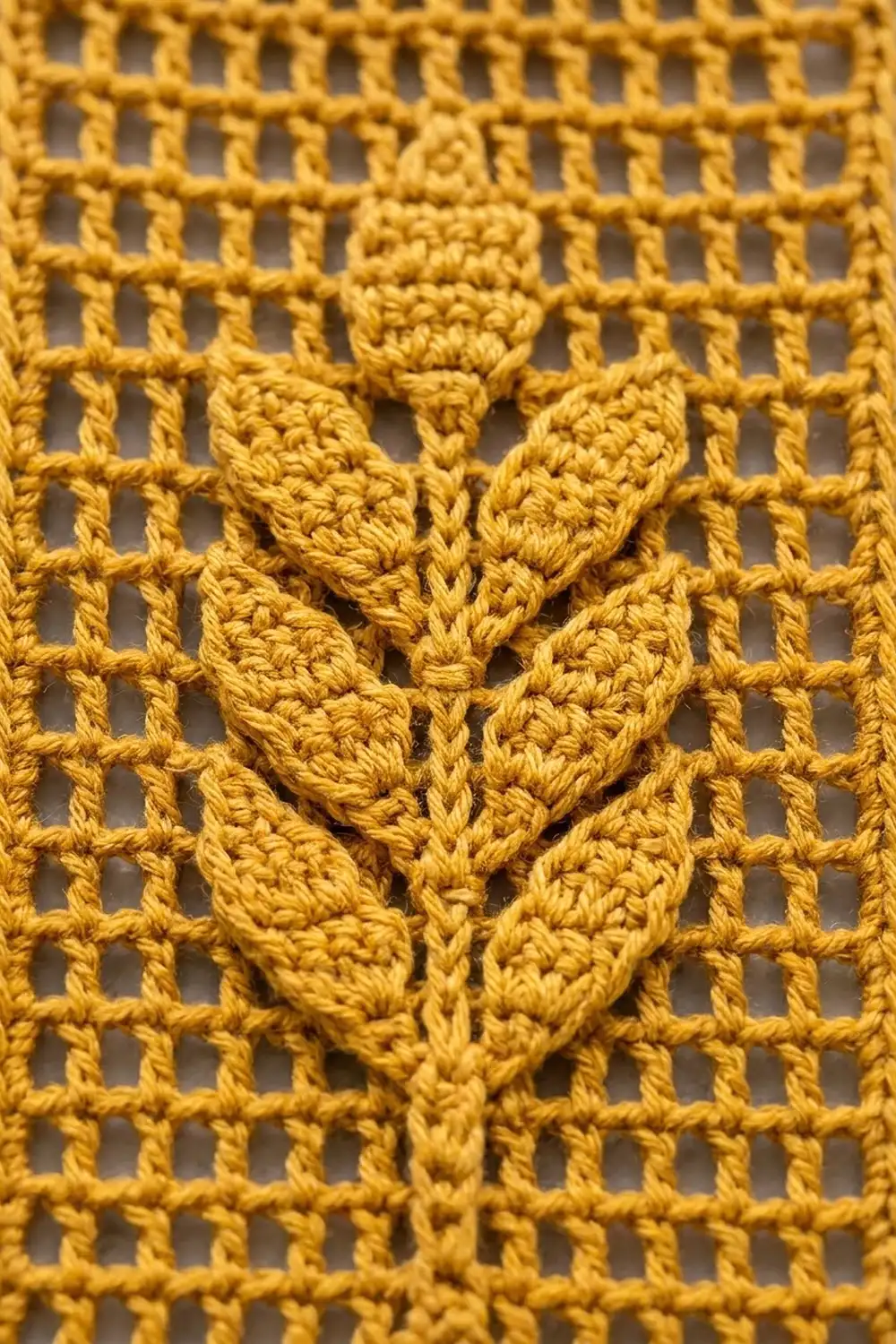
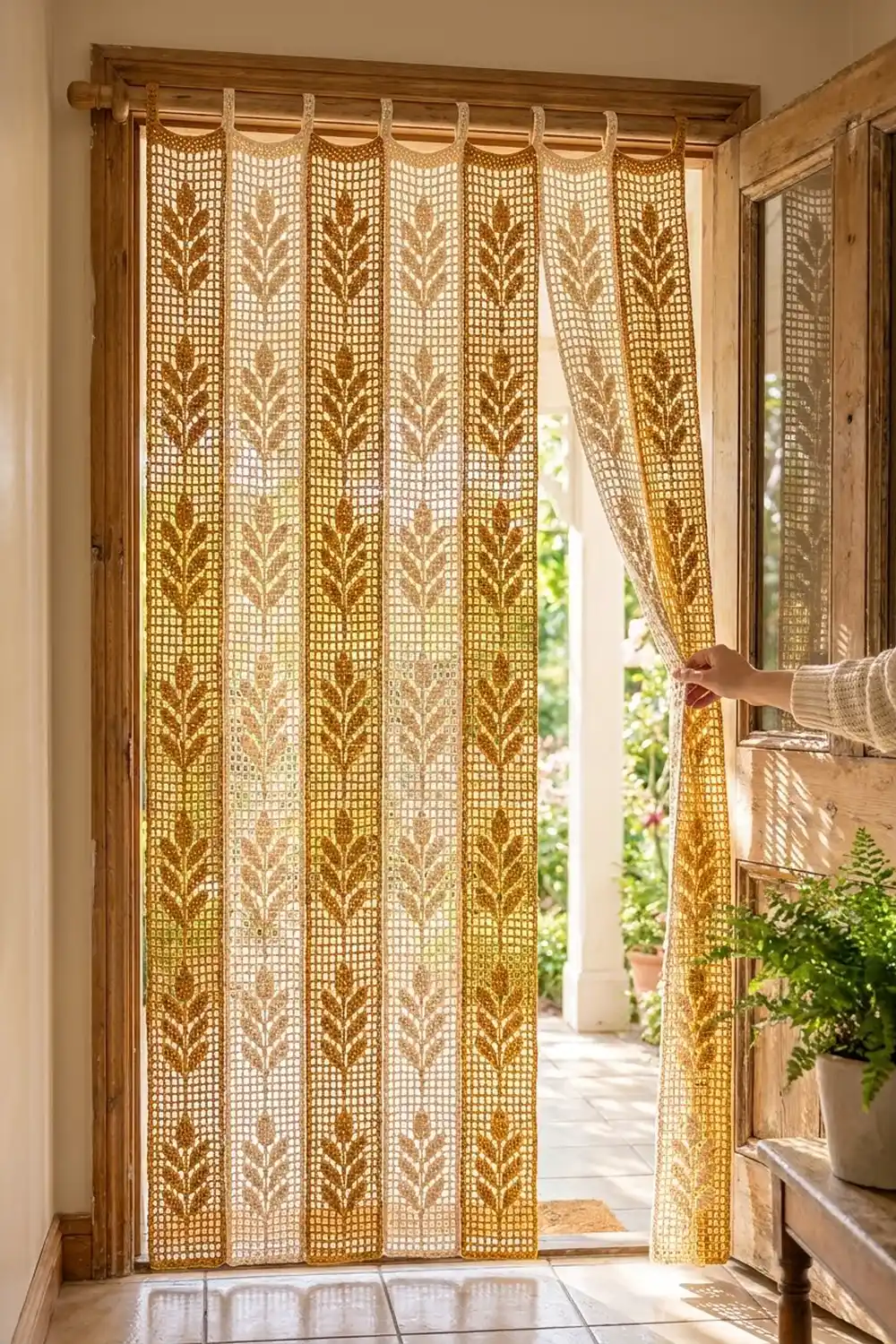
This door curtain is made of seven separate filet crochet strips. Each strip has a column of wheat ears worked in solid blocks against an open mesh grid. The strips hang side by side from a rod, so light comes through the mesh and you can push a strip aside to walk through.
The palette is warm and simple: four golden mustard strips alternate with three cream strips. The solid wheat blocks look slightly brighter than the mesh around them because the stitches are packed more tightly, so the motifs show up even though each strip uses only one color.
The pattern uses US crochet terms. Each strip is 6.2 in (15.7 cm) wide and 75.5 in (191.8 cm) long after its border, plus 2 in (5.1 cm) hanging tabs. Hung with 0.75 in (1.9 cm) gaps, all seven strips span 47.9 in (121.7 cm).
Each strip is worked flat in rows from the bottom up. You finish it with one round of single crochet and then add two tab loops at the top. The strips are never sewn together.
Finished Size and Construction
- Strip size before border: 5.7 in x 75 in (14.5 cm x 190.5 cm)
- Border depth: 0.25 in (0.6 cm) on every side
- Strip size after border: 6.2 in x 75.5 in (15.7 cm x 191.8 cm)
- Tab loop height: 2 in (5.1 cm)
- Total hanging length (border plus tabs): 77.5 in (196.9 cm)
- Skill level: Intermediate (filet crochet, reading counts accurately)
- Terminology: US
- Yarn weight: Fine / sport (2), cotton
- Hook: 3.5 mm (E-4)
- Number of pieces: 7 separate strips
- Layout: One row of 7 strips hung side by side, not joined
- Grid per strip: 11 squares wide x 150 rows tall
Materials
Choose a smooth, mercerized or combed cotton in sport weight. Cotton holds the crisp square grid and keeps the strips from stretching too much under their own weight. Avoid acrylic: a strip this long will grow when it hangs.
- Golden mustard: 850 g / about 2,805 m (4 strips)
- Cream: 650 g / about 2,145 m (3 strips)
Quantities assume roughly 330 m per 100 g and include a margin of about 15%. Each strip uses around 185 g.
Tools:
– 3.5 mm (E-4) crochet hook
– Tapestry needle
– Stitch markers
– Measuring tape
– Rust-proof pins and a large blocking surface
– Spray bottle
– Curtain rod, at least 48 in (121.9 cm) of usable length and no more than 1.25 in (3.2 cm) in diameter
Abbreviations (US Terms)
- ch – chain
- sc – single crochet
- dc – double crochet
- sk – skip
- sp – space
- st(s) – stitch(es)
- RS / WS – right side / wrong side
- rep – repeat
Filet terms:
– Square: one grid unit, made of 3 sts (plus the shared dc on its left). Each row has 11 squares, totaling 34 sts: 1 edge dc + 11 x 3.
– Space (S): ch 2, sk 2 sts, dc in next st.
– Block (B): dc in next 3 sts. When working over a space, that means 2 dc in the ch-2 sp, then dc in the next dc.
– Turning ch: ch 3 at the start of a row counts as the first dc.
Gauge and Checkpoints
Gauge: 8 squares x 8 rows = 4 in (10.2 cm) in filet mesh, which equals 24 dc x 8 rows = 4 in (10.2 cm). One square is 0.5 in x 0.5 in (1.3 cm x 1.3 cm).
Swatch: Ch 27. Work Row 1 as written below, but you will end with 25 dc (8 blocks). Then work 7 rows of spaces. Block the swatch lightly before measuring.
Test one strip first. Check these points as you work:
- After Row 1: width is 5.7 in (14.5 cm).
- After Row 19 (first wheat ear done): length is 9.5 in (24.1 cm).
- After Row 35: length is 17.5 in (44.5 cm).
- After Row 150: length is 75 in (190.5 cm).
If your work is too big, go down 0.25 mm in hook size. If it is too small, go up 0.25 mm. If only the height is off, check your dc height. Pull up each loop to the same height and do not yank the turning chain tight.
Strip Pattern (Make 7)
Foundation and Bottom Edge
Foundation: Ch 36.
Row 1 (RS): Dc in 4th ch from hook (the skipped ch count as the first dc) and in each ch across. (34 dc = 11 blocks)
Row 2: Ch 3, turn. Ch 2, sk 2 dc, dc in next dc; rep from * across, working the last dc in the top of the turning ch. (12 dc + 11 ch-2 sps = 34 sts; 11 spaces)*
Row 3: Ch 3, turn. Ch 2, sk ch-2 sp, dc in next dc; rep from * across. (34 sts; 11 spaces)*
Wheat Motif (16-Row Repeat)
Every row starts with ch 3, turn, and ends with the last dc in the top of the turning ch. Every row has 34 sts.
Squares are numbered 1–11. Square 6 is the center column, and the motif is symmetrical around it, so the numbering works in either direction. Squares 1 and 11 are always spaces, which keeps the side edges open and even.
The list below shows which squares are blocks. All other squares are spaces.
| Motif Row | Blocks at squares | Blocks | Spaces |
|---|---|---|---|
| 1 | 6 | 1 | 10 |
| 2 | 6 | 1 | 10 |
| 3 | 2, 6, 10 | 3 | 8 |
| 4 | 2, 3, 6, 9, 10 | 5 | 6 |
| 5 | 3, 4, 6, 8, 9 | 5 | 6 |
| 6 | 4, 5, 6, 7, 8 | 5 | 6 |
| 7 | 6 | 1 | 10 |
| 8 | 3, 6, 9 | 3 | 8 |
| 9 | 3, 4, 6, 8, 9 | 5 | 6 |
| 10 | 4, 5, 6, 7, 8 | 5 | 6 |
| 11 | 6 | 1 | 10 |
| 12 | 4, 6, 8 | 3 | 8 |
| 13 | 4, 5, 6, 7, 8 | 5 | 6 |
| 14 | 5, 6, 7 | 3 | 8 |
| 15 | 6 | 1 | 10 |
| 16 | none | 0 | 11 |
Motif Rows 1–2 form the bottom of the stem. Rows 3–6, 7–10, and 11–13 form three tiers of grains. Each tier starts at the outside and steps inward and upward until it meets the stem, which creates the V shape. Rows 14–15 form the tip grain. Row 16 is the open gap before the next ear.
Rows 4–147: Work Motif Rows 1–16 nine times in total. That is 9 x 16 = 144 rows. Place a marker at the end of each repeat.
- Motif Row 1 falls on Rows 4, 20, 36, 52, 68, 84, 100, 116, and 132.
- Motif Row 16 falls on Rows 19, 35, 51, 67, 83, 99, 115, 131, and 147.
Top Edge
Rows 148–149: Ch 3, turn. Work 11 spaces. (34 sts each)
Row 150: Ch 3, turn. 2 dc in ch-2 sp, dc in next dc; rep from * across. (34 dc = 11 blocks)* Do not fasten off.
Row tally: 1 solid + 2 mesh + 144 motif + 2 mesh + 1 solid = 150 rows. 150 rows x 0.5 in = 75 in (190.5 cm).
Make All Pieces
- Golden mustard: 4 strips
- Cream: 3 strips
- Total: 7 strips
Layout from left to right:
| M | C | M | C | M | C | M |
  1   2   3   4   5   6   7
M = golden mustard   C = cream
Strips 1 and 7 are mustard, so the mustard frames the doorway on both sides.
Joining (Hanging Assembly)
The strips are not sewn or crocheted together. They hang separately so you can walk through them.
Spacing: Hang the strips 0.75 in (1.9 cm) apart. The total width is 7 strips x 6.2 in = 43.4 in (110.2 cm), plus 6 gaps x 0.75 in = 4.5 in (11.4 cm), for a total of 47.9 in (121.7 cm).
Tension: Hang all strips for 24 hours before you set the final spacing, because cotton relaxes a little. Every strip should hang to within 0.5 in (1.3 cm) of the others. If one is longer, re-block it or recheck its row count.
Size checkpoint: All bottom edges should line up within 0.5 in (1.3 cm) of each other.
Border and Tabs
Border gauge: 6 sc = 1 in (2.5 cm) along every edge. A border round adds 0.25 in (0.6 cm) on each side.
Corner rule: Every corner is a group of 3 sc worked in one stitch or space. The middle sc of each group is the corner st. The per-side counts below include both corner sts of that side.
Border Round (RS): Continue from Row 150, ch 1 and do not turn.
- Top edge: 3 sc in the first st. Sc in the next 32 sts. 3 sc in the last st.
- Long side: 3 sc in each row-end down the side. That is 150 rows x 3 = 450 sc.
- Bottom edge: Work into the foundation chain. 3 sc in the first ch. Sc in the next 32 ch. 3 sc in the last ch.
- Second long side: 3 sc in each row-end, for 450 sc.
Sl st to the first sc to join.
Counts per side:
– Top and bottom: corner + 1 + 32 + 1 + corner = 36 sc each.
– Each long side: corner + 1 + 450 + 1 + corner = 454 sc each.
– Total: 2 x 36 + 2 x 454 − 4 shared corners = 976 sc.
– Check the total directly: 4 corner groups x 3 + 2 x 32 + 2 x 450 = 12 + 64 + 900 = 976.
Why the math works: Each dc row is 0.5 in (1.3 cm) tall, and 3 sc at 6 sc per inch also cover 0.5 in. That keeps the long sides flat, with no ruffling and no puckering. On the top and bottom edges, the 34 sts already sit at 6 sts per inch, so 1 sc per stitch matches them exactly.
Tabs (make 2 per strip): Number the top-edge sts 1–36, starting with the top right corner st and with the RS facing you.
- Join yarn in st 4.
- Row 1: Ch 1, sc in sts 4–9. (6 sc)
- Rows 2–16: Ch 1, turn, sc in each sc across. (6 sc)
- Fasten off, leaving a 10 in (25.4 cm) tail.
- Fold the tab to the WS and whipstitch its last row to the base of Row 1. This makes a loop 2 in (5.1 cm) tall.
- Repeat on sts 28–33.
This leaves 3 sts at each end and 18 sts between the tabs, so the tabs sit symmetrically. Each tab is 1 in (2.5 cm) wide.
Final Blocking
- Weave in all ends along the dc posts of solid blocks, where they hide best.
- Soak each strip in cool water for 10 minutes. Press out the water. Do not wring.
- Roll the strip in a towel to remove more moisture.
- Lay it flat and pin the corners to 6.2 in x 75.5 in (15.7 cm x 191.8 cm).
- Pin along the long sides every 6 in (15.2 cm), keeping the edges straight.
- Use your fingers to nudge the mesh squares into true squares and the stems into straight lines.
- Let it dry completely, which takes 24–48 hours.
- Hang the strip from the rod and let it settle for one day before final spacing.
Final Quality-Control Checklist
- Every strip has 150 rows and 34 sts per row.
- Each strip has 9 complete wheat ears, centered on square 6.
- Squares 1 and 11 are spaces in every motif row.
- Each border has 976 sc, with 36 on the top and bottom and 454 on each long side.
- Tabs sit on sts 4–9 and 28–33 and are each 2 in (5.1 cm) tall.
- Every strip measures 6.2 in x 75.5 in (15.7 cm x 191.8 cm).
- Color order is M, C, M, C, M, C, M.
- All ends are woven in securely.
Troubleshooting
- Squares look like tall rectangles: Your dc are too tall. Pull up shorter loops or go down a hook size.
- Wheat ear is off-center: Recount from square 1. Every row must have 11 squares.
- The strip slants: You likely missed the turning-ch stitch at the row end. Always work the last dc into the top of the ch 3.
- Long edges ruffle: You worked more than 3 sc per row-end. Rip back and recount to 450 per side.
- Long edges pull in: You worked fewer than 3 sc per row-end, or your border tension is too tight.
- Strips have stretched to different lengths: Re-block them together and pin them to the same 75.5 in (191.8 cm) length.
Care
Hand wash in cool water with a mild detergent, roll in a towel, and dry flat. Do not tumble dry, and do not hang the strips while they are wet, because the cotton will stretch.
Final Notes
All the sizes come from one gauge. One square measures 0.5 in (1.3 cm), and 11 squares plus the edge dc make a 5.7 in (14.5 cm) strip. 150 rows give 75 in (190.5 cm) of length. The border adds 0.25 in (0.6 cm) on each side, for 6.2 in x 75.5 in (15.7 cm x 191.8 cm), and the tabs add 2 in (5.1 cm) at the top. Seven strips with 0.75 in (1.9 cm) gaps span 47.9 in (121.7 cm). Check your gauge at each checkpoint and all seven strips will hang evenly.
Happy crocheting!