
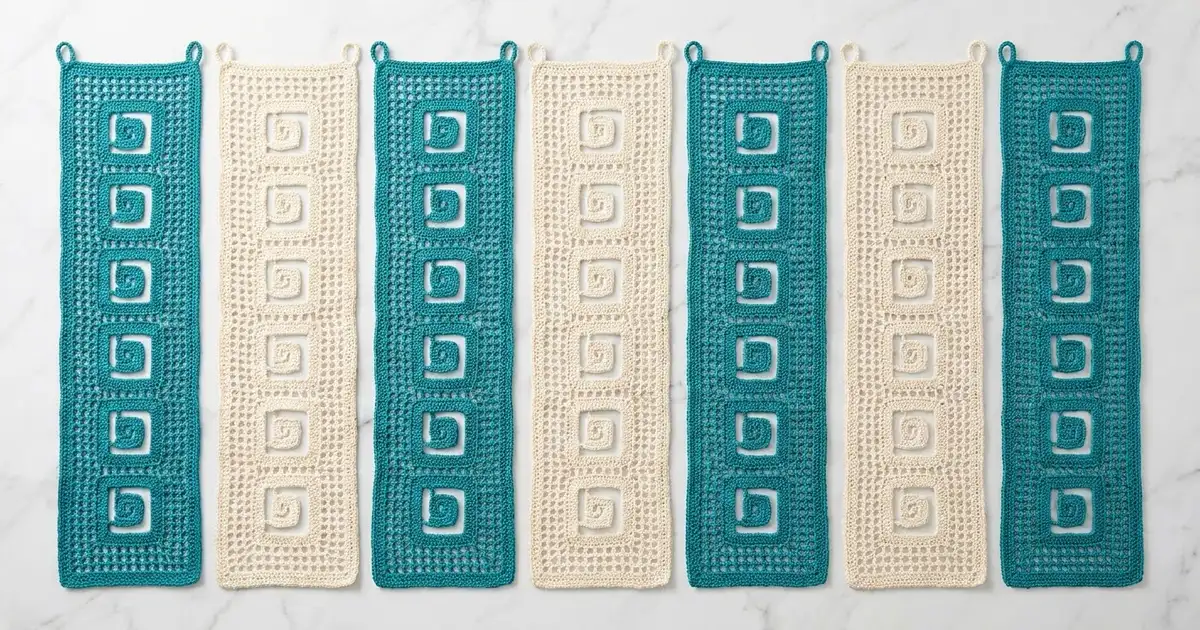
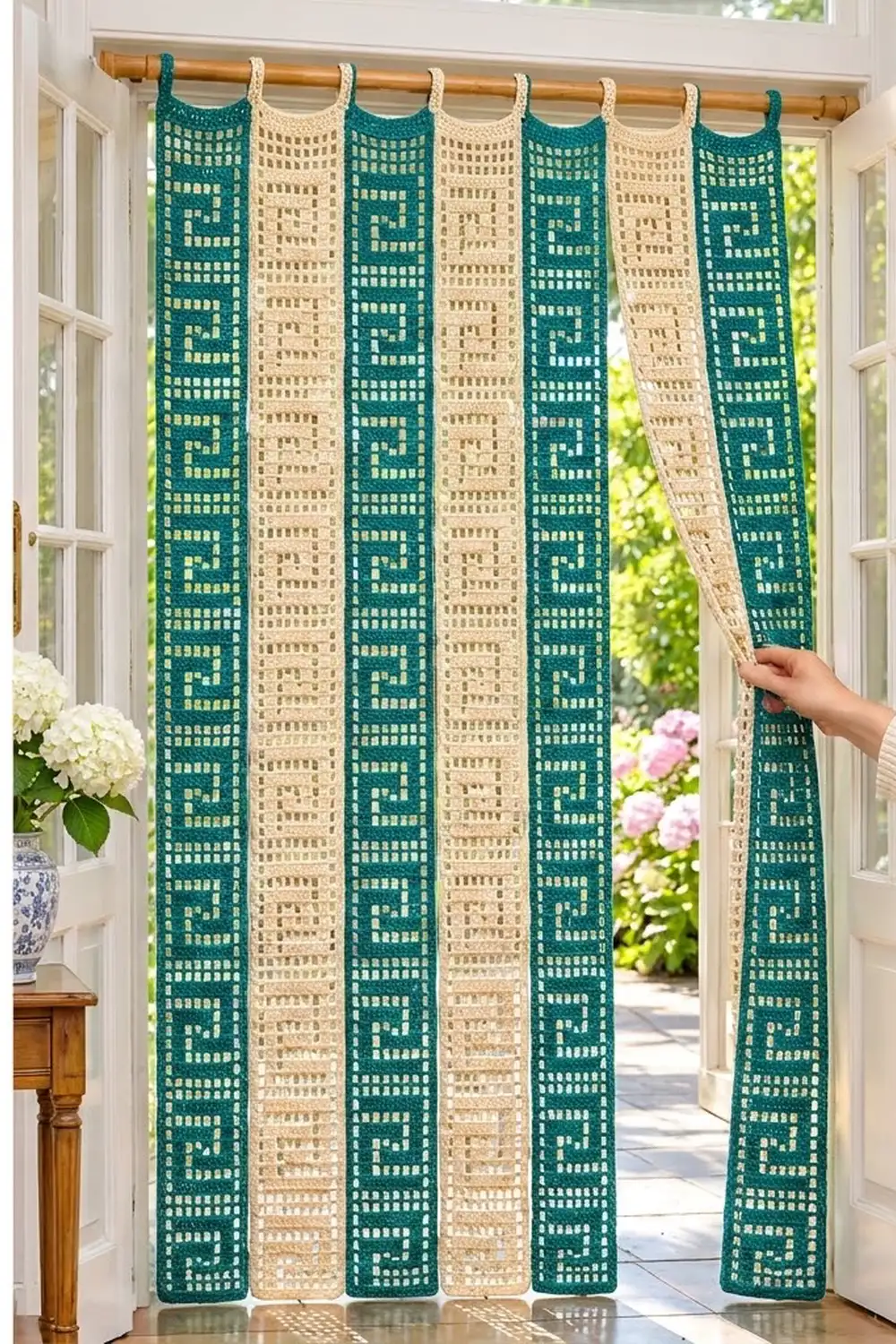
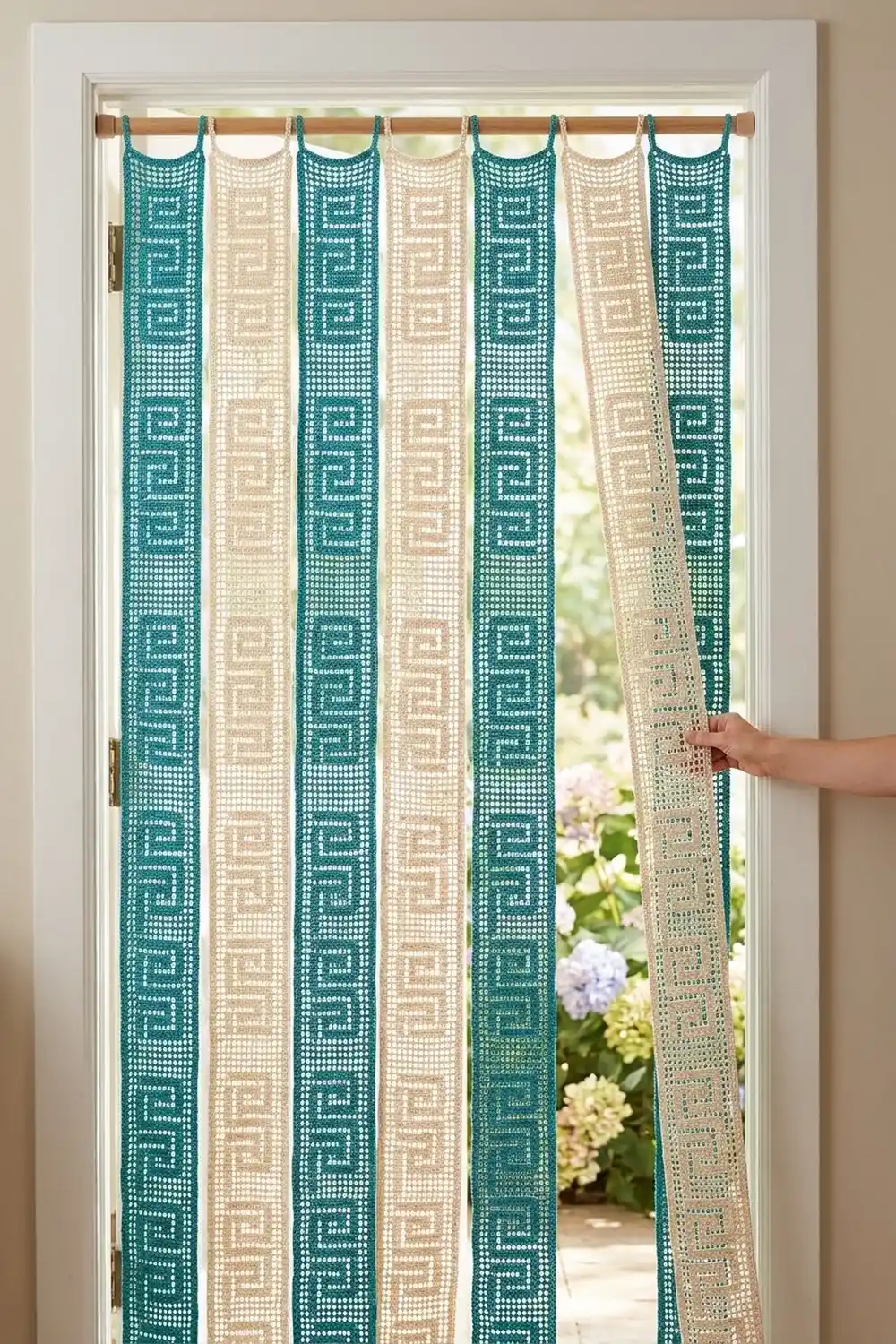
This door curtain is made of seven long filet crochet strips, each carrying a column of squared Greek key spirals. The strips hang side by side from a rod on small loops, so light and air pass between them and you can walk through by brushing them aside.
The sample alternates deep teal and soft cream: four teal strips and three cream strips, starting and ending with teal. Filet mesh keeps the look light and graphic, and the solid key motifs read clearly from across a room. The pattern uses US crochet terms throughout.
Each finished strip measures 6.0 in (15.2 cm) wide by 73.0 in (185.4 cm) long, plus loops that rise 1.4 in (3.6 cm). With seven strips hanging edge to edge, the curtain is 42.0 in (106.7 cm) wide.
Each strip is worked flat in rows from a foundation chain, following a filet chart of 11 squares across. A two-round single-crochet border is then worked around it, and two hanging loops are added to the top edge. The strips are never sewn together.
Finished Size and Construction
- Finished strip size: 6.0 in x 73.0 in (15.2 cm x 185.4 cm), not counting loops
- Skill level: Intermediate (basic filet crochet: reading a chart, working blocks and open squares)
- Terminology: US crochet terms
- Yarn weight: DK (#3) cotton or cotton blend
- Hook: 4.0 mm (US G-6)
- Number of pieces: 7 separate strips (4 teal, 3 cream)
- Layout: 7 strips in one row on a rod, alternating colors, not joined
- Strip size before border: 5.5 in x 72.5 in (14.0 cm x 184.2 cm), 11 squares x 145 rows
- Border depth: 0.25 in (0.6 cm) on every edge
- Total curtain width: 42.0 in (106.7 cm); use a rod at least 44 in (111.8 cm) long
Materials
Choose a smooth, mercerized or combed DK cotton. Cotton holds the square mesh well, blocks crisply, and doesn’t stretch as much as acrylic under the weight of a long hanging strip. Avoid fuzzy or loosely plied yarns, because they blur the open squares.
- Teal: 600 g, about 1,380 m (twelve 50 g balls of about 115 m each)
- Cream: 450 g, about 1,035 m (nine 50 g balls of about 115 m each)
Each strip uses about 135 g. These quantities allow 150 g (about 345 m) per strip, so they already include a margin of roughly 10% for gauge swatches and tension differences.
Tools:
– 4.0 mm (US G-6) crochet hook
– Tapestry needle
– Stitch markers
– Scissors
– Measuring tape
– Rust-proof pins and a long blocking surface
– Spray bottle
– Curtain rod at least 44 in (111.8 cm) long and no more than 1 in (2.5 cm) in diameter
Abbreviations (US Terms)
- ch – chain
- sl st – slip stitch
- sc – single crochet
- dc – double crochet
- sk – skip
- sp – space
- st(s) – stitch(es)
- RS / WS – right side / wrong side
- O – open square
- B – block (filled square)
Filet squares: every square shares its closing dc with the next square, and every row has 11 squares and 34 sts in all (12 dc counting the turning chain, plus 22 sts in fills or ch-2 spaces).
- Open over open: ch 2, dc in next dc.
- Open over block: ch 2, sk 2 dc, dc in next dc.
- Block over open: 2 dc in ch-2 sp, dc in next dc.
- Block over block: dc in next 3 dc.
- Row start: both edge columns are always open, so every row begins with ch 5 (counts as dc and ch 2), sk the first dc and the next 2 sts, and works the first dc in the next dc. Every row ends with a dc in the 3rd ch of the turning ch-5.
Gauge and Checkpoints
Gauge: 10 squares x 10 rows = 5 in (12.7 cm) in filet mesh, so each square is 0.5 in (1.3 cm) wide and tall.
Test with one complete strip start before committing: work Rows 1–19 (the top margin and the first key) and measure.
- After Row 5: 5.5 in (14.0 cm) wide x 2.5 in (6.4 cm) long
- After Row 19: 5.5 in (14.0 cm) wide x 9.5 in (24.1 cm) long; the key motif is 4.5 in (11.4 cm) square
- After Row 145: 5.5 in x 72.5 in (14.0 cm x 184.2 cm)
- After border: 6.0 in x 73.0 in (15.2 cm x 185.4 cm)
If your strip is too wide or your squares look tall, go down a hook size. If it’s too narrow, or blocks look crowded, go up a hook size. Squares that are wider than tall usually mean a tight dc; try pulling up the first loop of each dc a little higher.
Strip Pattern (make 7)
Foundation: ch 38.
Row 1 (RS): dc in 8th ch from hook (skipped chs count as dc and ch-2 sp), *ch 2, sk 2 ch, dc in next ch; rep from * across, turn. (11 open squares; 34 sts)
Rows 2–5: ch 5, *dc in next dc, ch 2; rep from * 9 more times, dc in 3rd ch of turning ch, turn. (11 O; 34 sts)
Key Repeat (14 rows)
Rows 6–19 form one key repeat: 9 motif rows (M1–M9) and 5 open rows. The chart is drawn as seen from the RS, with columns numbered 1 to 11 from left to right. RS rows (odd numbers) are worked from right to left, starting at column 11; WS rows (even numbers) are worked from left to right, starting at column 1. The working orders below already account for direction.
       col: 1 2 3 4 5 6 7 8 9 10 11
M1 (Row 6 ) . X X X X X X X X X .
M2 (Row 7 ) . X . . . . . . . X .
M3 (Row 8 ) . X . X X X X X . X .
M4 (Row 9 ) . X . X . . . X . X .
M5 (Row 10) . X . X . X . X . X .
M6 (Row 11) . X . X . X X X . X .
M7 (Row 12) . X . X . . . . . X .
M8 (Row 13) . X . X X X X X X X .
M9 (Row 14) . X . . . . . . . . .
Row 6 (M1, WS): O, 9B, O.
Row 7 (M2, RS): O, B, 7O, B, O.
Row 8 (M3, WS): O, B, O, 5B, O, B, O.
Row 9 (M4, RS): O, B, O, B, 3O, B, O, B, O.
Row 10 (M5, WS): O, B, O, B, O, B, O, B, O, B, O.
Row 11 (M6, RS): O, B, O, 3B, O, B, O, B, O.
Row 12 (M7, WS): O, B, O, B, 5O, B, O.
Row 13 (M8, RS): O, 7B, O, B, O.
Row 14 (M9, WS): O, B, 9O.
Rows 15–19: 11 O in each row.
Every row has 11 squares and 34 sts. A row with 9 blocks has the same stitch count as a row of open mesh, because each block simply fills a ch-2 space with 2 dc.
The filled squares form one continuous spiral: up the left column, across the top, down the right side, along the bottom, and inward to a center hook, with a tail running down into the open band below.
Rows 20–145: repeat Rows 6–19 nine more times (10 keys in total). Row 145 is the last open row. Do not fasten off.
Strip before border: 11 squares x 145 rows, 5.5 in x 72.5 in (14.0 cm x 184.2 cm).
Make All Pieces
- Teal: 4 strips
- Cream: 3 strips
Layout on the rod, from left to right:
| T | C | T | C | T | C | T |
T = teal, C = cream. Each strip is 6.0 in (15.2 cm) wide once bordered.
Work every strip with the same hook and keep your tension consistent, so all seven lengths match within 0.5 in (1.3 cm).
Joining: Hanging Arrangement (No Seams)
These strips are not joined. Each one is finished, bordered and blocked on its own, then threaded onto the rod through its two loops.
- Slide the strips onto the rod in the T–C–T–C–T–C–T order.
- Space them edge to edge: seven strips of 6.0 in (15.2 cm) cover 42.0 in (106.7 cm).
- Let the strips hang straight; don’t stretch them sideways to fill a wider door. If the opening is wider, add another strip pair, or use rod brackets set outside the frame.
Size checkpoint: before hanging, lay all seven blocked strips side by side and check that their bottom edges line up. Re-block any strip that is more than 0.5 in (1.3 cm) off.
Border and Hanging Loops
Border gauge: 6 sc = 1 in (2.5 cm) along every edge.
The border is worked around each strip separately, so its counts come from that one strip’s edges only. Corners are ch-1 spaces, and corner spaces are not included in the side counts.
Round 1 (RS): ch 1, then work along the top edge (Row 145): sc in first dc, *2 sc in ch-2 sp, sc in next dc; rep from * across (34 sc). Ch 1 for the corner.
Work down the long side: 3 sc around each row-end post, 145 rows (435 sc). Ch 1 for the corner.
Work along the bottom edge into the foundation chain: sc at the base of each dc and 2 sc in each ch-2 sp (34 sc). Ch 1 for the corner.
Work up the second long side, 3 sc per row-end (435 sc). Ch 1, then sl st to the first sc. (938 sc + 4 corner ch-1 sps)
Round 2: ch 1, sc in each sc around, working (sc, ch 1, sc) in each corner ch-1 sp; sl st to first sc. Top and bottom edges: 1 + 34 + 1 = 36 sc each. Long sides: 1 + 435 + 1 = 437 sc each. (946 sc + 4 corner ch-1 sps) Fasten off.
Why the math works: the top edge has 34 sc over 5.5 in (14.0 cm), or 6.2 sc per inch. Each dc row is 0.5 in (1.3 cm) tall, so 3 sc per row-end gives 6 sc per inch on the sides. Because both edges match the border gauge, the edge lies flat without ruffling or cupping.
Hanging loops: number the 36 top-edge sc of Round 2 from 1 to 36, right to left with the RS facing.
- Loop A: join yarn with a sl st in st 2, ch 22, sk sts 3–5, sl st in st 6. Turn, work 30 sc over the ch-22 loop, then sl st in st 2. Fasten off.
- Loop B: join with a sl st in st 31, ch 22, sk sts 32–34, sl st in st 35. Turn, work 30 sc over the loop, then sl st in st 31. Fasten off.
Each loop rises 1.4 in (3.6 cm) and fits a rod up to 1 in (2.5 cm) in diameter. The total hanging length is 74.4 in (189.0 cm).
Final Blocking
- Weave in all ends along the border or inside block squares, never across open mesh.
- Wet the strip completely in cool water and gently squeeze it out; don’t wring.
- Roll it in a towel to remove excess water.
- Lay it flat and pin it to 6.0 in x 73.0 in (15.2 cm x 185.4 cm), working down the length in 12 in (30.5 cm) sections.
- Pin the long edges straight, checking the width every 10 rows.
- Nudge the open squares square with your fingertips so the mesh lines run straight.
- Mist again if needed and let it dry completely before unpinning.
Final Quality-Control Checklist
- Every row has 11 squares and 34 sts.
- Columns 1 and 11 are open the full length of the strip.
- Each strip has 10 identical keys, each 9 rows tall and separated by 5 open rows.
- Round 1 has 34 sc on the top and bottom edges and 435 sc on each long side.
- Round 2 has 36 sc on the top and bottom edges and 437 sc on each long side.
- Both loops are the same height and sit one stitch in from the corners.
- Blocked size is 6.0 in x 73.0 in (15.2 cm x 185.4 cm).
- There are 4 teal and 3 cream strips, and all seven lengths match within 0.5 in (1.3 cm).
Troubleshooting
- Strip slants or narrows: you probably missed the last dc into the turning chain. Count 12 dc per row.
- Key looks mirrored or broken: a row was read in the wrong direction. Check that odd rows start at column 11.
- Squares are taller than wide: use a smaller hook, or work a shorter dc.
- Side border ruffles: use 2 sc and 3 sc in alternating row-ends instead of 3 sc in each.
- Side border cups: your sc is loose; drop a hook size for the border only.
- Strip grows longer after hanging: cotton relaxes under its own weight. Block it, hang it for 48 hours, then re-block it if needed.
- Loops twist: make sure the 30 sc cover the chain evenly, with no bunching.
Care
Hand wash in cool water with mild detergent and dry flat to the blocked measurements. Don’t hang the strips wet, because the weight of the water will stretch them.
Final Notes
The measurement chain runs from small to large:
- Each square is 0.5 in (1.3 cm).
- 11 squares make a 5.5 in (14.0 cm) width.
- 145 rows make a 72.5 in (184.2 cm) length.
- The two-round border brings each strip to 6.0 in x 73.0 in (15.2 cm x 185.4 cm).
- Seven strips span 42.0 in (106.7 cm) on the rod.
If your gauge holds at the first checkpoint, every later number will follow.
Happy crocheting!