

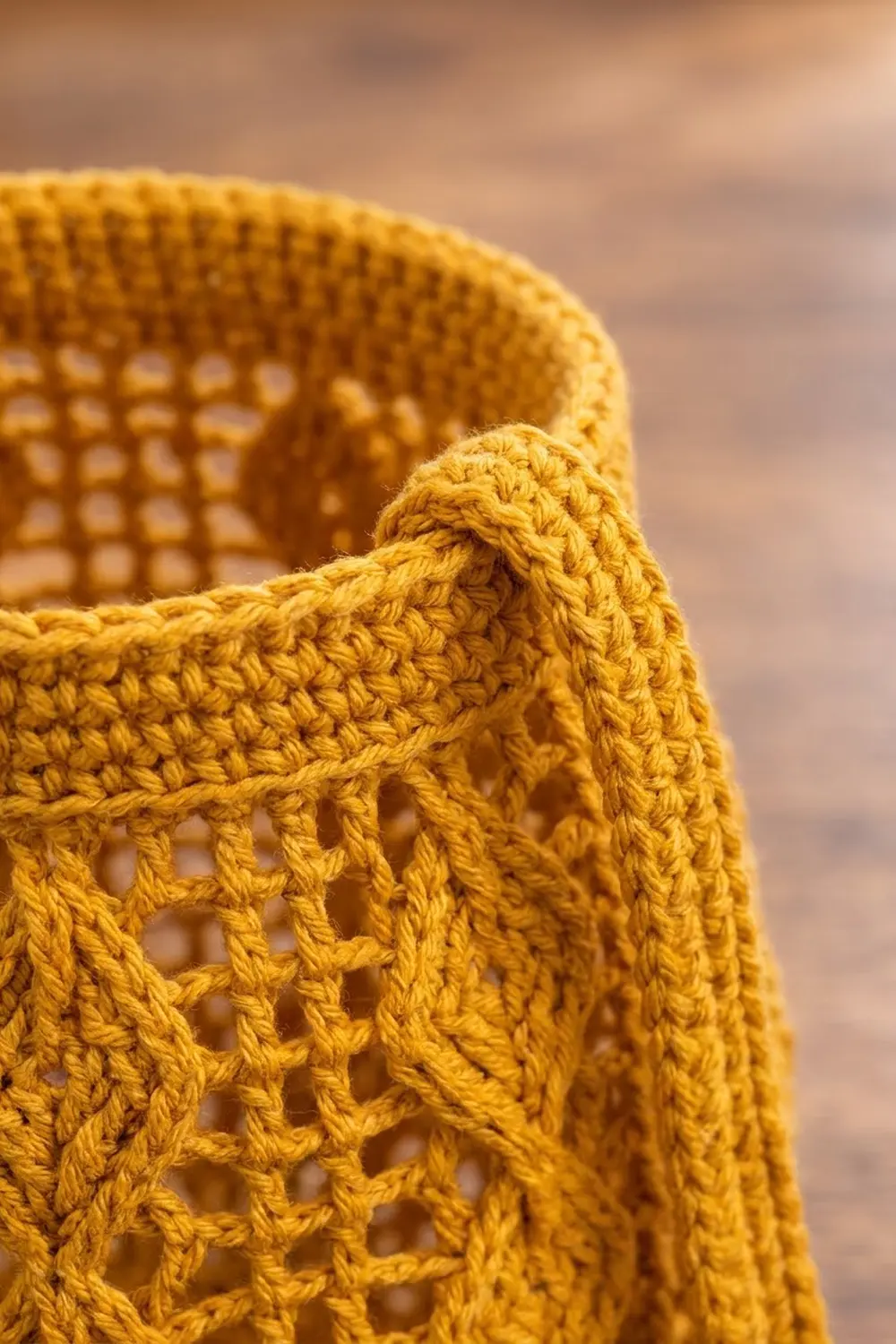
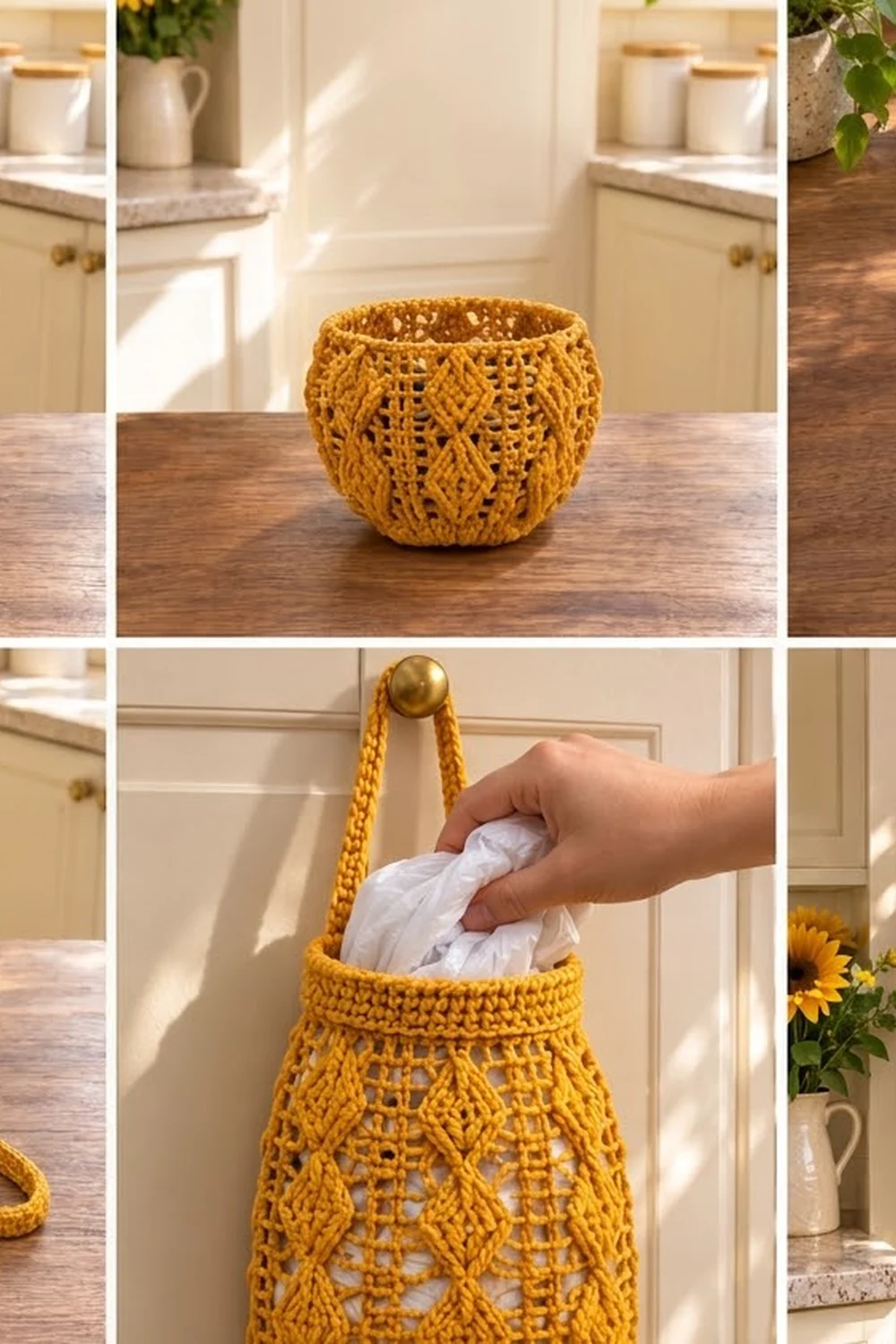
The Golden Lattice bag holder is a practical kitchen piece that looks good enough to leave out. It is a tall, egg-shaped tube with raised diamond columns set into open filet-style mesh. It has a firm single crochet band at the top, a long strap for hanging, and a drawstring tie at the bottom where the bags pull out.
The sample is worked in a warm mustard yellow cotton. It also works well in deep navy or any solid color that shows the texture clearly. Solid colors are best because the diamonds and mesh carry the design.
This pattern uses US crochet terms. The finished holder is about 9 in (22.9 cm) wide at its widest point when laid flat. It is 16.5 in (41.9 cm) tall from the bottom edge to the top of the band, not counting the strap.
The holder is one piece worked in joined rounds from the bottom up. You start with a drawstring eyelet band and increase to full width. Next you work three stacked diamonds in each of six columns, decrease, and finish with a solid band. The strap is crocheted straight off the rim. Finally, you thread a chain drawstring through the bottom eyelets and tie it in a bow.
Finished Size and Construction
- Finished size: 9 in (22.9 cm) wide flat at the widest point, 16.5 in (41.9 cm) tall, plus a 12.5 in (31.8 cm) strap
- Skill level: Intermediate
- Terminology: US crochet terms
- Yarn weight: Worsted (#4) cotton or cotton blend
- Hook: US H-8 (5.0 mm)
- Number of pieces: 1 body (strap worked in place) plus 1 chain drawstring
- Layout: Seamless tube, joined rounds, 6 diamond columns around
- Body circumference: 18 in (45.7 cm) at widest; 12 in (30.5 cm) at top and bottom
- Size before top band: 15 in (38.1 cm) tall
- Top band depth: 1.5 in (3.8 cm)
Materials
Choose a smooth, firm worsted cotton. Cotton holds the mesh open, keeps the diamonds crisp, and stretches very little when the holder is packed with bags. Avoid very soft or splitty yarn, which blurs the raised diamonds.
- Mustard yellow (sample color): 150 g, about 285 m
- Optional second holder (navy, or your choice): 150 g, about 285 m
Tools:
- US H-8 (5.0 mm) crochet hook
- 2 stitch markers
- Tapestry needle
- Scissors
- Tape measure
- Spray bottle, plus a balloon or rolled towel for blocking
The yarn amounts include a margin of about 15 percent for your gauge test and small differences in tension.
Abbreviations (US Terms)
- ch – chain
- sl st – slip stitch
- sc – single crochet
- dc – double crochet
- dc2tog – double crochet 2 together
- FPdc – front post double crochet
- sk – skip
- st(s) – stitch(es)
- sp – space
- rnd(s) – round(s)
Special stitches:
- MP (mesh pair): dc in next st, ch 1, sk next st. Covers 2 sts.
- SP (solid pair): FPdc around the post of next st, dc in next st or ch-1 sp. Covers 2 sts.
Each ch-1 counts as 1 st throughout. Every diamond round has 72 sts in a fixed rhythm. The odd positions are always “posts” (dc or FPdc), and the even positions are always “fillers” (ch-1 or dc). Because that rhythm never changes, every FPdc always has a dc or FPdc below it, and the mesh stays aligned from round to round.
Gauge and Checkpoints
Gauge:
- Double crochet: 16 sts and 8 rnds = 4 in (10.2 cm), counting ch-1 sps as sts
- Single crochet: 16 sts and 16 rnds = 4 in (10.2 cm)
Test the base first. Work Rnds 1–5 and lay the piece flat. If your gauge is right, it measures 9 in (22.9 cm) across and 2 in (5.1 cm) tall. This short test is worth doing, because the whole holder builds on it.
Checkpoints:
- After Rnd 5: 18 in (45.7 cm) around, 2 in (5.1 cm) tall
- After Rnd 13 (first diamond): 6 in (15.2 cm) tall
- After Rnd 29 (third diamond): 14 in (35.6 cm) tall
- After Rnd 31: 15 in (38.1 cm) tall; top edge 12 in (30.5 cm) around
- After Rnd 37: 16.5 in (41.9 cm) tall
If the piece is too big, go down a hook size. If it is too small, go up a hook size. Keep the stitch counts the same, because the diamond repeat needs exactly 72 sts.
Pattern
Bottom Eyelet Band
Ch 48. Sl st in the first ch to form a ring, taking care not to twist the chain.
Rnd 1: Ch 1, sc in each ch around, sl st in first sc. (48 sc)
Rnd 2 (eyelet round): Ch 4 (counts as dc and ch 1), sk next st. Dc in next st, ch 1, sk next st; repeat from * 22 more times. Sl st in 3rd ch of the beginning ch-4. (24 dc + 24 ch-1 sps = 48 sts)
Rnd 3: Ch 1, sc in each dc and each ch-1 sp around, sl st in first sc. (48 sc)
Increase Rounds
Rnd 4: Ch 3 (counts as dc here and throughout), dc in next 2 sts, 2 dc in next st. Dc in next 3 sts, 2 dc in next st; repeat from * 10 more times. Sl st in top of ch-3. (60 dc)
Rnd 5: Ch 3, dc in next 3 sts, 2 dc in next st. Dc in next 4 sts, 2 dc in next st; repeat from * 10 more times. Sl st in top of ch-3. (72 dc)
Place a marker in the first st of the round. Checkpoint: 18 in (45.7 cm) around.
Diamond Body
Each round has 6 repeats of 12 sts. In every repeat, sts 1–8 form the diamond panel and sts 9–12 form the mesh column between diamonds. Start every round with ch 3, which replaces the first dc or FPdc. End every round with sl st in the top of the ch-3.
When an instruction says “dc in next st” and the stitch below is a ch-1, work the dc into that ch-1 sp.
Rnd 6 (Diamond Rnd 1): MP, dc in next st, dc in next st, FPdc around next st, ch 1, sk next st, MP 3 times; repeat from * around. (72 sts; solid positions 4–5)
The second of the 2 dc in a row fills position 4. With the FPdc at position 5, this makes a diamond tip 2 sts wide.
Rnd 7 (Diamond Rnd 2): MP, SP 2 times, MP 3 times; repeat from * around. (72 sts; solid positions 3–6)
Rnd 8 (Diamond Rnd 3): Dc in next st, dc in next ch-1 sp, SP 2 times, FPdc around next st, ch 1, sk next st, MP 2 times; repeat from * around. (72 sts; solid positions 2–7)
Rnd 9 (Diamond Rnd 4): SP 4 times, MP 2 times; repeat from * around. (72 sts; solid positions 1–8)
Rnd 10 (Diamond Rnd 5): Dc in next st, dc in next st, SP 2 times, FPdc around next st, ch 1, sk next st, MP 2 times; repeat from * around. (72 sts; solid positions 2–7)
Rnd 11 (Diamond Rnd 6): MP, SP 2 times, MP 3 times; repeat from * around. (72 sts; solid positions 3–6)
Rnd 12 (Diamond Rnd 7): MP, dc in next st, dc in next st, FPdc around next st, ch 1, sk next st, MP 3 times; repeat from * around. (72 sts; solid positions 4–5)
Rnd 13 (Diamond Rnd 8): MP 6 times; repeat from * around. (72 sts: 36 dc + 36 ch-1 sps)
Checkpoint: 6 in (15.2 cm) tall.
The FPdc sts sit on odd positions and step outward, then inward, which raises the diamond outline above the mesh. The dc sts on even positions fill the ch-1 sps solid inside the diamond. Each diamond is 8 sts wide and 7 rnds tall, about 2 in (5.1 cm) wide and 3.5 in (8.9 cm) tall.
Rnds 14–21: Repeat Rnds 6–13. (72 sts each round)
Rnds 22–29: Repeat Rnds 6–13. (72 sts each round)
You now have 6 columns of 3 stacked diamonds, separated by mesh columns 2 pairs wide. Checkpoint: 14 in (35.6 cm) tall.
Counting tip: At the end of each repeat, check that you have just finished a ch-1. If a repeat ends on a dc, you have skipped or doubled a position. Fix it before moving on.
Decrease Rounds
Treat every dc and every ch-1 sp as 1 st.
Rnd 30: Ch 3, dc in next 3 sts, dc2tog. Dc in next 4 sts, dc2tog; repeat from * 10 more times. Sl st in top of ch-3. (60 dc)
Rnd 31: Ch 3, dc in next 2 sts, dc2tog. Dc in next 3 sts, dc2tog; repeat from * 10 more times. Sl st in top of ch-3. (48 dc)
Checkpoint: 15 in (38.1 cm) tall; top edge 12 in (30.5 cm) around. These rounds mirror Rnds 4–5 and give the holder its rounded egg shape at both ends.
Border: Top Band and Strap
Border gauge: 16 sc and 16 rnds = 4 in (10.2 cm). Each sc round adds 0.25 in (0.6 cm).
Rnds 32–37: Ch 1, sc in each st around, sl st in first sc. (48 sc each round)
Six rounds at 0.25 in (0.6 cm) each make the 1.5 in (3.8 cm) band.
Laid flat, the band has 2 sides of 24 sc each. Because 48 = 2 × 24, the strap anchors at st 1 and st 25 fall exactly on the two side folds. That keeps the strap centered so the holder hangs straight. Do not fasten off.
Strap Row 1: Ch 50, sk next 23 sts, sl st in st 25 of Rnd 37. (50 ch)
Strap Row 2: Ch 1, turn, sc in each ch across, sl st in st 1 of Rnd 37. (50 sc)
Strap Row 3: Ch 1, turn, sc in each sc across, sl st in st 26 of Rnd 37. (50 sc)
Fasten off. The strap is 3 rows deep: about 0.75 in (1.9 cm) wide and 12.5 in (31.8 cm) long. When hung, it rises about 6.25 in (15.9 cm) above the rim.
Drawstring
Ch 100, about 20 in (50.8 cm). Fasten off and tie an overhand knot in each end.
Starting and ending on the same side, weave the drawstring in and out of the 24 eyelets of Rnd 2. Pull to gather the bottom, leaving an opening of about 1.5 in (3.8 cm), and tie a bow.
Final Blocking
- Weave in all ends inside the top band or along the FPdc posts.
- Untie the drawstring and let the bottom open fully.
- Mist the whole holder with water until it is damp but not dripping.
- Slide a balloon inflated to about 18 in (45.7 cm) around, or a rolled towel, inside the body.
- Push each diamond into a crisp point and square up the mesh columns with your fingers.
- Straighten the strap and lay it flat.
- Let it dry completely, about 24 hours.
- Remove the form, re-thread the drawstring if needed, and tie the bow.
Final Quality-Control Checklist
- Every diamond round has 72 sts.
- All 18 diamonds have closed top and bottom tips.
- Mesh columns line up vertically without twisting around the body.
- The widest point measures 9 in (22.9 cm) flat.
- Total height is 16.5 in (41.9 cm), not counting the strap.
- The top band has 48 sc and lies flat.
- The strap anchors sit on opposite side folds at st 1 and st 25.
- The drawstring passes through all 24 eyelets and leaves a 1.5 in (3.8 cm) opening.
Troubleshooting
Diamonds look lopsided. Make sure FPdc sts land only on odd positions. Count positions from the marker.
Mesh columns spiral. Your joins may be drifting. Always sl st into the top of the ch-3, and start the next round in the very next st.
Holder is too wide. Go down a hook size and rework from Rnd 4.
Holder is too short. Your rounds may be compact. Add one more 8-round diamond repeat, which adds 4 in (10.2 cm), or go up a hook size.
Top band ruffles. Check that you have 48 sc. If the count is right, work the band with a hook one size smaller.
Strap twists. Make sure you turn for Rows 2 and 3 instead of working them in the round.
Bags fall out. Pull the drawstring tighter to make the opening smaller.
Care
Hand wash, or machine wash cold on a gentle cycle, then reshape and dry flat. Cotton may shrink a little in the first wash, so avoid high heat.
Final Notes
Here is how the measurements build on each other:
- A 48-st bottom ring increases to 72 sts and 18 in (45.7 cm) around.
- Six repeats of 12 sts carry 3 stacked diamonds through 24 rounds, about 12 in (30.5 cm) of body.
- The holder decreases back to 48 sts and finishes with a 1.5 in (3.8 cm) band with 24 sc on each side, which centers the 12.5 in (31.8 cm) strap.
If each checkpoint matches, the finished holder will measure 9 in (22.9 cm) wide and 16.5 in (41.9 cm) tall.
Happy crocheting!